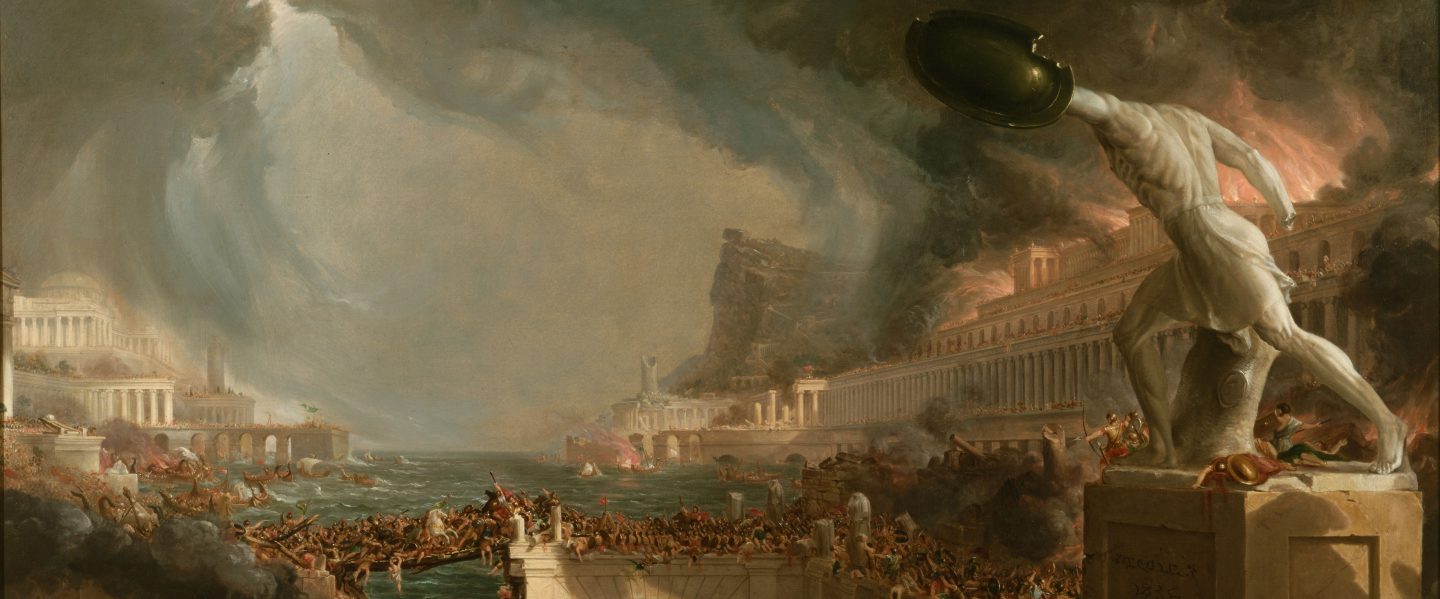

Christianity is a 2000 year old apocalyptic movement stuck in a world which stubbornly refuses to end.
Eschatology in Zoroastrianism and Zoroastrian Influence (Link)
Faith in the events beyond life on this earth is attested in the Zoroastrian scriptures from the very first, from the Gāthās. This faith developed and became central to later Zoroastrianism so that it colors almost all aspects of the religious life. It also seems to have had a deep impact on neighboring religions, notably on Judaism, and through it on Christianity and Islam, as well as on Manicheism.
The Ten Modes of Aenesidemus: Core Arguments of Pyrrhonian Skepticism
- From the variety among animals
Different species perceive the same objects differently (e.g., what is pleasant or nourishing to one animal is harmful or repulsive to another). We have no privileged reason to prefer human perceptions as the true ones. - From the differences among human beings
Individual humans (or groups) differ in constitution, temperament, and preferences, producing conflicting impressions of the same things. There is no neutral standard for deciding whose perception is correct. - From the different structures of the sense organs
The same object appears differently to different senses (e.g., a painting looks three-dimensional to sight but flat to touch). We cannot determine which sense (if any) reveals the object’s true qualities. - From circumstances (or conditions)
Perceptions vary with the observer’s state: health vs. illness, waking vs. sleeping, youth vs. age, motion vs. rest, hunger, drunkenness, emotional states, etc. The same thing can appear hot, sweet, or beautiful under one condition and the opposite under another. - From positions, distances, and locations
Objects change appearance according to where and how they are viewed (e.g., a tower looks round from afar and square up close; the same oar looks bent in water and straight out of it). - From intermixtures
We never perceive objects in isolation; they are always mixed with the medium (air, moisture, etc.) or with our own bodily conditions. What we experience is therefore a compound, not the pure object itself. - From the quantities and compositions (or formations) of objects
The same substance appears different according to its amount or arrangement (e.g., a few grains of sand feel rough, a larger quantity feels smooth; wine in small amounts invigorates, in large amounts intoxicates). - From relativity
Everything is relative to the perceiver, the circumstances, or other things. Nothing can be known as it is “in itself,” independently of these relations. - From the frequency or rarity of occurrence
Rare or unusual things strike us as more remarkable or valuable than common ones, even if they are not intrinsically different. Habit and familiarity alter our impressions. - From customs, laws, beliefs, and dogmatic assumptions
Different cultures, legal systems, religious traditions, and philosophical schools hold conflicting views about what is good, just, pious, or true. There is no agreed-upon criterion for deciding among them.
I suspend judgment on most claims to ultimate knowledge or inherent meaning, live by practical appearances and chosen commitments, confront the absence of cosmic significance without despair, and continue to treat certain moral distinctions as more than mere preference.
Tradition and Disruption by David Bentley Hart
Apocalypse, not dogma, is Christianity’s grounds for hope.
Once upon a time, Christianity grew and endured and even flourished over the course of many generations in total and blissful ignorance of any officially defined dogma, any single universally recognized canon of scripture, anything remotely like the systematic or dogmatic theologies of the coming ages of Christendom and after. I would add that, for most of that time, there was no single church hierarchy, and that the apostolic lines of succession preserved in later official chronicles were products partly of what one might call retroactive genealogy and partly of what one has to call pious misrepresentations; but we may leave that argument for another time. The point to make here is that, for the first several generations of Christians, anything so precise as a doctrinal symbol authorized by an episcopal council would have been either a curious superfluity of or ponderous encumbrance upon the faith. There had been divisions among Christians even in the apostolic era; the New Testament bears plenteous witness to this reality – so much so that the reader can easily get the impression that division was far more common than unity among the early Christian communities. But the principal reason that so many confessional and theological differences of such enormous consequence, on matters so basic to the faith, came to light within the church of the empire only well into the fourth century is that Christian faith and Christian hope had long been sustained by something quite different from official confessional unanimity. The differences had always been there, and in many respects were more or less as old as the faith itself; but for most of the time they were scarcely noticed, since the guiding concern of most Christians was not some perennial wisdom or immemorial doctrine handed down from the past, but rather the rapid approach of the Kingdom of God, the Age to Come, and the final advent of Christ as Lord of all things. Apocalyptic expectation – an eager certainty of the imminence of the full and final revelation of God’s truth in a restored and glorified cosmos – and not dogmatic purity was the very essence of faithfulness to the Gospel.

