Deceptive Simplicity

equity-vs-equality

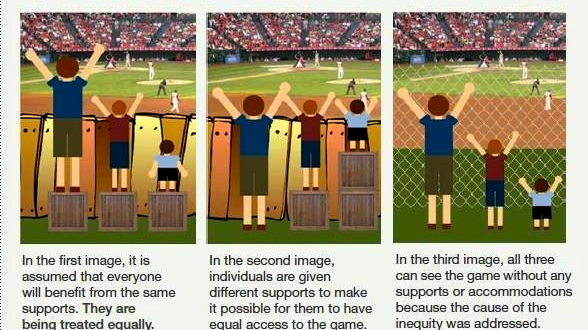
Sometimes we can use simple illustrations to explain more complex ideas. That is fine if the illustration is in fact used to explain the more complex idea. Often that’s not what happens – often we’re just shown the illustration, and because it’s simple, we think we understand the more complex situation automatically.

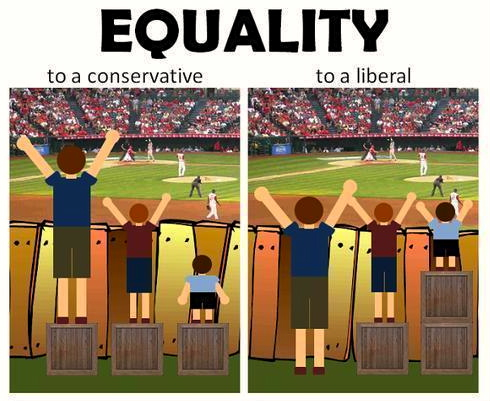
Take the picture above: On the left, they all have a box, but still the short guy can’t see. So, on the right, the tall guy gives him his box and all is well. That’s justice, see? Simple.

Well, if I were at a game watching over the fence and some guy needed my box to stand on, and I didn’t need it myself, of course I would give mine to him – I’m not a complete jerk. But of course, a baseball game is not what’s really the issue here. We’re talking about wealth, poverty, and social politics – much more complex issues.

How can we translate the simple illustration to the real complex problem?

We ask what each item in the illustration represents.

What do the boxes represent? Money? Power? Knowledge? All three? Something else? Why are there only three boxes? They can’t get more? Why do they all start off with one box each? Why is one guy taller than the other? Do these guys always stay the same height over the course of their lives? How is time illustrated in this picture, if at all?

What does the fence represent? Why is it the height it is? Is it shorter in other places where the short guy could see over with only one box? Why are all three guys standing right next to each other? In the real world, does the tall guy even know the short guy exists? Could the tall guy simple pass his box over to the short guy without someone else getting involved? What if the tall guy doesn’t want to give up his box? What if he’s going to need it to look over a taller section of fence further down?

What does the baseball game represent? Happiness? A house, car, and a flatscreen TV? Or just basic living needs? Who determines what poverty is? What’s being compared to what? Is the standard of living the same for all three guys? Is it essential to watch the game at all? Why don’t they buy tickets and watch inside?

These are just starter questions. As they’re answered more questions will come.

So, try answering all these questions and you’ll see that the situation is much more complicated than what the picture suggests.

Here’s a couple of other versions of the picture I found online…
frabz-16fc88

Ha! Okay, evil conservatives are the problem.
Equalisty-versus-equity-588x330

Chain link fences! Of course!


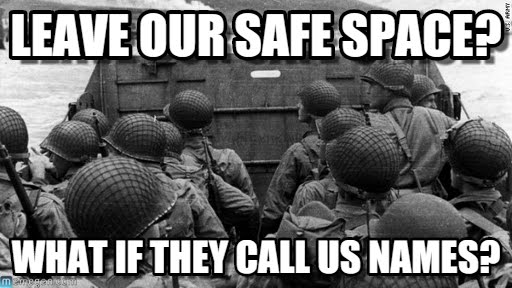
Safe Spaces be Damned

5kwoce

In light of all the “safe space” talk coming out of universities these days, I thought I’d quote Eugen Rosenstock-Huessy speaking to his students in a philosophy course at Dartmouth College in the 1950s….

“So my appeal in all these (philosophy) classes, you may now understand, has always been to you as people who have to outgrow your childishness. I therefore cannot act as your wet-nurse. I — I’m not interested when you have a cold. Have 10 colds. Suffer! Because it will make you able, if you really suffer, to grow up. And if you — (if) I should pity you in all your difficulties and hardships, you see, I would forestall this process. I would tell you that you are still protected. I am not here to protect you against anything. I’m here to expose you. And this is what the world can expect from anybody who has this tremendous retardation of his growth granted to him in a college.”

*Quote taken from lecture #15 of Cross of Reality taught at Dartmouth College in 1953.

Rosenstock-Huessy’s lectures are available for free mp3 download here.

Christianity V. Mythology

skeletonsIf you read about or listen to the history of an organization, institution, nation, or religion, and it’s all great and glorious, without anything negative, and its failures are erased from memory, it is mythology.
“All secular societies have a skeleton in their closet. Even family genealogies usually omit the unpleasant ancestors and tell fairy tales in their stead.

“Christianity, on the other hand, took the unpleasantness for granted: in place of a pedigree from a mythical ancestor it put original sin inherited from Adam. And resolutely, it began in the midst of time, not in a mythical fog. Against all deathless myths and hopeless cycles the price of a living future is to admit death in our lives and overcome it. This is the supreme gift of Christianity; it showed that the fear of death need not force man into the narrow cycle of any given community. In place of pagan dividedness it created a universal pedigree for man that transcends all partial ends and beginnings, and measures history from the end of time.”*

* Excerpt from The Christian Future by Eugen Rosenstock-Huessy, pg. 65

The Free Speech Trade-off

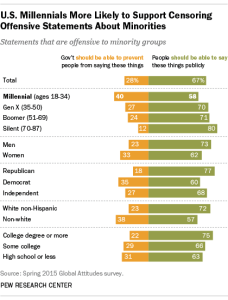
FT_15.11.19_speechAccording to this 2015 Pew Research article, 40% of U.S. millennials are in favour of the government having the authority to censor offensive speech about minorities.

Thomas Sowell has said: “Much of the social history of the Western world, over the past three decades, has been a history of replacing what worked with what sounded good.”

It sounds like a good idea to limit “hate speech”. Who would be against that? But if we stop at only what sounds good we create future trouble for ourselves. We have to ask questions and thoughtfully follow through on what these “good” ideas would actually create. Questions like: Who decides what “hate speech” is? Given the government has the authority to limit hate speech, would the government abuse that authority in the future?

I am in an interracial marriage. I’m a white Canadian, while my wife is a brown Cambodian. (Are you offended that I called her brown?) Suppose, while planning our marriage in Canada, we went to a bakery which was owned by a white supremacist. And suppose he refused to bake our wedding cake because he is against interracial marriage. I would be annoyed and a little offended at that. But, the most I would do is tell my friends and family about it and stop there. I’m not going to call the media. I’m not going to sue. I’m not going to boycott his bakery (although I can understand why others would). I’m not going to fight to give the government the power to shut him down. As much I wouldn’t like what he had done, I wouldn’t fight to take away his right to run his business as he wants. Because, if I take away his freedom, I take away everyone else’s freedom too.*

If the KKK comes marching through your town’s public square spewing hate speech against blacks and Jews, you have two options: you can ignore them or you can speak against them. One option you don’t have is to silence them. Even the KKK is protected by free speech**. However, if the KKK comes into your restaurant and decide to hold an impromptu rally, you can silence them by kicking them out of your business.

Thomas Sowell also often says: “There are no solutions, only trade-offs.” What is the free speech trade-off? Do we want the government to silence anyone who might offend us now, and, consequently, give the government the ability to abuse that authority in the future when our children and grandchildren are adults? (And if you don’t think that will happen, you just need to study history. Right now in certain Asian countries a person can be imprisoned for criticizing the government on Facebook. Do we want that in western society?) Or, we can grow a thicker skin and allow everyone to speak freely, even when it offends us, and ensure future generations will not have to live in fear that if they say the wrong thing, arbitrarily decided by government, they won’t end up in prison for ten years.

*I realize that there are already anti-discrimination laws in place, and I am not necessarily against those laws. This is just an example. 

**Free Speech: The right to speak without censorship or restraint by the government.

Poipet Through the Ages

When the Khmer Rouge came to power in Cambodia in the ’70s they destroyed much infrastructure, including the railroad. And as Cambodia has been rebuilding, the railroad is coming back.

Poipet is the main crossing point between Cambodia and Thailand. Here is Lonely Planet’s description of Poipet…

Long the armpit of Cambodia, notorious for its squalor, scams and sleaze, Poipet (ប៉ោយប៉ែត, pronounced ‘poi-peh’ in Khmer) has recently splurged on a facelift and no longer looks like the post-apocalyptic place it once was. Thanks mainly to the patronage of neighbouring Thais, whose own country bans gambling, its casino resorts – with names like Tropicana and Grand Diamond City – are turning the town into Cambodia’s little Las Vegas. However, beyond the border zone it’s still a chaotic, trash-strewn strip mall sprinkled with dodgy massage parlours. The Khmers’ gentle side is little in evidence, but don’t worry, the rest of the country does not carry on like this.

As the railroad is being rebuilt, it will eventually link Bangkok to Phnom Penh. That railroad will run right through Poipet.

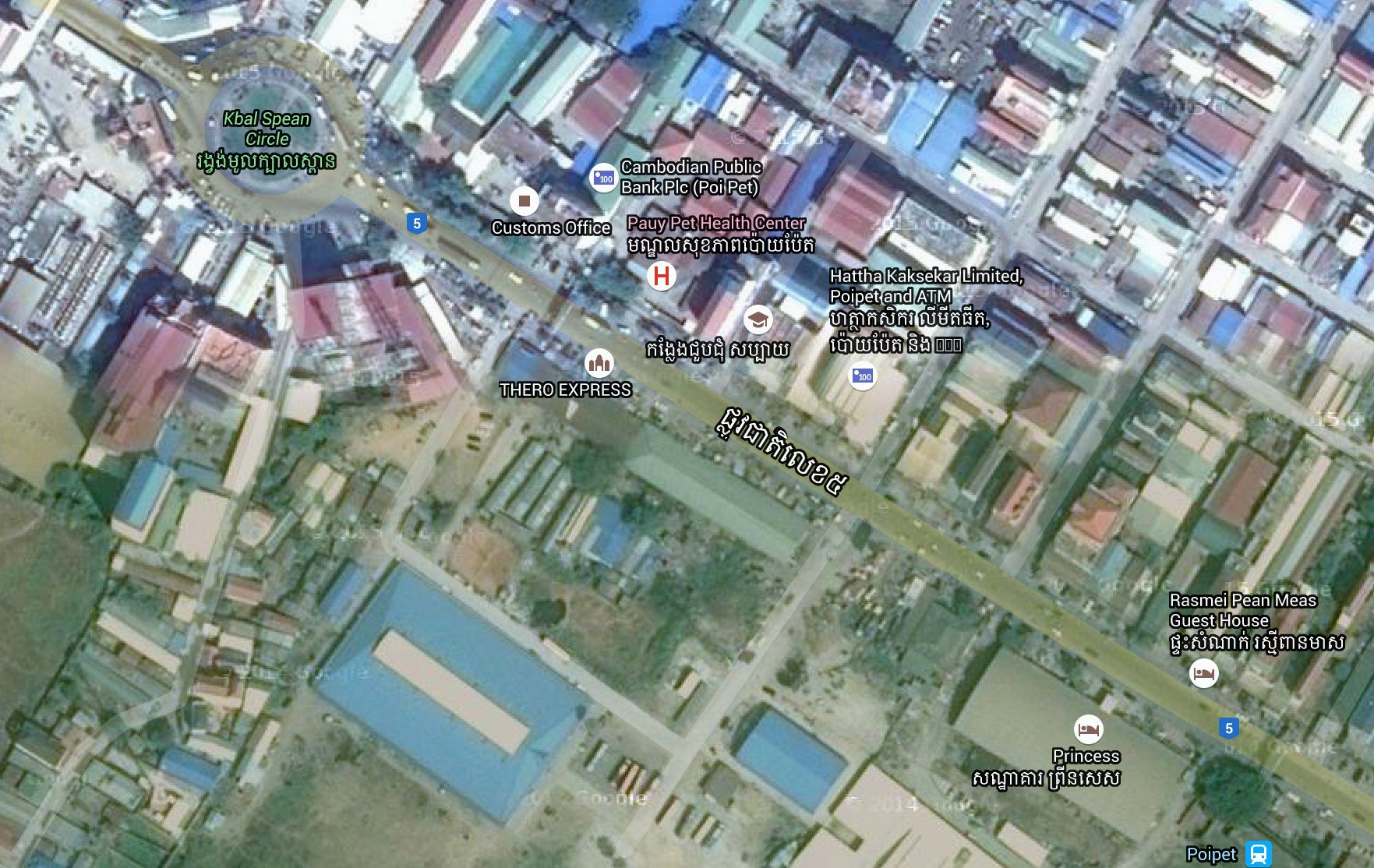
map 001

Just as you enter into Poipet from Thailand, there is a roundabout (Kbal Spean Circle in above picture) which then leads on to the main road through the city. The train will come straight through that roundabout (the busiest road in town) and then run south of the main road through the current slum area.

I don’t even want to think of how busy that border crossing area is going to be when the rail is finished and the train is running.

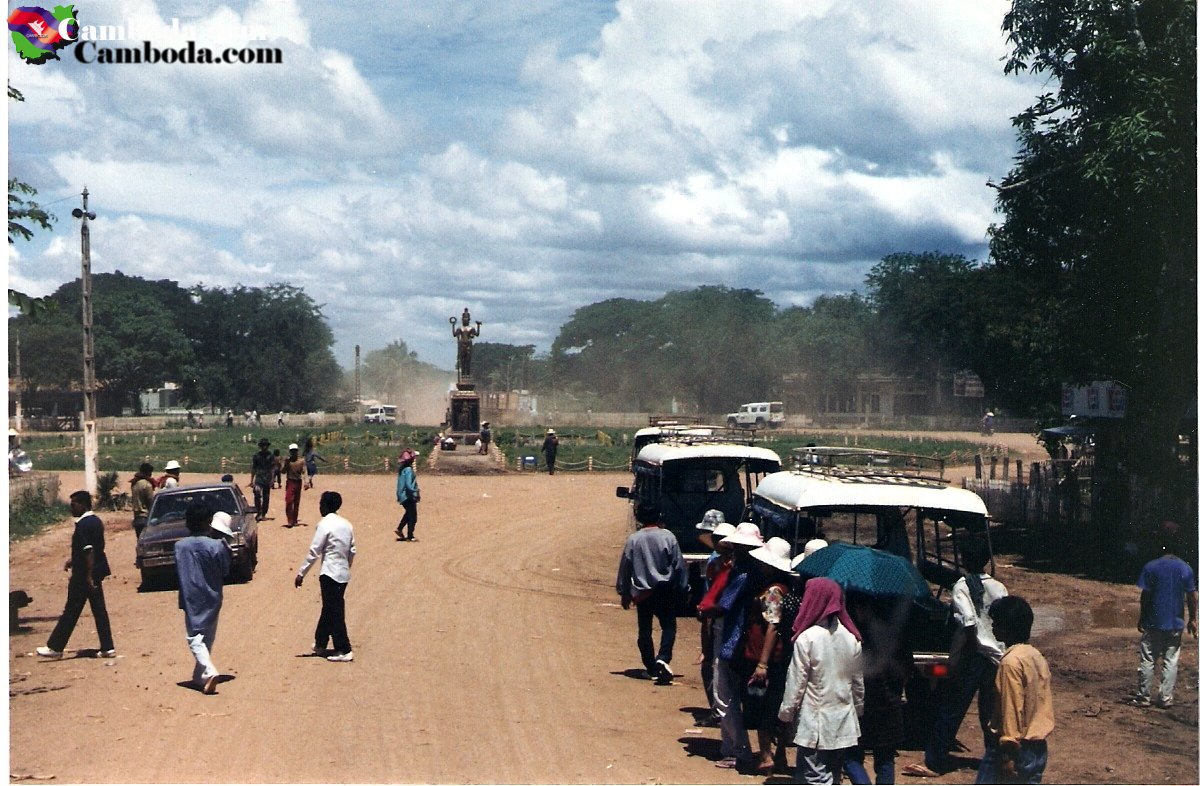
Here are some photos of that border crossing over the years….

1
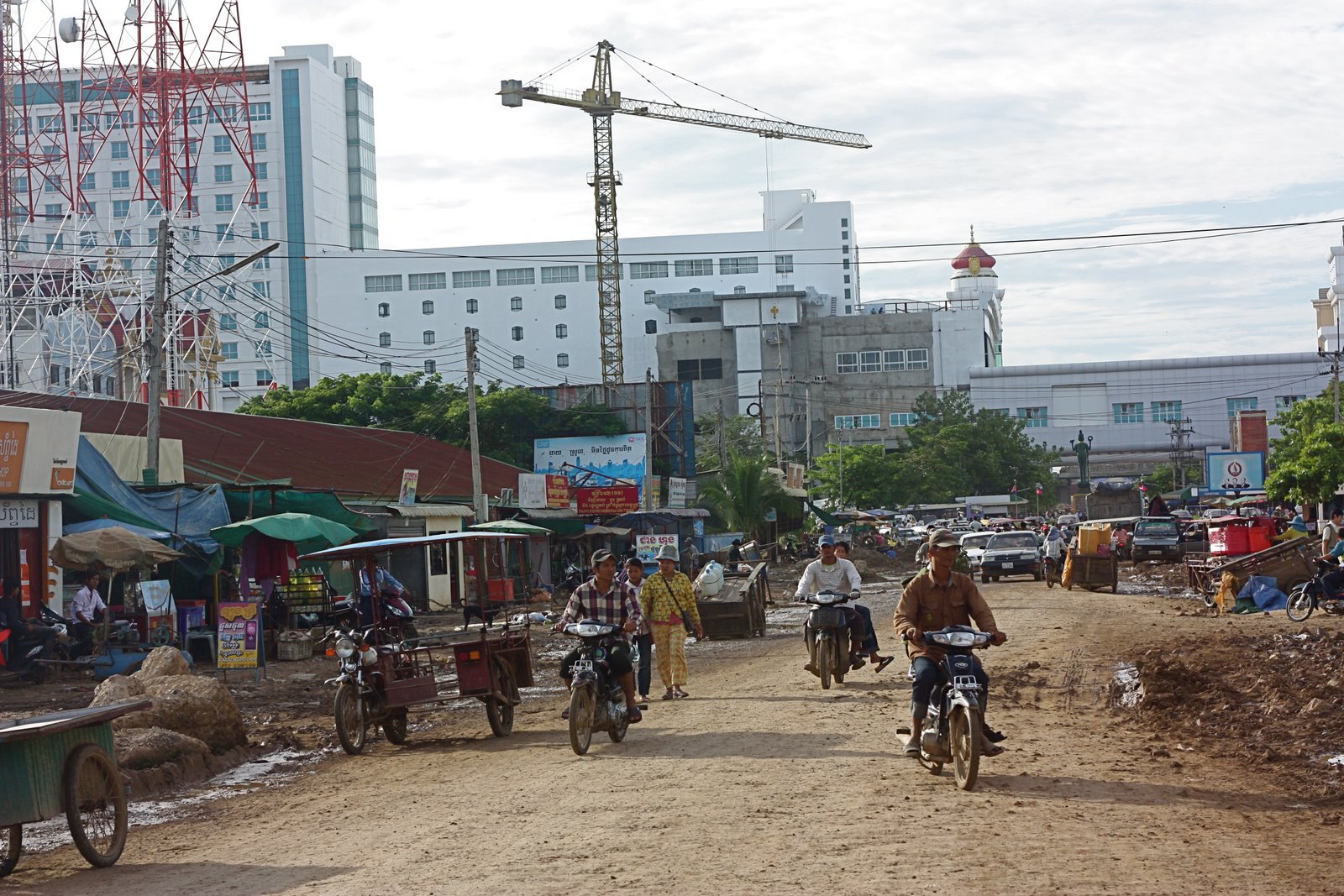
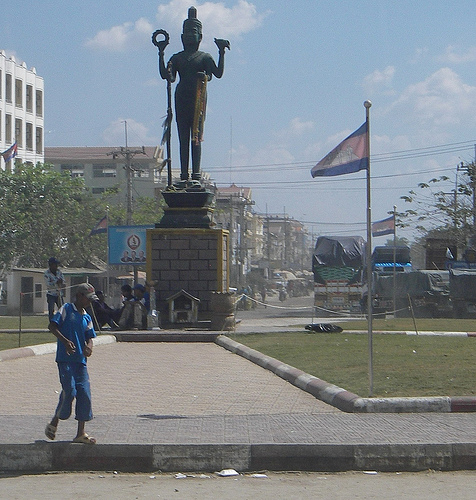
1) I don’t know how old this photo is, but it’s quite old I think. If you took this photo, your back would be towards Thailand, and you would be looking into the beginnings of Poipet and Cambodia. That’s a big idol standing in the middle of the Kbal Spean roundabout. All dirt roads.
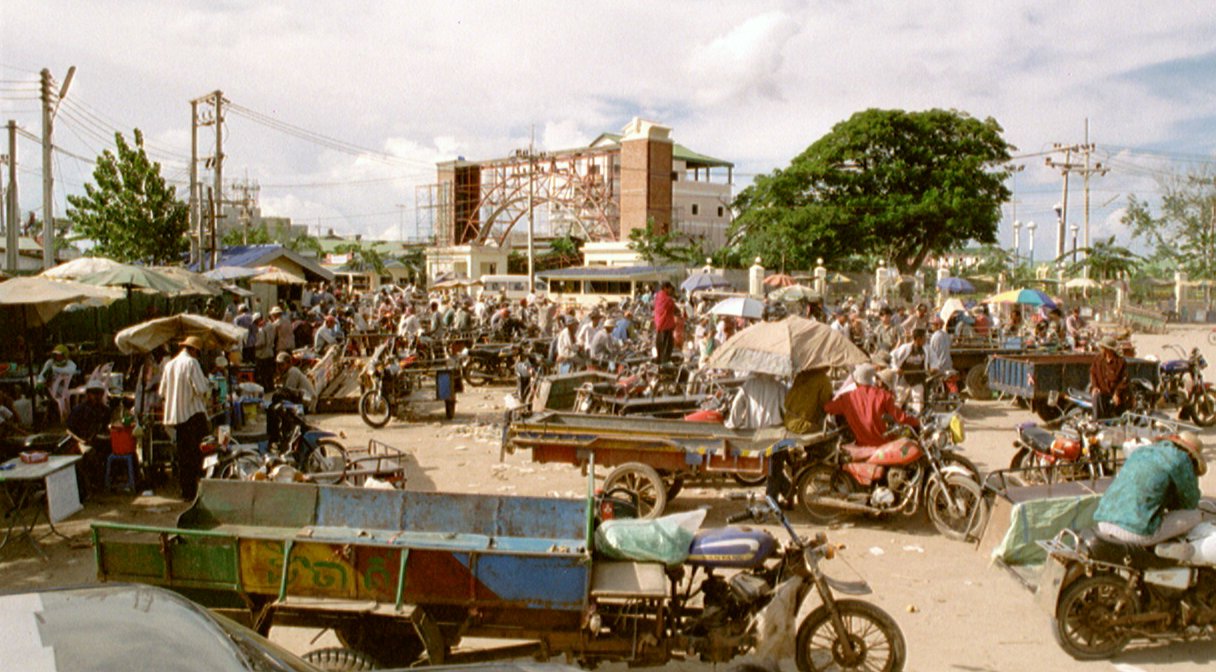
2
2) This photo is well over ten years old. Now we are looking towards Thailand while standing on the road of the round-about. That big idol is standing just off camera to the right. The first photo was taken from straight ahead of the view of this photo. That arch-way being constructed is the start of an entrance to a new casino.
3
3) This photo is taken from inside Poipet looking out towards Thailand (probably taken around 2006/2007 or so). The idol can be seen, but now we are seeing the reverse side from what we see in the first photo. The red brick pillar seen on the far right of this photo (centered from top to bottom) is the archway under construction in the last photo. Now we see the casinos are dominating the scene.
4
4) Now we are looking into Poipet again with Thailand at our back. Now we see there are lots of buildings, and the roads are paved. This is pretty much what Poipet looks like today, except that big idol is gone. The new railway is going to run straight through the roundabout.
5
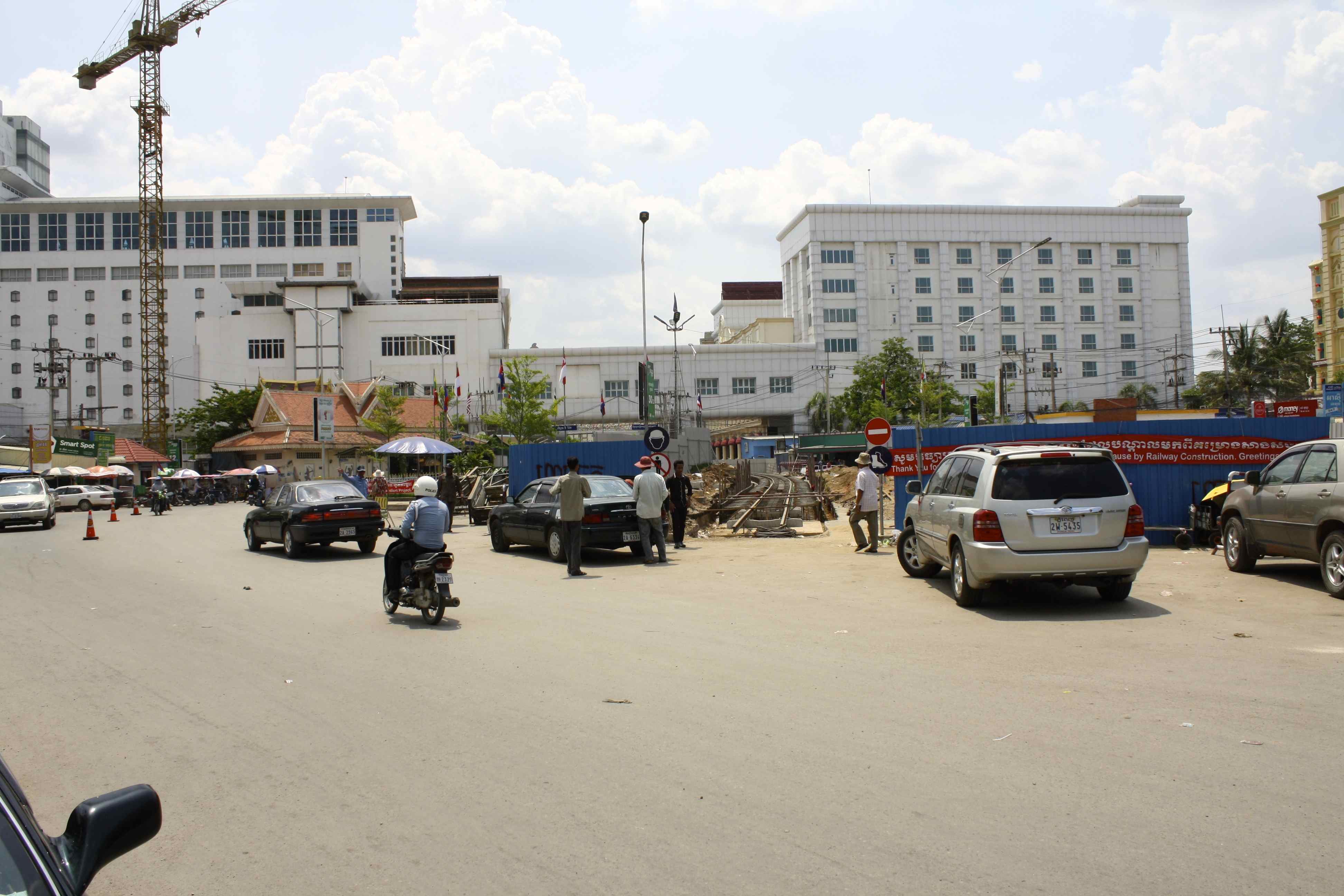
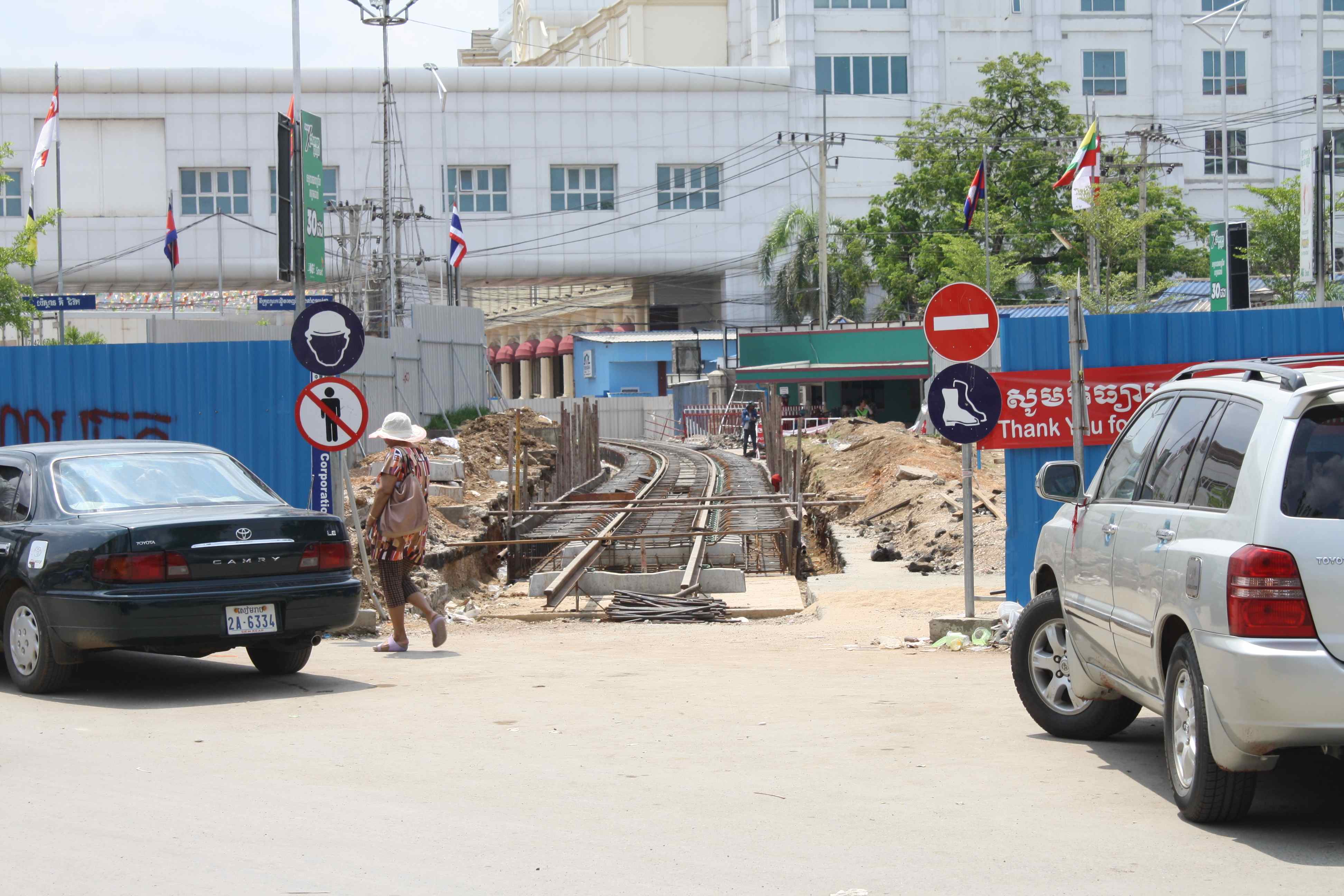
5) Here is the track being constructed. This photo was taken just a few days ago (May, 2016). The track is running right through where the roundabout used to be. Notice that the red brick archway from photos #2 and #3 has been torn down to make room for the train. Also notice the crane on the left is still there (from photo #3). I think that crane has become a permanent fixture.
6
6) A closer look. The casino builders knew the train would eventually come which is why they built the walkways up above the road to connect their buildings.

Sources…

Photo #1 is from Cambodia.com

Photo #2 is from this website.

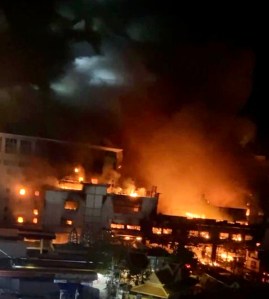
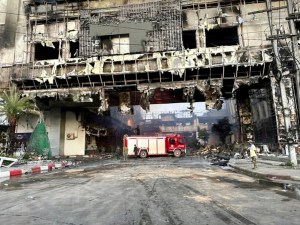
7) The casino burned down in 2022