Poipet Through the Ages

When the Khmer Rouge came to power in Cambodia in the ’70s they destroyed much infrastructure, including the railroad. And as Cambodia has been rebuilding, the railroad is coming back.

Poipet is the main crossing point between Cambodia and Thailand. Here is Lonely Planet’s description of Poipet…

Long the armpit of Cambodia, notorious for its squalor, scams and sleaze, Poipet (ប៉ោយប៉ែត, pronounced ‘poi-peh’ in Khmer) has recently splurged on a facelift and no longer looks like the post-apocalyptic place it once was. Thanks mainly to the patronage of neighbouring Thais, whose own country bans gambling, its casino resorts – with names like Tropicana and Grand Diamond City – are turning the town into Cambodia’s little Las Vegas. However, beyond the border zone it’s still a chaotic, trash-strewn strip mall sprinkled with dodgy massage parlours. The Khmers’ gentle side is little in evidence, but don’t worry, the rest of the country does not carry on like this.

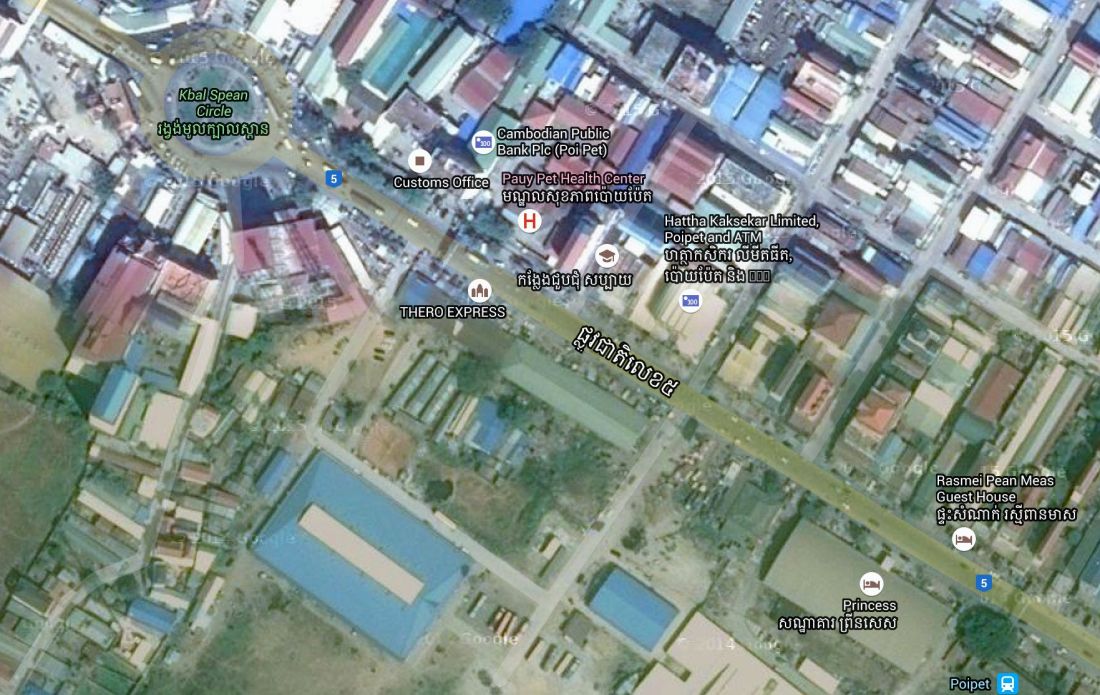
As the railroad is being rebuilt, it will eventually link Bangkok to Phnom Penh. That railroad will run right through Poipet.

map 001

Just as you enter into Poipet from Thailand, there is a roundabout (Kbal Spean Circle in above picture) which then leads on to the main road through the city. The train will come straight through that roundabout (the busiest road in town) and then run south of the main road through the current slum area.

I don’t even want to think of how busy that border crossing area is going to be when the rail is finished and the train is running.

Here are some photos of that border crossing over the years….

1
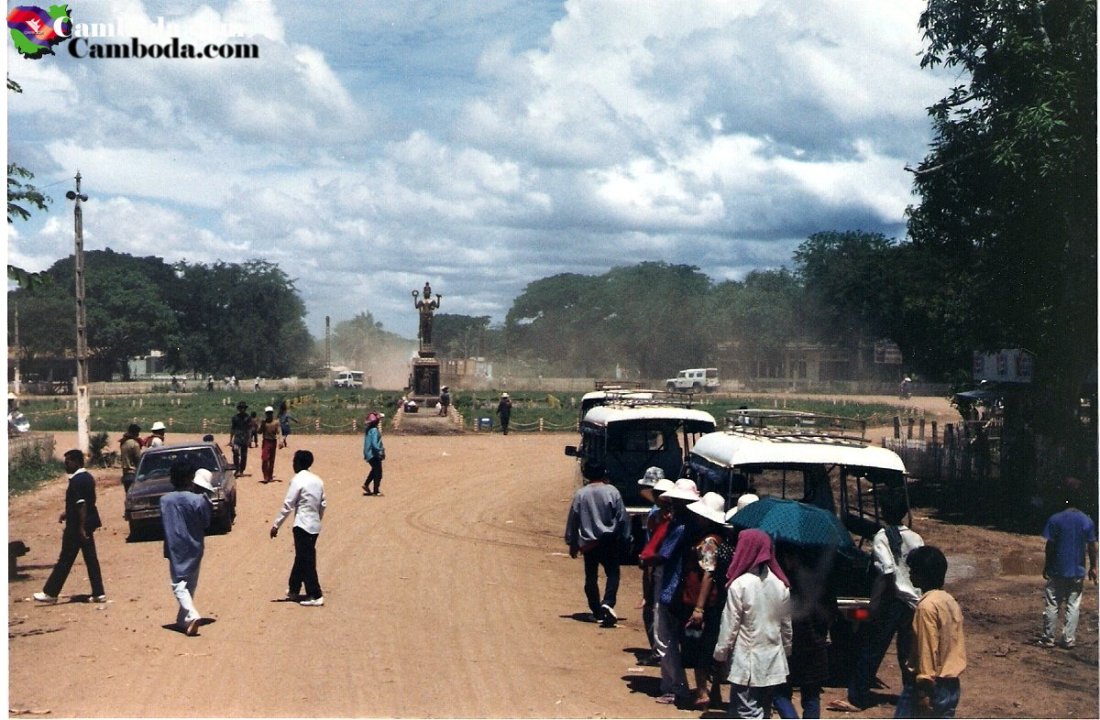
1) I don’t know how old this photo is, but it’s quite old I think. If you took this photo, your back would be towards Thailand, and you would be looking into the beginnings of Poipet and Cambodia. That’s a big idol standing in the middle of the Kbal Spean roundabout. All dirt roads.
2
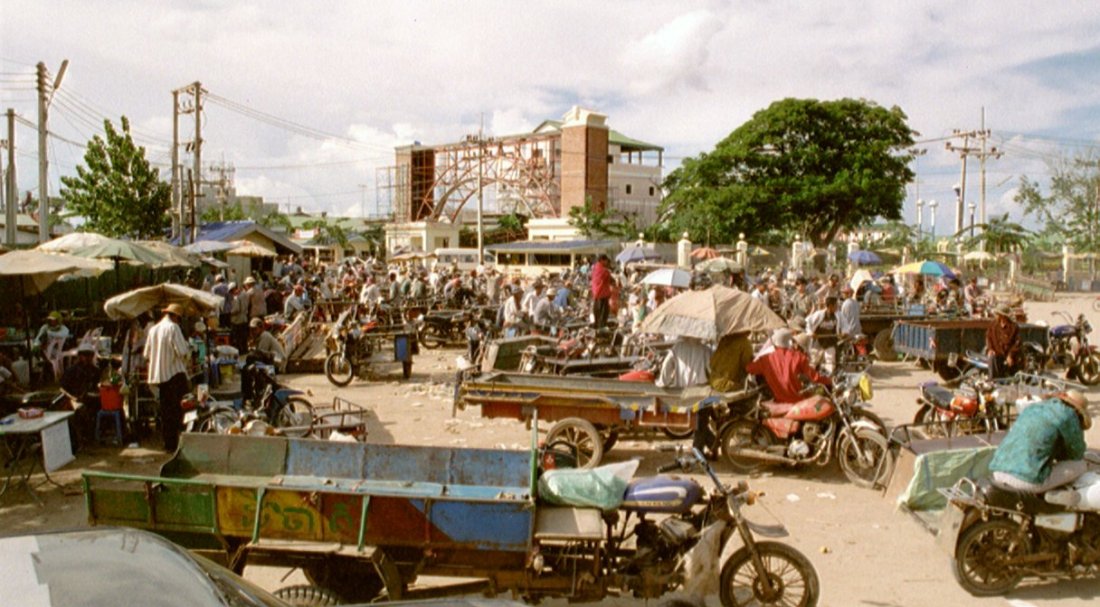
2) This photo is well over ten years old. Now we are looking towards Thailand while standing on the road of the round-about. That big idol is standing just off camera to the right. The first photo was taken from straight ahead of the view of this photo. That arch-way being constructed is the start of an entrance to a new casino.
3
3) This photo is taken from inside Poipet looking out towards Thailand (probably taken around 2006/2007 or so). The idol can be seen, but now we are seeing the reverse side from what we see in the first photo. The red brick pillar seen on the far right of this photo (centered from top to bottom) is the archway under construction in the last photo. Now we see the casinos are dominating the scene.
4
4) Now we are looking into Poipet again with Thailand at our back. Now we see there are lots of buildings, and the roads are paved. This is pretty much what Poipet looks like today, except that big idol is gone. The new railway is going to run straight through the roundabout.
5
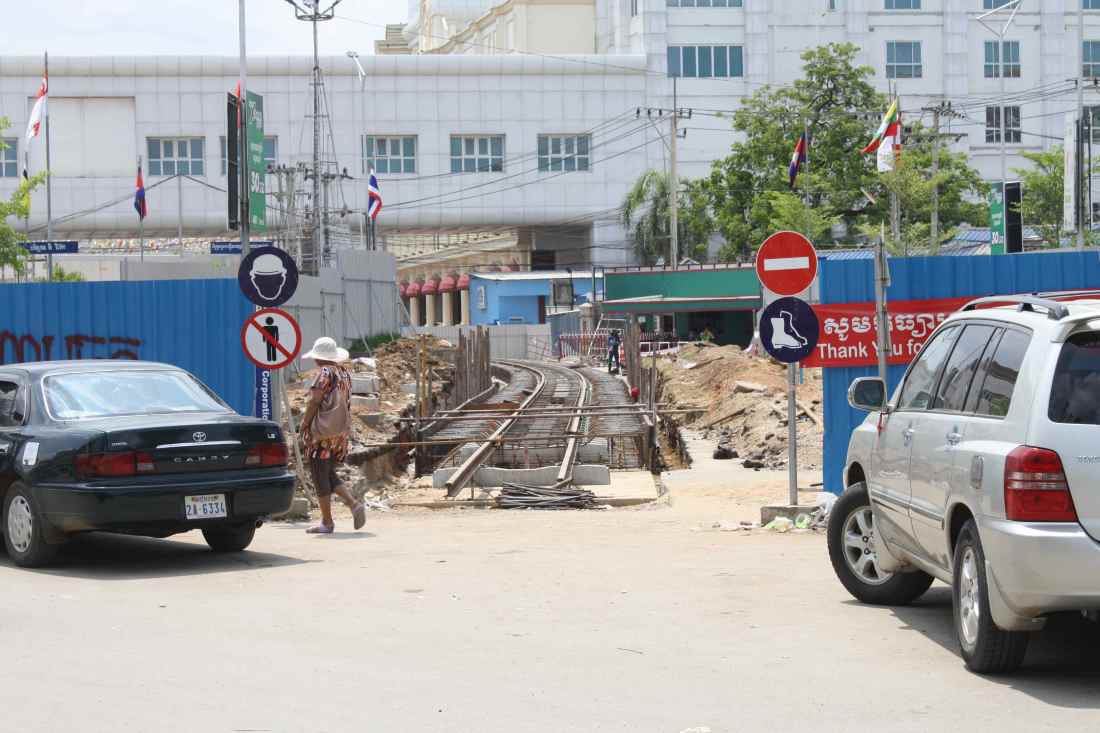
5) Here is the track being constructed. This photo was taken just a few days ago (May, 2016). The track is running right through where the roundabout used to be. Notice that the red brick archway from photos #2 and #3 has been torn down to make room for the train. Also notice the crane on the left is still there (from photo #3). I think that crane has become a permanent fixture.
6
6) A closer look. The casino builders knew the train would eventually come which is why they built the walkways up above the road to connect their buildings.

Sources…

Photo #1 is from Cambodia.com

Photo #2 is from this website.

Some Atheist Brief Book Reviews

19280426All God Worshippers Are Mad 

A short and stupid book. I give it one star out of five because it was only $1.99 on Kindle. I can’t decide if the book was written for 12 year olds, or if it was written by a 12 year old. For example… His first argument against God is basically summed up as: “In order for God to create the space/time universe, God’s existence can’t depend on space/time. My human brain can’t comprehend that. Therefore there is no God. Booyah!”
11081433

Why I Believed 

He’s got a couple of decent Dostoevsky-type arguments against faith/God, but most of what he says follows a “I just don’t want to believe anymore” kind of thinking. Christianity is a faith which requires engagement. If you choose not to engage it you will grow cold towards it.

 

4420281Don’t Sleep, There Are Snakes 

I’ll come back to this book for the language sections. Everett is a talented linguist. He had no business being a missionary though. I don’t think he ever fully understood what Christianity is. His descriptions of the faith show he never moved beyond a Sunday-school understanding of it.
 

24874812

God Needs to Go 

It’s hard to get into one of these books when it starts out with a straw-man argument; which this book does. In fact, this book is one straw-man after another — falsely representing Christianity and then attacking that false representation.

He makes a couple good points against prayer (or, what I would call the misuse of prayer).

Atheists often argue that morality is based on the evolved sense of the common good. While that might be true for economy, it is not true for morality. Morality is not the same across the world. A westerner being accepting of a transgender person is doing so because he believes it is loving to do so. That belief of loving acceptance stems directly from Christian morality. A Buddhist in Thailand who is accepting of a transgender person is not doing so out of love; his acceptance and noninterference is based on karmic justice. A Buddhist would be less inclined to help the poor for that very same reason, whereas a westerner would be more inclined to help the poor based on Christian morality.

The author states: “Except for certain religiously based societies, many of the secular nations display a sense of right and wrong that has allowed them advance in a positive way.” (page 23) “Certain religiously based societies” — every society is a religiously based society, including the ‘post-Christian’ west. A society’s morality is tied to its predominant religion. This is not hard to see. Western morality is based on Christianity, absolutely. If you don’t see that, you just need to do some travelling. A Buddhist nation’s morality is based on Buddhism. The same is true for Hindu and Muslim nations. If a person born and raised in a Buddhist nation becomes an atheist, his morality will still be based on Buddhism. (Although, Buddhism as a religion lacks the conditions to create atheists — which is a whole other interesting topic. Western atheism would not exist if it weren’t for Christianity.)

Then there are the usual arguments about slavery and God’s wrath and so forth. If you want to understand those issues in the Bible you have to understand two very important things: covenant and holiness. If you don’t get those two things, you won’t get the Bible.

And there are the attacks on biblical prophesy. Jesus said certain things about His return that supposedly didn’t happen. Well, there are plenty of books on eschatology to explain that. But if you’re not willing to study it out, then there’s nothing more to say. Reading Psalm 110 and Daniel 7:13-14 will get you well on your way to understanding what Jesus said when prophesying about Himself.

Playtime and Real Life

It seems the line between playtime and real life is fading these days. I see this everywhere, but here I want to focus on Bible College.

Here’s what I mean by playtime and real life:

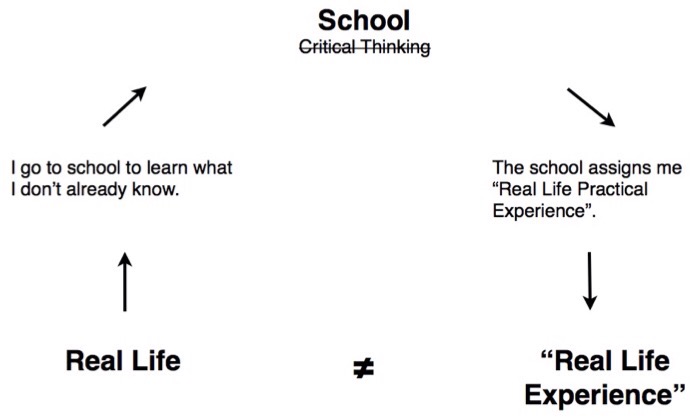
In playtime, you decide when things will begin, and when they’ll end. Also, what you do in playtime has no impact on the outside world around you. For example, think of a paintball game. In a paintball game you’re playing war. You and your friends decide you will “fight” from 9am till 2pm, with a break for lunch in between. Even though you are shooting at each other, no one is going to die or be seriously injured. Your play war will have no impact on the outside world; no one cares what you are doing in your little arena. No one outside or inside your game is going to change their lives on account of it.

Real war, however, is different. No one knows when a real war begins or when it will end. Everyone’s lives, inside the war and around it, will be affected. There are great responsibilities in war, for the foot soldier and the general. Death is real.

In some Bible Colleges there is a thing called “practical ministry” — where the students are supposed to get “real world” experience. But that is not what they get…

  
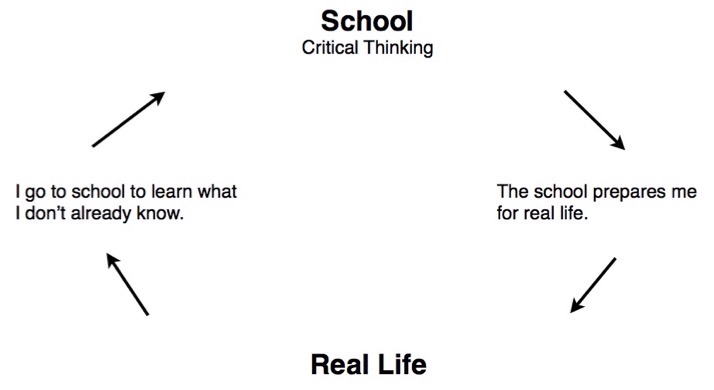
In “practical ministry,” playtime is confused with real life. No one is living real life in school. Practical ministry should really be called “playtime ministry.” Playtime is sometimes good as a way to learn about real life, but only as long as everyone understands the difference between the two and does not get them confused.

Practical equals reality. We need schools like this…

  
This confusion of playtime and real life carry on after the student has finished school, which is when the student faces the harsh reality and finds it is not what they expected.

Rather than having “practical experience” I think it would better to have an apprenticeship program. Students remain in the classroom full days for the first two years, learning all the theory they need. Then, if they pass that stage, they are assigned to a real ministry and apprentice there for an additional two (or more) years. There they will be trained in a real world situation, complete with all the responsibilities that come with it. Once their apprenticeship is complete, they will be ready to go out on their own.

The New Covenant Babel

What did Dostoevsky mean by this quote…

“…socialism is not merely the labor question, it is before all things the atheistic question, the question of the form taken by atheism today, the question of the tower of Babel built without God, not to mount to Heaven from earth but to set up Heaven on earth.”*

In the Old Covenant (Old Testament) time, God’s salvation system was through the temple and Jerusalem. A temple is a stairway and a gateway to Heaven. The city around the temple is the cultural bed in which the temple rests. Babel, then, was a counterfeit Jerusalem and temple — an Old Covenant counterfeit.

In the New Covenant we see, not us going up to Heaven, but rather, Heaven coming down to the earth (Revelation 21). What then would a New Covenant counterfeit look like? 

Dostoevsky recognized socialism as this counterfeit.

* Dostoevsky, Fydor, The Brothers Karamazov (Barnes & Noble: New York, 2004 [1879-1880]), pg. 32.

Sufficient Evidence: Empirically Impossible

Recently I posted this quote on my Facebook page:

“…socialism is not merely the labor question, it is before all things the atheistic question, the question of the form taken by atheism today, the question of the tower of Babel built without God, not to mount to Heaven from earth but to set up Heaven on earth.”*

A socialist atheist got upset by the quote and felt the need to reply, which went something like this:

Socialism is not atheistic! There is no god and we just want to create a society where all are taken care of. If there is a god then provide sufficient evidence. Until then stop wasting my time!

Forgetting the fact that his response confirmed the truth of the quote, and forgetting the fact that he was the one wasting my time by responding and demanding an explanation, I thought, “What would be sufficient evidence?”

Because, of course, empirically speaking, there is no sufficient evidence to prove God. Even if Jesus were to appear in the sky above this guy’s house and cry out with a loud voice, “I am Jesus! I am God! I created the universe!” my Facebook friend would still be left with the choice of wether to believe what he saw was real or not. And if he’s predisposed not to believe then he will probably explain away the experience as something natural. 

“It is not miracles that dispose realists (or empiricists) to belief. The genuine realist, if he is an unbeliever, will always find strength and ability to disbelieve in the miraculous, and if he is confronted with a miracle as an irrefutable fact he would rather disbelieve his own senses than admit the fact. Even if he admits it, he admits it as a fact of nature till then unrecognized by him. Faith does not, in the realist, spring from the miracle but the miracle from faith. If the realist once believes, then he is bound by his very realism to admit the miraculous also. The Apostle Thomas said that he would not believe till he saw, but when he did see he said, ‘My Lord and my God!’ Was it the miracle forced him to believe? Most likely not, but he believed solely because he desired to believe and possibly he fully believed in his secret heart even when he said, ‘I do not believe till I see.'”**

Now, as for socialism, I’ll leave that for another day. Until then, read anything on economics by Thomas Sowell. 

* Dostoevsky, Fydor, The Brothers Karamazov (Barnes & Noble: New York, 2004 [1879-1880]), pg. 32.

** Ibid., pg. 31.

What did Dostoevsky mean by comparing socialism with Babel, and why did he then contrast socialism with Babel in saying that socialism strives to bring Heaven to earth (whereas at Babel they were trying to get to Heaven)?