3.5 stars… This poorly titled book is full of interesting stories highlighting the often unseen advantages of the seemingly disadvantaged. But, the question which I kept asking as I read was: So, what’s the point?
Apart from the actual David vs. Goliath tale, Gladwell follows several stories to push his thesis: that the underdog, because of his disadvantage, is forced to act in ways which are unexpected, and so, give him an unexpected upper hand in a conflict…
The coach of an unskilled girls basketball team, with no chance of beating other teams with taller and more experienced players, discovers that if his girls concentrate on speed they can dominate every area of the court and shut down the opportunities of the other team to shoot and play an effective traditional game style.
Overly large class sizes hinder a teacher’s ability to control her class, so the obvious solution is small class sizes, right? Wrong. Class sizes which are too small hinder the learning experience for the kids in their own way. But yet, most parents hold to the idea that small class sizes are better, especially in expensive private schools.
If you finish at the top of your class in mathematics, and you get accepted into MIT, you should definetely go, right? Well, not necessarily. The competitiveness at MIT is so high you might find yourself so discouraged that you’ll end up dropping out. You might be better off going to a less elite university where, still being challenged, you will be at the same level as your classmates. As Gladwell writes: Better to be a big fish in a small pond than a small fish in a big pond. The economist, Thomas Sowell, touches on this when he talks about affirmative action. Black kids, getting the highest marks on their S.A.T.’s compared to their school mates, are being let into elite schools at lower standards than normal but are later dropping out. They would do much better at schools which perform to their level.
Dyslexia is a big problem for those who have it, but it also gives those same people a drive and a unique way of approaching life which opens unexpected doors.
All would agree that a child dying from cancer does not need to be put through any more pain than they are experiencing already. Well, one doctor, who, because of his difficult upbringing, lacked this empathetic wisdom, and put children though painful medical treatments, and in doing so, discovered how to prevent leukaemia patients from bleeding to death.
Martin Luther Kings’s team did some questionable things to get the rest of America to see the oppression the black community was suffering.
The German bombing of London in WWII did not quite have the desired effect, as the survivors developed a sense of invincibility having nearly been killed but still escaping. They became indifferent to the attacks.
Those are some examples, but there are more.
Gladwell wants to persuade the reader to not always hold to the idea that might is right, or that the status quo is best, or that “the way it’s always been done” is the way to achieve.
He writes:
“…look at the shepherd [David] and the giant [Goliath] and understand where power and advantage really lie. It matters, in a hundred and specific practical ways. It affects the decisions we make as parents, the schools we choose to attend, and the way we fight wars and battle crime. It shapes the way we understand creativity and entrepreneurship and the way the oppressed seek to take on bullies and tyrants … We aren’t very good at confronting the lessons about power … Understanding the power of the underdog requires an effort. It requires standing up to conventional wisdom.” (page 294)
As I wrote above, the question I asked continuously as I read was: What’s the point? Often, the status quo is the status quo because it works. Years of experience of those who came before are what make life currently good for all. If you do find yourself the underdog, trying to change things might not be the best thing to do. The girls basketball team mentioned above just ended up pissing off all the other teams in the league. How do you know when to shake things up and when not to? I guess it depends on how revolutionary you feel.
Don’t mistake this book as a simple read for the next holiday. It’s quite deep. It’s really a philosophical treatise on the subject of work in relation to practical knowledge and craftsmanship.
Matthew Crawford is an electrician turned political philosopher turned motorcycle mechanic. He has a Ph.D. in political philosophy, so he’s not just some “grunt.” Not that he would need a Ph.D. to write a thoughtful book on this subject — the experience of working in both the office and on the construction site is really what gave him the fuel to write this book.
In it, he compares working with one’s hands verses “knowledge-based” work. Which is better for the soul? Obviously he sides with the hands on work, and he writes a fine critique of the corporate culture which has developed in the west over the last few decades.
My favourite chapter is called The Contradiction of the Cubicle. Crawford compares the hierarchical structure of the office to that of the construction site. Here’s an excerpt:
In the office…
Through the exercise of charismatic authority, the manager unsettles others, shaking them out of their cramped views and stale habits, thereby unleashing the creativity of all workers. This is a charismatic leader of a new kind, a sort of radical democrat. He does not seek followers; he seeks to make every man a leader of himself…
Workers must identify with the corporate culture, and exhibit a high level of “buy-in” to “the mission.” The division between private life and work life is eroded, and accordingly the whole person is at issue in job performance evaluations.
(pg. 149-150)
On the construction site…
In the trades, a master offers his apprentice good reasons for acting in one way rather than another, the better to realize ends, the goodness of which is readily apparent. The master has no need for a psychology of persuasion that will make the apprentice compliant to whatever purposes the master might dream up; those purposes are given and determinate. He does the same work as the apprentice, only better… For the apprentice there is a progressive revelation of the reasonableness of the master’s actions. He may not know why things have to be done a certain way at first, and have to take it on faith, but the rationale becomes apparent as he gains experience. [Office style] teamwork doesn’t have this progressive character. It depends on group dynamics, which are inherently unstable and subject to manipulation…
[With the master/apprentice relationship] the judgements of the master [toward the apprentice] feel ennobling rather than debasing. There is a sort of friendship or solidarity that becomes possible at work when people are open about differences in rank, and there are clear standards.
(pg. 159-160)
“The Liberal Party believes that terrorists should get to keep their Canadian citizenship … because I do. And I’m willing to take on anyone who disagrees with that.”
~Prime Minister Justin Trudeau, July 4, 2015
The Friendly Forest
Once upon a time in the Friendly Forest there lived a lamb who loved to graze and frolic about. One day a tiger came to the forest and said to the animals, “I would like to live among you.” They were delighted. For, unlike some of the other forests, they had no tiger in their woods. The lamb, however, had some apprehensions, which, being a lamb, she sheepishly expressed to her friends. But, they said, “Do not worry, we will talk to the tiger and explain that one of the conditions for living in this forest is that you must also let the other animals live in the forest.”
So the lamb went about her life as usual. But it was not long before the tiger began to growl and make threatening gestures and menacing motions. Each time the frightened lamb went to her friends and said, “It is very uncomfortable for me here in the forest.” But her friends reassured her, “Do not worry; that’s just the way tigers behave.”
Every day, as she went about her life, the lamb tried to remember this advice, hoping that the tiger would find someone else to growl at. And it is probably correct to say that the tiger did not really spend all or even most of its time stalking the lamb. Still, the lamb found it increasingly difficult to remove the tiger from her thoughts. Sometimes she would just catch it out of the corner of her eye, but that seemed enough to disconcert her for the day, even if the cat were asleep. Soon the lamb found that she was actually looking for the tiger. Sometimes days or even weeks went by between its intrusive actions, yet, somehow, the tiger had succeeded in always being there. Eventually the tiger’s existence became a part of the lamb’s existence. When she tried to explain this to her friends, however, they pointed out that no harm had really befallen her and that perhaps she was just being too sensitive.
So the lamb again tried to put the tiger out of her mind. “Why,” she said to herself, “should I let my relationship with just one member of the forest ruin my relationships with all the others?” But every now and then, usually when she was least prepared, the tiger would give her another start.
Finally the lamb could not take it anymore. She decided that much as she loved the forest and her friends, more than she had ever loved any other forest were friends, the cost was too great. So she went to the other animals in the woods and said goodbye.
Her friends would not hear of it. “This is silly,” they said. “Nothing has happened. You’re still in one piece. You must remember the tiger is a tiger,” they repeated. “Surely this is the nicest forest in the world. We really like you very much and we would be very sad if you left.” (Though it must be admitted that several of the animals were wondering what the lamb might be doing to contribute to the tiger’s aggressiveness.”
Then, said two of the animals in the friendly forest, “Surely this whole thing can be worked out. We’re all reasonable here. Stay calm. There is probably just some misunderstanding that can easily be resolved if we all sit down together and communicate.” The lamb, however, had several misgivings about such a meeting. First of all, if her friends had explained away the tiger’s behavior by saying it was simply a tiger’s nature to behave that way, why did they now think that as result of communication the tiger would be able to change that nature? Second, thought the lamb, such meetings, well-intentioned as they might be, usually try to resolve problems through compromise. Now, while the tiger might agree to growl less, and indeed might succeed in reducing some of its aggressive behavior, what would she, the lamb, be expected to give up in return? Be more accepting of the tiger’s growling? There was something wrong, thought the lamb, with the notion that an agreement is equal if the invasive creature agrees to be less invasive and the invaded one agrees to tolerate some invasiveness. She tried to explain this to her friends but, being reasonable animals, they assured her that the important thing was to keep communicating. Perhaps the tiger didn’t understand the ways of the lamb. “Don’t be so sheepish,” they said. “Speak up strongly when it does these things.”
Though one of the less subtle animals in the forest, more uncouth in expression and unconcerned about just who remained, was overheard to remark, “I never heard of anything so ridiculous. If you want a lamb and a tiger to live in the same forest, you don’t try to make them communicate. You cage the bloody tiger.”
~Edwin Friedman (Friedman’s Fables, The Guilford Press, 1990) page 25-28
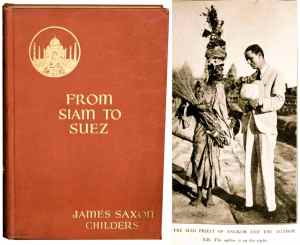
Photo caption: THE MAD PRIEST OF ANGKOR AND THE AUTHOR – N.B. The author is on the right.
From Siam to Suez is a rare old book written by James Saxon Childers (1899-1965) detailing his journey from China to Egypt in the early 20th century. Childers was an American writer and traveller who wrote several fiction books as well as travel books. His fiction did not do too well, but his travel books were popular.
Here I’m sharing chapter two of the book where Childers visits Angkor. I have been to Angkor several times and it never ceases to amaze me. I agree with Childers though: Angkor is a foreign mystery to the westerner — cut off from our history, culture, and religion.
Chapter II, From Siam to Suez by James Saxon Childers (Public Domain Book)
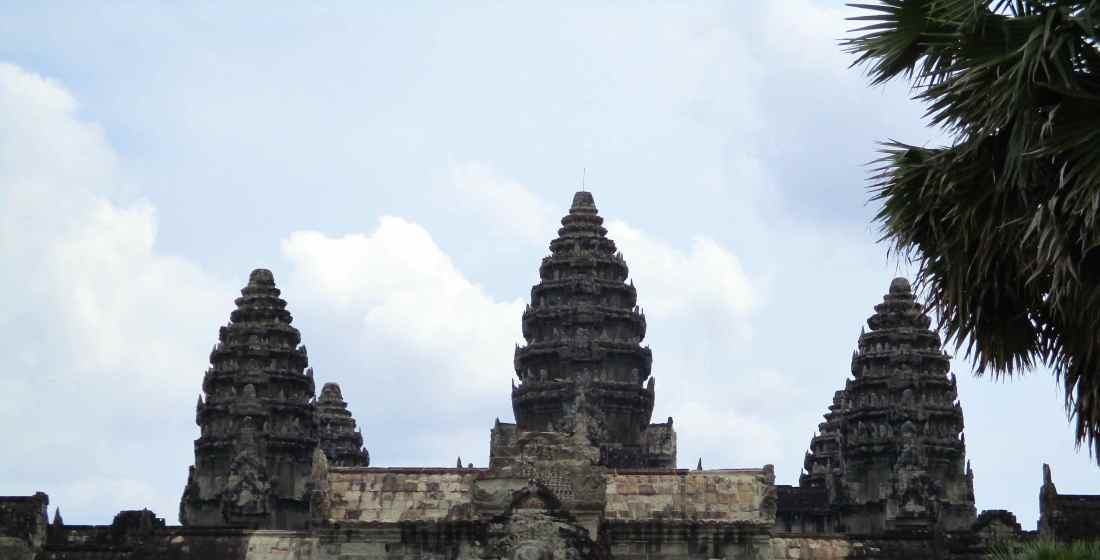
The towers of Angkor Wat temple
DEAR OCTAVUS ROY COHEN: You asked me to write to you about the ruins of Angkor. I’m sorry you did; for I’ve been in Angkor a week, yet can find out nothing about it. At night I prowl through the temple and in the day I ride elephants through the town, but the stones are only stones and I hear nothing.
In Athens I can see Socrates in his ragged old coat, forever talking, forever making his soul as good as possible. In Rome I hear the tramp of the legions and Cato shout, “Delenda est.” In Paris I see Villon staggering, staggering just a little as he searches for the snows of yesteryear. In the streets of London, Doctor Johnson shambles along with Boswell at his side. I hear him say: “Sir, when a man is tired of London, he is tired of life.” But Angkor is silent. The lips of the four-faced god are mute; even the spirit of his devotees has gone into the awful jungle.
I would not have you feel that Angkor prompted me to ask Cleopatra’s famous question: “Is this the mighty ocean? Is this all?” In a way, I have not been disappointed in Angkor, but the place has not set me on fire; I have not felt as I did when looking at the Great Wall of China, or at the Parthenon, or at the Forum: Genghis Khan never stormed these gates, Phidias never worshipped in this temple, Cæsar never walked these streets…
I arrived at Angkor after a week’s visit to Saigon, the real capital of Indo-China, a French city set in a jungle. The French own Saigon: they dominate it; one sees the native only as a servant, or as a soldier in the troupes coloniales. The architecture of Saigon is French. The paved boulevards are French. The big shops are French. There is a Hôtel de Ville, a Théâtre Municipal, a Musée, a Jardin Botanique. Saigon in its buildings, parks, and streets is definitely a counterpart of Paris, but the buildings are merely masquerade; even a transient detects a noxious decadence in the lives of the haggard officers of the Foreign Legion, of the white-faced government employees, of the red-faced rubber planters–Frenchmen forced to live in daily contact with the jungle and its diseases, the heat and its diseases, the sullen hatred of the natives, opium, the nostalgic realization of exile, and the insidious enervation of the Orient.
After a week’s visit in Saigon–seven days of ghastly heat and of torment from mosquitoes, seven nights of tennis and absinthe frappés, of late dinners and champagnes and brandies, of visits to opium houses and to other houses where depravity in its most vicious form is commonplace–I was glad to hire an automobile for the two-hundred-mile ride over the jungle road to the ruins of Angkor.
≈
Three times he spoke his name and three times I tried to repeat it. He laughed as I stumbled through the confusion of syllables, and when at last I called him Rollo, he didn’t seem to object. He was a white-haired old man of eighty-four years, and his entire international vocabulary was this: “Angkor Thom,” “Angkor Vat” (pronounced Angkor Wot), “Buddha,” “Vishnu,” “soldat,” “le roi,” “madame le roi,” “Naga,” and “all right.” For a week we talked with each other daily, and we used no other words than these. A stranger might have been puzzled had he seen us in conversation, for he might not have comprehended the gestures of our arms, the contortions of our bodies, and the significant grimaces by which we discussed history, art, and curious practices.
I found Rollo late one afternoon squatting on his haunches, chewing betel nut, and spitting the blood-red juice upon the stone causeway that leads to the temple of Angkor.
“You speak English?” I asked.
Rollo stood, bowed to me, raised his arm and swept it before him, encompassing by his gesture the entire façade of the mighty temple.
“Angkor Vat,” he said.
“Yes, I know, but do you speak English, and could you tell me where I could find a guide?”
Again the inclusive gesture and again: “Angkor Vat?”
“Good, but you speak French peut-être? Oui? Vous parlez français?”
But the habit was on him: once more I learned that at the distant limit of the great arc described by his hand stood the temple of Angkor.
“Righto, old chap.” I nodded and smiled to him. “Merci bien.”
I started along the causeway. Rollo trotted beside me, his little wooden clogs tap tapping upon the stones.
“Where are you going?” I demanded.
“Angk–”
“So I gather, but why are you following me?”
He looked at me and smiled. Absurdly enough I thought of wrinkled copper.
“All right,” he said, and startled me by his linguistic versatility. He struck his chest, touched my arm, and, clasping his hands, showed that we were friends.
Afterward he pointed ahead at the temple. Crouching low, peering all about him, he stood on tiptoe, gazing with keenest interest. Finally, with two forefingers ever moving one before the other, he signalled our advance.
“But, see here, you don’t speak any language I understand. How can you–”
Already he was tap-tapping toward the temple. I could only follow. And so, led by this venerable Cambodian, this graybearded ancient of infinite gentleness, of wisdom to leap the barrier of language, I began a tour of architectural wonders wrought more than a thousand years ago.
≈
Cambodia is a kingdom in French Indo-China, and in the center of Cambodia are the famous ruins of Angkor, once capital of the most powerful nation of Asia. Angkor was built by a people called the Khmers–whence they came nobody knows, where they went nobody knows, but at one time more than a million men lived in Angkor; and its grandeur shamed the Rome of Augustus, the Athens of Pericles, and the Babylon of Nebuchadnezzar. To-day there is nothing except the shell of the mighty city and a silent temple of infinite majesty–a city and a temple, gray stone ghosts in a jungle of green.
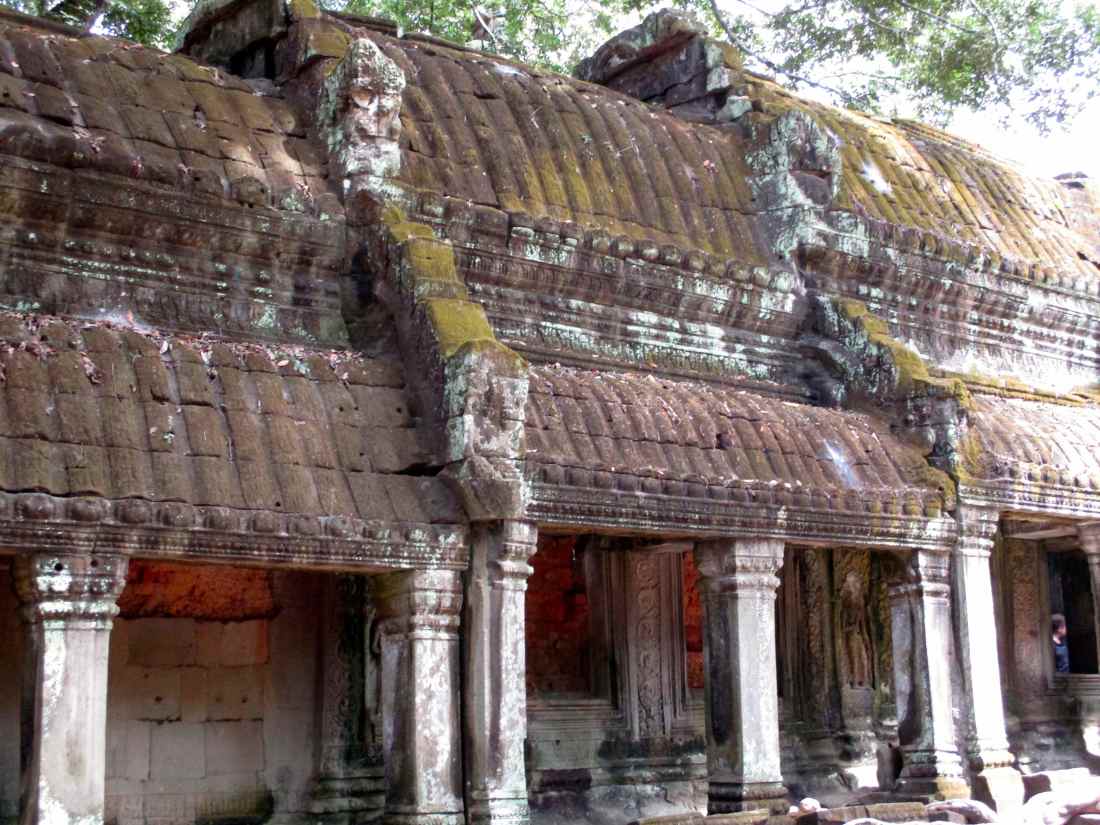
Ta Prohm temple
Some writers have declared that the Khmers were driven from their capital after a war in which their enemies combined against them. Others believe the Khmers were blotted out by a swift plague. French scholars who have spent years studying the ruins and their inscriptions contend that in the fourteenth century the slaves of Angkor suddenly fell upon their masters and destroyed them. Chaos followed. Gradually the slaves reverted to savagery, and gradually the savages degenerated into the decayed peoples who live their shabby lives near the ruins to-day.
≈
“Angkor Vat,” said Rollo, pausing at the entrance of the famous temple, then leading me into the outer corridor. “Vishnu,” he said, pointing at a giant figure with hundreds of arms. Upon the wall was an unbroken bas-relief depicting wars, battles, and fearful exploits of wondrous men. “Soldats,” Rollo explained.
“And a bloodthirsty lot–eh, Rollo?”
“Soldats,” he answered, solemnly.
We turned a corner and the subject of the bas-relief changed to tortures used by the Khmers. One man’s eyes were being plucked out by vultures. Another writhed between two stones that were slowly pushed together. A third was hacked in pieces with great axes. One miserable wretch was surrounded by a number of ladies who cut tidbits from his body.
Whenever we arrived opposite a particularly gruesome carving, Rollo demonstrated. I shall always remember his graphic depiction of a disemboweled man whose entrails were used as a skipping rope–Rollo danced about with the happy abandon of a child whirling a daisy chain. In the middle of his danse macabre I caught his little white jacket and pulled at it, stopping him. He bowed, and, hurrying past the other torture scenes, led me around the great square, more than a mile in length.
Angkor was built with gray sandstone that takes a polish almost like marble. In the middle of the twelfth century when the temple was built by the architect Visvakarman, thousands of tons of this stone were brought in huge blocks from quarries nineteen miles away. The outer gallery and inner gallery are connected by a stone causeway thirty-six feet wide. In the center of the temple are five huge domes, the middle one thrusting its rude splendour six hundred feet into the air. The walls, columns, entablatures, and pilasters are all marvelously decorated with carvings of the heavenly dancers, the monkey gods, and the divine tevadas with lotus flowers in their hands. When the moon touches them with silver, the carvings look like lace lying lightly upon stone.
The temple now is deserted save for Buddhist priests and sightseers, and millions of bats that defile the floor and pollute the air with the gagging smell of their bodies–besides these, there is nothing alive in a temple where once a million men bowed before their gods.
≈
“Angkor Thom,” said Rollo on the second morning of my visit, as he made signs for me to mount one of the two elephants he had hired to take us to “The Great Capital,” the deserted city that lies one mile from the temple. We could have gone in automobiles, but Rollo insisted I ride as rulers had ridden, and because of his insistence I climbed to the howdah where I watched the mahout kick the elephant and strike it with an iron hook until at last the great beast heaved itself toward Angkor Thom.
Elephant ride from the entrance gate of Angkor Thom to the Bayon Temple
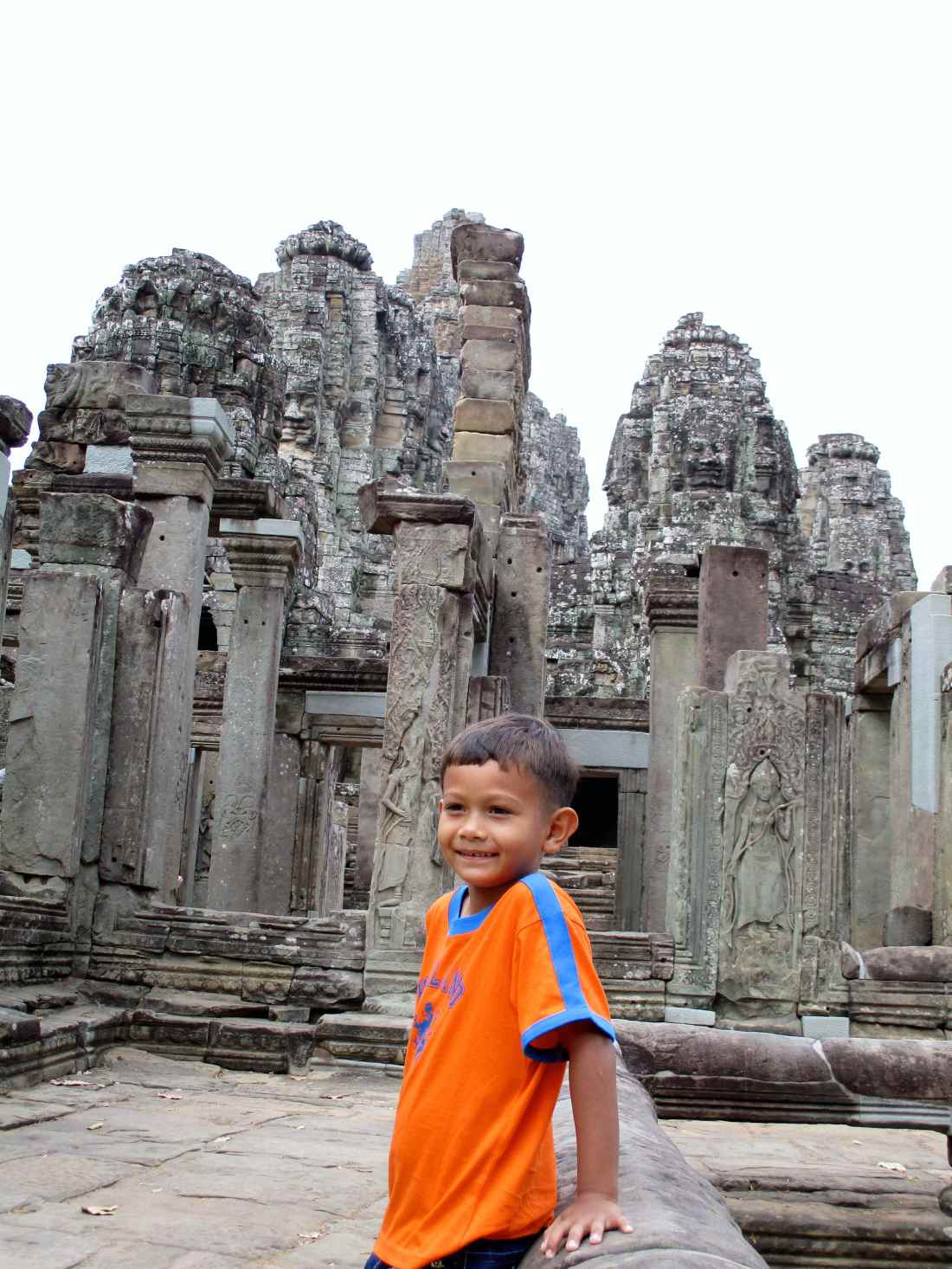
The boundaries of the old city are marked by a wall, its massive stone gates arching high in primitive splendor above the roadway. Within the boundaries are the remains of a dozen buildings with enormous square towers still standing, each side of each tower cut as a huge Brahmanic face. In all parts of the city are terraces adorned with figures of startling beauty, treasures of sculpture.
My son at the Bayon Temple (the temple of the Brahmanic faces)
The time may come when I forget the towers and the terraces and the carvings, but I shall never forget the dreadful silence of that dead city. In Angkor Thom, “The Great Capital,” one hears only the occasional call of a bird; the awful stillness sings the saga of departed pomp and power.
A thousand years ago the jungle was cut away and Angkor Thom was built. To-day the jungle is taking back its own, crumbling and swallowing proud buildings erected by proud men. Seeds dropped by birds have grown into trees and their roots have split the heads of the ancient gods. Other trees send their roots above ground and over all barriers more than a hundred feet to wrap about blocks of stone and tear them from their moorings. Myriads of small plants, the jungle’s infantry, advance in almost solid formation. A thousand years the jungle has waited, watching the aspiration of man. Then man died. The living jungle crawled in to blot out the scar of civilization.
≈
I am writing you this letter, Roy, in the modern hotel built by the French at Angkor. I have just returned from wandering through the temple alone. Far back in the inner sanctum, I heard the liquid notes of the bamboo xylophone, played in the native village, join with the low chant of the Buddhist priests and come softly over the lake. The great temple stretched away from me, its stones silver in the moonlight, its shadows hiding the brooding souls of millions of men dead for centuries. . . . Long I sat listening to the xylophone and to the chanting. Long I peered at the ancient stones. And yet when I left the temple at midnight, the souls of the builders were still hidden in shadows.
A not so subtle critique of post-modernism. And, a decent murder mystery as well.
Jon Mote is hired by the widow of a recently deceased English professor to investigate his murder. Jon is not a detective, but has experience in research. With his sister Judy, a mentally handicapped side-kick, Jon begins to learn things about his former English professor which call into question the post-modern view of the world.
Jon also has his own demons to face, and a history of religion and abuse to come to terms with.
It’s an easy read and under 200 pages. I enjoyed it.

 David and Goliath: Underdogs, Misfits, and the Art of Battling Giants by Malcolm Gladwell





 Pursuit of Percipience