“If the land is not to be lost to hordes from outside, we in all the Western World shall have to recover the power to build communities. It is quite worthless to map out programs of rehabilitation or resettlement since not one of the individuals thus resettled or rehabilitated has the stamina to partake in the revival of the community. First of all, before any planners can carry out any plan, we shall have to create opportunities in which men recover their power to found or re-found communities. This power is lost. The modern mind has lost the recipe.”
Judaism Despite Christianity is a collection of letters between Franz Rosenzweig and Eugen Rosenstock-Huessy written in 1916. That’s a hundred years ago, but the topics discussed in these letters directly relate to our world today. Rosenzweig and Rosenstock-Huessy were prophets.
Franz Rosenzweig (FR) was a practicing Jew, but that was not true of him or his family while he was growing up. It was in his encounters with Eugen Rosenstock-Huessy (ERH), a Christian, when he was forced to face the emptiness of his tradition-only religion. Thanks to ERH, not only did FR have to face the reality that merely paying homage to his Jewish faith was not good enough, he also had to face the possibility that Judaism itself was no longer necessary in a Christian world.
FR’s view of history was described by Alexander Altmann, who wrote an essay about the correspondence between FR and ERH, as this:
What happens in history, [Rosenzweig] says, is not a struggle between man’s faith and man’s reason but a struggle between God and man. In world history the absolute powers themselves are dramatis personae [the characters of the play]. Revelation breaks into the world and transforms creation, which is the Alpha of history, into redemption, which is the Omega. Philosophy has a pagan quality. It is an expression of the Alpha, of creation, of pure nature to which God has given freedom — even against himself. But as revelation comes into the world, it gradually absorbs philosophy, deprives it of its pagan elements, and illuminates it with its own light. The Omega of history will be realized after the element of creation, the world’s freedom, has spent itself. Then God, who has allowed the world to be in the Alpha, will again be the First and the Last, the Alpha and the Omega.*
FR, along with others, believed the Church was entering into the “Johannine” period of Christianity. Rather than the “Petrine” or “Pauline” periods, in which the Church focused mainly on dogma (Who are we?), in the Johannine period the Church would focus primarily on reaching out to the Gentiles. This Johannine period would be directed by the Spirit, whereas previous periods were directed by the Father and the Son. If this was/is true, then the world was/is coming into its “Omega” time, and Judaism is being left behind as a relic of the “Alpha” time.
If it was the function of Christianity to convert the heathen and to transform the Alpha element of creation — the world in its raw state — into the Omega element of redemption — the world as the place of revelation — was there any room left for Judaism?†
This created a crisis for FR, and he strongly considered converting to Christianity. The Church was symbolized as holding the sceptre of power and rule, while the synagogue held only a broken staff. FR did not, however, want to enter the Church as a pagan, he wanted to enter as a true Jew, and this desire forced him to establish a new and more serious relationship with his Jewish faith. In the end, it was that new relationship with Judaism which prevented him from ever becoming a Christian at all.
FR eventually came to the conclusion that Judaism still served an important role in the Christian world. He recognized that her [Judaism’s] stern refutation of the pagan world and her uncompromising attitude constituted the only safeguard for the completion of the work of revelation and of the church herself.‡ Jews and Judaism continue to exist to remind the Church of what it is, and what its purpose is. ERH was obviously influenced by FR’s idea as he wrote a couple decades later in his book, Out of Revolution, something very similar:
The Jew is a stranger among the Gentiles, a reminder to them that their Christianity is always threatened by a backsliding into mere paganism.§
When [the Jews] were scattered over the earth after the loss of Jerusalem in 70 A.D., they had no other function than to bear witness to the “economy of revelation,” to the growing Kingdom of God. Without their existence, the gospel of Jesus might have come to the Gentiles like a myth or a legend. Christianity becomes an historical fact only through the existence of Jews. The natural inclination of men and nations to take flight into dreams of ancestral pride or the cobwebs of abstract philosophy always leads to excesses of agnosticism and mythology. The Jews, simply by their existence, bar the nations from a relapse into that comfortable self-adoration which makes Jesus himself into a blond Germanic hero instead of a despised Jew.||
[T]he Jews are not like the Armenians in Turkey or the Japanese in California or the Irish in New England. The Jews were created as counterfoil to the Gentiles; and whenever … the Christians grow weak in their faith, hope, and love, then the glowing nucleus of revelation and the inanimate forms of creation diverge and threaten to destroy human history, which is a process of salvation of the world and the conversion of the pagans by the Word.¶
Before this point, FR was afraid to talk to ERH again about his Judaism. ERH, in a conversation with FR in 1913, had shaken FR’s beliefs to the foundation. But now, as FR dived deeper into this new understanding of what Judaism existed for, he began to feel ready to confront ERH yet again, and defend his beliefs and Judaism as he could not before. This was the state of FR when these letters between himself and ERH began.
ERH and FR touch on the topic of the “stubbornness of the Jews” quite a bit in the letters. As FR writes to ERH…
But I should like to quote you [from] one … legend. The Messiah was born at exactly at the moment when the temple was destroyed [A.D. 70], but when he was born, the winds blew him forth from the bosom of his mother. And know he wanders unknown among the [Jewish] peoples, and when he has wandered through them all, then the time of our redemption will have come.
So that Christianity is like a power that fills the world (according to the saying of one of the two scholastics, Yehuda ha-Levi: it is the tree that grows from the seed of Judaism and casts its shadows over the earth; but its fruit must contain the seed again, the seed that nobody who saw the tree noticed. This is a Jewish dogma, just as Judaism as both the stubborn origin and last convert is a Christian dogma.# [Note: At no point in the letter does FR close the parenthesis.]
[T]he corresponding Jewish outcome of the theological idea of Christianity as a preparer-of-the-way is the pride of the Jews. This is hard to describe to a stranger. What you see of it appears to you silly and petty, just as it is almost impossible for the Jew to see and judge anti-Semitism by anything but its vulgar and stupid expressions. But (I must say again, believe me) its metaphysical basis is, as I have said, the three articles: (1) that we have the truth, (2) that we are at the goal, and (3) that any and every Jew feels in the depths of his soul that the Christian relation to God, and so in a sense their religion, is particularly and extremely pitiful, poverty-stricken, and ceremonious; namely, that as a Christian one has to learn from someone else, whoever he may be, to call God “our Father.” To the Jew, that God is out Father is the first and most self-evident fact — and what need is there for a third person between me and my father in Heaven? That is no discovery of modern apologetics but the simplest Jewish instinct, a mixture of failure to understand and pitying contempt.**
FR, throughout his letters, seems to believe that if and when a Jew converts to Christianity, he is not doing so as a Jew, but as a Gentile, for no true Jew would leave Judaism. This belief irks ERH, and he criticizes FR for not seeing Judaism as being trapped in the elemental (Alpha) part of reality while rejecting the revelation (Omega) part. As to FR’s statement that Jews need not a third person between them and God, ERH writes: Christ has mediated to us the breaking through into the universe in a heavenward direction of this force [faith], which was latent and imprisoned in the earth.††
ERH points out how, at Babel, humanity was split and that the Jews were separated at that time by God to be His chosen people. However, the healing of humanity came through Christ…
“The Word became flesh” — on that proposition everything indeed depends. While the word of man must always become a concept and thereby stagnant and degenerate, God speaks to us with the “word become flesh,” through the Son. And so the Christian revelation is the healing of the Babylonian confusion of tongues, the bursting open of the prison, but also the sign on the new tongues, speech that is now informed with soul. Since then, it has become worthwhile to think again, because thought has a standard outside itself, in the visible footsteps of God…
That from which Christ redeems is exactly the boundless naïve pride of the Jew, which you yourself exhibit. In contrast to the peoples talking the 372 languages of Babel, this pride was and is well founded, and therefore the Jews were separated and chosen out of all the peoples of the earth, until the destruction of the Temple. But Christianity redeems the individual from family and people through the new unity of all sinners, of all who are weary and heavy laden. That is Christianity, and its bond is equal need.‡‡
ERH further criticizes FR by saying that, even though the Jews say all people will one day come to Jerusalem to pray, they continually crucify the One who made that truth possible. The Jews have rejected and grown to be far away from the revelation that is Christ. In appearance they wait upon the word of the Lord, but they have grown through and through so far away from revelation that they do everything they can to hinder its reality. With all the power of their being they set themselves against their own promises.§§
FR later argues that Christians only have what the Jews gave them, and any Gentile who becomes a Christian was first “Judaized” — a Judaizing of the Pagans as he puts it. He writes: Your [ERH’s] whole description of the Synagogue since A.D. 70 forgets, or refuses to recognize, that we consciously take upon ourselves “the yoke of the kingdom of heaven,” that we pay the price for the sin of pride of non-cooperation, of walking without mediator in the light of God’s countenance. We pay subjectively through suffering the consciousness of being shut out, of being alienated, and objectively, in that we are to you the ever-mindful memorial of your incompleteness (for you who live in a church triumphant need a mute servant who cries when you have partaken of God’s bread and wine, [“Master, remember the last things”]. (FR wrote this last part in Greek.)||||
Well, this bantering back and forth goes on between the two in all the letters, but there is more to these letters than that. FR and ERH also discuss philosophy, history, and other religions. I can’t comment on all of that, and I don’t understand all of it either.
In the end I can’t say that FR and ERH resolved their conflict. FR died young and never was able to complete his whole theory of thought. He did publish his work Star of Redemption, which was highly influenced by ERH and these letters. ERH taught at Dartmouth College from 1935-1957, and died in 1973. You can listen to many of his lectures here. I recommend starting with The Cross of Reality.
I highly recommend this book if your are into Franz Rosenzweig and/or Rosenstock-Huessy, and the relationship between Christianity and Judaism today.
“Man’s dignity lies not in producing private opinions but in timing public truth. His speech must not only be more than himself: it must come at the right moment, in the fullness of time. Then his words acquire a ‘once for ever’ meaning. All the sayings of Jesus were quite simple; they became important forever because they were spoken at the right moment, ‘when the time was fulfilled.’ A truth taught without the time element is abstract, therefore not vital. Truth is concrete at the lucky opportunity and hour. When we speak too late or too early we are out of luck; our truth remains abstract, and we fail to create a present in which people transcend mere past and future; we lack presence of mind.”
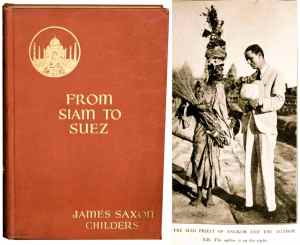
Caption of the photo: THE MAD PRIEST OF ANGKOR AND THE AUTHOR… N.B. The author is on the right
From Siam to Suez is a rare old book written by James Saxon Childers (1899-1965) detailing his journey from China to Egypt in the early 20th century. Childers was an American writer and traveller who wrote several fiction books as well as travel books. His fiction did not do too well, but his travel books were popular.
Here I share a chapter from Siam to Suez. Childers wrote each chapter of this book as a letter to either a family member or to one of his friends. This chapter was written while he was in Thailand (then called Siam). I chose this chapter because Bangkok is a place I visit regularly, and is one of my favourite places to do so. Enjoy…
Chapter VI, From Siam to Suez by James Saxon Childers (Public Domain Book)
I’m going to the fights this afternoon, Dad, because Wongkit is fighting. Wongkit is a boy from the northern hills who is so strong that men even in Bangkok heard about him. They heard that in the games he could throw the teak log farther than any other. Thinking that he might become a champion boxer, they sent for him. Six weeks ago he arrived in Bangkok, bringing his old father.
I first heard about Wongkit from Tom, my guide. “He will make a great boxer,” Tom said, “greater than any we have seen.” Then he cautioned me not to speak of Wongkit. “Only a few persons know of him and we want to keep him secret; we want to bet our money and get good odds. That’s why we brought him.”
Ten days ago Tom came to my room at the hotel. “What would you like to do this afternoon?” he asked.
“What have you?”
“Would you like to go to the market and see the silversmiths at work on bowls and boxes?”
“I’ve seen those silversmiths a dozen times.”
“Would you care to see the Siamese infantry drilling in the park?”
“It’s much too hot for that.”
“What about a visit to the gambling houses? I know where–”
“No, thank you. And I don’t want to see any temples or monasteries. And I don’t want to call and drink tea with ladies of casual virtue. I’m tired of all that. You’ll have to offer something really interesting to get me out in that sun.”
Tom thought for a moment, then gave up. “There’s nothing else,” he said.
“Then take the afternoon off.”
“Thank you, sir. I’ll just go along and see Wongkit. He’s in his training quarters and–”
I picked up my sun helmet. “Why do you guides the world over think there’s nothing but temples, and scenery, and brothels? Why didn’t you say something about Wongkit’s training quarters?”
“But, sir, do you mean–”
“I mean we’re going to see this Wongkit — that is, if he won’t object to my coming.”
“He would be honoured. But do you really mean–”
“I mean I’d rather visit a Siamese boxer in his training quarters that see most of the temples in Bangkok.”
As we drove across town, Tom told me of an elephant hunt on which he captured two enormous bulls. He was working to a glorious climax, and the story was getting more and more imaginative, when our car drew up beside a rickety pier.
“We get out here, sir,” Tom said.
We hired a small gasoline boat and crossed the river that runs through the heart of Bangkok. Then we entered one of the innumerable klongs, or canals…. Bangkok often has been called the Venice of the Orient; the name is partly justifiable, for there are some sections of the city where the streets are all canals and one can travel only by boat…. Tom and I passed dozens of small dories, anchored in the klongs, from which merchants did their trading. We passed a floating cloth shop where a young man haggled with two ladies on a shopping tour; they had paddled up in a crudely built canoe. We passed fish shops, dead fish hanging by their tails from the top of the sun-shade over the fishmonger, live fish in wire boxes let down into water. We passed crockery shops, hat shops, and ships where baskets were sold. We passed a warehouse from which a line of coolies loaded bags of rice on a great blunt-nosed sampan.
“Where’s Wongkit’s place?” I asked.
“A little further on,” Tom said, and pointed.
Behind the shops were many private homes, the backs of frail houses resting on the ground, the fronts resting on piles driven into the mud at the bottom of the canal. From our boat Tom and I saw men and their wives and children, some working, some sleeping, some playing. Many of the smaller children had pieces of bamboo tied to them so that they would float if they fell into the water.
“But don’t the mosquitoes almost eat them up?” I asked, remembering that in Bangkok one does not dine without putting feet and legs into a sack of heavy cloth and tying the top above the knees.
“The mosquitos don’t bother them,” Tom said. “Little babies, yes; but after they get older, the mosquitos don’t trouble them.”
Traffic in the canal is made up largely of boats owned by floating peddlers. Fruit peddlers steer from house to house. Women peddlers drift along in boats filled with Siamese skirts, and bright cloths for children, and cotton camisoles for young ladies. The canal restauranteur glides about in a boat not much larger than a canoe, cold food in the bow, a small stove amidship to heat rice and meat and bits of vegetables. An entire meal is piled upon a leaf and handed to a customer squatting on the bank, or who pulls alongside in another boat.
Through these canals, Tom and I cruised until at last we came to a bamboo ladder that rose from the water. We stepped from our boat and climbed the ladder. Before us was heavy undergrowth rising from a soggy marsh. Great palm trees leaned over and splotched the canal with shadows. Leading away from the ladder were planks, laid end to end.
“Wongkit lives ahead, sir,” Tom said.
We walked over the planks, mud oozing up beside them, until we came to a clearing where stood three frame houses, one of them Wongkit’s.
“He will be in the back,” Tom said.
We found him there, totally naked. I have never seen such a body. He was tall for Siamese, almost six feet, and the upper half of his body was a magnificent triangle; then his hips spread, and his legs rippled down in perfect symmetry. At a glance one could see his tremendous strength, his muscles live as young rattan. Wongkit’s features looked less like an Oriental’s than those of a Greek from the time of Praxiteles.
When Tom introduced me, Wongkit put his hands together and crouched, saluting me as royalty. I took one of his hands and shook it. He didn’t understand the custom and looked puzzled until Tom explained; then slowly he shook my hand four times, nodding and smiling as he did.
In the corner of the room stood an old man with white hair and wrinkled face. Tom introduced me, and the old man bowed and spoke. “He says,” Tom interpreted, “that he is Wongkit’s father.” In the softest and most musical voice I have ever heard, the father bade me welcome. “My house,” he said, “is the master’s house.” Then he added: “It is gracious of the American to visit my son, Wongkit.”
We sat down and watched the boy at his training. He shadow-boxed, flexed his legs, slashed backward with his elbows, rammed forward with his head; everything he did was poetry of motion. He worked for an hour and we watched. Afterward we drank tea. Then Tom and I went back to our boat. Wongkit, still naked, came with his father to see us off.
“What do you think of him?” Tom asked, as we passed through the canals.
“I don’t know, Tom. I don’t know enough about Siamese boxing, but to me he doesn’t seem vicious enough.”
Tom laughed. “That’s because he’s not fighting against any one. Wait until he gets in the ring. He will–” Tom flung out one foot and almost lost his balance– “he will win us a lot of money.”
Two days later I went to see Wongkit again. The old father and I helped Tom rig up a sack of sand for Wongkit to punch and kick, then we withdrew to a corner and sat there. Neither of us could understand anything the other said, but that made no difference. We could smile and bow to each other, and with little courtesies show our friendship.
Four times I have been to see Wongkit in his training; I can’t decide whether I go to see Wongkit and his rippling muscles, or the old man with his soft voice and kindly eyes. I am certain, though, that the father and I have become fine friends. Truly we have. I take him small gifts, and always he gives me little presents. On Friday he saved me some dwarf bananas. Day before yesterday he served me a double handful of rice, dipping it up in his hands and dropping it all hot on a banana leaf. He showed me how to catch it with my fingers, roll it into a tiny ball, and throw it in my mouth. At first I couldn’t do it properly and he laughed. When after a time I didn’t spill any, he was pleased. Then we cleansed our hands and went in to watch Wongkit at his boxing. We took our place in a corner; there was holy prayer in the father’s eyes as he watched his son, as in stillness and silence the old man fondled his pride and his glory.
Yesterday Wongkit and his father asked me about boxing in America. Wongkit wanted to know about the strange world where boxers never lack rice, and have beds to sleep on. “My father,” Wongkit said, “approves of my going to America. He will come with me. He will live as I live. He will have rice whenever he wants.”
This afternoon Wongkit is fighting for the first time. Tom already has gone, vastly excited: he and his friends have bet all their money. I haven’t bet any money, but I, too, am excited, for I have come to be fond of Wongkit, so gentle and tender with his father, and I have learned truly to love the old man. The fight is to begin in forty minutes. I must hurry to get to the ringside; I told them I’d sit in the front row. I’ll finish this letter later…
I promised I would finish this letter and because of my promise I shall. Wongkit went into the ring at ten minutes after four. He wore red tights. They were a little too short for him. After he had prayed, he turned and looked at his father. The old man nodded and held up his hands, gave his blessing to his boy. It was two minutes later that the other fighter, an experienced fighter, kicked Wongkit in the spleen, ruptured it, and killed him. Wongkit fell to the canvas, trembled, and lay still.
Some day, Dad, I may forget Wongkit, for he was a young man, strong, peering over the horizon, his dream bright within him; and he went out in a flash, before he knew. I may forget him, but I’ll never, never forget the look of the old father as he stared at that limp thing they carried away in their arms.
As a man enters his 40s, he probably has accomplished much of the goals he had while in his 20s and 30s (marriage, kids, career), or he has found that some of those goals may never be realized. As a result, he may feel unsatisfied with his life and there may be a period of stagnation. Often, a man in his 40s must take stock of his life and decide where he wants to go from there. If he doesn’t let stagnation take over, his 40s could be the beginning of the most fulfilling time of his whole life.
“As a man passes 40, his task is to assume responsibility for new generations of adults… He must become paternal in new ways to younger adults. He cannot treat them as if they were children under his benign control. He must find new ways to combine authority and mutuality — accepting his own responsibility and offering leadership, yet also taking them seriously as adults, inviting their participation and fostering their growth toward greater independence and authority. While he is becoming a senior member of the adult world, he must relate to persons in their thirties as junior but fully adult members who will soon succeed him, and to persons in their twenties as novices going through their initial formative period within the adult world.
“In every stage [of age development], developing is a process in which opposite extremes are to some degree reconciled and integrated. Both generativity and its opposite pole, stagnation, are vital to a man’s development. To become generative, a man must know how it feels to stagnate — to have a sense of not growing, of being static, stuck, drying up, bogged down in a life full of obligation and devoid of self-fulfillment. He must know the experience of dying, of living in the shadow of death.
“The capacity to experience, endure and fight against stagnation is an intrinsic aspect of the struggle toward generativity in middle adulthood. Stagnation is not purely negative nor to be totally avoided. It plays a necessary and continuing part in mid-life development. The recognition of vulnerability in myself becomes a source of wisdom, empathy and compassion for others. I can truly understand the suffering of others only if I can identify with them through an awareness of my own weakness and destructiveness. Without this self-awareness, I am capable only of the kind of sympathy, pity and altruism that reduces the other’s hardship but leaves him still a victim.”


 Pursuit of Percipience