Notes for My Students ~ Eschatology

I’m uploading some notes on the book of Daniel, the Olivet Discourse, and the book of Revelation here. This is for my students to have easy access to the notes online.

If anyone else stumbles on this post, you are welcome to the notes if you are interested in the subject.

The notes on Daniel are based primarily on James B. Jordan’s commentary The Handwriting on the Wall.

The notes on Revelation are based mainly on James B. Jordan’s Revelation Lectures (which, at the time of this posting [August 22, 2016] are on sale for $40 – down from $175 – on WordMp3.com).

Click below for the notes…

Daniel, Olivet, and Revelation

**Please note: The notes have not been edited for spelling mistakes or other formatting issues.

Christianity V. Mythology

skeletonsIf you read about or listen to the history of an organization, institution, nation, or religion, and it’s all great and glorious, without anything negative, and its failures are erased from memory, it is mythology.

“All secular societies have a skeleton in their closet. Even family genealogies usually omit the unpleasant ancestors and tell fairy tales in their stead.

“Christianity, on the other hand, took the unpleasantness for granted: in place of a pedigree from a mythical ancestor it put original sin inherited from Adam. And resolutely, it began in the midst of time, not in a mythical fog. Against all deathless myths and hopeless cycles the price of a living future is to admit death in our lives and overcome it. This is the supreme gift of Christianity; it showed that the fear of death need not force man into the narrow cycle of any given community. In place of pagan dividedness it created a universal pedigree for man that transcends all partial ends and beginnings, and measures history from the end of time.”*

* Excerpt from The Christian Future by Eugen Rosenstock-Huessy, pg. 65

Some Atheist Brief Book Reviews

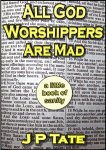
19280426All God Worshippers Are Mad 

A short and stupid book. I give it one star out of five because it was only $1.99 on Kindle. I can’t decide if the book was written for 12 year olds, or if it was written by a 12 year old. For example… His first argument against God is basically summed up as: “In order for God to create the space/time universe, God’s existence can’t depend on space/time. My human brain can’t comprehend that. Therefore there is no God. Booyah!”
11081433

Why I Believed 

He’s got a couple of decent Dostoevsky-type arguments against faith/God, but most of what he says follows a “I just don’t want to believe anymore” kind of thinking. Christianity is a faith which requires engagement. If you choose not to engage it you will grow cold towards it.

 

4420281Don’t Sleep, There Are Snakes 

I’ll come back to this book for the language sections. Everett is a talented linguist. He had no business being a missionary though. I don’t think he ever fully understood what Christianity is. His descriptions of the faith show he never moved beyond a Sunday-school understanding of it.
 

24874812

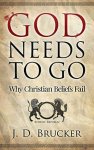
God Needs to Go 

It’s hard to get into one of these books when it starts out with a straw-man argument; which this book does. In fact, this book is one straw-man after another — falsely representing Christianity and then attacking that false representation.

He makes a couple good points against prayer (or, what I would call the misuse of prayer).

Atheists often argue that morality is based on the evolved sense of the common good. While that might be true for economy, it is not true for morality. Morality is not the same across the world. A westerner being accepting of a transgender person is doing so because he believes it is loving to do so. That belief of loving acceptance stems directly from Christian morality. A Buddhist in Thailand who is accepting of a transgender person is not doing so out of love; his acceptance and noninterference is based on karmic justice. A Buddhist would be less inclined to help the poor for that very same reason, whereas a westerner would be more inclined to help the poor based on Christian morality.

The author states: “Except for certain religiously based societies, many of the secular nations display a sense of right and wrong that has allowed them advance in a positive way.” (page 23) “Certain religiously based societies” — every society is a religiously based society, including the ‘post-Christian’ west. A society’s morality is tied to its predominant religion. This is not hard to see. Western morality is based on Christianity, absolutely. If you don’t see that, you just need to do some travelling. A Buddhist nation’s morality is based on Buddhism. The same is true for Hindu and Muslim nations. If a person born and raised in a Buddhist nation becomes an atheist, his morality will still be based on Buddhism. (Although, Buddhism as a religion lacks the conditions to create atheists — which is a whole other interesting topic. Western atheism would not exist if it weren’t for Christianity.)

Then there are the usual arguments about slavery and God’s wrath and so forth. If you want to understand those issues in the Bible you have to understand two very important things: covenant and holiness. If you don’t get those two things, you won’t get the Bible.

And there are the attacks on biblical prophesy. Jesus said certain things about His return that supposedly didn’t happen. Well, there are plenty of books on eschatology to explain that. But if you’re not willing to study it out, then there’s nothing more to say. Reading Psalm 110 and Daniel 7:13-14 will get you well on your way to understanding what Jesus said when prophesying about Himself.

The New Covenant Babel

What did Dostoevsky mean by this quote…

“…socialism is not merely the labor question, it is before all things the atheistic question, the question of the form taken by atheism today, the question of the tower of Babel built without God, not to mount to Heaven from earth but to set up Heaven on earth.”*

In the Old Covenant (Old Testament) time, God’s salvation system was through the temple and Jerusalem. A temple is a stairway and a gateway to Heaven. The city around the temple is the cultural bed in which the temple rests. Babel, then, was a counterfeit Jerusalem and temple — an Old Covenant counterfeit.

In the New Covenant we see, not us going up to Heaven, but rather, Heaven coming down to the earth (Revelation 21). What then would a New Covenant counterfeit look like? 

Dostoevsky recognized socialism as this counterfeit.

* Dostoevsky, Fydor, The Brothers Karamazov (Barnes & Noble: New York, 2004 [1879-1880]), pg. 32.

Sufficient Evidence: Empirically Impossible

Recently I posted this quote on my Facebook page:

“…socialism is not merely the labor question, it is before all things the atheistic question, the question of the form taken by atheism today, the question of the tower of Babel built without God, not to mount to Heaven from earth but to set up Heaven on earth.”*

A socialist atheist got upset by the quote and felt the need to reply, which went something like this:

Socialism is not atheistic! There is no god and we just want to create a society where all are taken care of. If there is a god then provide sufficient evidence. Until then stop wasting my time!

Forgetting the fact that his response confirmed the truth of the quote, and forgetting the fact that he was the one wasting my time by responding and demanding an explanation, I thought, “What would be sufficient evidence?”

Because, of course, empirically speaking, there is no sufficient evidence to prove God. Even if Jesus were to appear in the sky above this guy’s house and cry out with a loud voice, “I am Jesus! I am God! I created the universe!” my Facebook friend would still be left with the choice of wether to believe what he saw was real or not. And if he’s predisposed not to believe then he will probably explain away the experience as something natural. 

“It is not miracles that dispose realists (or empiricists) to belief. The genuine realist, if he is an unbeliever, will always find strength and ability to disbelieve in the miraculous, and if he is confronted with a miracle as an irrefutable fact he would rather disbelieve his own senses than admit the fact. Even if he admits it, he admits it as a fact of nature till then unrecognized by him. Faith does not, in the realist, spring from the miracle but the miracle from faith. If the realist once believes, then he is bound by his very realism to admit the miraculous also. The Apostle Thomas said that he would not believe till he saw, but when he did see he said, ‘My Lord and my God!’ Was it the miracle forced him to believe? Most likely not, but he believed solely because he desired to believe and possibly he fully believed in his secret heart even when he said, ‘I do not believe till I see.'”**

Now, as for socialism, I’ll leave that for another day. Until then, read anything on economics by Thomas Sowell. 

* Dostoevsky, Fydor, The Brothers Karamazov (Barnes & Noble: New York, 2004 [1879-1880]), pg. 32.

** Ibid., pg. 31.

What did Dostoevsky mean by comparing socialism with Babel, and why did he then contrast socialism with Babel in saying that socialism strives to bring Heaven to earth (whereas at Babel they were trying to get to Heaven)?