

Here is a link to an excellent series on Eschatology, the book of Revelation, and Covenant Theology by David Chilton.
I highly recommend you take the time to listen to all the messages if you’re interested in the “Last Days”.
Here is a link to an excellent series on Eschatology, the book of Revelation, and Covenant Theology by David Chilton.
I highly recommend you take the time to listen to all the messages if you’re interested in the “Last Days”.

When I was a boy the condition of my bedroom was usually somewhere between death and destruction. It was messy. My mom often told me to clean it up, but since those warnings were never enforced, the state of my sleeping space never changed. My dad never looked into my bedroom, so all was well on that front.
One day, a day when my dad took a rare weekday off from work, I came home from school to have my mom bemoan to me that my dad was up in my room cleaning. This was bad news. In the boredom of his atypical day off, he wandered upstairs, saw my shame, and in an act of pure fury, proceeded to decontaminate it. I ran up to my room to find my dad on all fours haphazardly tossing whatever was on my closet floor over his back toward the waiting giant sized garbage bag, already half full with my precious valuables. The vacuum cleaner was busy devouring, and whatever was too small for my dad’s fingers was sucked up into its dark belly. All my things, which I had successfully categorized as junk and treasure, were seen as rubbish to my dad and were treated that way.
I learned a valuable lesson that day: if I don’t clean my own room, someone else will, and he’ll do it more harshly than I.
I’m reminded of this dark day of my childhood as I read about all the business and controversy over John MacArthur’s “Strange Fire” conference. MacArthur has basically taken the entire Charismatic Movement and thrown it into the hellfire. Very harsh. Too harsh. I disagree with MacArthur as I do believe that certain charismatic spiritual gifts are for believers today. But there is a line. Some charismatics cross that line, some charismatics don’t know where the line is. As a result there is a lot of stupid stuff that goes on in the Charismatic Movement which never gets addressed by Bible believing charismatics. Charismatics don’t clean their own house, and because of that, someone else is doing it for them, and he is harsh.
A “smalltime”Christian like me living on the backside of the desert in Cambodia writing a blog that nobody reads isn’t going to have much of an impact. But there are respected “continuationists” known to the public eye who have the ability to expose and depose the kooky charismaniacs. They need to speak up.

This book is what I’d call a “nuts and bolts” approach to eschatology. Other books I’ve read on the subject take a more broad look at Biblical prophesy and try to give the overall sense of what the big story of the Bible is without making any definitive statements. This book takes the reader through a verse by verse exposition of the prophesies and the authors are not afraid to come to some profound conclusions.
I enjoyed this book a lot, and while I am still kicking the tires of the different eschatological view points, this book seriously pushed me in some new directions. It is interesting that a lot of Christians will just assume that what they’ve always heard is true. Premillennial Dispensationalism is true, right? Well, read this book and you might change your thoughts on the subject. Or, perhaps, it’ll newly get you thinking on eschatology when you’ve never considered the topic a worthwhile use of your time.
The viewpoint is a partial preterist one. Preterism is the opposite of futurism, and so, in this book, the authors argue that much of the Biblical prophesies currently believed by many to not have happened yet, have indeed already happened — prophesies that were future for the original readers, but now fulfilled and in the past for us. No future anti-Christ figure taking over the world, no microchips implanted in foreheads, no secret rapture of the Church, no revived Roman empire, 666 refers to Nero, the Olivet Discourse mainly refers to the destruction of the temple and Jerusalem in 70 AD — these are the kinds of points you’ll find in this book, and the authors present a strong case.
But, as the title suggest, the main point of this book is to present a hopeful vision of the future. Jesus has already established His kingdom, His kingdom is growing and will one day fill the earth, and our future is getting brighter and brighter, not darker and darker. And before you cry heresy, understand that many prominent church fathers held to the same view as the authors of this book, and the authors quote some of these past theologians throughout.
Read the book if you want to be challenged and perhaps learn some new exciting things about God’s great plan for humanity, heaven, and earth.
Click here to buy from Amazon: “Victorious Eschatology” by Harold R. Eberle and Martin Trench
Click here for a related article I wrote about a similar book.

There are two ways, I think, we should read the Bible. One is to study it deeply. This means choosing a chapter or a couple of verses at a time and reflecting on each word carefully. The second way is to read it in a more general fashion, like how you’d read a novel. The first way is to get you to understand fully what each specific author wanted to get across to his readers. The second is to get you intimately involved with the whole overarching plan of God.
One handy way to deeply study the Bible is to use a Hebrew and Greek lexicon. This way you can look up the original meaning of the words you’re currently reading in English. I wouldn’t recommend getting too caught up in this though. The people who translated the different versions of the Bible were experts in the Greek and Hebrew, and so, took great care in getting the proper meaning of the original into English. But still, if you’re curious about a word, you can look it up, and you might be surprised at what you find.
Here’s an example:
Romans 8:15 says,
“For you did not receive the spirit of slavery to fall back into fear, but you have received the Spirit of adoption as sons, by whom we cry, ‘Abba! Father!'”
We read the word ‘adoption’ and assume that it simply refers to kids with no parents getting parents. But it means something different. The Greek word, ‘uihothesia’, means the establishing or setting in place a male child into the position of being a son. And what Paul was likely referring to is the Roman practice where a father would officially set his oldest son into the place of being the legitimate heir to the family. A male child didn’t automatically become an heir simply for being the oldest biological offspring, and the father could cast him out of the family if he wanted to. It wasn’t till the boy was older, and had proven to his father that he was worthy of the family name, that the father would officially name him the heir. Once the boy was set in place he had all the rights, privileges, and burdens of that family. He was seen as being one with his father and having the authority of his father.
Now when we apply this analogy to the modern Christian, the term ‘son’ becomes gender neutral, and the ‘adoption’, or setting in place one as God’s heir who has rights and authority as His heir, appertains to all believers. This changes our understanding of adoption from being, “I was an orphan and now I have a daddy who loves me” to being, “I was not rejected by my Father, and now I have all the rights and privileges of being His son, His heir.” And when you begin to study what having His authority means, you will begin to understand how profound this ‘adoption’ really is.
A tool I use for this kind of study is “eSword“. It is free for PC, and there is an app for iPad, which is not free, but I bought it and use it all the time.
A tool I use for my general reading of the Bible is a reading plan called “Professor Grant Horner’s Bible Reading System”. This plan is designed to get you to read from all over the Bible each day. The plan suggests you read ten chapters per day, but you can set your own pace. Click here to read about the plan. I like this plan because it gives you a good bird’s eye view of the whole Bible and you will see scripture supporting scripture — all of the Bible tied together.
Another tool is, as you’re reading the New Testament, when an author quotes an Old Testament passage, you may have a Bible which gives you what that OT verse is. For example, Paul, in 1 Corinthians 15:27, quotes Psalm 8:6. Now if you flip to the Psalm verse you won’t see in your Bible a reference to 1 Corinthians. So, write it there yourself. Now, every time you read the NT and see a reference to the OT, go to the OT and write in the NT verse yourself. Once you’ve done that for awhile you’ll find as you’re reading the OT all sorts of references to the NT. Why is this helpful? Because then you’ll have Jesus, Paul, Peter, John, and the other NT writers teaching you how to understand the OT passages. Every time you come across one of your written references in the OT to the NT, go and look it up, and the NT writer will tell you what that OT verse is really saying. Now, again, you have a tool to give you a clear overarching view of the plan of God.
There are lots of good ways to read and study the Bible. I love studying the Bible and can spend hours doing it. These are just a couple of ways I do so.
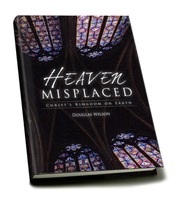
‘Heaven Misplaced’ is an eschatological book written from a post-millennium point of view. If you’re unfamiliar with the term ‘post-millennium’, for now, you just need to know that the ‘millennium’ refers to the 1000 year rule and reign of Christ referred to in Revelation 20. The ‘post’ refers to when Christ will return. So, ‘post-millennium’: Jesus will rule and reign from heaven for the 1000 years (which may or not be a literal 1000 years) and He will return after, or post, the millennium. Another position is called pre-millenniumism, and another amillennialism.
The main points of the book:
1) Jesus is the savior of the whole world. This does not mean every last individual will be saved, but it also does not mean that only a handful of elect Christians will be saved. Jesus came to save the world and He will do just that.
2) Man lost dominion of the world in the garden to the “powers and principalities”. Jesus conquered the powers and principalities on the cross. Jesus has been given all authority. Man once again has dominion of the world through Christ. The Great Commission can now be accomplished.
3) The Great Commission will be fulfilled not when the Gospel reaches each nation, not when individual disciples are made in each nation; it will be fulfilled when each nation on earth is discipled — every nation a Christian nation — not every individual a Christian, but every nation being predominately Christian — a worldwide Christendom. This completion of the Great Commission will usher in the millennium. Jesus will not return until this has been accomplished.
You don’t have to agree with the post-millennialist view to benefit from reading this book. In fact, I highly recommend you do read it especially if you disagree with this view. Often views of the end times are so much doom and gloom. This book is very positive and hopeful. It’ll get you excited about being a Christian.
I gave it 5 out of 5 stars.
 Pursuit of Percipience