Explaining Postmodernism (Book Review)

ep Explaining Postmodernism: Skepticism and Socialism from Rousseau to Foucault by Steven R.C. Hicks (which is available for free here) is a well written and fairly easy to understand critique against the train wreck that is postmodernism.

I am not completely finished this book as I want to read through the philosophical sections slowly so that I can pick up everything. For me, this is not a book that can be read quickly as there is lots of new information that I don’t want to overlook.

Hicks blames Immanuel Kant for getting the whole thing started with his theory of perception. Kant opposed objectivism and reason because we people can never know reality apart from the mediator of our senses. The chair is red because the light reflects off of the chair and some colours are absorbed while others reflect into your eye which converts the info into electrical impulses and sends them to your brain and hopefully nothing goes wrong along the way. But is the chair really red? Really? Who knows? You certainly don’t, because according to Kant, you only live in your head. “The key point about Kant, to draw the analogy crudely, is that he prohibits knowledge of anything outside our skulls” (Hicks, pg. 41)

“Once reason is in principle severed from reality, one then enters a different philosophical universe all together.” (Hicks, pg. 41) There can not be absolute truth if reality exists apart from one’s perception of reality. I cannot declare that there are only two genders if that claim is solely based on my subjective perception of reality. If that claim is true it has to be objectively true regardless of my observation, or even my existence.

I agree that Kant went to far in limiting us to “our skulls,” but I would argue that we are indeed limited to the physical universe — our senses may show us what’s real objectively, but only within the universe we have access to. Kant criticized objectivity in defence of God. We can see what we see because God gave us the senses to see it, but that does not mean we are seeing things as they really are, but rather, only as how our God given senses allow for. We can take that too far and limit ourselves only to our heads, but we can also take objectivity too far when we deny that things exist beyond our ability to sense them. We can’t prove that God exists with the scientific method, but that doesn’t mean God does not exist. Postmodernists hold to the “limited to the skull” theory, not to defend God, but to attack any and all truth claims. But, as Hicks argues in the book, it is impossible to live in a world where nothing is objectively true.

After the first chapter, Hicks goes deeper into the philosophical background which produced postmodern thought. If you are not interested in all that, then I recommend reading at least the first chapter of this book. In it, Hicks gives a good overview of what postmodernism is as compared to modernism and pre-modernism (briefly illustrated in this chart, from pg. 15)….
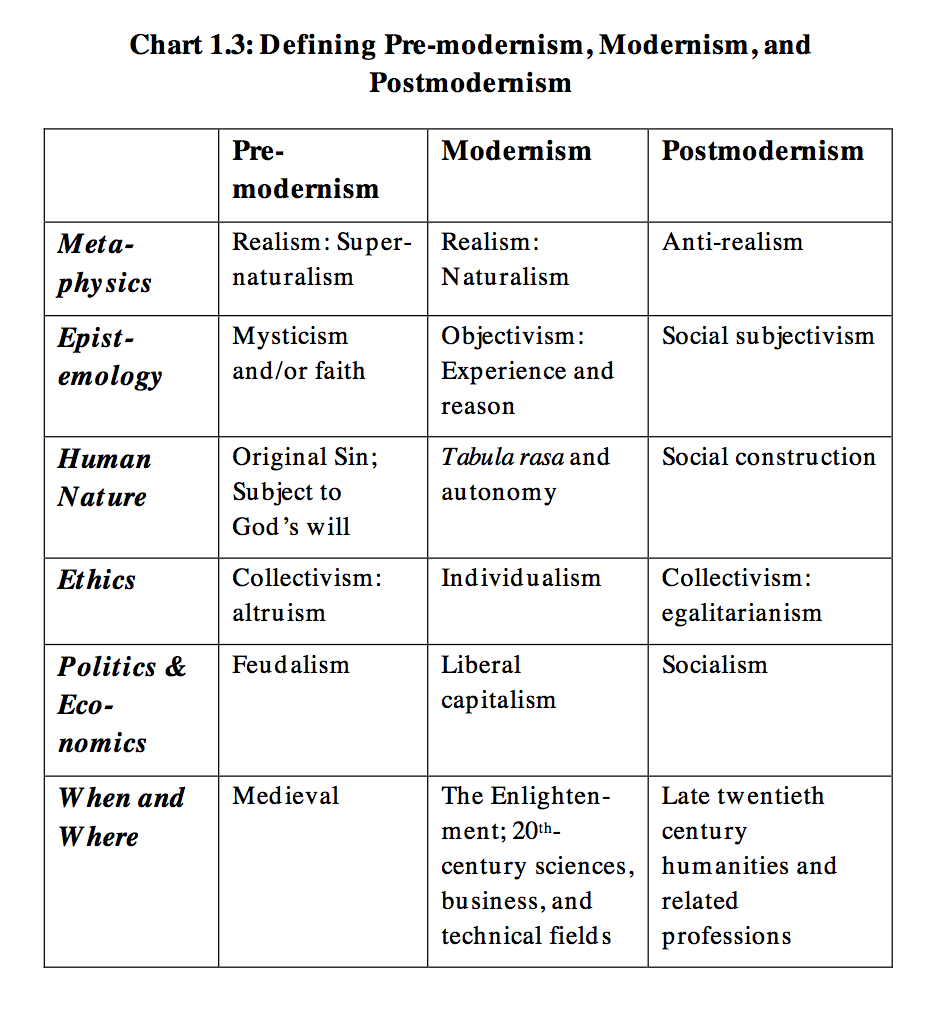
chart 001

So far, it’s a good book. And as I say, if you’re not interested in all the philosophy, at least read the first chapter. Perhaps when I’m finished reading the whole book I’ll update this review.


Generation to Generation Quotes #2

Edwin Friedman, in his book Generation to Generation, relates the structure of families to an electrical circuit. Your family is either “wired” as a series circuit or a parallel circuit, or, more likely some combination of the two.

fig2_parallel-series-circuit-battery-light-bulbs

Notice in the series circuit, the electricity has to travel through each light bulb before completing the circuit, which means, that if any one light bulb burns out, the circuit will not be complete, the electricity will not flow, and none of the bulbs will light up. In the parallel circuit, however, there is a complete circuit through each individual light bulb, meaning that even if any bulb burns out, it will not effect the flow of electricity through the other bulbs.

If a family is like the series circuit, anytime a problem or crisis happens, the whole family breaks down. There is no one to take a leadership role to fix the problem. Friedman calls this “linear thinking.” Members of a family need to differentiate themselves from the others in order to create a more parallel system.

“Differentiation means the capacity of a family member to define his or her own life’s goals and values apart from surrounding togetherness pressures, to say ‘I’ when others are demanding ‘you’ and ‘we.’ It includes the capacity to maintain a (relatively) nonanxious presence in the midst of anxious systems, to take maximum responsibility for one’s own destiny and emotional being.” (Friedman, pg. 27)

In a family, when some problem occurs, often one family member will show the symptoms of that problem more than he others. That member Friedman calls the identified patient. “The concept of the identified patient … is that the family member with the obvious symptom is to be seen not as the ‘sick one’ but as the one in whom the family’s stress or pathology has surfaced.” (Friedman, pg. 19)

A mistake, according to Friedman, made by counsellors is to assume that the identified patient is the only one with a problem and then try to “fix” that one person. In reality, the problem is with the whole family, and the whole system needs fixing.

The identified patient is often diagnosed with some condition. Friedman criticizes this practice….

“Diagnosis in a family establishes who is to be the identified patient. It is inherently an anti-systems concept. It is linear thinking [series circuit]. It denies other variables that are present in the system. Existentially, it makes someone ‘other,’ and allows the remainder of the family to locate their troubles in the diagnosed member. It also disguises opinions and judgments; in an intense ‘congregational [church] family’ struggle, this hidden effect adds to polarization.

“Within the personal family, the labelling effects of diagnosis destroy the person. It decreases, in the diagnosed member, a sense of control over the situation, increases his or her dependancy, and thus lowers their pain thresholds. The effect on nonsymptomatic members is that it fixes their perception of the diagnosed person’s capabilities. Eventually a family member’s label will become confused with his or her identity. Diagnosis also tends to concretize. It makes everything and everyone more serious.” (Friedman, pg. 56)

~All quotes from Generation to Generation: Family Process in Church and Synagogue by Edwin H. Friedman

Thomas Sowell Quotes #8

“[U]nder any movement or set of collective beliefs, a feeling of being on the side of angels can be a dangerous self-indulgence in a heedless willfulness that is sometimes called idealism. This kind of idealism can replace realities with preconceptions, and make the overriding goal the victory of some abstract vision, in defiance of reality or in disregard of the fate of fellow human beings. The symbols of the preconception can become goals in themselves.”

~from Wealth, Poverty and Politics, page 420

In a vision driven group, “buying into the vision” is seen as more virtuous than actually doing something useful. Even those in the group who aren’t doing anything, or who are doing things poorly, will be held in high regard if they “get a hold of” and celebrate the vision. Conversely, those who may be doing productive work which is good for others, but show little enthusiasm for the vision, will be seen as dangerously independent and not “team players.”

Further reading: Shop Class as Soulcraft (Brief Book Review)

https://www.youtube.com/watch?v=b3U38_5tvqQ&feature=youtu.be

Generation to Generation Quotes #1

“Thresholds for both physical and emotional pain are lower when we are functioning dependently, and are higher when we are motivated to accomplish something. But there is also an interrelational aspect to this threshold dimension of pain. Where members of a family are too quick to spare another pain, the resulting dependency tends to make the other’s threshold fall. In addition, he or she will become addicted to having pain relieved through someone else’s functioning. Conversely, where families can begin to increase their threshold to another’s pain, the other person’s threshold is likely to rise, even though he or she may at first go through ‘withdrawal’ symptoms when the ‘addiction’ is taken away. Those who focus only on comfort, on relieving pain, or filling another’s need, tend to forget that another’s need may be not to have their needs fulfilled.”

~from Generation to Generation, by Edwin H. Friedman, page 48

Thomas Sowell Quotes #7

Moral condemnation is not causal explanation, despite how often the two have been combined in a politically attractive package. Despite the tendency of political, and especially ideological, explanations of economic disparities to combine moral and causal factors, the reason so many mountain peoples [for example] around the world have been poor has not been that others went up into those mountains and took away their wealth, but that the mountain peoples seldom produced much wealth in the first place…

“…it is staggering that some people imagine that they can take on the [large] task of righting the wrongs of the past, committed by people long dead, without igniting dangerous new hostilities among the living.”

~from Wealth, Poverty and Politics, page 271-272