
If Evangelical Fundamentalism is the true version of Christianity then I am in trouble since I can’t bring myself to believe in it. Thankfully Christian faith is varied enough that one can find a niche to remain a believer in. There are two scholars which showed me this was possible: David Bentley Hart and Dale C. Allison. Below is recent interview done with Allison (ignore the click bait titles)…
Category: Early Christianity
Refining Paul’s Theology

The following is an AI generated essay. However, the ideas influencing the essay are my own. To save time I will often use AI to compress my ideas into essay form, which I can then refer to later. In my opinion that is one of the ways to correctly use AI. And this blog is as good a place as any to post it.
Paul, Israel, Adam, and the Nations
A Second Temple Jewish Logic of Election, Atonement, and New Creation
Introduction
The apostle Paul is often portrayed as the architect of a new, universal religion that abandoned Israel’s particular story in favor of a generalized theology of salvation. Historically, this portrayal is misleading. Paul understood himself not as departing from Israel’s scriptures, but as re-reading them under the pressure of a single, destabilizing event: the resurrection of Jesus.
This essay argues that Paul’s theology is best understood as a carefully balanced synthesis of three narrative layers already present in Second Temple Judaism:
- Creation (Adam and humanity)
- Covenant (Israel and Torah)
- Eschatology (Messiah and resurrection)
Paul’s inclusion of Gentiles does not bypass Israel, nor does it flatten Jewish categories into abstraction. Instead, it follows a coherent internal logic in which Israel remains central, Adam explains humanity’s universal plight, and Jesus stands at the intersection of both stories.
1. Temple Judaism and the Limits of Atonement
In the First and Second Temple periods, Israelites did not believe their sacrifices directly atoned for the sins of the nations. Temple sacrifice was:
- Covenantal (for Israel)
- Geographically and cultically located (land, sanctuary, priesthood)
- Purificatory, especially for Israel’s sin and the sanctuary polluted by it
Gentiles could offer sacrifices, and the Temple was seen as the cosmic center sustaining order for the whole world, but this benefit was indirect. The nations were not cleansed of sin simply because Israel offered sacrifice.
This distinction is crucial. Later Christian claims of universal atonement represent a genuine theological shift, not a straightforward continuation of Temple belief.
2. Paul’s Scriptural Justification: Not Innovation, but Re-reading
Paul knew his claims were radical. He therefore grounded them explicitly in Israel’s scriptures.
Abraham before Torah
Paul emphasizes that Abraham was declared righteous before circumcision and before the Law (Genesis 15:6). This allowed Paul to argue that:
- Covenant faithfulness could precede Torah
- Gentile inclusion was not an afterthought, but anticipated from the beginning
Deuteronomy’s Curse Logic
Paul reads Deuteronomy’s warnings seriously. Israel’s failure under Torah places her under covenant curse (exile). Jesus’ crucifixion—“hanging on a tree”—forces a re-reading of Deuteronomy 21:23. For Paul:
- The Messiah bears the curse on behalf of Israel
- The Law is not evil; sin exploits it
- The curse must be lifted before Abraham’s blessing can flow outward
Resurrection as the Turning Point
Paul’s theology does not pivot on Jesus’ death alone, but on resurrection. Resurrection signals:
- The beginning of the age to come
- The defeat of death
- The vindication of Jesus as Messiah
Without resurrection, Paul explicitly says his gospel collapses.
3. Why Gentiles Needed Justification
Gentiles were not under the Mosaic Law. So why, according to Paul, did they need salvation?
The Adamic Problem (Romans 5)
Paul’s answer is Adam.
- Sin and death enter the world through Adam
- Death reigns over all humanity before the Law
- The Law intensifies sin but does not create it
This allows Paul to distinguish:
- Israel’s problem: covenantal failure under Torah
- Humanity’s problem: enslavement to sin and death through Adam
Gentiles are condemned not as Torah-breakers, but as creatures who have misused creation and fallen under the power of death.
4. Adam and Israel: Parallel Stories
Second Temple Jews already recognized parallels between Adam and Israel:
| Adam | Israel |
|---|---|
| Placed in Eden | Placed in the land |
| Given a command | Given Torah |
| Warned of death | Warned of exile |
| Exiled eastward | Exiled among nations |
Paul does not reduce Adam to Israel, nor Israel to Adam. Instead:
- Adam is the prototype
- Israel is the recapitulation
- Christ is the resolution of both
Jesus succeeds where both Adam and Israel fail—not by abandoning Israel’s story, but by embodying it faithfully.
5. Two Problems, One Messiah
Paul’s theology can be summarized as addressing two distinct curses:
- The curse of the Law (Israel’s covenantal failure)
- The curse of Adam (humanity’s enslavement to death)
Jesus’ death and resurrection deal with both, but not in the same way.
- As Israel’s Messiah, Jesus bears the Law’s curse
- As representative human, Jesus undoes Adam’s reign of death
The order matters: Adam is resolved through Israel’s Messiah.
6. Paul’s Chiasmic Logic of Election
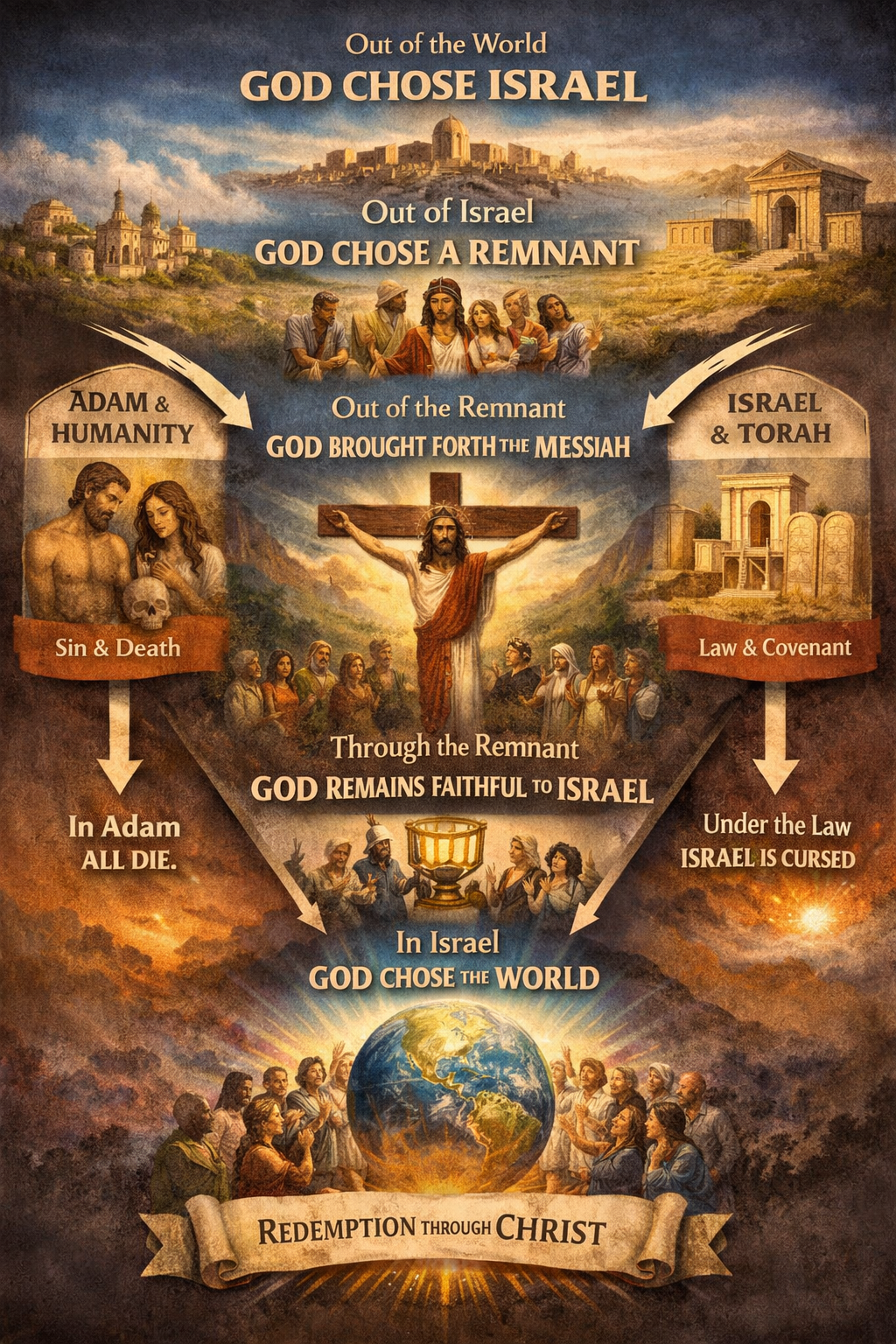
Paul’s theology of election can be expressed as a dynamic narrowing and widening:
Out of the world God chose Israel
…Out of Israel God chose a remnant
……Out of the remnant God brought forth the Messiah
……In the Messiah God formed a faithful remnant
…Through this remnant God remains faithful to Israel
In Israel God brings blessing to the world
This structure preserves:
- Israel’s priority
- Gentile inclusion
- The Messiah as the hinge of history
- Election as vocation, not favoritism
Paul explicitly rejects the idea that the remnant replaces Israel. Instead, the remnant is the means by which God remains faithful to Israel, and Israel is the means by which God blesses the nations.
7. Where Later Christianity Breaks with Paul
Paul’s logic often breaks down in later Christianity due to simplification:
Adam Absorbs Everything
Adam becomes the sole explanatory category, while Israel’s covenantal role fades. This flattens Paul’s careful distinction between creation-failure and covenant-failure.
The Law Becomes the Villain
Torah is reinterpreted as legalism rather than gift. This distorts Paul’s claim that the Law is “holy and good.”
Resurrection Loses Centrality
Atonement becomes focused almost entirely on the cross as payment for guilt, rather than resurrection as the defeat of death and the beginning of new creation.
Israel Is Explained Away
Romans 9–11 is sidelined. The church becomes the endpoint rather than the participant in an unfinished story.
These shifts were historically understandable—especially in a Gentile-majority, post-Temple world—but they are not faithful to Paul’s own architecture.
Conclusion
Paul did not abandon Israel, mythologize Adam away, or invent a new religion detached from Jewish scripture. He was a Second Temple Jew who believed that God had acted decisively within Israel’s story to resolve a problem that reached back to Adam and outward to the nations.
For Paul:
- Israel remains chosen
- Adam explains universal need
- Christ stands at the center
- Resurrection signals new creation
- History is still unfolding
Gentile inclusion is not a detour from Israel’s vocation—it is the goal toward which that vocation always pointed.
Understanding Paul this way does not require agreeing with him. But it does require taking him seriously on his own terms.
***
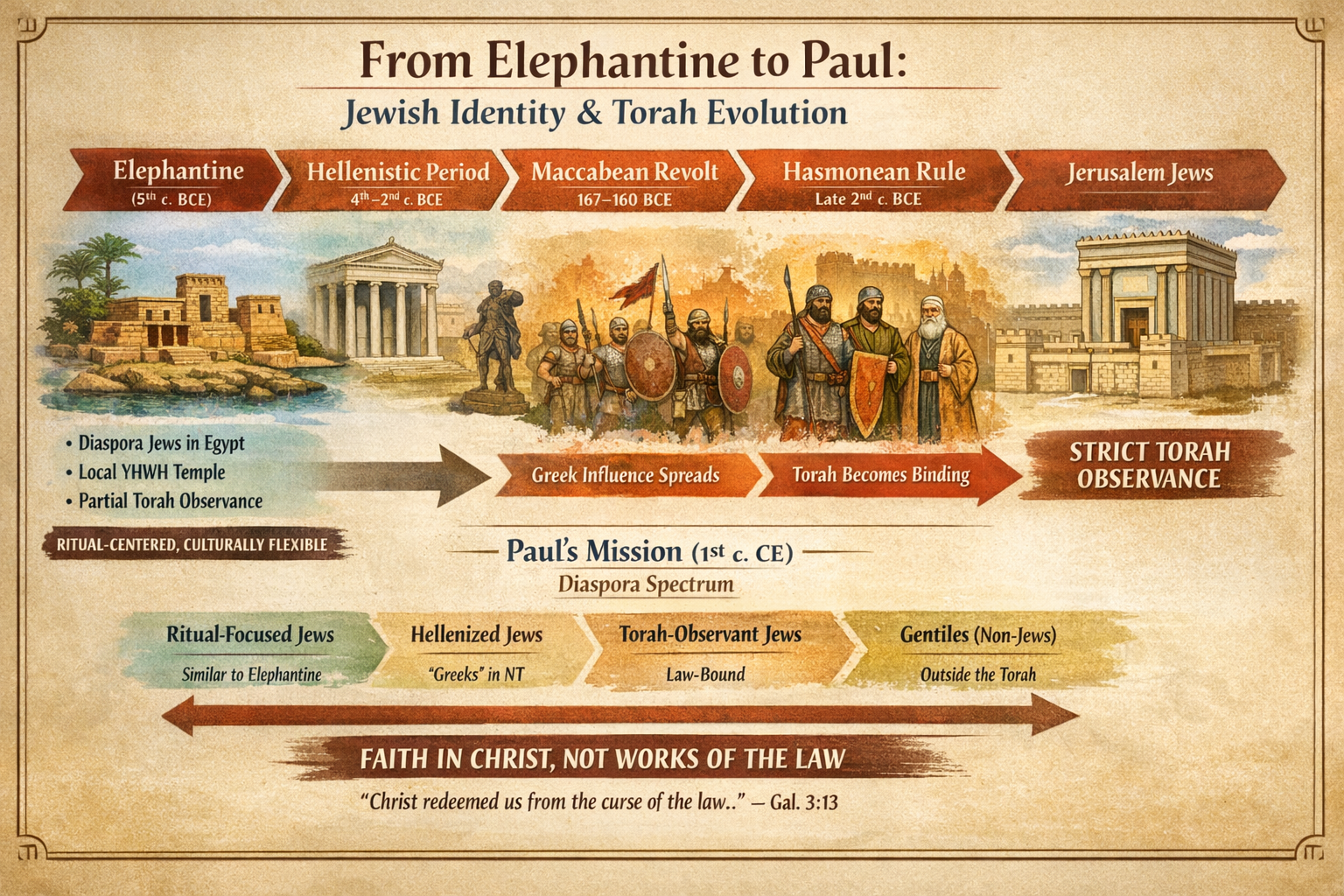
From Elephantine to Galatia: Understanding Diaspora Judaism and Paul’s Mission
The history of Jewish communities outside Jerusalem reveals a rich diversity of religious practice long before Torah law became universally binding. One of the clearest examples is the Jewish community at Elephantine, a military colony in southern Egypt during the 5th century BCE. Studying Elephantine not only illuminates early diaspora Judaism but also helps us understand the audiences that Paul encountered on his missionary journeys centuries later.
1. The Elephantine Community
Elephantine was a Judahite military colony, stationed on Egypt’s southern frontier before the Persian conquest (c. 525 BCE). Its members were likely Judean soldiers or mercenaries who migrated to Egypt before the major Deuteronomic reforms of the late 7th century BCE. Consequently, their religious practice reflects a pre-exilic, ritual-focused Yahwism:
- They had their own temple devoted to YHWH, where priests oversaw sacrifices.
- Their daily life and legal documents show partial adherence to Torah traditions, but not full Torah law enforcement.
- They interacted with local Egyptians and other peoples, suggesting a degree of cultural flexibility and syncretism.
- Notably, their petitions to the Jerusalem priesthood for temple support did not receive clear approval, showing the limits of central authority at the time.
In short, Elephantine Jews were religiously Jewish but socially flexible, practicing a form of Judaism that was ritual-centered rather than text-centered.
2. Why Elephantine Was Eventually Forgotten
By the 2nd century BCE, Judaism had begun a process of centralization and textualization that made communities like Elephantine historically obsolete:
- Centralization of worship in Jerusalem made autonomous temples theologically problematic.
- Torah law became the definitive marker of Jewish identity, replacing older ritual customs.
- Diaspora communities like Elephantine lacked scribal and institutional power, meaning their traditions were not preserved.
- As Jerusalem-centered Judaism solidified, communities outside its influence were quietly ignored or absorbed, leading Elephantine to fade from memory.
Elephantine, therefore, provides a snapshot of Judaism before Torah law became normative, illustrating how Jewish identity and practice evolved over centuries.
3. The Emergence of Normative Torah
The transformation from Elephantine-style Judaism to Torah-centered Judaism was largely complete by the 2nd century BCE, driven by historical pressures:
- Hellenistic Rule and Seleucid Oppression: Greek culture and political control threatened Jewish religious practices, culminating in Antiochus IV’s desecration of the Jerusalem Temple.
- Priestly Corruption and Internal Crisis: Disputes over legitimate leadership and proper observance highlighted the need for a standardized legal framework.
- The Maccabean Revolt (167–160 BCE) established Hasmonean rule, making Torah observance state-enforced, not optional.
- Diaspora Pressures: Torah law became a marker of identity, distinguishing Jews from surrounding Gentiles.
The result: Torah became binding and normative, defining Jewish identity for the first time in a widespread, enforceable way.
4. Diaspora Jews in Paul’s Time
By the 1st century CE, diaspora Jewish communities still exhibited considerable diversity in Torah observance and cultural assimilation:
- Elephantine-type Jews: Highly ritual-centered, partially Torah-observant, integrated into local culture.
- Hellenized diaspora Jews (“Greeks” in the NT sense): Some Torah knowledge, varying observance, Greek names and customs, partially assimilated.
- Jerusalem-centered Jews: Fully Torah-observant, resistant to Hellenistic influence, centralized around Temple and priesthood.
- Gentiles: Non-Jews with no obligation under Torah, often converts to Judaism via proselytism.
This spectrum helps us understand Paul’s ministry: many Jews outside Jerusalem were culturally and religiously flexible, making them receptive to his message of faith in Christ over strict law observance.
5. Paul and the Galatian Audience
In Galatians 3:13, Paul writes:
“Christ redeemed us from the curse of the law by becoming a curse for us…”
Here, he addresses an audience that includes diaspora Jews and Gentile converts who were under pressure from “Judaizers” to adopt Torah practices like circumcision. These Jews:
- Likely resembled Elephantine-type or Hellenized diaspora Jews, partially observant but culturally integrated.
- Faced choices between ritual identity and faith in Christ.
- Needed reassurance that salvation did not require full Torah compliance, particularly circumcision, the visible marker of law.
Paul’s argument is historically consistent: he appeals to the flexible, diaspora identity that existed in Jewish communities long before Torah law was universally enforced.
6. Conclusion
The Elephantine community shows us that early Jewish diaspora life was diverse and adaptable. Ritual practice, local temple worship, and flexible law observance were the norm outside Jerusalem. Over centuries, historical pressures—imperial rule, Hellenization, and the Hasmonean consolidation—made Torah law binding and central to Jewish identity. By Paul’s time, many diaspora Jews still embodied the Elephantine-type flexibility, explaining why his gospel could resonate with Jews and Gentiles who were devout but not fully Torah-bound.
Understanding this continuum—from Elephantine to Galatia—illuminates both the historical development of Judaism and the social context of Paul’s missionary work, highlighting how faith and law interacted in a changing world.
***
The Church Fathers and the Gift of Tongues
We see the gift of tongues practiced in the New Testament. In the book of Acts, the gift is associated with the baptism of the Holy Spirit. Paul also talks about the gift, most notably in his letter to the Corinthian church.
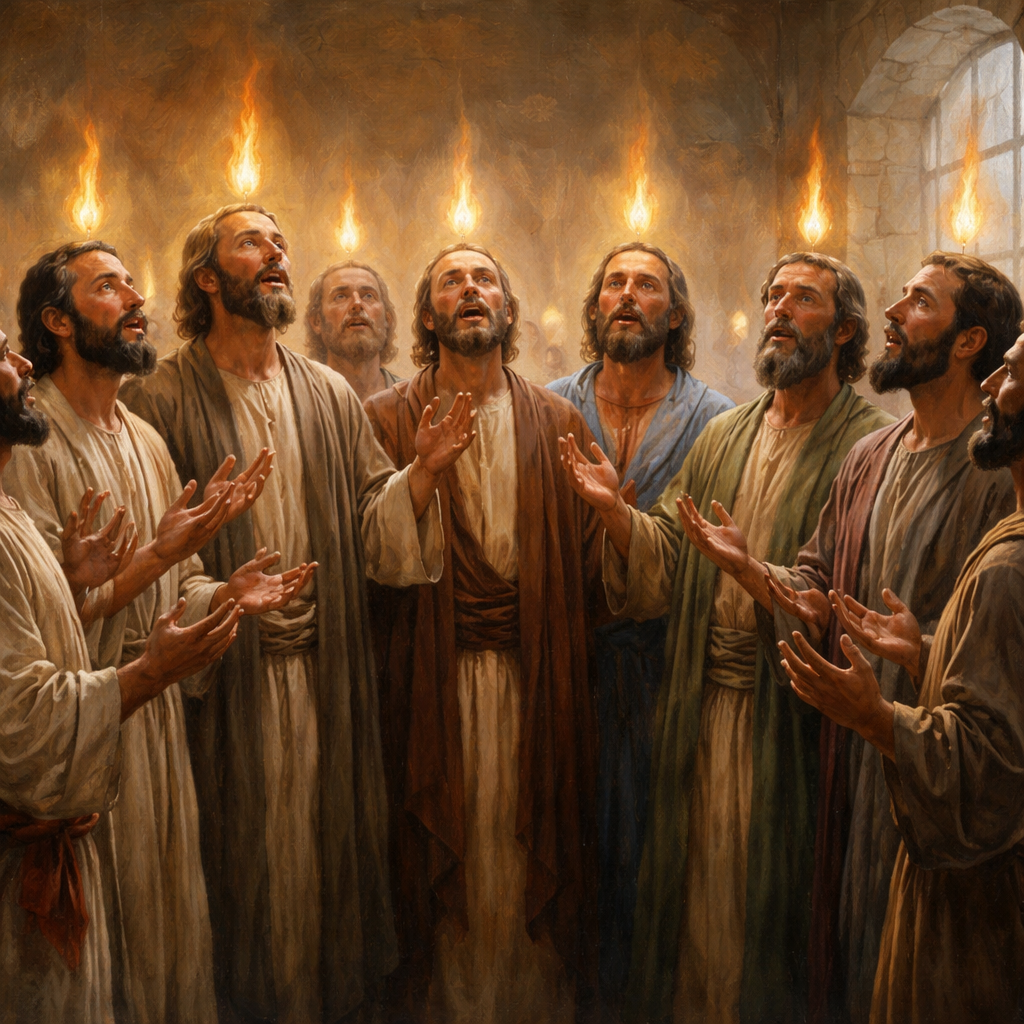
Tongues is a mysterious gift, and it can be difficult to determine its purpose. Personally, I see it as a reversal of Babel. God divided mankind at Babel through language, and then God drew mankind to Himself at Pentecost. The gift seemed to be the ability for one to speak in a real language (of which was spoken in the Roman empire) without having to first study that language. This allowed the gospel to spread out quickly across language barriers in the first critical years of the Church.
To see what came of the gift in the post-apostolic generations of the early Church we can look to the Church Fathers.
Irenaeus (c. 130–202 AD)
As Bishop of Lyons and a disciple of Polycarp (who knew the Apostle John), Irenaeus is one of the earliest post-apostolic writers to mention tongues. In his work Against Heresies (Book 5, Chapter 6), he describes it as a ongoing gift in his time: “We do also hear many brethren in the Church, who possess prophetic gifts, and who through the Spirit speak all kinds of languages, and bring to light for the general benefit the hidden things of men, and declare the mysteries of God.” He frames it as the ability to speak foreign languages miraculously, aligning with the Pentecost event in Acts 2, and emphasizes its role in revealing truths and benefiting the community.
For Irenaeus, the gift was still being practiced in his day, it was the ability to speak real languages, and its purpose was for prophesy and mission.
Tertullian (c. 155–220 AD)
A North African theologian and apologist, Tertullian refers to tongues in Against Marcion (Book 5, Chapter 8), where he discusses spiritual gifts in the context of Montanism (a prophetic movement he later joined). “Let him who claims to have received gifts… produce a psalm, a vision, a prayer—provided it be with interpretation.” He implies tongues as intelligible speech, often requiring interpretation, and sees it as evidence of the Holy Spirit’s work similar to the apostles’. He notes encounters with the gift of interpretation in his day but doesn’t describe it as ecstatic babbling; instead, it’s tied to rational, prophetic expression.
For Tertullian, the gift was still being practiced in his day, it required interpretation, and its purpose was for the edification of the Church.
Origen (c. 185–253 AD)
The Alexandrian scholar comments on tongues in his Commentary on 1 Corinthians and other works, such as De Principiis. He views it as the miraculous knowledge of foreign languages without prior study, emphasizing that the speaker might not understand their own words unless interpreted (echoing 1 Corinthians 14:13). Origen argues the gift was temporary, part of the “signs” of the apostolic age, and by his time, it was no longer commonly exercised.
“The signs of the Holy Spirit were manifest at the beginning… but traces of them are found in only a few.” (Against Celsus 7.8)
For Origen, the gift was real and apostolic, already becoming uncommon by the mid-3rd century, and was seen mainly as a foundational sign for the church’s early mission.
John Chrysostom (c. 347–407 AD)
The Archbishop of Constantinople, known for his homilies, discusses tongues extensively in his Homilies on First Corinthians (e.g., Homily 35). He interprets it as speaking in actual languages like Persian, Roman, or Indian, directly linking it to Pentecost. Chrysostom stresses that it was a “sign” for unbelievers (per 1 Corinthians 14:22) and notes its cessation: by the late 4th century, it had largely disappeared from the church, as the need for such miracles had passed with the spread of Christianity.
“This whole place is very obscure; but the obscurity is produced by our ignorance of the facts referred to and by their cessation, being such as then used to occur but now no longer take place.” (Homilies on 1 Corinthians 29)
For John Chrysostom, the gift was something real from an earlier era, but no longer practiced in his day.
Augustine of Hippo (c. 354–430 AD)
In works like The Letters of Petilian and his sermons, Augustine acknowledges tongues as a historical gift from the early church, where converts sometimes spoke in new languages upon baptism. However, he explicitly states that by his era, the gift had ceased: “In the earliest times, the Holy Ghost fell upon them that believed: and they spoke with tongues… These were signs adapted to the time. For there behooved to be that betokening of the Holy Spirit… That thing was done for a betokening, and it passed away.” He sees it as fulfilled in the church’s global unity rather than ongoing miracles.
For Augustine, the gift was a sign for the church’s beginning, meant to show the universality of the gospel, and was no longer needed once the Church was established.
Other Notable Mentions
- Hippolytus (c. 170–235 AD): In Apostolic Tradition, he equates tongues with the apostles’ experience at Pentecost, viewing it as foreign languages.
- Gregory of Nazianzus (c. 329–390 AD): In his Oration on Pentecost, he describes it as a reversal of Babel, enabling communication in diverse human tongues.
- Cyril of Jerusalem (c. 313–386 AD): In Catechetical Lectures, he marvels at the apostles learning multiple languages instantly through the Spirit.
The Church Fathers seemed to be unified in their understanding of the gift of tongues:
No father describes tongues as:
- a private prayer language
- a necessary sign of Spirit baptism
- a normative experience for all believers
No early source connects tongues with:
- altered states of consciousness
- repetitive ecstatic syllables
- individual spiritual status
Tongues were real languages, not private ecstasy.
They belonged especially to the apostolic age, when the gospel was breaking into new linguistic worlds.
They declined naturally as the church became established.
They were signs of God’s power, not badges of spiritual rank.
They were always meant to serve the church, not the ego of the speaker.
In summary, the Church Fathers saw the gift of tongues as a practical miracle for spreading the gospel across linguistic barriers, not as private prayer languages or gibberish. References become scarcer after the 3rd century, with later writers like Chrysostom and Augustine indicating its decline, attributing this to the church’s maturation. This contrasts with some modern interpretations, but the patristic evidence emphasizes its historical and evangelistic role.
Jesus is Not Coming Down From the Sky
There is No Santa
Imagine a young boy who believes in Santa Claus. He believes that the presents he finds under the tree each Christmas morning were placed there by a magical man who came down the chimney, and who afterward hopped on his sleigh pulled by flying reindeer.
But, one Christmas Eve, the boy decides he wants to see Santa for real and so he sneaks out of his room late at night hoping to catch Santa in action. What he does see, however, is his own parents carefully laying out presents, one by one, around the base of the tree. And so, he knows the truth. It is in fact his own parents who are delivering the goods.
Now, with this knowledge, would it be proper for the boy to then believe that it is his own parents who slid down the chimney? And it his own parents who will fly off into the night on the sleigh? No, of course not. The boy must disregard the entire Santa narrative. There’s no one coming down the chimney. It’s all his parents buying the presents from the store, wrapping them out of sight, and placing them under the tree. Once the boy discovers the truth about one thing, he must apply that truth to everything else.
First Century Cosmology
First century Christians did not have telescopes. They believed the realm above them was a series of layers transcending the dome of the sky. They believed that angels and God literally resided in and above the layers containing the sun, moon, and stars. God’s throne room was a literal place up in what we would call “outer space.” When Jesus ascended up to the Father, to sit at His right hand, Jesus literally went up to sit on a literal throne in a literal throne room.
Since Jesus was up in outer space, of course when He returns, he will return from outer space. Where else would He come from?
21st Century Cosmology
Today we have telescopes. We know that we live in one galaxy among billions, and that each galaxy contains billions, if not trillions, of stars. The universe is so vast, it is beyond comprehension. In fact, the universe is likely infinite. We know this now.
We know that there is no Santa. Therefore, is it proper for us to continue to believe that one day the world will see Jesus descending down to the earth through the layers of the heavens as they believed He would in the 1st century? Should we combine their cosmology with our own? No, of course not. Ask any Christian today where heaven is, and unless he’s a flat-earther, he will likely say that heaven is located in the spiritual realm, someplace beyond the material realm that we do not have access to.
New Testament Eschatological Language
New Testament (NT) eschatology is primarily Israel’s eschatology. The Church’s eschatology builds upon it, but then transcends it. The cosmos coming under judgement for the NT authors was the Israelite cosmos. The end was near, at hand, at the door, soon, and about to happen. Every NT author believed he was living in the last days. And he was, to the degree that the old order of things was coming to an end. The apocalyptic language of the NT reflects this.
Israel’s eschatology is not the Church’s eschatology. The Church’s eschatology is this: Just as a dragnet draws all the fish into the boat, so is all creation being drawn to the Father by the redemptive work of Christ. We don’t know when this work will be complete, and we don’t know what it will finally look like. For now it is beyond our comprehension, beyond our reach.
It’s okay to be somewhat agnostic when it comes to eschatology. Embrace the mystery. Whatever you do, don’t go on believing that your dad has a pack of flying reindeer hidden away in a barn somewhere.
We Are Not Israel
Israel is gone. Our faith is not “Judeo/Christian.” We are just Christian. Yes, Jesus was the Messiah Israel was waiting for, but He was not the Messiah they were expecting. Jesus was not the blood soaked Davidic warrior coming to destroy Rome and establish a powerful Israelite theocracy the 1st century Jews were hoping for. This is why He was rejected.
Jesus subverted all Messianic expectations. His kingdom is not of this world. He came to conquer a higher enemy. He came to do the will of the Father, not Israel. The Father’s will is to redeem His creation. This is what Christianity is: The redemption of creation through Christ.
For Christians, Israel has become allegory. The Old Testament scriptures are transformed to types and shadows. It’s not our literal history. It’s our mythology.
Most Christians live like this even if not fully aware of it. They may say the stories are literal history, but they always apply the stories allegorically to their own life’s journey. It doesn’t matter if the stories are literal history or not; anything to do with Israel we allegorize.
Jesus is not coming down from the sky. Israelite cosmology is not true. That’s okay, because we are Christians. We know more. We’ve seen more. We know what is mythology and what is reality. We know the truth, and what we know is true; we must apply it to everything else.
The Hebrew Bible: Septuagint and Masoretic Texts
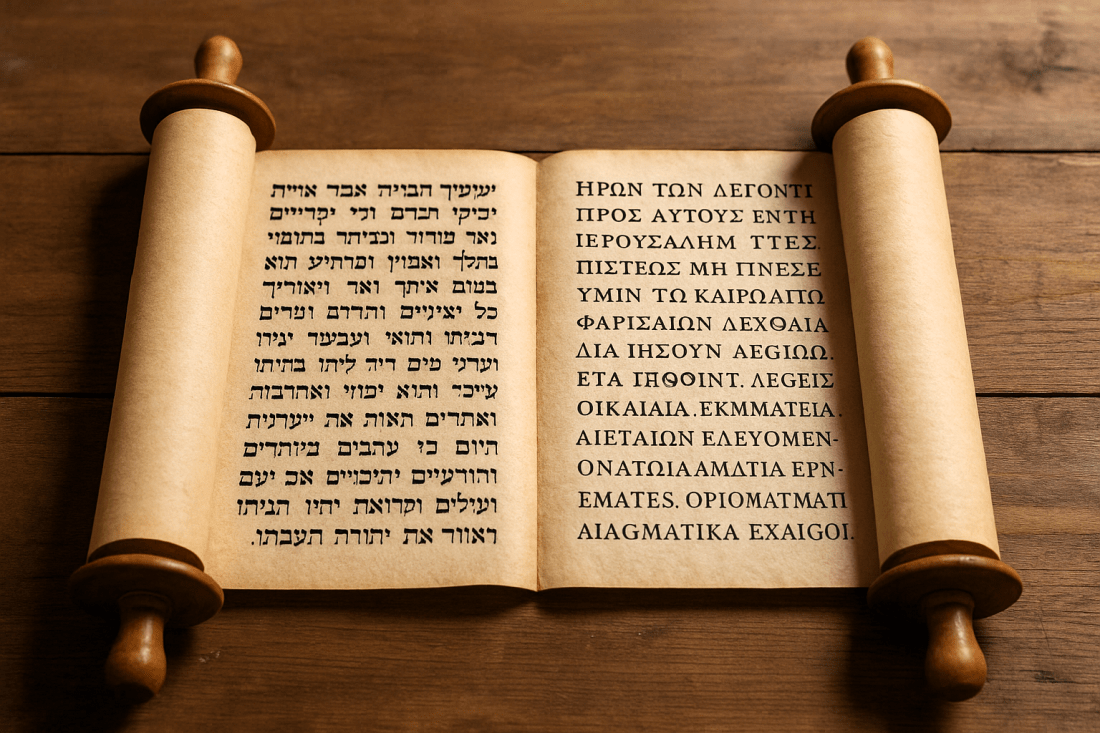
In this space I am going to store research concerning all things Hebrew Scriptures, focusing much on the Masoretic Text (MT) and the Septuagint (LXX): videos, articles, essays, Dead Sea Scroll (DSS) research, AI research, etc… So, if you are studying the MT and/or the LXX, and you’ve stumbled across this post, I hope you find something useful.
***
***
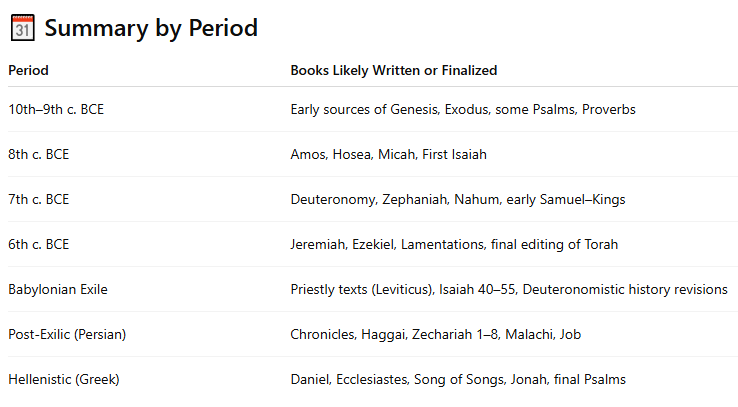
Dating the Scriptures (AI Research – Grok, ChatGPT, and Claude)
Torah (Pentateuch)
The first five books—Genesis, Exodus, Leviticus, Numbers, and Deuteronomy—are traditionally attributed to Moses but are now understood by most scholars as composite works from multiple sources (Yahwist, Elohist, Priestly, and Deuteronomic) compiled over centuries. Final redaction likely occurred during or after the Babylonian Exile (6th century BCE).
- Genesis: Likely compiled in its current form during the Persian period (538–332 BCE), though it incorporates earlier oral and written traditions from the 10th–6th centuries BCE. The creation stories, patriarchal narratives, and flood accounts reflect ancient Near Eastern motifs, with some elements possibly dating to the early monarchy (10th century BCE). The final shaping likely occurred post-Exile to address the needs of the returning community.
- Exodus: Composed over time, with narrative cores (e.g., the Exodus event, covenant at Sinai) possibly rooted in 13th–10th-century BCE traditions. The Priestly and Deuteronomic elements were likely added during the 7th–5th centuries BCE, with final redaction in the Persian period (5th century BCE).
- Leviticus: Primarily a Priestly work, likely composed between the 6th and 5th centuries BCE during or after the Exile, though some ritual laws may reflect earlier practices (8th–7th centuries BCE). Its focus on purity and temple worship suggests a post-Exilic context.
- Numbers: A composite text with narrative and legal material, likely compiled in its final form during the Persian period (538–332 BCE). It incorporates earlier traditions, such as wilderness wanderings and census accounts, potentially from the 10th–7th centuries BCE, with Priestly and Deuteronomic additions in the 7th–5th centuries BCE. The final redaction reflects post-Exilic concerns about community identity and land allocation.
- Deuteronomy: Likely composed in stages, with a core tied to the reforms of King Josiah (late 7th century BCE, c. 622 BCE), based on its alignment with the “Book of the Law” found in 2 Kings 22:8–10. Additional material was added during the Babylonian Exile (597–538 BCE) and finalized in the Persian period (5th century BCE). Its covenantal theology and legal code reflect both pre-Exilic and post-Exilic contexts.
Nevi’im (Prophets)
The Nevi’im include the Former Prophets (historical narratives: Joshua – 2 Kings) and Latter Prophets (prophetic oracles: Isaiah – Malachi). The Former Prophets form part of the Deuteronomistic History (DtH), likely compiled during the Babylonian Exile (6th century BCE) with earlier sources. The Latter Prophets’ dates are tied to the historical periods of the named prophets, though redaction often occurred later.
- Joshua: Part of the Deuteronomistic History, compiled in the 6th century BCE during the Exile. It incorporates earlier traditions about the conquest of Canaan (potentially 13th–10th centuries BCE), but its final form reflects Exilic theology, emphasizing obedience to the covenant.
- Judges: Also part of the Deuteronomistic History, finalized c. 6th century BCE. Stories of the judges likely stem from oral traditions of the pre-monarchic period (12th–11th centuries BCE), but the text’s structure and theological framing suggest Exilic redaction.
- 1 Samuel: Part of the Deuteronomistic History, compiled c. 6th century BCE. It includes traditions about Samuel, Saul, and David from the early monarchy (11th–10th centuries BCE), redacted to emphasize divine kingship and covenant fidelity.
- 2 Samuel: Continues 1 Samuel, part of the Deuteronomistic History, finalized c. 6th century BCE. It draws on court records or oral traditions about David’s reign (10th century BCE), shaped by Exilic concerns about leadership and divine judgment.
- 1 Kings: Part of the Deuteronomistic History, compiled c. 6th century BCE, with possible updates in the Persian period. It incorporates royal annals and temple records from the monarchic period (10th–7th centuries BCE), framed to explain the Exile as divine punishment.
- 2 Kings: Completes the Deuteronomistic History, finalized c. 6th century BCE, with a possible secondary redaction (Dtr2) post-562 BCE to account for Judah’s fall. It uses earlier sources from the divided monarchy (9th–7th centuries BCE).
- Isaiah: A composite work spanning centuries. Chapters 1–39 (First Isaiah) are largely from the 8th century BCE (c. 740–700 BCE), attributed to Isaiah of Jerusalem. Chapters 40–55 (Second Isaiah) date to the late Exilic period (c. 550–538 BCE), and chapters 56–66 (Third Isaiah) to the early Persian period (c. 538–500 BCE). Redaction continued into the 5th century BCE.
- Jeremiah: Core oracles from Jeremiah’s ministry in the late 7th–early 6th centuries BCE (c. 627–587 BCE). The book was likely edited during the Exile (6th century BCE) and finalized in the Persian period, incorporating prose narratives and later additions.
- Ezekiel: Primarily from Ezekiel’s prophetic activity during the Exile (c. 593–571 BCE). The book’s final form, with its priestly and visionary content, was likely completed shortly after, c. 550 BCE.
- Hosea: Oracles from Hosea’s ministry in the Northern Kingdom (c. 750–725 BCE), with possible redaction in Judah during or after the fall of Israel (722 BCE). Final form likely 7th–6th centuries BCE.
- Joel: Difficult to date precisely due to lack of historical markers. Likely post-Exilic (5th–4th centuries BCE), though some argue for a pre-Exilic core (8th–7th centuries BCE). Its apocalyptic tone suggests a later composition.
- Amos: Oracles from Amos’ ministry in the Northern Kingdom (c. 760–750 BCE), with possible Judahite redaction after 722 BCE. Final form likely 7th–6th centuries BCE.
- Obadiah: Likely post-Exilic (5th century BCE), addressing Edom’s role in Judah’s fall (587 BCE). Some suggest an earlier core (7th–6th centuries BCE).
- Jonah: Likely a post-Exilic composition (5th–4th centuries BCE) due to its narrative style and universalist themes. Some argue for a 6th-century BCE origin, but its fictional nature suggests a later date.
- Micah: Oracles from Micah’s ministry (c. 740–700 BCE), with possible Exilic or post-Exilic additions (6th–5th centuries BCE). Final form likely 5th century BCE.
- Nahum: Oracles concerning Nineveh’s fall (612 BCE), likely composed shortly after, c. 612–600 BCE, with possible later redaction.
- Habakkuk: Oracles from the late 7th century BCE (c. 605–598 BCE), addressing Babylon’s rise. Final form likely early 6th century BCE.
- Zephaniah: Oracles from Zephaniah’s ministry (c. 640–622 BCE), with possible Exilic redaction. Final form likely 6th–5th centuries BCE.
- Haggai: Dated precisely to 520 BCE, based on internal references to the second year of Darius I. Minimal redaction, likely finalized shortly after.
- Zechariah: Chapters 1–8 from Zechariah’s ministry (c. 520–518 BCE). Chapters 9–14 (Second Zechariah) are likely later, from the 5th–4th centuries BCE, due to distinct style and historical context.
- Malachi: Post-Exilic, likely 5th century BCE (c. 450–400 BCE), addressing temple and social issues in the Persian period.
Ketuvim (Writings)
The Ketuvim include diverse genres (wisdom, poetry, history), with composition spanning a wide range. Many reached their final form in the Persian or Hellenistic periods.
- Psalms: A collection spanning centuries, with individual psalms potentially from the 10th century BCE (Davidic period) to the 5th century BCE. The collection was likely finalized in the Persian period (5th–4th centuries BCE).
- Proverbs: Contains older sayings (some possibly from Solomon’s time, 10th century BCE), but the collection was likely compiled in the Hellenistic period (c. 332–198 BCE), with final redaction in the 3rd century BCE.
- Job: Likely composed in the 6th century BCE, post-Exile, though its poetic core may reflect earlier traditions (7th–6th centuries BCE). Its philosophical tone suggests a post-Exilic context.
- Song of Songs: Possibly rooted in earlier love poetry (8th–7th centuries BCE), but likely compiled in the Persian or Hellenistic period (5th–3rd centuries BCE).
- Ruth: Likely post-Exilic (5th–4th centuries BCE), reflecting Persian-period concerns about identity and inclusion. Some argue for an earlier monarchic setting (8th–7th centuries BCE).
- Lamentations: Likely composed shortly after Jerusalem’s fall (587 BCE), with final form in the early 6th century BCE. Its poetic structure suggests rapid composition.
- Ecclesiastes: Likely composed in the Hellenistic period (c. 3rd century BCE, possibly 250–200 BCE), due to its philosophical tone and linguistic features. Some suggest a 4th-century BCE origin.
- Esther: Post-Exilic, likely 5th–4th centuries BCE, reflecting events in the Persian court. Its narrative style suggests a later date, possibly 4th century BCE.
- Daniel: Chapters 1–6 likely from the 6th century BCE (Exilic), but chapters 7–12, with apocalyptic visions, date to the 2nd century BCE (c. 167–164 BCE), during the Maccabean revolt. Final form c. 164 BCE.
- Ezra: Likely compiled in the Persian period (5th century BCE, c. 450–400 BCE), with sources from the return from Exile (538 BCE onward).
- Nehemiah: Companion to Ezra, compiled c. 450–400 BCE, with memoir material from Nehemiah’s governorship (c. 445 BCE).
- 1 Chronicles: Likely 4th century BCE, post-Exilic, retelling Israel’s history with a focus on Davidic lineage and temple worship. Draws on earlier sources (e.g., Samuel, Kings) from the 10th–6th centuries BCE.
- 2 Chronicles: Companion to 1 Chronicles, also 4th century BCE, with similar sources and theological focus on Judah’s temple and monarchy.
Notes on Scholarship and Evidence
- Earliest Evidence: The Dead Sea Scrolls (c. 2nd century BCE) provide the oldest surviving Hebrew manuscripts, confirming that many books were in near-final form by then. Earlier inscriptions, like the Khirbet Qeiyafa ostracon (c. 1000 BCE), suggest Hebrew writing existed by the early monarchy, supporting the possibility of early written traditions.
- Challenges: Dating relies on internal evidence (historical references, linguistic features) and external evidence (archaeology, ancient Near Eastern texts). The Documentary Hypothesis, though less dominant, informs Pentateuchal studies, while the Deuteronomistic History model shapes understanding of Joshua–Kings.
- Debates: Conservative scholars (e.g., Edwin R. Thiele) argue for earlier dates, especially for Pentateuchal traditions (15th–13th centuries BCE), citing Mosaic influence. Critical scholars (e.g., John J. Collins, Israel Finkelstein) favor later dates, emphasizing Exilic and post-Exilic redaction. Archaeological evidence, like the Ketef Hinnom scroll (7th century BCE), supports pre-Exilic writing but not necessarily full texts.
- Compilation Over Time: Most books evolved through oral traditions, written sources, and multiple redactions. For example, the Pentateuch’s final form reflects post-Exilic priorities, but earlier traditions may date back centuries. Prophetic books often combine a prophet’s oracles with later editorial framing.
***
📜 The Torah / Pentateuch (Genesis – Deuteronomy)
Traditional attribution: Moses
Scholarly view: A compilation of sources over centuries
| Book | Date | Notes |
|---|---|---|
| Genesis | 10th–5th century BCE | Contains material from the J (Yahwist, ~950 BCE), E (Elohist, ~850 BCE), P (Priestly, ~6th century BCE), and D (Deuteronomist, ~7th century BCE) sources. Final form likely post-exilic (5th century BCE). |
| Exodus | Same as Genesis | Composite from J, E, P, and D traditions. |
| Leviticus | ca. 6th–5th century BCE | Primarily Priestly material, likely written or compiled during the Babylonian Exile. |
| Numbers | 10th–5th century BCE | Composite like Genesis and Exodus. Final form post-exilic. |
| Deuteronomy | ca. 7th century BCE, with later edits | Core written during Josiah’s reforms (~620 BCE). Final form edited in exile or post-exile. |
📘 Historical Books (Joshua – Esther)
| Book | Date | Notes |
|---|---|---|
| Joshua | 7th–6th century BCE | Possibly Deuteronomistic History; post-Josiah, edited in exile. |
| Judges | 7th–6th century BCE | Part of the Deuteronomistic History (DtrH). |
| 1 & 2 Samuel | 7th–6th century BCE | Earlier sources from 10th–9th c. BCE; edited by Deuteronomistic historians. |
| 1 & 2 Kings | 6th century BCE | Finalized during Babylonian Exile; strong Deuteronomistic theology. |
| Ruth | 5th–4th century BCE | Set in Judges era, but written later; some see it as a response to Ezra-Nehemiah’s exclusionary policies. |
| 1 & 2 Chronicles | ca. 400–350 BCE | Post-exilic; retelling of Samuel–Kings from a priestly perspective. |
| Ezra–Nehemiah | ca. 400–350 BCE (some argue slightly later) | Compiled from earlier memoirs and edited in post-exilic period. |
| Esther | 4th–3rd century BCE | Possibly fictional court tale with Persian setting; no direct mention of God. |
🎙️ Wisdom and Poetry (Job – Song of Songs)
| Book | Date | Notes |
|---|---|---|
| Job | Core: 6th–5th century BCE; edits later | Possibly written in exile; explores innocent suffering. |
| Psalms | ca. 10th–3rd century BCE | Collected over centuries; some psalms trace to Davidic era, others are post-exilic. |
| Proverbs | Core: 10th–6th century BCE; final: ~4th c. | Some sayings may be Solomonic; final compilation likely late Persian period. |
| Ecclesiastes | ca. 3rd century BCE | Philosophical reflections, traditionally attributed to Solomon. |
| Song of Songs | ca. 4th–3rd century BCE | Love poetry; possibly allegorical or secular; final form Hellenistic. |
| Lamentations | ca. 586–500 BCE | Likely written after the destruction of Jerusalem by Babylon. |
📢 Major Prophets (Isaiah – Daniel)
| Book | Date | Notes |
|---|---|---|
| Isaiah | Parts from 8th–5th century BCE | Divided into First Isaiah (1–39) ~740–700 BCE, Second Isaiah (40–55) ~540 BCE (exilic), Third Isaiah (56–66) ~500–450 BCE (post-exilic). |
| Jeremiah | 7th–6th century BCE | Contains autobiographical materials, later edited. |
| Ezekiel | ca. 593–571 BCE | Written during exile in Babylon. |
| Daniel | ca. 167–164 BCE | Set in Babylon, but written during Antiochus IV’s persecution; earliest example of apocalyptic literature in Bible. |
📣 Minor Prophets (The Twelve)
Often collected as one book in the Hebrew Bible. Dates vary per prophet:
| Book | Date |
|---|---|
| Hosea | 8th century BCE (before 722 BCE) |
| Joel | ca. 500–350 BCE (disputed: some say earlier) |
| Amos | ca. 760–750 BCE |
| Obadiah | ca. 6th century BCE |
| Jonah | ca. 4th–3rd century BCE |
| Micah | ca. 740–700 BCE |
| Nahum | ca. 620–610 BCE |
| Habakkuk | ca. 610–597 BCE |
| Zephaniah | ca. 640–609 BCE |
| Haggai | 520 BCE |
| Zechariah | Chapters 1–8: 520–518 BCE; 9–14: ~4th century |
| Malachi | ca. 450–400 BCE |
***
Based on the latest scholarly consensus, here’s a comprehensive list of when each Old Testament book is thought to have been written:
Torah (Five Books of Moses)
Genesis, Exodus, Leviticus, Numbers, Deuteronomy
- The majority of modern biblical scholars believe that the Torah reached its present form in the post-exilic period (5th century BCE)
- However, these books contain material from various periods, with some traditions potentially dating much earlier
Historical Books
Joshua, Judges, 1-2 Samuel, 1-2 Kings
- This group of books, plus Deuteronomy, is called the “Deuteronomistic history” by scholars, appearing in two “editions”, the first in the reign of Judah’s King Josiah (late 7th century BCE), the second during the exile (6th century BCE)
- Final form: 6th century BCE (Babylonian exile period)
1-2 Chronicles
- Chronicles was composed between 400 and 250 BCE, probably in the period 350–300 BCE
Ezra-Nehemiah
- Ezra–Nehemiah may have reached its final form as late as the Ptolemaic period, c. 300–200 BCE
Ruth
- The Book of Ruth is commonly dated to the Persian period (538-332 BCE)
Esther
- Esther to the 3rd or 4th centuries BCE
Poetic/Wisdom Literature
Job
- It is generally agreed that Job comes from between the 6th and 4th centuries BCE
Psalms
- The psalms making up the first two-thirds of the psalter are predominantly pre-exilic and the last third predominantly post-exilic. The collected book of Psalms was possibly given its modern shape and division into five parts in the post-exilic period, although it continued to be revised and expanded well into Hellenistic and even Roman times
Proverbs
- Proverbs is a “collection of collections” relating to a pattern of life which lasted for more than a millennium, and impossible to date
- Contains material from various periods, making precise dating difficult
Ecclesiastes
- Ecclesiastes can be no earlier than about 450 BCE, due to the presence of Persian loan-words and Aramaic idioms, and no later than 180 BCE
Song of Songs
- The Song of Songs could have been composed at any time after the 6th century BCE
Lamentations
- It is generally accepted that the destruction of Jerusalem by Babylon in 586 BCE forms the background to the Book of Lamentations
Major Prophets
Isaiah
- Scholars recognise three “sections” in the Book of Isaiah
- First Isaiah (chapters 1-39): 8th century BCE
- Second Isaiah (chapters 40-55): 6th century BCE (exile period)
- Third Isaiah (chapters 56-66): 5th century BCE (post-exilic)
Jeremiah
- The Greek version was probably finalised in the early Persian period and translated into Greek in the 3rd century BCE, and the Hebrew version dates from some point between then and the 2nd century BCE
Ezekiel
- Internal evidence dates the visions to between 593 and 571 BCE. While the book probably reflects much of the historic Ezekiel, it is the product of a long and complex history, with significant additions by a “school” of later followers
Daniel
- The Book of Daniel can be dated more precisely to 164 BCE thanks to its veiled prophecy of the death of a Greek king of Syria
Minor Prophets
In the Hebrew Bible the Twelve Minor Prophets are a single collection edited in the Second Temple period, but the collection is broken up in Christian Bibles. With the exception of Jonah, which scholars regard as fictional, there exists an original core of prophetic tradition behind each book
The individual books span from the 8th century BCE (Amos, Hosea) to the post-exilic period (Haggai, Zechariah, Malachi).
Key Points:
- Much of the Hebrew Bible/Old Testament may have been assembled in the 5th century BCE
- Many books underwent complex editorial processes over centuries
- Dating relies primarily on internal evidence and historical references
- The final canonical form of most books was established during or after the Babylonian exile (6th-5th centuries BCE)
This represents the current scholarly consensus, though individual scholars may hold different views on specific books, and new archaeological discoveries continue to refine our understanding of biblical composition dates.
***
 Pursuit of Percipience