
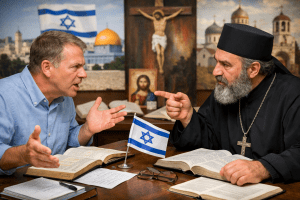
Dispensationalist (D):
Brother in Christ (though we differ on this), the true Israel today is the physical, ethnic descendants of Abraham, Isaac, and Jacob—the Jewish people—and the modern nation of Israel is the beginning of God’s literal, prophesied regathering of that very nation. The Church has not replaced Israel. God has not canceled, spiritualized, or transferred His unconditional covenants with Israel to the Church. Israel and the Church remain two distinct peoples of God with distinct callings and distinct futures in God’s redemptive plan.
Let me state it plainly from Scripture, as we both love the Bible:
- God’s covenants with Israel are unconditional and irrevocable. In Genesis 12:1-3, 15:18, and 17:7-8, God promised Abraham a land, a seed, and a blessing that would be “an everlasting covenant.” These are not conditioned on Israel’s perfect obedience. Paul, writing under the inspiration of the Holy Spirit, declares in Romans 11:29: “For the gifts and the calling of God are irrevocable.” If God could break His word to ethnic Israel, how could we trust His word to the Church?
- The Church is a mystery, not the new Israel. Ephesians 3:3-6 calls the Church “the mystery” that was hidden in ages past. The New Testament never calls the Church “Israel.” Paul makes the distinction crystal clear in Romans 9–11: “I ask, then, has God rejected his people? By no means!” (Rom 11:1). He goes on to say that a partial hardening has come upon Israel “until the fullness of the Gentiles has come in. And in this way all Israel will be saved” (Rom 11:25-26). That is future, national, ethnic Israel—not the Church.
- The regathering of Israel in our day is biblical prophecy being fulfilled. Ezekiel 36–37, Isaiah 11:11-12, Jeremiah 31:8-10, and Amos 9:14-15 all describe a literal, physical return of the Jewish people to their ancient homeland in unbelief first, followed by national repentance and the pouring out of the Spirit. We have watched this happen since 1948. The existence of the modern State of Israel is not a political accident; it is the sovereign hand of God keeping His ancient promises. To say the Church is now “the true Israel” is to spiritualize away these plain prophecies and to rob God of His faithfulness to the Jewish people.
So, to answer the question directly: The true Israel today is still Israel—the Jewish people and the nation God has regathered in the land He promised them. The Church is the bride of Christ, a heavenly people with a heavenly calling (Ephesians 1:3; Philippians 3:20). We are grafted into the blessing of Abraham (Rom 11:17), but we do not become Israel, nor do we replace her. God is not finished with the Jewish people. One day, “all Israel will be saved,” and the Lord Jesus will return to reign from Jerusalem on the throne of David (Luke 1:32-33; Zechariah 14).
That is my position, firmly rooted in a literal, grammatical-historical reading of Scripture—the same hermeneutic that tells us Jesus is coming back bodily. I look forward to hearing your Orthodox perspective, brother. Over to you.
Eastern Orthodox (EO):
Brother, I hear your concern clearly—you’re trying to defend the faithfulness of God to His promises. That’s something we absolutely share. But your framework creates a division in God’s people that the apostles consistently move away from, not reinforce.
From an Eastern Orthodox perspective, the issue isn’t whether God is faithful to Israel. The issue is: what is Israel, according to the fullness of revelation in Christ?
Let me respond directly to your points.
1. The Covenants Are Indeed Irrevocable—but Fulfilled in Christ
You’re right to emphasize Genesis and Romans 11. God does not break His promises. But the apostles teach that those promises are fulfilled, expanded, and transfigured in Christ—not maintained as a parallel track for ethnic Israel apart from Him.
Look at how Paul the Apostle interprets Abraham:
- “Not all who are descended from Israel belong to Israel” (Romans 9:6)
- “If you are Christ’s, then you are Abraham’s offspring” (Galatians 3:29)
That’s not a minor clarification—that’s a redefinition centered on union with Christ.
The promise was never about ethnicity alone. It was always moving toward Christ, the true Seed (Galatians 3:16). So the “irrevocable” promise is kept—but in the Body of Christ, not in a separate ethnic covenant running alongside the Church.
If you insist the promise must remain tied to ethnicity, you end up saying that belonging to Christ is not sufficient to inherit Abraham’s promises. That’s a serious problem.
2. The Church as “Mystery” Doesn’t Mean “Separate Peoples”
You’re right that Ephesians 3 calls the Church a mystery. But what is that mystery?
That the Gentiles are fellow heirs, members of the same body…
Not a second people. Not a parallel plan. The same body.
Orthodoxy sees this as the fulfillment of Israel—not its replacement, but its transformation and enlargement.
This is why the New Testament freely applies Israel-language to the Church:
- “A chosen race, a royal priesthood, a holy nation” (1 Peter 2:9 — originally said of Israel)
- “The Israel of God” (Galatians 6:16)
And Christ Himself redefines the people of God:
- “The kingdom of God will be taken away from you and given to a people producing its fruits” (Matthew 21:43)
That’s not two peoples of God. That’s one people, reconstituted around Christ.
3. Romans 9–11: The Strongest Case… and It Still Doesn’t Support Your Conclusion
You’re right—this is the central passage. But notice how the metaphor works:
- There is one olive tree, not two.
- Some natural branches (unbelieving Jews) are broken off.
- Wild branches (Gentiles) are grafted in.
- Natural branches can be grafted back in if they do not persist in unbelief.
The condition is explicit: faith in Christ.
So yes, “all Israel will be saved.” But the question is: how?
Not by a separate covenant. Not by ethnicity.
But by being grafted back into the same tree—which is Christ and His Body.
If you read this as a future salvation of ethnic Israel apart from incorporation into the Church, you’re reading something into the text that isn’t there.
4. The Modern State of Israel ≠ Biblical Israel
This is where your position becomes historically and theologically fragile.
You’re identifying a 20th-century political entity—State of Israel—with the Israel of prophecy.
But the New Testament never directs us to watch geopolitical developments as the fulfillment of God’s covenant promises. Instead, it consistently redirects attention to Christ and His Kingdom.
Even the prophecies you cited (Ezekiel, Jeremiah, Amos) are read in the apostolic Church as ultimately fulfilled in:
- The coming of Christ
- The gift of the Spirit
- The gathering of Jews and Gentiles into one people
For example, Acts 15 explicitly interprets Amos 9 as fulfilled in the inclusion of the Gentiles into the Church—not in a modern nation-state.
So the question becomes: are we reading the prophets through Christ… or reading Christ through the prophets?
5. One People of God, Not Two Destinies
Your system ultimately creates:
- An earthly people (Israel)
- A heavenly people (the Church)
But that split doesn’t exist in apostolic teaching.
In Christ:
- Heaven and earth are united
- Jew and Gentile are united
- All promises find their “Yes” (2 Corinthians 1:20)
There is one Bride, not two.
Let Me Be Direct
Your position is trying to protect God’s faithfulness—but it does so by holding onto shadows after the reality has come.
Ethnic Israel is not rejected. Far from it.
They are called—just like everyone else—into the fullness of what Israel was always meant to be: life in Christ.
So who is the true Israel today?
Those—Jew or Gentile—who are united to Christ, the true Israel, and who live in His Body, the Church.
Not a replacement.
A fulfillment.
If you want to push this further, I’d press you on one question:
Can someone reject Christ and still inherit the covenant promises made to Abraham—yes or no?
Your answer to that will expose where our frameworks truly diverge.
D:
Brother, I appreciate the thoughtful way you’ve engaged the Scriptures. We both love the Word and want to honor God’s faithfulness. But with respect, your Orthodox supersessionist (or “fulfillment”) view doesn’t actually protect God’s faithfulness—it redefines the promises until they no longer mean what God originally said. That is the heart of our disagreement.
Let me answer your direct question first, plainly and biblically:
No. A person who rejects Christ cannot inherit the full spiritual blessings of the Abrahamic covenant in this age. Salvation has always been by grace through faith—whether looking forward to the coming Messiah in the Old Testament or looking back to the finished work of Christ today. Unbelieving ethnic Jews, like unbelieving Gentiles, are “children of wrath” apart from Christ (Ephesians 2:3). That is not in dispute.
But here is where your framework collapses: the Abrahamic covenant was not only about spiritual blessing—it included unconditional, physical, national, and territorial promises that God swore by Himself to fulfill for Abraham’s physical descendants through Isaac and Jacob. Those promises were never conditioned on perfect obedience or even on faith. They stand on God’s character alone.
- Genesis 15: God put Abraham to sleep and walked the covenant pieces alone. It was unilateral.
- Genesis 17:8 – “I will give to you and to your offspring after you the land of your sojournings… for an everlasting possession.”
- Romans 11:28-29 – “As regards the gospel, they are enemies for your sake. But as regards election, they are beloved for the sake of their forefathers. For the gifts and the calling of God are irrevocable.”
Paul does not say the ethnic promises are canceled or transferred. He says a hardening has come upon part of Israel until the fullness of the Gentiles comes in, and then “all Israel will be saved” (Romans 11:25-26). The context is national deliverance and restoration after the Church age, not individual salvation by being absorbed into the Church.
Now, let’s address your points directly:
- “Not all who are descended from Israel belong to Israel” (Rom 9:6) This is true—but Paul is distinguishing between the elect remnant within ethnic Israel and the nation as a whole. He never says the nation itself ceases to exist in God’s plan or that ethnic descent no longer matters. In the very next chapter he expresses his heart’s desire for the salvation of his “kinsmen according to the flesh” (Rom 10:1). And in Romans 11 he grieves over the broken-off branches but expects them to be grafted back in as natural branches—not turned into wild ones.
- Galatians 3:29 – “If you are Christ’s, then you are Abraham’s offspring” Yes! Believing Gentiles become spiritual heirs of the blessing. But notice: Paul never says believing Gentiles become “Israel,” inherit the land promises, or replace the physical seed. He is talking about justification and blessing, not national identity or the land covenant. Mixing categories here is the classic error of covenant theology.
- One Olive Tree Exactly—one tree, but with two kinds of branches: natural (Israel) and wild (Gentiles). The root is the patriarchs and the covenants. Gentiles are grafted in to share the fatness, but they do not become natural branches, nor does the tree stop being Israel. The natural branches that were broken off can be grafted back in by faith—but the tree retains its identity as rooted in Israel. Your view turns the natural branches into wild ones or pretends the distinction disappears. Paul keeps the distinction alive.
- “The Israel of God” (Gal 6:16) and 1 Peter 2:9 “The Israel of God” in Galatians 6:16 most naturally refers to believing Jews (the remnant), not the whole Church. And 1 Peter 2:9 applies priestly language to the Church because the Church is a spiritual house and holy priesthood in this age—but that does not cancel the future national promises to Israel. The New Testament applies Old Testament language typologically and spiritually without nullifying the literal future fulfillment. This is consistent literal interpretation.
- Modern Israel and prophecy You say the New Testament never tells us to watch geopolitical events. Yet Jesus Himself said, “Learn the parable from the fig tree” (Matthew 24:32-34) regarding the signs of His coming, and the fig tree is a well-known symbol for Israel (Hosea 9:10, Joel 1:7, etc.). The prophets repeatedly describe a regathering in unbelief first, followed by spiritual revival (Ezekiel 36:24-28; 37:1-14). That is exactly the pattern we have seen since 1948: Jews returning to the land physically while largely in unbelief, with a growing remnant of Messianic believers. Acts 15 applies Amos 9 to the Church age, but that does not exhaust the prophecy—Amos 9:11-15 clearly continues into the millennial restoration of Israel’s kingdom. Partial fulfillment now does not cancel future literal fulfillment.
- One people or two? Scripture teaches one plan of redemption but two distinct programs within that plan. The Church is the mystery body of Christ (Eph 3:1-6), a heavenly people called out during Israel’s temporary setting aside. Israel is an earthly nation with earthly promises that will be fulfilled when Christ returns to reign on the throne of David in Jerusalem (Luke 1:32-33; Acts 1:6-7; Zechariah 14). There is one Savior, one gospel, but distinct callings: the Church is the bride; restored Israel will be the restored wife in the kingdom. Heaven and earth will be united under Christ’s rule, but that does not erase the distinction God Himself maintains.
Brother, the danger in your view is that it ultimately makes God’s specific promises to ethnic Israel meaningless. If every promise is “fulfilled in Christ” in a purely spiritual way, then God could have simply said “spiritual blessings” from the beginning and never mentioned land, seed, or nation. But He did mention them—repeatedly, in detail, and unconditionally.
The true Israel today, in the sense of God’s covenant people with national future promises still outstanding, remains the Jewish people. The Church is the current vessel of God’s saving grace and heavenly calling. When the Church is complete, God will turn again to Israel, and “all Israel will be saved” as a nation at the return of the Lord.
That preserves both the faithfulness of God to every word He spoke and the absolute necessity of faith in Christ for salvation.
Your turn, brother. How do you handle the many unconditional land promises that God swore to give to Abraham’s physical descendants forever if the Church has fully absorbed Israel’s identity and future? Does God keep His word literally, or only spiritually?
EO:
Brother, you’ve sharpened the issue well. Let me answer you directly without sidestepping: God keeps His word literally—but the “literal” meaning of the promises is revealed fully only in Christ. If you freeze the meaning at the pre-Christ stage, you don’t preserve the promise—you actually stop short of its fulfillment.
Let’s deal with your core challenge: the land, the nation, and the “forever” promises.
1. The Land Promise Was Always Pointing Beyond Itself
You’re reading the land as a permanent, geographically bounded possession for ethnic Israel. But the Scriptures themselves expand that meaning before we even get to the New Testament.
- Abraham is promised the land… yet he never truly possesses it (Acts 7:5).
- And then this: “He was looking forward to the city… whose builder is God” (Hebrews 11:10).
More importantly:
- “The promise to Abraham… that he would be heir of the world” (Romans 4:13)
That’s not a small upgrade. That’s the Spirit interpreting the land promise as cosmic inheritance, not a strip of territory.
So the question is: which is more “literal”—
a narrow piece of land in the Levant, or the renewed creation under Christ’s reign?
From the Orthodox view, the land was real—but it was also typological, pointing forward to something greater that Christ actually brings.
2. “Everlasting Possession” Doesn’t Mean What You Think It Means
You’re leaning hard on Genesis 17:8. Fair enough. But “everlasting” (olam) in Scripture often refers to something enduring within a covenantal framework—not necessarily unending in the exact same form.
For example:
- The Levitical priesthood is called “everlasting” (Exodus 40:15)
- The sacrificial system is described in similar terms
Yet both are fulfilled and transformed in Christ.
If you insist that “everlasting” must mean unchanged, physical continuation, then you’d have to argue we should still have animal sacrifices and a Levitical system today.
But we don’t—because those realities find their fulfillment in Christ, not their cancellation.
The same principle applies to the land.
3. Romans 11: Yes, Israel Has a Future—but Not Apart from the Church
You’re right to press Romans 11. Orthodoxy doesn’t dodge it.
Yes:
- Israel is “beloved for the sake of the fathers”
- The gifts and calling are irrevocable
- “All Israel will be saved”
But here’s the key point you’re importing into the text:
You assume this salvation happens as Israel, distinct from the Church
The text never says that.
What it says is:
- They will be grafted back into their own olive tree
- And that tree already includes believing Gentiles
There is still one tree.
So when “all Israel” is saved, it is through faith in Christ and reintegration into the same people of God—not through a parallel covenant or a restored national system running alongside the Church.
You’re preserving distinction by creating something Paul never describes:
two covenantal destinies within one plan.
4. You’re Splitting What the New Testament Unites
This is where your system really strains the text.
You say:
- One gospel
- One Savior
- But two peoples, two callings, two destinies
The apostles say:
- “He has made both one” (Ephesians 2:14)
- “One new man in place of the two” (Ephesians 2:15)
Not parallel tracks.
A new reality.
And this is crucial: the dividing wall is not just moral—it includes the covenantal distinctions themselves.
If after Christ we still have two distinct covenant peoples with different destinies, then that wall isn’t actually gone—it’s just postponed.
5. On the Modern State of Israel
Let’s be blunt here, because this is where your interpretation leans heavily on recent history.
You’re reading State of Israel back into Ezekiel, Isaiah, and Amos.
But the apostles don’t interpret the prophets that way.
In Acts 15, James explicitly applies Amos 9 to what God is doing in the Church right now—the inclusion of the Gentiles. He doesn’t say, “and this will later be fulfilled in a geopolitical restoration.”
You’re adding a second fulfillment layer that the New Testament itself doesn’t require.
And more importantly:
The New Testament consistently shifts the center of gravity away from land and toward Christ Himself as the place where God dwells with His people.
6. Your View Protects the Form, But Misses the Fulfillment
Let me press you a bit, because this is where your framework quietly creates tension:
You insist that:
- Land must remain land
- Nation must remain nation
- Israel must remain ethnically defined
But the New Testament repeatedly shows that in Christ:
- Temple → Christ and His Body
- Sacrifice → Christ
- Priesthood → Christ
- Jerusalem → “the Jerusalem above” (Galatians 4:26)
So why does land alone remain strictly physical and national?
That’s not consistency—that’s selectivity.
So What Happens to the Land Promise?
Here’s the Orthodox answer, plainly:
God does keep His promise to Abraham’s descendants.
But the promise is fulfilled in a way greater than its initial form:
- Not just a strip of land → but the whole renewed creation
- Not just one ethnic nation → but a people from all nations in Christ
- Not just political restoration → but resurrection and the Kingdom of God
And yes—ethnic Jews are not excluded from this. In fact, Paul expects their return in large numbers. But when they come, they don’t step into a separate destiny.
They come home to Christ and His Church, which is the fulfillment of Israel.
Let Me Turn Your Question Back, Sharply
You asked whether God keeps His word literally or spiritually.
Here’s the real question:
When the New Testament itself expands and reinterprets Old Testament promises in light of Christ, are you willing to follow that inspired interpretation—even when it goes beyond a strictly national reading?
Because if you’re not, then your “literal” reading isn’t actually submission to Scripture—
It’s a decision to stop reading before the final chapter is given.
I’ll leave you with this tension:
If Abraham is now “heir of the world” (Romans 4:13),
why are you insisting on giving him less?
D:
Brother, thank you again for the respectful tone and for engaging the text. I hear your heart for the unity we have in Christ. But with love, I must say that your approach does the opposite of what you claim: instead of letting the New Testament interpret the Old, you are letting a later theological system (covenant theology / replacement theology in Orthodox dress) override the plain meaning of both Testaments. You are spiritualizing promises that God gave in literal terms, and then claiming the New Testament demands it. It doesn’t.
Let me answer your sharpened points directly and biblically.
First, your core challenge on the land promise:
You say the land was always “typological” and pointing to something greater—the renewed creation or the “heavenly Jerusalem.” But Scripture never says the land promise is canceled, transferred, or fully spiritualized. It says the opposite.
- The Abrahamic land covenant in Genesis 15 and 17 is unconditional and everlasting. God walked the pieces alone while Abraham slept. It was not dependent on Israel’s performance. “Everlasting” (olam) in this context means enduring through God’s faithfulness, not “until the Messiah comes and we spiritualize it.”
- Compare it to the New Covenant in Jeremiah 31:31-34, which is also called “everlasting” in other passages. Dispensationalists believe the New Covenant will be literally fulfilled with a regenerated, believing Israel in the future kingdom—not exhausted by the Church. The same consistent hermeneutic applies to the land.
- Romans 4:13 says Abraham would be “heir of the world.” Yes! That is the expansion of blessing through Christ to the nations. But expansion does not mean cancellation of the original specific promise. The same Paul who wrote Romans 4 also wrote Romans 11, where he still distinguishes ethnic Israel and expects national restoration. You cannot use Romans 4 to erase the territorial promises repeated throughout the prophets.
- Hebrews 11:10, 13-16 — Abraham looked for a heavenly country. True. Old Testament saints had faith that looked beyond this life. That does not mean God lied about giving their descendants the land of Canaan literally. The heavenly hope does not nullify earthly promises. Otherwise, why did God bring Israel back from Babylon into the land? Why the detailed borders in Ezekiel 47-48 for a future temple and land division?
You ask why the land alone remains physical while temple, sacrifice, and priesthood are transformed. Simple: because the New Testament explicitly shows the fulfillment and end of the old sacrificial system (Hebrews 8-10 — one sacrifice forever). It does not explicitly say the land promise or the nation of Israel is dissolved. Instead, it reaffirms Israel’s future (Romans 11, Acts 1:6-7 where the disciples ask about restoring the kingdom to Israel and Jesus does not correct their expectation, only the timing).
On “everlasting” covenants:
Your examples fail. The Levitical priesthood and sacrifices were part of the Mosaic Covenant, which was explicitly conditional and temporary (a tutor until Christ — Galatians 3:24-25). The Abrahamic Covenant is unconditional and foundational. God swore it by Himself. Treating them the same is mixing apples and oranges. The Davidic Covenant is also unconditional (2 Samuel 7) — a descendant of David will sit on the throne forever. Jesus fulfills this literally in His second coming and millennial reign (Luke 1:32-33; Revelation 20).
Romans 11 again:
You say “one tree” means no distinction. But Paul keeps the distinction: natural branches (Israel) vs. wild branches (Gentiles). The wild branches are warned not to boast against the natural ones. The natural branches are broken off because of unbelief, and can be grafted back in by faith. When “all Israel will be saved,” the context (vv. 23-32) is the national turning after the fullness of the Gentiles. This happens at the end of the Church age, leading into the kingdom. It is not “Israel joins the Church and disappears as a distinct people.” Paul calls them “Israel” right up to the end.
Ephesians 2:14-15 — “one new man.” Yes! Jew and Gentile are reconciled in one body in this age through the cross. That is the Church. But that does not erase God’s future plans for national Israel in the kingdom age. The Church is the mystery parenthesis; Israel’s national program resumes after the rapture of the Church. One plan of redemption, different administrations (dispensations).
Modern State of Israel:
You dismiss it because the apostles didn’t interpret the prophets that way. Of course not — the regathering prophecies (like Isaiah 11:11 — “a second time”) point to a future, final restoration. The partial return from Babylon was the first; 1948 onward is the beginning of the second. Acts 15 quotes Amos 9:11-12 to show Gentile inclusion in the present age, but Amos 9 continues with promises of Israel’s restoration, planting, and never again being uprooted — language that fits the future kingdom, not the Church age alone. James saw a present application; that does not exhaust the prophecy. Consistent with progressive fulfillment.
The New Testament does redirect focus to Christ — He is the center! But Christ Himself spoke of Jerusalem’s future (Matthew 23:39 — “you will not see me again until you say, ‘Blessed is he who comes in the name of the Lord’”), the regathering (Matthew 24:31), and His reign from Jerusalem. The apostles asked about restoring the kingdom to Israel (Acts 1:6); Jesus affirmed the reality, only correcting the timing (“It is not for you to know the times…”).
The real question back to you:
When the New Testament reaffirms God’s faithfulness to ethnic Israel (Romans 9-11), quotes Old Testament land and kingdom prophecies without spiritualizing them away, and leaves the door open for national restoration, why do you insist on reinterpreting those promises so that ethnic Israel as a nation has no future distinct role?
If Abraham is heir of the world, that includes the specific land as the centerpiece of the renewed earth under Christ’s rule (Zechariah 14; Isaiah 2; Ezekiel 37-48). Why insist on giving Abraham and his physical descendants less than what God swore — a literal land, a literal nation, a literal King on David’s throne — in addition to the spiritual blessings now enjoyed by the Church?
God is able to keep every word He spoke — spiritual blessings for all in Christ and literal national restoration for Israel in the kingdom. That is not two peoples of God with two ways of salvation. It is one God, one Savior, two distinct programs in one overarching plan, both glorifying Christ.
The true Israel today — the covenant people to whom God still owes national promises — is the Jewish people. The Church is the body of Christ, grafted in to bless the world during this age. One day soon, the Church will be caught up, and God will fulfill every remaining promise to Israel when “the Deliverer will come from Zion” (Romans 11:26).
Brother, does your view allow God to literally fulfill the land and throne promises to the physical descendants of Jacob, or must every Old Testament promise be fully absorbed and transformed so that national Israel ceases to have a future as Israel?
I await your reply with anticipation. May the Lord Jesus Christ be glorified as we search the Scriptures.
EO:
Brother, you’ve laid out your system clearly—and I respect that you’re trying to be consistent. But the consistency you’re aiming for comes at a cost: you’re holding onto earlier forms in a way that the New Testament itself does not. You say I’m importing a theological system; I’d say you’re importing a framework (dispensationalism) that forces the text to maintain distinctions the apostles repeatedly collapse in Christ.
Let me answer your central challenge head-on:
Does my view allow God to literally fulfill the land and throne promises?
Yes—but not in the limited, pre-Christ way you’re insisting on.
That’s the key divide between us.
You’re treating “literal” as “unchanged, national, territorial continuation.”
The apostles treat fulfillment as real, intensified, and transformed in Christ.
1. You Keep Saying “Unconditional” — But Ignore How the New Testament Applies It
You’re right: Genesis 15 is unilateral. God binds Himself.
But the New Testament tells us how those promises are actually inherited:
- “The promises were made… to your offspring, who is Christ” (Gal 3:16)
- “If you belong to Christ, then you are Abraham’s offspring” (Gal 3:29)
That’s not a side note—that’s the controlling interpretation.
So yes, the promise is unconditional in its origin.
But its inheritance is Christ-centered, not ethnicity-centered.
If you separate those, you end up with promises guaranteed to people regardless of their relationship to Christ—which the New Testament never allows.
2. You’re Creating a Future That Requires Rebuilding What Christ Fulfilled
Let’s talk plainly about your endgame:
- A restored national Israel
- A literal land inheritance
- A Davidic throne in Jerusalem
- A millennial kingdom with temple elements (from Ezekiel 40–48)
That raises a serious problem:
What is the theological function of that system after the Cross?
The New Testament spends enormous energy showing that in Christ:
- Temple → fulfilled
- Sacrifice → fulfilled
- Priesthood → fulfilled
- Kingship → fulfilled (Christ reigns now)
So if you reintroduce a system centered in Jerusalem with national distinctions, you’re not just “adding fulfillment”—you’re reconstructing categories that the apostles present as completed in Christ.
Even if you say “it’s memorial” or “different in nature,” the question remains:
Why return to a geographically centered kingdom when Christ has already universalized the Kingdom of God?
3. Acts 1:6–7 Doesn’t Support Your System
You lean on the disciples asking about restoring the kingdom to Israel.
But notice carefully:
They’re still thinking in pre-Pentecost categories.
Christ doesn’t affirm their expectation—He redirects them:
- Not when Israel gets a kingdom
- But you will receive power… and be my witnesses to the ends of the earth
That’s not a delay of a national program.
That’s a reorientation of the entire mission outward, beyond Israel.
And what happens immediately after?
Pentecost → the Spirit → the Church.
That’s the “restoration,” but not in the way they expected.
4. Romans 11 Still Doesn’t Give You a Separate Program
You keep asserting a future national restoration distinct from the Church.
But the text itself never says:
- A separate covenant track
- A millennial national system
- A restoration apart from incorporation into Christ
What it does say:
- They are grafted back into the same tree
- Their salvation comes through the Deliverer (Christ)
- Mercy comes the same way to Jew and Gentile
You’re reading a whole eschatological structure into a passage that simply doesn’t spell that out.
5. On the Land: You Still Haven’t Grappled With the Expansion
You acknowledged Romans 4:13—good. But you minimized it.
Let’s be blunt:
If Abraham is heir of the world, then the land of Canaan is not the final or ultimate fulfillment—it’s a type within a larger reality.
You keep saying “expansion doesn’t cancel the original.”
True—but it can fulfill it in a way that transcends its initial boundaries.
Example:
- The promise of a son → fulfilled in Isaac → ultimately fulfilled in Christ
- The temple → fulfilled in Christ and His Body
- Jerusalem → fulfilled as the “Jerusalem above”
In every case, the pattern is the same:
Real → greater reality in Christ
So why isolate land and say:
“No, this one must stay narrowly geographic forever”?
That’s not how the New Testament handles Old Testament categories.
6. Your System Quietly Depends on a Parenthesis Theory
You said it plainly:
“The Church is the mystery parenthesis; Israel’s program resumes later.”
That idea is not stated anywhere in Scripture.
It’s a theological construction to preserve two tracks:
- Israel (earthly)
- Church (heavenly)
But Paul the Apostle doesn’t describe a paused program. He describes a mystery now revealed—that Gentiles are incorporated into the same promises.
Not inserted temporarily.
Not a detour.
The unfolding plan itself.
7. Let’s Cut to the Core Issue
You’re trying to protect this principle:
God must fulfill promises exactly as originally stated, in the same categories.
But the apostles show something deeper:
God fulfills promises truly, but often beyond the categories in which they were first given.
That’s not unfaithfulness.
That’s greater faithfulness.
Final Answer to Your Question
Does my view allow God to fulfill:
- Land promises? → Yes, in the renewed creation
- Throne promises? → Yes, in Christ’s eternal reign (already begun, consummated at His return)
- Promises to Israel? → Yes, in the one people of God united in Christ
But it does not require:
- A separate national destiny
- A re-established geopolitical center
- A dual-people framework
And Here’s the Question You Still Haven’t Resolved
You said:
Ethnic Israel has a future as Israel, distinct from the Church.
So answer this carefully:
In that future kingdom, what ultimately defines belonging to the covenant people—ethnicity, or union with Christ?
If the answer is union with Christ, then distinction isn’t doing the work you think it is.
If the answer is ethnicity, then you’ve introduced a covenantal category that operates alongside Christ—not through Him.
That’s the tension your system can’t quite resolve.
Brother, I don’t think you’re wrong to insist God keeps His promises.
I think you’re stopping those promises too early, before they reach their full height in Christ.
D:
Brother, I thank you for continuing this conversation with clarity and passion for Christ. We both agree that every promise finds its “Yes” in Him (2 Corinthians 1:20). The divide is whether that “Yes” fulfills and then transcends the original promises in a way that dissolves the literal, national aspects God repeatedly emphasized, or whether Christ’s work guarantees the literal fulfillment of those promises alongside the spiritual blessings. I maintain the latter, because a consistent, literal-grammatical-historical reading of all Scripture demands it. Your approach selectively spiritualizes the parts that don’t fit a unified “one people” model while the apostles themselves never abolish the distinction.
Let me answer your points head-on, and then directly address your final question.
1. Galatians 3:16 & 29 — The Seed and the offspring
Yes, Christ is the singular Seed through whom all the promises are channeled and inherited. Believing Gentiles become Abraham’s offspring and heirs of the blessing. But Paul never says they become the nation of Israel, inherit the specific land promises given to the physical descendants, or that the national covenants are voided. Galatians 3 is about justification by faith and the blessing of Abraham coming to the Gentiles — not a cancellation of the land, seed, or kingdom promises made to the physical line of Jacob. If it were, Paul contradicts himself in Romans 9-11, where he still treats ethnic Israel as a distinct entity with irrevocable gifts and calling.
The promises were made to Abraham and to his seed (plural in many places). Christ is the channel, but the physical descendants retain their place in God’s plan. To make everything collapse into “if you’re in Christ, you’re Israel” is to read more into Galatians than is there.
2. Rebuilding what Christ fulfilled?
You caricature the future kingdom as “reconstructing” old shadows. Not at all. Dispensational premillennialism teaches that the millennial kingdom will be the literal fulfillment of the unconditional covenants under the reign of the glorified Christ:
- The New Covenant will be fully applied to a regenerated national Israel (Jeremiah 31:31-34; Ezekiel 36:24-28).
- The temple in Ezekiel 40-48 is a memorial temple in the kingdom age (like the Lord’s Supper is a memorial), not a return to Levitical sacrifices for atonement. Christ’s one sacrifice is sufficient forever; the temple will point back to it and forward to eternal realities.
- The throne of David will be literally occupied by Jesus in Jerusalem (Luke 1:32-33; Zechariah 14:9, 16-21).
This is not “going back” — it is going forward to the consummation where heaven and earth are renewed, and Israel serves as the head nation under her Messiah-King, blessing the world (Isaiah 2:2-4; Zechariah 8:23). The Church, as the bride of Christ, will reign with Him (Revelation 20:4-6; 2 Timothy 2:12). Distinct roles, one King, one kingdom.
The apostles present the cross as fulfilling the redemptive purpose (atonement, access to God), but they do not declare the national/land promises exhausted. If they did, why does the New Testament still speak of Israel’s future salvation and restoration in national terms?
3. Acts 1:6-7
The disciples asked a legitimate question based on Old Testament promises. Jesus did not say, “You’re misunderstanding — there will be no restoration of the kingdom to Israel.” He said, “It is not for you to know the times or seasons that the Father has fixed by His own authority.” That affirms the reality of the restoration while correcting the timing and their role (be witnesses first). Immediately after, the angelic messengers in Acts 1:11 reaffirm the literal, bodily return of Jesus. The Church age is the time of Gentile ingathering, but it does not cancel Israel’s future. Your reading turns a timing statement into a category cancellation.
4. Romans 11
The text does describe a future for national Israel: partial hardening until the fullness of the Gentiles, and then all Israel will be saved by the Deliverer coming from Zion. The olive tree has natural branches (Israel) and wild branches (Gentiles). The grafting back in preserves the distinction — natural branches returning to their own tree. Paul does not say “Israel disappears into the Church.” He says “all Israel” — a corporate, national entity — will experience salvation. This fits the prophetic pattern of national repentance and restoration (Zechariah 12:10; Romans 11:26-27 quotes Isaiah).
5. Land and expansion
Romans 4:13 expands the blessing to the world through Christ — wonderful! But expansion does not mean the original land promise is demoted to a mere type with no future literal reality. The land of Israel will be the geographic and political center of the millennial kingdom from which Christ rules the nations (Isaiah 2; Micah 4; Zechariah 14). The renewed creation includes a renewed earth with a specific promised land as its focal point. Abraham will inherit both the world and the specific territory God swore to him and his physical descendants. To call the land promise “narrow” while the greater reality includes it is to undervalue God’s detailed, repeated oaths.
6. Parenthesis / mystery
The Church as a “mystery” is explicitly Pauline (Ephesians 3:1-6; Colossians 1:26-27) — something not revealed in the Old Testament: Jews and Gentiles as fellow heirs in one body, the Church. This was hidden in past ages. Israel’s program (the kingdom offered, then postponed due to rejection) is set aside temporarily while God calls out the Church. This is not an “imported framework” — it is the plain reading of the progress of revelation. The Old Testament prophets saw one coming kingdom; they did not see the Church age intercalated between the first and second comings of Messiah.
Your final question — resolved clearly:
In the future kingdom, belonging to the covenant people (Israel) will be defined by both ethnicity and union with Christ — because the nation will be a regenerated, believing Israel. “All Israel will be saved” means the nation as a whole turns to the Messiah in faith at His return (Zechariah 12:10; Romans 11:26). There will be no unbelieving “covenant people” operating apart from Christ. Ethnicity remains the identifying mark of who “Israel” is (the physical descendants of Jacob), but salvation and covenant blessing come only through faith in Christ. Gentiles in the kingdom will enjoy blessings as well, but they do not become ethnic Israel. The Church (already raptured and glorified) will reign with Christ over the nations, including a restored Israel.
This is not “alongside Christ” — it is through Christ, with Israel fulfilling her original calling as a kingdom of priests and a light to the nations under her King.
Brother, your system collapses the distinctions the Bible maintains throughout: Israel and the Church, earthly and heavenly callings, this age and the age to come. It forces you to spiritualize hundreds of specific prophecies about land, nation, temple, and throne so that they no longer mean what God said when He spoke them. A literal reading honors God’s faithfulness to every word without denying that Christ is the center and fulfillment of redemption.
The true Israel today — the people to whom God still has outstanding national covenants — is the Jewish people, even in unbelief, because God’s election and gifts are irrevocable. The Church is the heavenly body of Christ during this parenthesis. One day, the two will be distinct yet both under the glorious reign of the Lord Jesus in a renewed earth.
If your view truly follows the apostles’ interpretation, why do they never once say “the Church is the new Israel” or “Israel’s land promises are now spiritualized for the Church”? They apply types and shadows where appropriate, but they leave the national promises intact for the future.
Your turn. How do you explain the detailed, unconditional land allotments in Ezekiel 47-48 if the land promise has been fully transcended into the “renewed creation” with no special place for Israel? Does God keep His word to the letter, or only to the “spirit” as redefined after the fact?
May the Holy Spirit illumine us both as we seek to rightly divide the Word of truth. Grace and peace to you in our Lord Jesus Christ.
EO:
Brother, you’ve argued your position with real care—and I respect that. But at this point the disagreement is very focused:
You believe faithfulness requires God to fulfill earlier forms in the same categories (land = land, nation = nation, Israel = ethnic Israel forever).
I’m saying the apostles show that faithfulness means bringing those promises to their intended goal in Christ—even when that stretches beyond their original form.
Let me answer your Ezekiel challenge directly, because that’s where you’ve pressed hardest.
1. Ezekiel 47–48: You’re Treating an Apocalyptic Vision as a Survey Map
You’re reading Ezekiel’s land allotments as if they must be fulfilled in a future geopolitical layout.
But look at the features of the same vision:
- A temple far larger than any historical one
- A river flowing from it that turns the Dead Sea fresh (Ezekiel 47:1–12)
- Tribal portions arranged in perfectly parallel horizontal bands
That’s not how land was ever distributed historically—not under Joshua, not after exile.
This is prophetic, symbolic, and theological geography.
The point isn’t cadastral precision. The point is:
- God dwells with His people
- Life flows outward from His presence
- The land is reordered in perfect harmony
And the New Testament picks this up—not by pointing to a future Middle Eastern map, but by showing the reality:
- In John 7:38–39, Christ speaks of living water flowing from within believers (the Spirit)
- In Revelation 22, that same river flows from the throne of God in the new creation
So the question isn’t: “Where are the tribal borders today?”
It’s: what reality was Ezekiel pointing toward?
2. You’re Inconsistent About Genre—and It Shows
You said earlier:
- Sacrifices → fulfilled in Christ
- Temple → fulfilled
- Priesthood → fulfilled
But when you reach Ezekiel, suddenly:
- Temple → rebuilt
- Land → literal
- System → reintroduced (even if “memorial”)
That’s not consistency—that’s selective literalism.
Because if you’re going to take Ezekiel 47–48 strictly literally, then you also have to deal with:
- Sacrificial language in Ezekiel 43–46
- Priestly functions
- Ritual structures
Calling them “memorial” is not drawn from the text—it’s a theological adjustment to avoid contradicting Hebrews.
So in practice, you’re already doing what you accuse me of:
You reinterpret parts of the prophecy to fit the New Testament—just not all of it.
3. The Apostolic Pattern: Promise → Fulfillment → Transformation
You asked why the apostles never explicitly say “the Church is the new Israel.”
Fair push. But look at what they do say:
- Paul the Apostle: “He is not a Jew who is one outwardly…” (Rom 2:28–29)
- “Not all who are descended from Israel belong to Israel” (Rom 9:6)
- “If you are Christ’s, then you are Abraham’s offspring” (Gal 3:29)
They don’t use your categories at all. They redefine identity around Christ.
Likewise:
- Temple → believers are the temple (1 Cor 3:16)
- Priesthood → all believers (1 Peter 2:9)
- Citizenship → “heavenly” (Phil 3:20)
So when you say, “Why don’t they say it explicitly?”—
the answer is: they say it by consistently relocating every defining feature of Israel into Christ and His Body.
4. On “Keeping the Word to the Letter”
You keep framing this as:
Does God keep His word literally, or only spiritually?
That’s a false binary.
Because the New Testament shows God keeping His word:
- Truly (not canceled)
- Christologically (centered in Jesus)
- Eschatologically (fulfilled in the Kingdom)
Let me give you a concrete example:
- God promised David a throne in Jerusalem
- You expect a future earthly reign from that location
But the New Testament says:
- Christ is already enthroned at the right hand of God (Acts 2:30–36)
That’s not a cancellation—it’s a greater enthronement than David ever had.
So again: fulfillment doesn’t always look like repetition.
5. Your “Two Programs” Idea Still Has No Direct Text
You keep appealing to a:
- Church age “parenthesis”
- Then Israel’s program resumes
But no apostle ever lays that out.
What they do describe is:
- A mystery now revealed (Gentiles included)
- One body
- One inheritance
- One hope
Not a pause and restart.
An unveiling of what God was doing all along.
6. Let’s Answer Ezekiel Plainly
So here’s the direct answer you asked for:
How do I explain Ezekiel 47–48 if the land promise is transcended?
Like this:
- The vision is real—but prophetic and symbolic
- It points to the restoration of God’s people and His dwelling among them
- Its ultimate fulfillment is not a future tribal map, but the renewed creation where God dwells with His people in fullness
And crucially:
The New Testament itself never points us back to Ezekiel’s land divisions as something to await literally.
It always points forward to:
- Resurrection
- The Kingdom
- The New Creation
7. Let Me Push You Where It Matters
You’ve built a system where:
- Ethnic Israel remains permanently distinct
- Land remains central geographically
- A millennial structure re-centers the world on that region
But here’s the tension:
After Christ has come, died, risen, and been enthroned… why would God re-center His kingdom on an ethnic-geographic structure again?
That’s the question your system doesn’t fully answer.
Because the trajectory of the New Testament is outward:
- From one nation → all nations
- From one land → the whole earth
- From one temple → Christ and His Body everywhere
Not back inward again.
Final Thought
You’re right to insist God keeps His promises.
But you’re treating the early form of those promises as if it must be the final form.
The apostles don’t do that.
They show us that in Christ:
- The promise isn’t reduced
- It isn’t canceled
- It is fulfilled in a way so much greater that the earlier form can’t contain it anymore
So I’ll leave you with this—not as a trap, but as the real dividing line between us:
If the New Testament consistently universalizes what was once national, why insist that one piece—the land—must remain permanently particular?
That’s the hinge your whole system swings on.
I’ll let this be your final response in this debate. Please, after responding, summarize your position again as to who the true Israel is today as your conclusion.
D:
My final response as a dispensational evangelical Christian:
Brother, thank you for the spirited and thoughtful exchange. I have enjoyed pressing into the Scriptures with you. We both cherish the Lord Jesus Christ as the center of all God’s purposes, and we both affirm that God is utterly faithful to every promise He has made. The difference lies in our hermeneutic: whether we read the Bible with a consistent literal-grammatical-historical approach that lets God mean what He says in the plain sense of the text (including future national promises to Israel), or whether we allow a theological grid to spiritualize and universalize those promises until the original meaning is transformed beyond recognition.
You have pressed hard on Ezekiel 47–48, and I will answer plainly. Yes, that vision contains symbolic and idealized elements (a massive temple, a life-giving river, perfectly arranged tribal strips that were never historically implemented in exactly that way). Prophecy often uses heightened, apocalyptic language. But that does not mean the entire vision is purely symbolic with no literal future fulfillment. The same prophets who use vivid imagery also describe real, physical regatherings, a real return to the land, and a real future temple in the kingdom age. The river of life in Ezekiel 47 finds its ultimate fulfillment in the new creation (Revelation 22), but that does not cancel an intermediate millennial fulfillment where the glorified Christ reigns from Jerusalem, with a temple that serves as a memorial to His finished work on the cross. The New Testament does not reinterpret Ezekiel’s land divisions away; it simply does not address every detail of the future kingdom because the focus during the Church age is the gospel going to the nations.
Your charge of selective literalism is understandable but misses the mark. The Mosaic system (sacrifices, priesthood under the old covenant) was explicitly temporary and conditional — a shadow pointing to Christ (Hebrews 8–10; Galatians 3:24-25). The Abrahamic, Davidic, and New Covenants are unconditional in their core promises of land, seed, and kingdom. We do not “reintroduce” atonement sacrifices; we see the kingdom temple pointing back to the once-for-all sacrifice of the Lamb. This is consistent, not selective. The apostles fulfilled the redemptive shadows at the cross; they never declared the national covenants with Israel null and void.
You ask why God would “re-center” on an ethnic-geographic structure after Christ. Because that is exactly what the prophets foretold and what the Lord Jesus Himself affirmed. The kingdom of God has a center — Jerusalem — from which righteousness flows to all nations (Isaiah 2:2-4; Zechariah 14; Micah 4). Christ’s universal reign does not erase the particular promises He made to the fathers. The trajectory is not “from national to universal, therefore national disappears”; it is “through the particular (Israel and the land) the blessing reaches the universal.” Israel was always meant to be a light to the nations from the land, under her Messiah. In the millennium, that purpose reaches its climax before the eternal state.
The New Testament never says the Church is the new Israel. Instead, it carefully maintains the distinction: the Church is the mystery body composed of Jew and Gentile during Israel’s partial hardening (Ephesians 3; Romans 11). The apostles redefine identity for salvation and blessing around Christ — yes — but they never transfer Israel’s national name, land promises, or future kingdom role to the Church. “Not all who are descended from Israel belong to Israel” distinguishes the remnant from the nation; it does not dissolve the nation’s identity or God’s plans for it. “If you are Christ’s, then you are Abraham’s offspring” gives believing Gentiles a share in the blessing; it does not make them the physical seed or the nation to whom the land was sworn.
Your system ultimately makes God’s specific, repeated, unconditional promises to the physical descendants of Abraham, Isaac, and Jacob evaporate into spiritual generalities. If every detail can be universalized away, then why did God speak so specifically and repeatedly about the land, the city, the throne, and the nation? A faithful reading lets God keep every word — the spiritual blessings now for the Church and the literal national restoration for Israel in the age to come.
Conclusion — Who is the true Israel today?
The true Israel today is the physical, ethnic descendants of Abraham, Isaac, and Jacob — the Jewish people — as the covenant people to whom God made irrevocable national promises of land, seed, and kingdom that have not yet been fully fulfilled. The modern regathering of the Jewish people to their ancient homeland is the beginning of God’s literal fulfillment of those ancient prophecies (Ezekiel 36–37; Isaiah 11:11). Though currently in unbelief as a nation, they remain beloved for the sake of the fathers, and a day is coming when “all Israel will be saved” (Romans 11:26) through faith in their Messiah, the Lord Jesus Christ.
The Church is not Israel. The Church is the heavenly body and bride of Christ, a mystery composed of believing Jews and Gentiles, called out during this present age while Israel’s national program is temporarily set aside. We Gentiles are grafted in to enjoy the spiritual blessings, but we do not replace or become the true Israel. God has two distinct peoples with distinct callings in His one redemptive plan: Israel with an earthly calling and future kingdom role, and the Church with a heavenly calling.
When Christ returns, He will fulfill every remaining promise: He will reign on the throne of David in Jerusalem, restore the nation of Israel, and bring blessing to all the earth from that center. Only then will the fullness of “true Israel” be seen in a regenerated, believing Jewish nation dwelling securely in the land God swore to give them forever.
That is the position I defend, not because I love ethnic distinctions more than Christ, but because I believe this is what the whole counsel of God teaches when read plainly and consistently. God is faithful to Israel and to the Church. To Him be the glory forever.
Thank you for the debate, brother. May the Lord Jesus Christ, the King of Israel and Head of the Church, be magnified in both our lives. Grace and peace to you.
That is my final response to this debate. Please give your final response as well and conclude with a summary as to who you believe the true Israel is today.
EO:
Brother, I appreciate the seriousness and clarity you’ve brought to this. You’ve defended your framework consistently, and I don’t think you’re careless with Scripture—you’re trying to protect the reliability of God’s word. Where I believe you go wrong is not in affirming God’s faithfulness, but in how you define what that faithfulness must look like once Christ has come.
Let me give a final, focused response.
1. Your System Depends on Freezing the Old Testament at the Pre-Christ Stage
You keep returning to this idea:
“Let God mean what He said in the plain sense.”
That sounds right—but it quietly assumes that the plain sense is exhausted before Christ interprets it.
The apostles don’t do that.
They don’t merely repeat Old Testament categories—they re-read them in the light of Christ’s death and resurrection. And when they do, things expand, deepen, and sometimes shift in ways that would not have been obvious beforehand.
That’s not “spiritualizing.”
That’s apostolic interpretation.
2. You Say I “Universalize”—But the New Testament Actually Does
You’ve resisted this point, but it’s still sitting there:
- Abraham → heir of the world
- Jerusalem → the Jerusalem above
- Temple → Christ and His Body
- People of God → one new man
That movement—from particular to universal in Christ—is not something I’m imposing. It’s something the New Testament itself consistently does.
The question isn’t whether the particular mattered.
It did.
The question is whether it remains the final form.
3. Your Millennial Structure Solves One Problem by Creating Another
You’ve tried to preserve:
- Literal land
- Literal nation
- Literal throne
So you introduce a future millennial system where all of that coexists with Christ’s completed work.
But step back and look at what that requires:
- A restored centrality of Jerusalem
- A distinct ethnic-national identity with covenantal significance
- A structured world order flowing from that geography
Even with your “memorial” explanation, you’re reintroducing forms tied to the old order after Christ has already fulfilled and transcended them.
You call it “forward.”
But structurally, it looks like a partial return to categories the New Testament has already universalized.
4. On Israel’s Future: We Actually Agree More Than You Think
You’ve emphasized Romans 11 repeatedly—and rightly.
Let me be clear:
I affirm with you that:
- Ethnic Israel is not rejected
- There will be a turning of the Jewish people to Christ
- “All Israel will be saved” in that sense
Where we differ is this:
You say that future includes a distinct national covenantal identity and role.
I say it culminates in their full inclusion into the one people of God in Christ, without re-establishing a separate covenantal structure.
So yes—Israel has a future.
But that future is not parallel to the Church.
It is fulfilled within the same Body.
5. The Core Issue You Never Escaped
You answered my earlier question carefully, but the tension remains.
You said that in the future:
- Israel is defined by ethnicity
- Yet fully saved through Christ
So in your system, even after full redemption:
- Ethnicity still carries covenantal significance
- Distinction remains built into the structure of God’s people
But the New Testament trajectory pushes the other direction:
- “There is neither Jew nor Greek… for you are all one in Christ Jesus” (Gal 3:28)
That’s not just about access to salvation—it’s about the new identity of the people of God.
You preserve unity spiritually, but reintroduce division structurally.
6. On the Modern Nation
You’ve treated the modern return to State of Israel as the beginning of fulfillment.
I’ll be direct: that connection is theological inference, not apostolic teaching.
The New Testament never instructs the Church to identify prophetic fulfillment with political developments. It consistently directs attention to:
- Christ’s reign
- The life of the Church
- The coming resurrection and new creation
So building an eschatological framework on modern geopolitics is, at best, uncertain ground.
Final Conclusion
You’ve argued that my view risks dissolving God’s promises.
I’m saying your view risks not letting those promises reach their full, Christ-defined completion.
So here is the Orthodox answer, stated plainly:
Who Is the True Israel Today?
The true Israel is Christ Himself—and all who are united to Him, whether Jew or Gentile, within His Body, the Church.
- He is the true Seed of Abraham
- He is the true Son of David
- He embodies and fulfills Israel in His own Person
And therefore:
All who belong to Christ are the continuation and fulfillment of Israel—not by replacing it, but by participating in what Israel was always meant to become.
What About Ethnic Israel?
- They are not rejected
- They remain beloved for the sake of the fathers
- They are called to return—and many will
But when they do, they will not enter a separate destiny.
They will enter the same Kingdom, the same Body, the same fulfillment in Christ.
Final Word
God has kept—and will keep—every promise He made.
Not by preserving every shadow in its original form,
but by bringing all things to their fullness in the Lord Jesus Christ.
That is where we ultimately part ways:
You are guarding the form of the promises.
I am pointing to their fulfillment in Christ as their final meaning.
Grace and peace to you as well, brother.