Srai Sim’s Story

On April 17, 1975, the Khmer Rouge army marched into Phnom Penh. Over the next few frantic days, journalists covered what they saw before they were forced to leave. They watched, astounded, as Khmer Rouge soldiers, young peasants from the provinces, mostly uneducated teenage boys who had never been in a city before, swept through town. For them, Phnom Penh offered many mysteries. The boys didn’t know what to make of telephones, or toilets. But they set to their job right away, evacuating Phnom Penh, forcing all its residents, at gunpoint, to leave behind everything they owned and march toward the countryside. Hospital patients still in their white gowns stumbled along carrying their IV bottles. Screaming children ran in desperate search for their parents.
~Joel Brinkley, “Cambodia’s Curse”, pg. 40

image

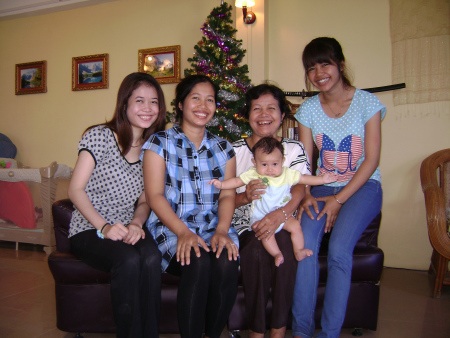
Srai Sim is my wife Makara’s mother and a survivor of the Khmer Rouge regime. This is her story.

Early Life and Marriage

Born in 1954 in Phnom Penh, Cambodia’s capital, Srai Sim was the only daughter in a family of five children. Her father worked for the government, while her mother was a homemaker.

At sixteen, Srai Sim married a hardworking young sergeant in the army. Together, they welcomed their first daughter, Srai Dtop, and looked forward to a promising future.

The Khmer Rouge Takeover

In 1975, as the United States withdrew from Vietnam, Cambodia was already in turmoil, plagued by political instability. That April, the Khmer Rouge (KR) took control of Phnom Penh, ordering its residents to evacuate under the false pretense of an impending American bombing. In reality, the KR sought to eradicate urban life and transform Cambodia into an agrarian society.

Seven months pregnant with their second child and with a three-year-old daughter in tow, Srai Sim and her family were forced to march out of the city. They were herded like cattle to Kampong Speu, where she gave birth to Srai Owne. A month later, they were relocated to Moung Roussei in Battambang province, given a week to rest, and then sent to Phnom Thippadei to build their own shelter and work under grueling conditions.

imageTragedy Strikes

Two months after settling in, KR soldiers began identifying former government workers. Srai Sim’s husband, a soldier under the previous government, was among those selected. The KR claimed these men would return safely to Phnom Penh, but only the men were taken.

A month after her husband’s departure, Srai Sim’s eldest daughter, weakened by starvation and illness, passed away before her fourth birthday. With little food herself, Srai Sim could no longer produce breast milk, and just three weeks later, baby Srai Owne also died. Soon after, a KR soldier visiting his mother in Moung Roussei revealed the truth—Srai Sim’s husband had been executed along with all the other men.

With no children to care for, Srai Sim was assigned to hard labor in the rice fields. Each day from 6 a.m. to 10 p.m., she worked under the threat of death, surviving on meager portions of rice soup. Malnourished and exhausted, she began to lose her eyesight. A friend had to guide her, and she feared being executed if the soldiers discovered her blindness.

When the rice season ended, she was reassigned to transporting wood by ox cart. The work was less physically demanding, and over time, her eyesight returned.

imageA Forced Marriage

At the worksite, Srai Sim met Heang, a former farmer. The KR leaders, intent on forcing city dwellers and rural workers to intermarry, ordered them to wed. When Srai Sim refused, insisting her husband was waiting for her in Phnom Penh (though she knew he was dead), a soldier threatened to kill her. Resigned to survive, she relented. Along with 22 other couples, they were forcibly married on the same day.

Though Heang was happy to have a wife, Srai Sim remained distant. He feared she would leave him and would cling to her at night to prevent her escape. Soon after, she was sent back to the rice fields, while Heang was relocated 40 kilometers away to cut trees. Despite the grueling distance, he would walk all night just to visit her before making the return journey.

Escape and Survival

By late 1978, the Vietnamese invaded Cambodia to overthrow the Khmer Rouge. The fighting made its way to the Moung Roussei area. KR soldiers began killing many Cambodians rather than letting them escape during the chaos of the fighting. The KR soldiers rounded up Srai Sim and all the other workers and took them into the forest where Heang was working. They sent everyone up a small mountain to create a stronghold against the Vietnamese soldiers. It was extremely hot up the mountain, and they began to run out of drinking water.

Dehydration and heat took their toll. Those who attempted to flee were shot or caught in crossfire. Realizing they would die if they stayed, Srai Sim and Heang made a run for safety. As they sprinted, bullets flew past them. Miraculously, they reached Vietnamese soldiers, who ushered them to safety. By early 1979, the KR had fallen, and the couple settled in Moung Roussei.

sim n kids sm

A New Beginning

In 1980, Srai Sim and Heang had their first son, Sarin. Over the years, they welcomed more children: Makara, Petra, Seyha, Gunya, and Dtolla.

When Sarin was 17, he joined a Christian church and became deeply involved. Though Srai Sim remained devoted to Buddhism, she allowed him to practice his faith. However, financial hardship struck, shaking her beliefs. With her family struggling, Sarin invited her to church. She agreed.

At the service, she was overwhelmed by emotion, crying throughout. Though she didn’t understand why, she felt she had encountered God. She soon chose to follow Christ.

sim school

Serving Others

In 2002, the family moved to Poipet, where Sarin found work at a casino to support them. Trusting fully in God, Srai Sim started a house church, sharing her faith with her neighbors.

Today, she continues to serve as the director of a school in Poipet, strong in her Christian faith, working tirelessly to guide others to the truth she has found.

image

Slum Dog Missionary Kid~Part One

image

I often think about how it will be for my children to grow up in Cambodia as it is so different from where I grew up. So, I thought I’d start writing about that here…

I grew up in a privileged home in Canada. Canada: one of the richest nations, good schools, “free” health care, quality law enforcement, and clean streets.

One can be quite sheltered living in Canada, but they don’t have to be. There is still the abusive family, alcoholism, homelessness, drug abuse, etc… But one can easily turn a blind eye to all of that and focus on entertainment and self fulfillment. And you don’t need a lot of money to do that; it is a mindset that makes people selfish and inward focused, not an abundance of, or lack of, money.

When I lived in Canada I would often volunteer for an inner-city church which would serve dinner to the poor every Friday night. It wasn’t a soup kitchen, it was a restaurant. The patrons would arrive, be seated, given a menu, and served by a waiter. Most of the food came from local grocery stores giving deli-made sandwiches, donairs, microwave pizza, sometimes a cake or two; all the stuff, while still good, that was no longer sellable from the store’s counter. There was rarely a shortage of that food. There was a professional chef who would cook up one special meal for the night: spaghetti and meatballs, or pork chops with mashed potatoes and gravy, something good like that. Those chef specials were always 86’d first.

Sometimes I worked as a waiter, but usually I was given doorman duty. My job as a doorman was to let people in as the empty tables allowed. And, more importantly, my job was to keep anyone out who was visibly drunk or high. Those who were denied access were given a bowl of soup, a bun, and a coffee at the door. Occasionally a disallowed customer would gladly accept his soup and toss it all over the doorman. That never happened to me though, it only happened to the doormen who got too preachy about the evils of alcohol. The key word was ‘visibly’ drunk or high. I once had a man show up wearing a jester’s hat. I told him I couldn’t let him in (I was sure I could smell booze coming from his long beard too). He asked if he could come in if he took off the hat and behave himself. I thought for a second and said yes. He went in and didn’t make any problems.

The restaurant was in the basement of an old Catholic church. The church had a rectory, then used for storage, towards the back and up an old narrow staircase. The rectory was painfully small with space for no more than a bed and a table. A pocket-sized bathroom with defunct plumbing was situated in the corner. The sanctuary was used on Sundays by the church running the restaurant. The floor of the sanctuary was old wood, uneven and wavy, covered with dirty carpet. I feared my foot would go through if I stepped on a particularly weak spot. The whole place smelled of moth balls and old plaster. It was one of those old buildings that is both alluring and repugnant at the same time.

I enjoyed working the door. As a waiter I was too busy to talk to anyone, but as a doorman I was able to have many interesting conversations. Street people don’t bother with small talk, you get all the gritty details from the start. “Hi. My name’s Joe. I’m a recovering cocaine addict. I had a relapse last week. I just got to take it one day at a time”…”My name is Steve. There are bad people trying to get into my room at night. I hear them talking in the hallway. Last night they were banging on my door. I don’t open it though. I told the landlord, but he won’t listen to me”. Often they would ask me to pray for them, which I did.

In Canada there are different kinds and levels of poverty: there is college student poor and “going out on my own” poor, which are just temporary situations; there is poor due to a lack of self esteem or ambition, in which the person will have a low paying job and a small apartment, maybe an old car, but not much beyond that, and not much hope it’ll ever get better; and then there is the deep poverty where one doesn’t have a home, or a job, or even a change of clothes. This deep poverty is not caused by laziness or lack of ambition–there are other factors, like mental illness.

My first encounter with this deep poverty happened when I was 19 years old. I was an electrical apprentice. My boss, a Christian man, would often do work for inner city businesses at a discounted rate. One of these businesses was an old hotel, maybe one hundred years old or so. Now it was being used as an apartment building for street folk. Have $50? You can rent a room at the York Hotel for a couple of nights. A ‘No Knives’ sign hung at the front entrance. The reception desk was worked by a perpetually tired woman. The wide staircase leading up to the rooms had a dusty carpet which I’m sure at one time was plush and luxurious. Each single room was just that: a single bed in one corner, a small wall-mounted sink in the other, a cheap light above the sink and one on the ceiling, both with an off-white glass shade with blue floral design, hundred year old paint job on the walls. Bathrooms were common-use down the hall, four urinals along the wall and two stalls with wooden dividers and doors. No showers. I never looked into the women’s washroom.

My boss, Bert, and I were there to fix some lights which had stopped working in four rooms, two rooms above the other two on different floors. Three rooms empty, one occupied. The problem in all four rooms was related so we started in the one closest to the electrical panel and worked our way through the other rooms in succession, and finally to the last room where the guest was staying. Bert knocked on the door and an old man answered. The man was completely naked. My sheltered 19 year old brain didn’t know what to make of that. Why would he not put clothes on before answering the door? Does he not care if a woman was knocking? What if it was the receptionist? Maybe she’d be too tired to care. The old man appeared to be half asleep. Bert, who was himself past 60 years old, calmly and politely explained why we were there and suggested the man take a moment to put some pants on before we came in, which he did.

Bert left me alone in the room to investigate above the ceiling light. The old man, wearing dingy grey pants now, lay on the bed with his back to me, sleeping. One ratty small black bag sat on the floor beside the bed. It slumped in on itself, mostly empty. Before getting on the bed, before Bert left the room, the old man did not once make eye contact with us. He always looked at the ground and nodded to whatever Bert spoke to him. There was nothing in his eyes or facial expression to show that he cared much about anything. It’s as though there was a continuous sighing coming from him, not audible, just there about him. I finished fixing what didn’t really need fixing and quietly let my self out, closing the door behind. After we’d gone I regretted not leaving some cash on his bed. I thought about that old man a lot. I still do.

To be continued…

Who Will Save Cambodia?

Sam Rainsy, photo source: rfa.org
**Sam Rainsy, photo source: rfa.org**

We don’t know what the future holds, but we know who holds the future.

When Sam Rainsy returned to Cambodia from exile he said, “I have come to rescue the country!”*

His party did not win and Hun Sen still has majority power (although greatly reduced**). But this is okay, because Sam Rainsy is not the savior of Cambodia.

Is Hun Sen a good guy? Well, click here to read for yourself. But I am personally happy with the election results.

If you study Cambodia’s history you will see that ever since the fall of the Khmer empire this small country has always seemed to be in the middle of someone else’s conflicts–Vietnam and Thailand, France and Thailand, the USA and Vietnam, the USA and China. And then there was that whole Khmer Rouge thing. As a result, Cambodia has not enjoyed any kind of lasting stability for hundreds of years.

For the last fifteen years or so Cambodia has had some measure of stability, more than its had in a long time. Older Cambodians support Hun Sen because they remember well the Khmer Rouge days and they are very happy with where the country is at now, and they credit this to Hun Sen as he is the one who’s been in power for the last three decades. Younger Cambodians have no memory of the Khmer Rouge days as they were born afterwards. They only see Hun Sen as a brutish thug who needs to be replaced quickly.

But at this time an abrupt radical change in the Cambodian government would only bring more instability, and most likely more violence. Those of us who are Christians know and trust who is really in charge. And in trusting God we can be patient and not foolishly rush into a humanistic kind of radicalism which sees political figures (and the UN, and the USA) as saviors.

What about Hun Sen? God will judge Hun Sen. And as the Gospel spreads, and the Cambodian people are shown the light of the truth, the condition of the government will follow what the people believe.

“I exhort therefore, that, first of all, supplications, prayers, intercessions, and giving of thanks, be made for all men;
For kings, and for all that are in authority; that we may lead a quiet and peaceable life in all godliness and honesty.
For this is good and acceptable in the sight of God our Saviour;
Who will have all men to be saved, and to come unto the knowledge of the truth.”
1 Timothy 2:1-4

*Opposition Leader Sam Rainsy Returns to Cambodia

**Hun Sen’s Ruling Party Claims Victory

Further reading: Time to Stop the Rhetoric; Survey of Cambodian Public Opinion; Cambodia Strives for Credible Election

Know Thy System, Know Thy Self

image

Thus says the Lord, your Redeemer, the Holy One of Israel,
“I am the Lord your God, who teaches you to profit,
Who leads you in the way you should go.”
~Isaiah 48:17

I am a blessed man. Four short years ago I came out to Cambodia a pathetic bachelor. Now I have a great wife, two wonderful kids, a good home, and a successful Christian elementary school. I am well supported by my home church, as well as by some individual donors. The organization I work with supports the school faithfully. God teaches His own to profit and I am very thankful.

I remember hearing of one missionary who mentioned to his organization’s leader that he needed music equipment for his church. The leader offered to help with the cost. The missionary went ahead and bought all the equipment: sound system, drums, guitars, etc… Afterwards he presented the receipt to the leader. The leader refused to pay for any of it. People got offended and angry.

I knew a different missionary who organized an outreach event. Again, the leader offered to cover some of the costs. After the event, no money came in. This missionary got offended and angry.

So I went ahead and asked the leader of the organization, “Why do you say you’ll help, but then don’t?”

The response was, “If we say we will help, we will help. But when someone wants money, they first need to submit a budget, then we need to approve that budget, and then we will give money, not before. We can’t just hand out money blindly. There is a system which must be followed.”

Ah, a system.

I went back to the missionary and asked, “Did you know you had to submit a budget first?”

He rolled his eyes and said, “Yeah, but I don’t have time for that!”

Don’t have time? You don’t have time to do the one thing required to get the money being offered to you? I guess it’s easier to sabotage your own chances and complain about it later.

It is like being very hungry, having a delicious plate of food in front of you, but not having the time to lift the spoon to your mouth. (Proverbs 19:24)

But I shouldn’t be too hard on him. No one had taught him the system.

When I started up the school, I knew I would need financial support. I knew there was a system to follow in order to get that support. The one problem was that I didn’t know the system. So what did I do? I got help from someone who did know the system, and she was able to guide me through the process. And it worked! I received the funding as promised. I learned the system, I respected the system, and I was able to profit from it.

The system will not be perfect, and where it needs change, we can work to change it. But to effectively change it, we must work within it. My prayer to God is that He will always be teaching me how to profit, how to work within the system, how to do what is required of me.

God willing, I will be an old experienced man one day, then it will be my job to teach the younger missionaries the system, and how to profit within it.