
The Age of Empires

stages of empire

The Fate of Empires written in 1978 by Sir John Glubb (1897-1986) is an illuminating essay on the life cycle of empires, which turn out to be very much the same for different empires around the world and through the centuries.

You can read the essay for yourself here, and I highly recommend that you do. But in this article I will try to give you a brief overview of what Glubb writes.

First, Glubb argues that the life span of empires tend to be the same: about 250 years, or ten generations (if a generation is considered to be 25 years)….
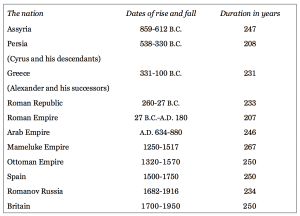
Screen Shot 2017-09-21 at 12.53.32 PM

Each empire seems to progress through four main stages: 1) The Age of Outburst/Pioneering/Conquest; 2) The Age of Affluence; 3) The Age of Intellect; 4) The Age of Decadence.*

First, in the Age of Outburst, often a group of hard working, aggressive people, who are not in any strong position of power already, rise up and take control. Perhaps they move in and take the power over from an older empire which is far along into its decadence stage, or perhaps they move in on a less developed culture and dominate it. This age is characterized by exploring men with fearless initiative and military conquest of older orders.

Second, there is commercial expansion ushering in the Age of Affluence. With one power controlling many sections of land comes ease of travel, common currency, common language, law and order — all of which allow people to trade extensively. If the empire is large, it will cover several different cultures in different climates making available many various goods to consumers all over the empire. Great wealth grows during this age.

Third is the Age of Intellect. With affluence comes a decline in “courage, enterprise, and a sense of duty … [and] the first direction in which wealth injures the nation is a moral one.” (Glubb) The general outlook of the citizens of the empire move from one of service to one of selfishness. While the Age of Intellect creates advances in science and technology, and while it also creates a culture of reason, debate, and argument, it also leads to division in the empire as the common good obvious in the previous ages becomes muddied in the endless chatter of the intellectuals. While the problems created by the selfish culture can only be solved by renewed selfless service, the intellectuals believe they can solve the problems with their new ideas. It doesn’t work and the culture weakens and loses self-esteem.

When the system holding the empire begins to degrade, the empire enters its final stage: Decadence. The people have lost sight of why the empire should even exist and have little to no desire to preserve it. Glubb gives some signs which show an empire has entered this last stage: civil dissension, an influx of foreigners (who do not conform to the host culture), frivolity, a decline in religious belief and morals, and a welfare state. The heroes of the first ages of the empire, warriors and leaders, are replaced by pop-stars and celebrity chefs. Glubb also points out that in the age of decline more and more women want to enter into positions of power previously only held by men. He doesn’t go into why, but it is interesting to point out. (A confusion of gender seems to be a factor in the Decadence stage.)

Glubb asks the important question: Can we learn from history? His answer is yes, if we actually study it — if we actually study world history instead of only our own empire’s history. Only when we learn to prevent the Age of Decadence by not becoming selfish and lazy in the Age of Affluence can we hope to break through the continuing fate of empires.

Further reading…

First Things: Camille Paglia’s Teaching

The Case Against Western Civilization by James B. Jordan

I also highly recommend James B. Jordan’s book Crisis, Opportunity, and the Christian Future

*Glubb divides the life span of the empire into six stages: 1) Pioneers; 2) Conquest; 3) Commerce; 4) Affluence; 5) Intellect; 6) Decadence. I’ve compressed it to four for the sake of simplicity.


Jesus and Covenantal Righteousness

Screen Shot 2017-09-17 at 2.21.26 PM

Do we fully grasp the righteousness of Jesus in the post-Reformation world? Is theology set in stone now? Was it perfected by the Reformers?

The Reformation did a lot of good for Christianity, but one thing it did not do is reconnect the Church with its Hebraic roots in covenant; i.e. the covenant started with Abraham and continuing on to Jesus and beyond. Post-Reformation Christians are more influenced by Plato than they are by Abraham, Moses, David, the prophets, and even Paul.

Because the modern Church does not have a proper understanding of the covenant which existed between God and Israel, we get a whole lot wrong when trying to understand the life, teachings, and work of Jesus two thousand years ago.

Followers of Plato tend to believe that there is a standard of good and evil, which can exist apart from God, which God Himself submits to, even if He Himself created that standard. Hebrew faith, however, holds that God arbitrarily decides what is good and evil, and without God there would be no such thing as good and evil. If the Hebrews are correct, then how can we ever know if we are in right standing with God? According to the Hebrews, we can know through covenant: a covenant in which the conditions are clearly laid out for each party — God has His obligations and the people have theirs.

The righteousness of Jesus, then, in regards to His life and ministry two thousand years ago, is not so much dependant on Him perfectly submitting to a standard of good and evil as it is dependant on Him perfectly submitting to the conditions of the covenant existing between God and Israel.

So, we could say that the primary mission of Jesus (the man living two thousand years ago) was not to live a perfect life without sin on behalf of all mankind (although He did indeed do that); His primary mission was to fulfill the primary mission of Israel, which was to reconcile mankind with God.

That kind of sounds like saying the same thing twice in just a little different way. But, why couldn’t have God just given the mission of Israel directly to Jesus first? Why fumble around with Israel at all? I write a little about that here: In The Fullness of Time.

In the Fullness of Time

hourglassBut when the fullness of the time had come, God sent forth His Son, born of a woman, born under the law, to redeem those who were under the law, that we might receive the adoption as sons.

~Galatians 4:4-5 (NKJV)

Why couldn’t have Jesus been born to one of Eve’s virgin daughters?

Why did God “fumble” around with Israel for hundreds of years before finally sending the One person who could save humanity from its fallenness?

One answer that could be correct is that God wanted humanity to mature to a certain point before sending Jesus.

When Jesus did come, there were two important things that had happened by that time: 1) The Roman Empire had advanced to the furthest point humanity could ever hope to advance to without Jesus; 2) Israel had regressed to the lowest state it could ever regress to thus completely disqualifying them of their God given purpose in the world.

Let’s start with Israel. Israel was a kingdom of priests to the nations; to act as mediators between God and the world. Just as original humanity was created to image God to creation in wise stewardship, and image creation to God in thankful worship, so Israel was created to image God to the nations and the nations to God. When they followed that purpose they were at peace with the nations, but when they rebelled against it, they were at war with the nations.

The number one issue which turned the Israelites away from their calling was the worship of the gentile gods. Read through 1 & 2 Kings and see the pattern: Israel worshipped false gods, there was a time of discipline from God, there was repentance, things got better. Finally, God had enough and sent Israel into exile. If they weren’t going to fulfill their calling, they would lose their nation and position as mediators. The exile was temporary and Israel was later allowed to go back to Jerusalem, rebuild the city and the temple.

Notice, when reading the Old Testament, the Israelites didn’t deal with demons at all. Elijah didn’t go around casting out unclean spirits from individuals. The war was with the false gods.* However, when Jesus came onto the scene, there were demons everywhere, and Jesus never had to rebuke the Jews for their worship of Baal. This is illustrated in the parable found in Luke 11:24-26….

“When an unclean spirit goes out of a man, he goes through dry places, seeking rest; and finding none, he says, ‘I will return to my house from which I came.’ And when he comes, he finds it swept and put in order. Then he goes and takes with him seven other spirits more wicked than himself, and they enter and dwell there; and the last state of that man is worse than the first.” (NKJV)

The Israelites were purged of their gentile god worship in the exile, and never fell into that again. But, by the time Jesus came, the Jewish people had fallen into something worse: they made their own religion into a false god. No longer were they acting as mediators between God and man, leading gentiles to salvation — now they were actively keeping people out of the kingdom through their false interpretation of their covenant with God (see Matthew 23:15). They couldn’t have made a more heinous mistake, and were worse off then than before the exile.

When reading Daniel 2 & 7 and Revelation 13, it can be seen that the Roman Empire was a conglomeration of the three empires which came before: Babylon, Persia, and Greece. After Babylon fell, Jerusalem and Judah became the spiritual heart (the Holy Land) of those empires. Israel was no longer a sovereign nation, but as far as God’s calling for the Jews was concerned, what came after the exile was more glorious than what was there before (see Jeremiah 31:31-40 and Zechariah 2:1-13).

The Roman Empire was the furthest development of those empires; it was the combined strength and wisdom of the greatest societies that existed before the rule of Jesus. Where was humanity to go from there but downward? It was time for the true King of the world to come and take His place. That is illustrated in Daniel 2 & 7 — the kingdom of God comes and crushes the old empires and consumes the world.

It is somewhat of a mystery** as to why God would want humanity to progress to a certain point before acting. That is true for our own personal lives as well. If God would act sooner, things would get better quicker, right? But, if humanity was created to grow and mature over time, then this action of God makes sense, to a certain degree anyway. Children don’t always understand the actions of their parents, at least not until they’re old enough to do so.

We must trust that in the fullness of time, or when the time is right, God will act, and the best possible outcome will result.

Here is a related message by James B. Jordan in which he discusses the maturation process of humanity…..


*I realize that there were demons behind those false gods.

**N.T. Wright in his book The Day the Revolution Began writes this:
“…the ‘continuing exile’ [the exile into Babylon and the continued subjugation under Gentile powers afterward] of Daniel 9 and many other texts, was not just a long, dreary process of waiting. It was the time in which the strange power called ‘Sin,’ the dark force unleashed by human idolatry, was doing its worst precisely in the people of God. God’s people were captive, enslaved, to Babylon and its successors and to the dark powers that stood behind them. What God was doing through the Torah [the law], in Israel, was to gather ‘Sin’ together into one place, so that it could then be condemned.” (Page 286)

***

Thomas Sowell Quotes #10

“History can be cruel to theories, as it has been cruel to peoples … But history is what happened, not what we wish had happened, or what a theory says should have happened. History cannot be prettified in the interests of promoting ‘acceptance’ or ‘mutual respect’ among peoples and cultures. There is much in the history of every people that does not deserve respect. Whether with individuals or with groups, respect is something earned, not a door prize handed out to all. It cannot be prescribed by third parties, for what is to be respected depends on each individual’s own values or the social values accepted by that individual–and ‘equal respect’ is an internally contradictory evasion. If everything is respected equally, then the term respect has lost its meaning.”

~from the Preface of Migrations and Cultures: A World View

Why Does Justin Trudeau March in Gay Pride Parades?

Screen Shot 2017-08-25 at 8.58.44 AM

As a Christian, I don’t agree with the gay lifestyle. But, also as a Christian, I believe gays are created in the image of God and are deserving of dignity and respect. I’ve known several gay men and women throughout my life, and what I’ve always seen in them are people struggling to live normal decent lives.

This is why I hate gay pride parades. Pride parades don’t portray gays as dignified or people deserving of respect. They portray them as fools and buffoons who are completely obsessed with sex; people whose entire identity is based on their sexual orientation. If that’s truly what it means to be gay, then why would we celebrate that? And if that’s not what it means to be gay, then why are we portraying it as such?

Imagine if gays were in the majority and straights in the minority, and there were “straight pride” parades in which men and women dance around, bare asses showing, grinding each other in the streets, onlookers cheering and yelling, “Straight pride! Yeah!” It would be absurd. No one would take straight people seriously, and I, as a straight man, wouldn’t be caught dead participating in one of those parades.

So why does the Prime Minister of Canada attend so many pride parades? Does he really care for gays and think that pride parades are what’s best for them? Possibly. But I would argue he’s not there to help gays, nor does he really care about them. He’s there to virtue signal to straight liberals. He’s there to show the whole world what a cool national leader he is — not like that orange haired idiot down south!

If you’re gay and reading this article, I hope you’re pursuing a life of dignity, decency, and respect. I believe you will only find that life by turning to Jesus, who will not reject you simply for being gay.

***

Now, you might not like Lauren Southern because she’s too “right wing”. I certainly don’t agree with a bunch of what she says. But, I ask you to put that aside for the moment, because I think she really gets to the core issue of pride parades in this video……