Unicorns in the Bible

unicorn 001
The Bible (King James Version) mentions the unicorn several times: Numbers 23:22, 24:8; Deuteronomy 33:17; Job 39:9; Psalm 22:21, 29:6, 92:10; Isaiah 34:7.

Other versions of the Bible, such as the New American Standard Version, will instead use the term wild ox, as the Hebrew word, rê’em [pronounced: reh-ām’], probably refers to a wild bull.

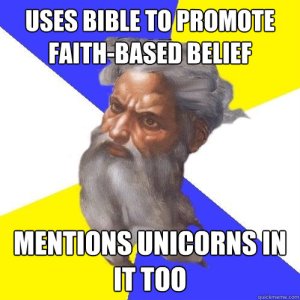
Atheists like to bring up the Bible’s use of unicorns to attack its validity. Surely, if the Bible mentions unicorns, a mythical beast lacking any evidence for ever existing, then the Bible itself is a mythical document not to be taken seriously.

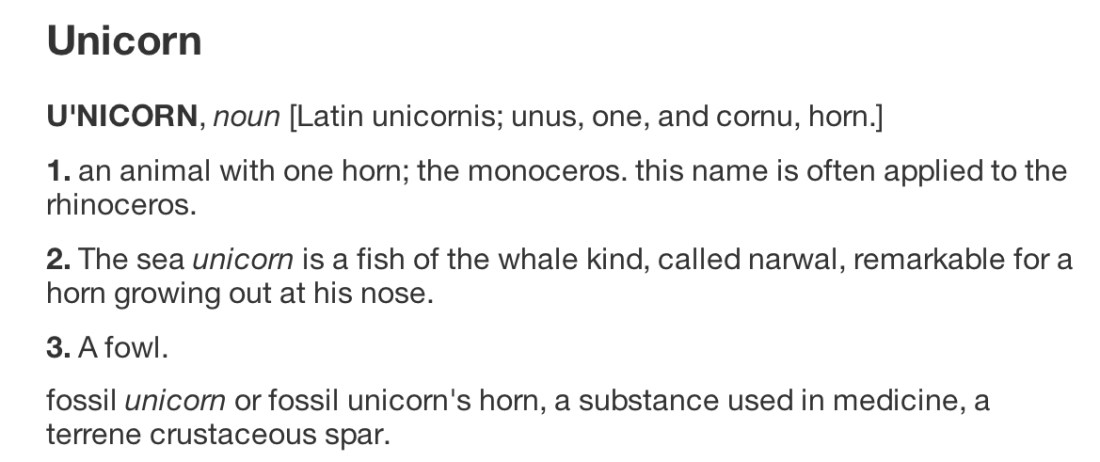
But what an intellectually lazy argument it is to automatically assume that the KJV Bible, a document translated over 400 years ago from Hebrew, Greek,* and Latin sources,** would use the word unicorn in the same way it is used today. Indeed, all you have to do is go back 200 years to find unicorn defined differently than today. The 1828 Webster’s Dictionary defines it as this…

unicorn

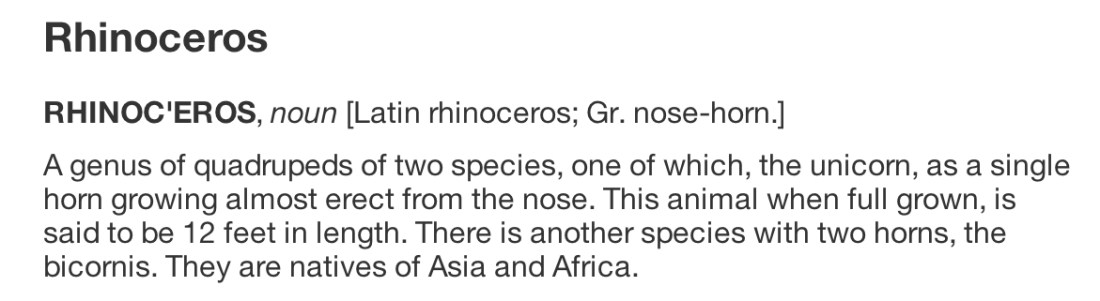
A rhinoceros. And the same dictionary defines rhinoceros as this…

Rhino

This does not mean that the KJV Bible is talking about rhinoceroses when using the term unicorn. But, it does make it rather obvious that the definition of unicorn is not the same today as it was 400 years ago, and the argument to write-off the Bible as myth due to its use of the word unicorn is unfounded.

Here is a good video which inspired this article…

* The Greek of unicorn is μονόκερως transliterated as monokeros [one horn].

** The Latin version of the Bible (the Latin Vulgate) uses the term rinocerotis in Deuteronomy 33:17 and rinoceros in Job 39:9.

God & Humour

bps

Notice that humour, no matter what culture you’re from, is based on the “fallenness” of Man. There is always the contrast of our nobleness against our absurdity: a well dressed man slipping on a banana peal; the oldest and wisest of us being too deaf to understand what’s going on; the majestic design of our bodies and any white man dancing…

Whether the joke is dark, clean, dry, family oriented, racial, or about animals, the formula is always the same.

So what if our “fallenness” was taken away? What if we were always noble and majestic without all the insanity? Would we be grey and boring? Well, it depends. But, for the moment we can at least be certain that our humour is a product of our circumstance: the contrast of what we were designed to be opposed to what we currently are.

Does God have a sense of humour? It doesn’t appear so in the Bible. Jesus wept, but He didn’t laugh — at least it wasn’t recorded if He did. On the one hand, if the formula above is correct, God can’t have a sense of humour as He is not fallen in any way. On the other hand, we are created in His image, so if we have some sense of humour it must come from Him.

The only explanation that makes sense is that God does indeed have humour but it transcends our own — a humour based on joy rather than the conflicting absurdity which is our current existence. Our humour is but a broken shadow of His own.

It’s hard to understand as everything we experience seems to be relative to other things. You put your left hand in ice cold water, and your right hand in hot water, then put both hands in room temperature water — your left will feel it as hot while your right as cold. So, which is it? Does the picture below make you sad or angry? Or do you laugh?

dark

IC1101

ic1101

I’m always amazed when I think of IC1101, the largest galaxy known.

Whereas our own, Milky Way, galaxy is about 100 thousand light years across and contains about 200 to 400 billion stars, IC1101 is 6 million light years across and may contain up to 100 trillion stars.

The galaxy is made up of mostly old reddish yellow stars, in contrast to the Milky Way’s young bluish stars. There are not many new stars being created in IC1101, and it most likely grew to its size by several galaxies colliding into each other over the ages.

I wonder what the night sky would look like if Earth were a part of IC1101 rather that the Milky Way. Would there always be a reddish yellow glow, even at midnight? Would our telescopes be able to penetrate the trillions of stars to reveal the universe beyond? Would we even know there were other galaxies?

Here are a couple of good videos featuring IC1101….


Related reading: The Largest Galaxy in the Known Universe – Futurism

The Gift of Translation

17951546_1253070168140005_4069840308123258842_n
With it being the Easter season, the photo on the right is what you’ll see on a typical atheist Facebook fan-page including the caption, “Read a history book Christians.” The argument being, I guess, that Christians are so stupid that they don’t realize they’re actually worshipping a pagan fertility god on Easter instead of Jesus. Well, if that argument is valid, then I could also say the same for atheists celebrating Christmas — “Those atheists are so stupid. They think they are celebrating a holiday time of giving and family, but they are unknowingly worshipping Jesus.” It’s a stupid argument.

My response to the Facebook post was this:
Christians co-opted pagan holidays and made them their own; made them Christian holidays. It’s similar to how secular culture has co-opted some Christian holidays. That’s what happens when one culture dominates another. Christians know the true origin of Easter, and they don’t care. They’ve changed it into a holiday to celebrate the resurrection of Christ.

And it got me thinking about speaking in tongues. In Acts 2, the disciples were given the ability to speak new languages so that all who were present at the temple heard the “wonderful works of God” in their own language. Tongues is best understood when studied in relation to Babel. At Babel (Genesis 11), God scattered the nations through the confusion of language. Directly after that, He called Abram and set him apart from the nations. From Abram came Israel, which was a nation of priests to the Gentile nations to act as a mediator between God and man. The mission of Israel was perfected and completed in Jesus through His death and resurrection — the old world died in Christ and a new world was born with His rising. Once the work of Jesus was complete, there was no more need for the nations to be separate, so God reversed Babel and brought them back together. He did that at Pentecost (Acts 2) through the gift of tongues… or a better way to say it: the gift of translation.

The gift of tongues/translation is manifest today in that wherever Christians go, they translate Christianity into the receiving culture. That starts with language, i.e. the Bible, but it doesn’t end there. Language has two aspects: the objective and the subjective. The objective is simply using words to pass along information. The subjective however, is poetry, novels, song lyrics, plays, movies, TV shows, etc… All that which creates a culture comes from the subjective.

We can call the before-Christ time the Old Covenant World, and the after-Christ time the New Covenant World. In the New Covenant world, Christ has all authority and that authority passes down to the Church. One thing Christians can do, which Old Covenant Israelites could not do, is choose their own holidays. In the Old Covenant, God strictly decided when Israel’s festivals and holidays would be. In the New Covenant world, Christians decide for themselves — the Christian calendar is much more arbitrary. Another aspect of the authority handed to Christians is the fact that Christians are commissioned to take over the world.

So, we can put this all together: 1) Translation; 2) Holidays; 3) Dominion. When Christianity is moving in on a new culture, it will translate itself into that culture, remaking the holidays, and taking dominion. That’s how it works with any dominating force moving in on another culture. We see it with non-Christian influences as well, such as the secular force in the west today.

In Cambodia, the biggest holiday of the year is the Khmer New Year, which is the Buddhist new year celebration. The holiday is celebrated by water fights — people in the streets throwing water at each other. It’s a good way to celebrate, since April, when the holiday falls, is the hottest month of the year. What would happen to Khmer New Year if Cambodia became a Christian nation? Would the celebration of Buddhism still stand? No. Would there still be water fights in April. Most probably. It would just be co-opted by the Christians. In fact, what a great way to celebrate Easter — with the living water of Jesus.

Further reading…

Was Easter Borrowed from a Pagan Holiday – Christianity Today

Concerning Halloween – James B. Jordan

Thomas Sowell Quotes #7

Moral condemnation is not causal explanation, despite how often the two have been combined in a politically attractive package. Despite the tendency of political, and especially ideological, explanations of economic disparities to combine moral and causal factors, the reason so many mountain peoples [for example] around the world have been poor has not been that others went up into those mountains and took away their wealth, but that the mountain peoples seldom produced much wealth in the first place…

“…it is staggering that some people imagine that they can take on the [large] task of righting the wrongs of the past, committed by people long dead, without igniting dangerous new hostilities among the living.”

~from Wealth, Poverty and Politics, page 271-272