Free Speech is for Jerks

Screen Shot 2017-06-16 at 11.36.04 AM
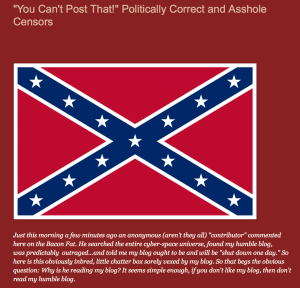
Screenshot of the blog “The Baconfat Papers”

Recently an Edmontonian man was charged with hate speech for a blog he wrote called The Baconfat Papers (www.sunrayzulu.blogspot.com). The blog has been removed, but I found some of his articles via Wayback Machine.

Now, while I hate racism and think it’s evil (and this guy’s blog was especially despicable — basically at the Westboro Baptist Church level), if a guy wants to write a racist blog, he has the right to do so. That’s free speech, and free speech is for jerks too. If you are offended, don’t read it.

If a guy writes a blog which physically threatens someone or calls for others to physically hurt someone, that’s different. That’s no longer free speech of course, since someone’s life may be in danger.

I don’t know if the author of Baconfat, Barry Winters, actually physically threatened anyone; maybe he did. If he did, yes he needs to be charged — but not with hate speech.

“Hate Speech” is one of those ambiguous terms that confuse the issue and leave too much room for abuse. If Barry Winters physically threatened someone, then let him be charged specifically for that. Or, if he called for others to physically hurt someone, let him be specifically charged for that. But if he just wrote a bunch of blogs about how he hates Natives and gays, so be it — that’s just his opinion. It’s evil and wrong, and you can either write to him and tell him why he’s wrong, or, more wisely, just ignore him. There are plenty of guys like Barry Winters out there. They pose no threat unless we give them a platform. And the way to remove their platform is to ignore them — not remove free speech for everybody. Because in the end, who will it be that defines “Hate Speech?”

~Further reading…

He may be Canada’s ‘ultimate troll,’ but should Edmonton blogger be charged for spreading hate?

Progressive Conservatism

This is What it’s Like to be a Race Baiter in Alberta

***

BS’rs vs Liars

Smells-Like-Bullshit_fb_99704

A liar is someone who knows that what he’s saying is not true, and he wants to deceive you for his own personal gain and/or to protect himself. He doesn’t necessarily want his lie to be true. He just wants you to believe it so that he can get on with his plans.

A bullshitter, however, while not speaking the perfect truth, wants what he’s saying to be true, and he wants you to want it to be true as well. He will over exaggerate his statistics to make things appear to be better, or more worthy of praise, than they really are. He knows it’s bullshit, he feels it inside, but he convinces himself it’s true just long enough to blurt it out. He hopes that you won’t look too deeply into what he’s saying, and he knows most people won’t.

Thomas Sowell Quotes #8

“[U]nder any movement or set of collective beliefs, a feeling of being on the side of angels can be a dangerous self-indulgence in a heedless willfulness that is sometimes called idealism. This kind of idealism can replace realities with preconceptions, and make the overriding goal the victory of some abstract vision, in defiance of reality or in disregard of the fate of fellow human beings. The symbols of the preconception can become goals in themselves.”

~from Wealth, Poverty and Politics, page 420

In a vision driven group, “buying into the vision” is seen as more virtuous than actually doing something useful. Even those in the group who aren’t doing anything, or who are doing things poorly, will be held in high regard if they “get a hold of” and celebrate the vision. Conversely, those who may be doing productive work which is good for others, but show little enthusiasm for the vision, will be seen as dangerously independent and not “team players.”

Further reading: Shop Class as Soulcraft (Brief Book Review)

Unicorns in the Bible

unicorn 001
The Bible (King James Version) mentions the unicorn several times: Numbers 23:22, 24:8; Deuteronomy 33:17; Job 39:9; Psalm 22:21, 29:6, 92:10; Isaiah 34:7.

Other versions of the Bible, such as the New American Standard Version, will instead use the term wild ox, as the Hebrew word, rê’em [pronounced: reh-ām’], probably refers to a wild bull.

Atheists like to bring up the Bible’s use of unicorns to attack its validity. Surely, if the Bible mentions unicorns, a mythical beast lacking any evidence for ever existing, then the Bible itself is a mythical document not to be taken seriously.

But what an intellectually lazy argument it is to automatically assume that the KJV Bible, a document translated over 400 years ago from Hebrew, Greek,* and Latin sources,** would use the word unicorn in the same way it is used today. Indeed, all you have to do is go back 200 years to find unicorn defined differently than today. The 1828 Webster’s Dictionary defines it as this…

unicorn

A rhinoceros. And the same dictionary defines rhinoceros as this…

Rhino

This does not mean that the KJV Bible is talking about rhinoceroses when using the term unicorn. But, it does make it rather obvious that the definition of unicorn is not the same today as it was 400 years ago, and the argument to write-off the Bible as myth due to its use of the word unicorn is unfounded.

Here is a good video which inspired this article…

* The Greek of unicorn is μονόκερως transliterated as monokeros [one horn].

** The Latin version of the Bible (the Latin Vulgate) uses the term rinocerotis in Deuteronomy 33:17 and rinoceros in Job 39:9.