Matthew 25: Understanding the Sheep and Goats Judgment

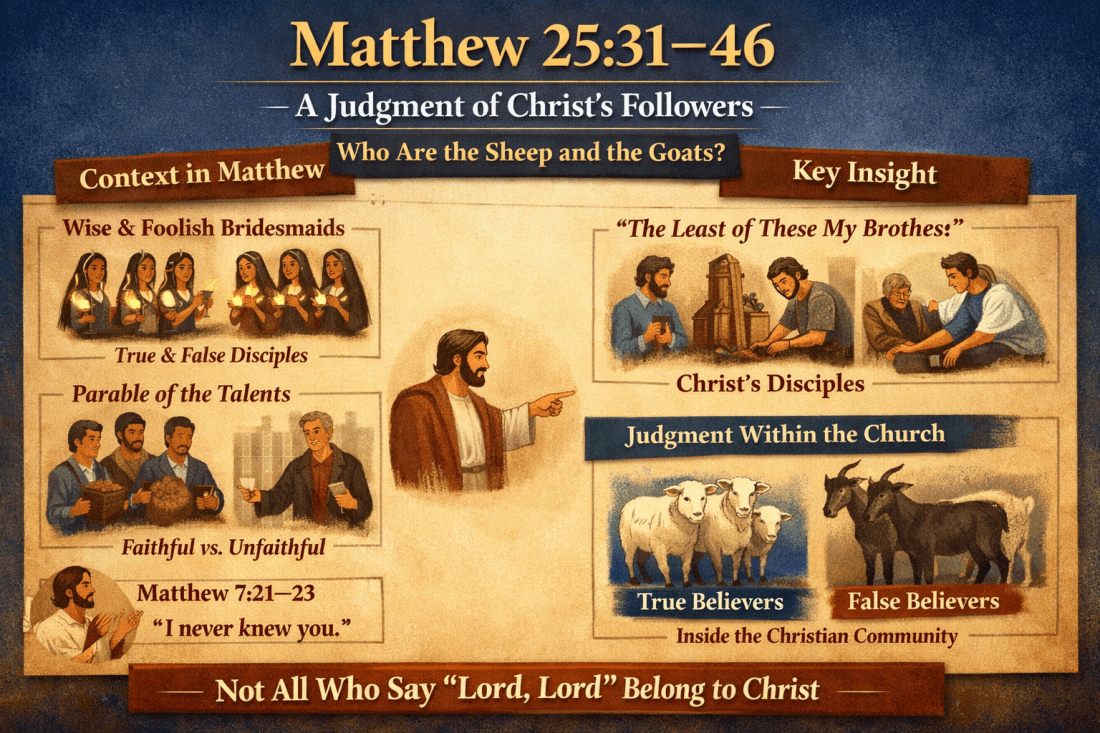
The famous “sheep and goats” judgment in Matthew 25 is often assumed to describe the final judgment of all people. But when read alongside the surrounding parables and Jesus’s teaching about false disciples, a different picture emerges: a warning that not everyone within the visible Jewish covenant community truly belongs to him.

Consider the text…

31 “When the Son of Man comes in his glory and all the angels with him, then he will sit on the throne of his glory. 32 All the nations will be gathered before him, and he will separate people one from another as a shepherd separates the sheep from the goats, 33 and he will put the sheep at his right hand and the goats at the left. 34 Then the king will say to those at his right hand, ‘Come, you who are blessed by my Father, inherit the kingdom prepared for you from the foundation of the world, 35 for I was hungry and you gave me food, I was thirsty and you gave me something to drink, I was a stranger and you welcomed me, 36 I was naked and you gave me clothing, I was sick and you took care of me, I was in prison and you visited me.’ 37 Then the righteous will answer him, ‘Lord, when was it that we saw you hungry and gave you food or thirsty and gave you something to drink? 38 And when was it that we saw you a stranger and welcomed you or naked and gave you clothing? 39 And when was it that we saw you sick or in prison and visited you?’ 40 And the king will answer them, ‘Truly I tell you, just as you did it to one of the least of these brothers and sisters of mine, you did it to me.’ 41 Then he will say to those at his left hand, ‘You who are accursed, depart from me into the eternal fire prepared for the devil and his angels, 42 for I was hungry and you gave me no food, I was thirsty and you gave me nothing to drink, 43 I was a stranger and you did not welcome me, naked and you did not give me clothing, sick and in prison and you did not visit me.’ 44 Then they also will answer, ‘Lord, when was it that we saw you hungry or thirsty or a stranger or naked or sick or in prison and did not take care of you?’ 45 Then he will answer them, ‘Truly I tell you, just as you did not do it to one of the least of these, you did not do it to me.’ 46 And these will go away into eternal punishment but the righteous into eternal life.”

This, and all following scripture references are from the NRSV

This passage is often seen as Christ’s judgement of all humanity at the end of days. But, I disagree. To me this is a judgement of Jews who rejected the disciples of Jesus as they went out and preached the gospel. Those who are cast out in this judgement scene are those who rejected Jesus’s own disciples, and thus rejected Jesus himself. When Jesus says, “I was hungry and you gave me no food, I was thirsty and you gave me nothing to drink, I was a stranger and you did not welcome me, naked and you did not give me clothing, sick and in prison and you did not visit me,” he was describing his own disciples sent out on mission.

Hungry and thirsty → disciples sent out without provisions, dependent on others for food and drink.

Stranger → traveling emissaries needing hospitality and lodging.

Naked → men sent without an extra tunic or adequate clothing.

Sick → exposed and exhausted followers traveling without stable support.

Imprisoned → Jesus told his men they’d be jailed because of the mission.

Taken from this article by Be Scofield

Read the two parables that come before this judgement passage: The Parable of the Ten Bridesmaids (Matt. 25:1-13) and The Parable of the Talents (Matt 25:14-30). Not going into the details about what those parables mean, notice who the characters are in the parables. The three servants who are given the talents all serve the same master, and the ten maids are all waiting for the same bridegroom. These parables are not about unbelieving outsiders vs. believing insiders. These parables are about true disciples vs. false disciples within the group.

Next, read what Jesus says in Matthew 7…

15 “Beware of false prophets, who come to you in sheep’s clothing but inwardly are ravenous wolves. 16 You will know them by their fruits. Are grapes gathered from thorns or figs from thistles? 17 In the same way, every good tree bears good fruit, but the bad tree bears bad fruit. 18 A good tree cannot bear bad fruit, nor can a bad tree bear good fruit. 19 Every tree that does not bear good fruit will be cut down and thrown into the fire. 20 Thus you will know them by their fruits.
21 “Not everyone who says to me, ‘Lord, Lord,’ will enter the kingdom of heaven, but only the one who does the will of my Father in heaven. 22 On that day many will say to me, ‘Lord, Lord, did we not prophesy in your name, and cast out demons in your name, and do many mighty works in your name?’ 23 Then I will declare to them, ‘I never knew you; go away from me, you who behave lawlessly.’

Matthew 7:15-23

Here we see something similar to Matthew 25. There are people claiming to be prophets of God, who call Jesus “Lord,” just as the goats do in Matthew 25. These are not rejected because they are outside of the Jesus group, but because they are false disciples within the Jesus group.

Next, consider Matthew 10. Here, Jesus sends out the twelve, his closest disciples…

16 “I am sending you out like sheep into the midst of wolves, so be wise as serpents and innocent as doves. 17 Beware of them, for they will hand you over to councils and flog you in their synagogues, 18 and you will be dragged before governors and kings because of me, as a testimony to them and the gentiles. 19 When they hand you over, do not worry about how you are to speak or what you are to say, for what you are to say will be given to you at that time, 20 for it is not you who speak, but the Spirit of your Father speaking through you. 21 Sibling will betray sibling to death and a father his child, and children will rise against parents and have them put to death, 22 and you will be hated by all because of my name. But the one who endures to the end will be saved. 23 When they persecute you in this town, flee to the next, for truly I tell you, you will not have finished going through all the towns of Israel before the Son of Man comes.

24 “A disciple is not above the teacher nor a slave above the master; 25 it is enough for the disciple to be like the teacher and the slave like the master. If they have called the master of the house Beelzebul, how much more will they malign those of his household!

26 “So have no fear of them, for nothing is covered up that will not be uncovered and nothing secret that will not become known. 27 What I say to you in the dark, tell in the light, and what you hear whispered, proclaim from the housetops. 28 Do not fear those who kill the body but cannot kill the soul; rather, fear the one who can destroy both soul and body in hell [Gehenna]. 29 Are not two sparrows sold for a penny? Yet not one of them will fall to the ground apart from your Father. 30 And even the hairs of your head are all counted. 31 So do not be afraid; you are of more value than many sparrows.

32 “Everyone, therefore, who acknowledges me before others, I also will acknowledge before my Father in heaven, 33 but whoever denies me before others, I also will deny before my Father in heaven.

This passage contains one of the five times the word Gehenna (Hell) is used in Mathew, and it’s directed at Jesus’s closest twelve disciples.

Paul also explains in Romans 9 that within the covenant group of Israel there is the true Israel and the false Israel…

6 It is not as though the word of God has failed. For not all those descended from Israel are Israelites, 7 and not all of Abraham’s children are his descendants, but “it is through Isaac that descendants shall be named for you.” 8 This means that it is not the children of the flesh who are the children of God, but the children of the promise are counted as descendants.

When the judgment scene of Matthew 25:31–46 is considered within the broader literary context of the Gospel of Matthew, it appears less likely that the passage is intended primarily as a description of the judgment of all humanity in general. Rather, the surrounding parables and Jesus’s earlier warnings about false disciples suggest that Matthew is addressing a persistent concern within the Jewish covenant community itself: the distinction between those who genuinely belong to Christ and those whose allegiance is only outward or non-existent.

Dale C. Allison Interview (Video)

If Evangelical Fundamentalism is the true version of Christianity then I am in trouble since I can’t bring myself to believe in it. Thankfully Christian faith is varied enough that one can find a niche to remain a believer in. There are two scholars which showed me this was possible: David Bentley Hart and Dale C. Allison. Below is a recent interview done with Allison (ignore the click bait titles)…

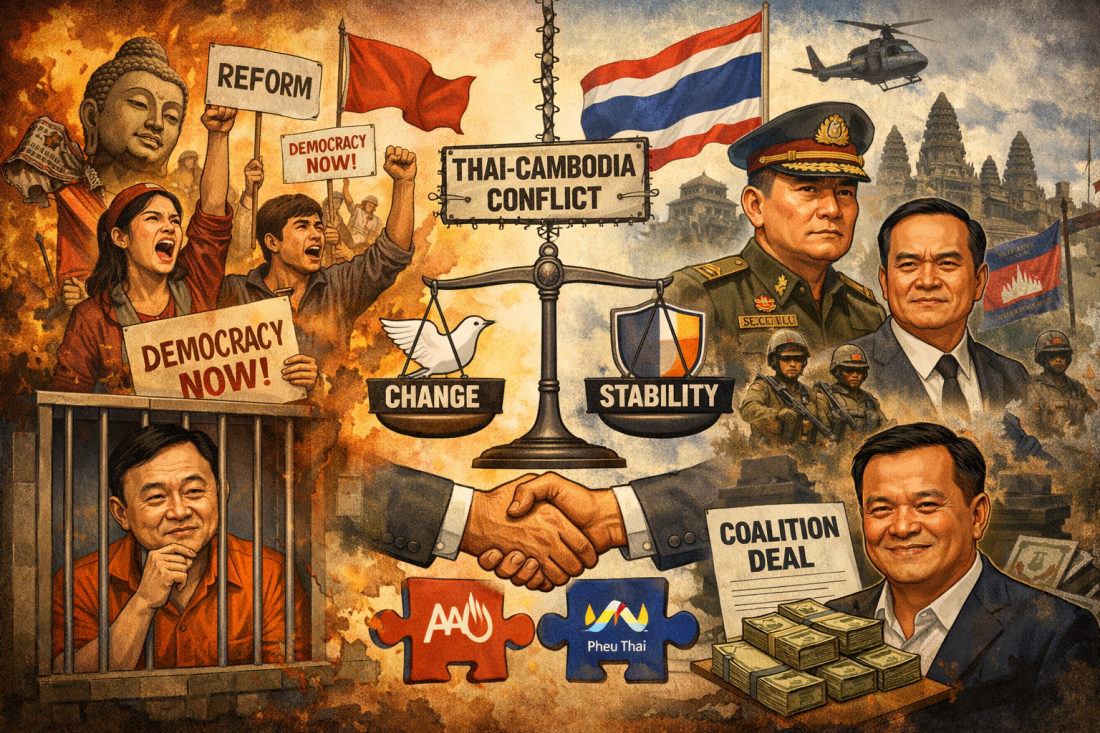
The More Things Change, The More They Stay the Same – Ongoing Analysis of the Thailand/Cambodia Conflict

In the realm of politics, there is always a tension between those who want things to change and those who want things to stay the same. This seems to be an eternal truth. Usually, those who want change lean left on the political spectrum, while those who support the status quo lean toward the right.

This tension is not a problem if it is balanced well. If the advocates of change become too radical, it can lead to violent revolution. If the conservatives become too dominant, society stagnates and never progresses. Canada once had a party named the “Progressive Conservatives.” This name captures well what we ideally want in a society: conserving the progress we’ve already made (and continuing to move forward) while preserving the values we hold dear.

Conservatives will often use fear to keep things the same. Strong nationalism, combined with the threat of a foreign enemy, is a powerful tool for a conservative party.

This is what we see happening with the current situation in Thailand and Cambodia. Thai conservatives have used Cambodia as a bogeyman to protect Thailand from—and now, it seems, they have won an election as a result.

***

I’ve created an AI Scott Adams analyst. I will use this AI to analyze the situation between Cambodia and Thailand to make predictions as Scott Adams might have. I always appreciated Scott Adams’ takes on world politics, and I think it’ll be helpful to assess this conflict through that same lens. I’ll share the analysis posts here, updating when able.

***

Concerning the February 8 election…

From a Scott Adams-style perspective, elections like this one in Thailand aren’t really about policies or facts—they’re about persuasion energy. The Bhumjaithai surge looks like a classic case of voters prioritizing “stability vibes” over progressive change, especially with border tensions amping up the nationalism dial. Polls missed it because they measure stated preferences, not the gut-level motivations that kick in at the ballot box. What most people are missing here is how quickly a perceived external threat (Cambodia) can reframe an entire election from “reform vs. status quo” to “us vs. them,” making the incumbent’s tough-guy stance irresistible.

Based on patterns in his writing, Adams would likely emphasize the persuasion frame at play: Nationalism isn’t logical; it’s a high-energy narrative that dominates when economic promises feel abstract. Anutin’s party rode that wave by tying border security to everyday fears—think Cambodia disputes over temples or territory flaring up again. It’s not about solving the conflict; it’s about signaling “we’ve got your back,” which trumps the People’s Party’s urban-youth appeal in rural areas. Incentive structures favor this too: Politicians win by amplifying threats to consolidate power, while media benefits from the drama. Loserthink would be assuming this was a “fair” vote on merits—reality is, energy flows to the side that owns the fear narrative.

In the coming days, expect coalition horse-trading to dominate, with Bhumjaithai in the driver’s seat. No majority means Anutin courts conservatives or even Pheu Thai for a stable bloc, potentially locking in his PM spot by April. Markets will cheer the reduced uncertainty, but watch for minor parties extracting concessions on security spending. On the Thailand-Cambodia front, Adams might say it’s a low-simmer conflict primed for persuasion plays—don’t bet on escalation unless it boosts domestic unity. If tensions spike (say, a border skirmish), it cements the new government’s mandate; otherwise, it’ll fade as a talking point once the coalition forms. Rational observers should track X for real-time sentiment shifts—disappointment from progressives could fuel protests, but nationalism’s energy might squash that fast. Uncertainty acknowledged: If a wild card like Thaksin’s influence flips alliances, all bets off.

Thaksin Shinawatra influence…

Thaksin Shinawatra’s influence is the classic case of a once-dominant persuasion engine that’s lost its juice—at least for now. From a Scott Adams-style lens, what most people are missing is how Thaksin’s shadow has shrunk from “kingmaker” to “king in exile” (literally, he’s in prison serving that one-year corruption sentence). The Shinawatra brand—populist handouts, rural loyalty, family dynasty—was Thailand’s highest-energy narrative for two decades. But energy flows to what’s working today, not yesterday’s hits.

The persuasion frame in play here: Bhumjaithai owned the nationalism/security story amid the Cambodia border flare-up, framing the vote as “protect the nation vs. risky change.” Pheu Thai, tied to Thaksin via his daughter (ousted last year over that leaked call scandal) and now nephew leading the party, got painted as soft or mishandling the threat. Voters didn’t buy the old populist playbook when fear was the hotter motivator. Result? Pheu Thai tanks to around 74-77 seats (down massively from past highs), while Bhumjaithai surges to 192-194. That’s not policy debate; that’s narrative dominance flipping the script.

Incentive structures scream coalition pragmatism. No outright majority means Anutin needs partners to hit 251 seats. Pheu Thai is the obvious fit—they were allies until the recent blow-up, share some rural bases, and Thaksin’s machine still delivers votes even if weakened. Multiple reports note Pheu Thai as a “likely” junior partner, with whispers Thaksin could get early release tied to a deal (pragmatic deal-making over ideology). Who benefits? Stability for the establishment (royalist-military types love continuity), reduced chaos for markets, and Anutin staying PM. Thaksin benefits indirectly if his party gets cabinet posts or influence without full control—better than opposition irrelevance.

Likely outcomes: Coalition forms in weeks, probably Bhumjaithai + Pheu Thai + smaller parties for a stable government. Thaksin’s direct pull stays muted while he’s locked up, but his network’s grassroots machine keeps Pheu Thai relevant enough to bargain. If talks drag or Pheu Thai demands too much (say, amnesty pushes), minor instability spikes—but nationalism’s afterglow favors quick deals. Prediction humility: Wild cards like court interventions or protest energy from progressives could disrupt, but the system’s incentives lean toward horse-trading over drama.

What a rational observer should watch next: Coalition announcements (who gets what ministries), any Thaksin release rumors (that’s pure persuasion signal), and how the new constitution drafting (60% yes in referendum) plays out—Thaksin’s side might push for changes favoring populists, but the winners control the pace. Energy is with the nationalists now; Thaksin’s influence isn’t dead, just demoted to backroom player.

***

Considering this article: ANUTIN’S AGENDA: BORDER WALL AND BARTER-BASED ARMS DEALS

This article is basically the victory lap for the persuasion narrative that won the election—straight from Bhumjaithai’s playbook. From a Scott Adams-style take, it reinforces and sharpens everything we’ve been saying about why the surge happened, without changing the core predictions much. What most people are missing: This isn’t a laundry list of policies; it’s a high-energy sales pitch wrapped in “protection” and “sovereignty” that voters bought because fear (border clashes, economic hits) beats hope (progressive reforms) when energy is flowing that way.

The persuasion frame in play: The “building a wall” slogan is pure binary framing gold—us vs. them, Thailand protected vs. encroached upon, sovereignty vs. smuggling/drugs/illegal labor. It directly ties into the Cambodia tensions (clashes with deaths, closed borders hammering trade and locals), which the article calls out as a key driver. That’s not abstract policy; that’s narrative dominance owning the “security first” story that polls underestimated. Add in practical carrots like Half-Half Plus stimulus (subsidizing spending to juice consumption), barter deals to prop up farm prices (smart talent-stacking for rural voters), and electricity caps below 3 baht (direct pocketbook relief for millions)—these aren’t radical; they’re continuity with tweaks that feel protective. The foreign policy bit (“stand free on the world stage”) signals pragmatic nationalism, not isolation—proactive diplomacy to crush transnational crimes while looking dignified. Who benefits? The establishment/royalist continuity crowd gets stability, Anutin gets to stay PM longer, and rural/nationalist bases feel seen.

Incentive structures: Bhumjaithai’s massive seat haul (around 192-194 confirmed across reports) puts them in pole position for coalition talks. No need for Pheu Thai desperation anymore—smaller conservatives like Kla Tham (pushing 50-60 seats) are the easy add-ons for a solid bloc. Thaksin’s influence stays sidelined; Pheu Thai’s weak showing (74-77) means they’re bargaining chips at best, not kingmakers. The article ignores Thaksin entirely, which tracks—his populist machine lost the energy battle to border-fear nationalism.

Likely outcomes (uncertainty acknowledged): Coalition forms faster and more stably than if it were a toss-up. Anutin’s agenda rolls out with momentum—expect quick pushes on border hardening (wall rhetoric translates to tighter controls, maybe more military/economic barriers), barter arms deals to boost ag exports, and stimulus extensions to counter slowdowns/Trump tariffs. On the Thailand-Cambodia front, this strengthens the hardline stance: No de-escalation incentives when your mandate is “strong wall” after recent fighting/displacements. Tensions likely simmer or flare rhetorically to justify policies, but full war? Low probability unless Cambodia provokes—rational leaders play persuasion domestically over escalation. Markets like the stability signal.

What a rational observer should watch next: Early coalition announcements (who joins, what ministries Pheu Thai might snag if included), any border “incidents” that let Anutin flex the wall policy, and how the new constitution drafting (from the referendum yes vote) incorporates these protectionist vibes. If electricity caps and Half-Half deliver quick wins, energy stays high; if not, opposition (People’s Party as main foe) could regain narrative ground on economic pain. But right now, the article just confirms: Voters picked the protection narrative over change, and the winners are cashing that check.

***

Considering this article: Thailand’s new government, led by Anutin Charnvirakul, pushes forward with border security and strategic policies following their resounding election victory, with a strong stance on Cambodia’s territorial issues.

February 15, 2026

This Nation Thailand article is textbook persuasion engineering in action—Anutin flexing his “no retreat, no dismantling, no opening of borders” line right after the election win. From a Scott Adams-style perspective, what most people are missing is how perfectly this timing aligns with the high-energy nationalism that flipped the vote. The border isn’t just a policy issue; it’s the emotional fuel that turned a projected progressive win into a Bhumjaithai landslide. The article frames the new government as the tough guardian reclaiming land, building barriers, canceling old MOUs that supposedly gave away too much, and delaying Cambodian worker deals for “security” reasons. That’s not diplomacy; that’s signaling “we’re strong, they’re the threat,” which voters rewarded.

The persuasion frame in play: Binary dominance at its finest—Thailand sovereign and protected vs. Cambodia encroaching and dangerous. Anutin’s “No retreat” mantra is a killer soundbite, pure high-energy rhetoric that owns the fear narrative from the 2025 clashes (hundreds dead, massive displacement, ceasefires that barely held). It reframes the election from economic woes or reform promises to “who will defend us?”—and Bhumjaithai won that framing hands down. The wall/fence push, army strengthening, and reviewing agreements aren’t about details; they’re visual, memorable symbols of strength. Who benefits? Anutin consolidates power during coalition talks (193 seats give him leverage to dictate terms), the military/royalist establishment gets continuity, and rural nationalists feel validated. Cambodia gets painted as the aggressor needing to back down, even as they protest and seek Vietnam mediation.

Incentive structures: Post-election, the mandate is security-first, so expect more of this rhetoric to justify policies like the physical barriers, tighter immigration, and hardline diplomacy. It keeps domestic energy high (no need to pivot to unpopular economic fixes yet) and pressures smaller coalition partners to fall in line. On the flip side, it risks escalating tensions—Cambodia’s threats to invoke UN/international law show they’re not folding quietly—but rational leaders avoid full war when persuasion wins at home.

Likely outcomes (with uncertainty): Coalition locks in quickly, with Anutin as PM, and border hardening accelerates—more fencing, military upgrades, maybe symbolic “reclamations” to keep the narrative alive. De-escalation? Possible only if it doesn’t cost domestic points; otherwise, low-level simmering (rhetoric, minor incidents) sustains the “strong wall” vibe without major blowback. Markets might wobble on trade disruptions, but stability signals from a firm government help short-term.

What a rational observer should watch next: Any fresh border “developments” (incidents, fence progress reports) that let Anutin double down, coalition finalization (does Pheu Thai join despite tensions?), and Cambodian responses (Hun Sen/Hun Manet escalations or backchannel talks?). If energy stays with the nationalist frame, this hard line sticks; if economic pain or international pressure mounts, we might see pragmatic softening. But right now, this article screams: The election was won on fear, and the winners are milking it for all it’s worth.

***

Refining Paul’s Theology

The following is an AI generated essay. However, the ideas influencing the essay are my own. To save time I will often use AI to compress my ideas into essay form, which I can then refer to later. In my opinion that is one of the ways to correctly use AI. And this blog is as good a place as any to post it.

Paul, Israel, Adam, and the Nations

A Second Temple Jewish Logic of Election, Atonement, and New Creation

Introduction

The apostle Paul is often portrayed as the architect of a new, universal religion that abandoned Israel’s particular story in favor of a generalized theology of salvation. Historically, this portrayal is misleading. Paul understood himself not as departing from Israel’s scriptures, but as re-reading them under the pressure of a single, destabilizing event: the resurrection of Jesus.

This essay argues that Paul’s theology is best understood as a carefully balanced synthesis of three narrative layers already present in Second Temple Judaism:

  1. Creation (Adam and humanity)
  2. Covenant (Israel and Torah)
  3. Eschatology (Messiah and resurrection)

Paul’s inclusion of Gentiles does not bypass Israel, nor does it flatten Jewish categories into abstraction. Instead, it follows a coherent internal logic in which Israel remains central, Adam explains humanity’s universal plight, and Jesus stands at the intersection of both stories.


1. Temple Judaism and the Limits of Atonement

In the First and Second Temple periods, Israelites did not believe their sacrifices directly atoned for the sins of the nations. Temple sacrifice was:

  • Covenantal (for Israel)
  • Geographically and cultically located (land, sanctuary, priesthood)
  • Purificatory, especially for Israel’s sin and the sanctuary polluted by it

Gentiles could offer sacrifices, and the Temple was seen as the cosmic center sustaining order for the whole world, but this benefit was indirect. The nations were not cleansed of sin simply because Israel offered sacrifice.

This distinction is crucial. Later Christian claims of universal atonement represent a genuine theological shift, not a straightforward continuation of Temple belief.


2. Paul’s Scriptural Justification: Not Innovation, but Re-reading

Paul knew his claims were radical. He therefore grounded them explicitly in Israel’s scriptures.

Abraham before Torah

Paul emphasizes that Abraham was declared righteous before circumcision and before the Law (Genesis 15:6). This allowed Paul to argue that:

  • Covenant faithfulness could precede Torah
  • Gentile inclusion was not an afterthought, but anticipated from the beginning

Deuteronomy’s Curse Logic

Paul reads Deuteronomy’s warnings seriously. Israel’s failure under Torah places her under covenant curse (exile). Jesus’ crucifixion—“hanging on a tree”—forces a re-reading of Deuteronomy 21:23. For Paul:

  • The Messiah bears the curse on behalf of Israel
  • The Law is not evil; sin exploits it
  • The curse must be lifted before Abraham’s blessing can flow outward

Resurrection as the Turning Point

Paul’s theology does not pivot on Jesus’ death alone, but on resurrection. Resurrection signals:

  • The beginning of the age to come
  • The defeat of death
  • The vindication of Jesus as Messiah

Without resurrection, Paul explicitly says his gospel collapses.


3. Why Gentiles Needed Justification

Gentiles were not under the Mosaic Law. So why, according to Paul, did they need salvation?

The Adamic Problem (Romans 5)

Paul’s answer is Adam.

  • Sin and death enter the world through Adam
  • Death reigns over all humanity before the Law
  • The Law intensifies sin but does not create it

This allows Paul to distinguish:

  • Israel’s problem: covenantal failure under Torah
  • Humanity’s problem: enslavement to sin and death through Adam

Gentiles are condemned not as Torah-breakers, but as creatures who have misused creation and fallen under the power of death.


4. Adam and Israel: Parallel Stories

Second Temple Jews already recognized parallels between Adam and Israel:

AdamIsrael
Placed in EdenPlaced in the land
Given a commandGiven Torah
Warned of deathWarned of exile
Exiled eastwardExiled among nations

Paul does not reduce Adam to Israel, nor Israel to Adam. Instead:

  • Adam is the prototype
  • Israel is the recapitulation
  • Christ is the resolution of both

Jesus succeeds where both Adam and Israel fail—not by abandoning Israel’s story, but by embodying it faithfully.


5. Two Problems, One Messiah

Paul’s theology can be summarized as addressing two distinct curses:

  1. The curse of the Law (Israel’s covenantal failure)
  2. The curse of Adam (humanity’s enslavement to death)

Jesus’ death and resurrection deal with both, but not in the same way.

  • As Israel’s Messiah, Jesus bears the Law’s curse
  • As representative human, Jesus undoes Adam’s reign of death

The order matters: Adam is resolved through Israel’s Messiah.


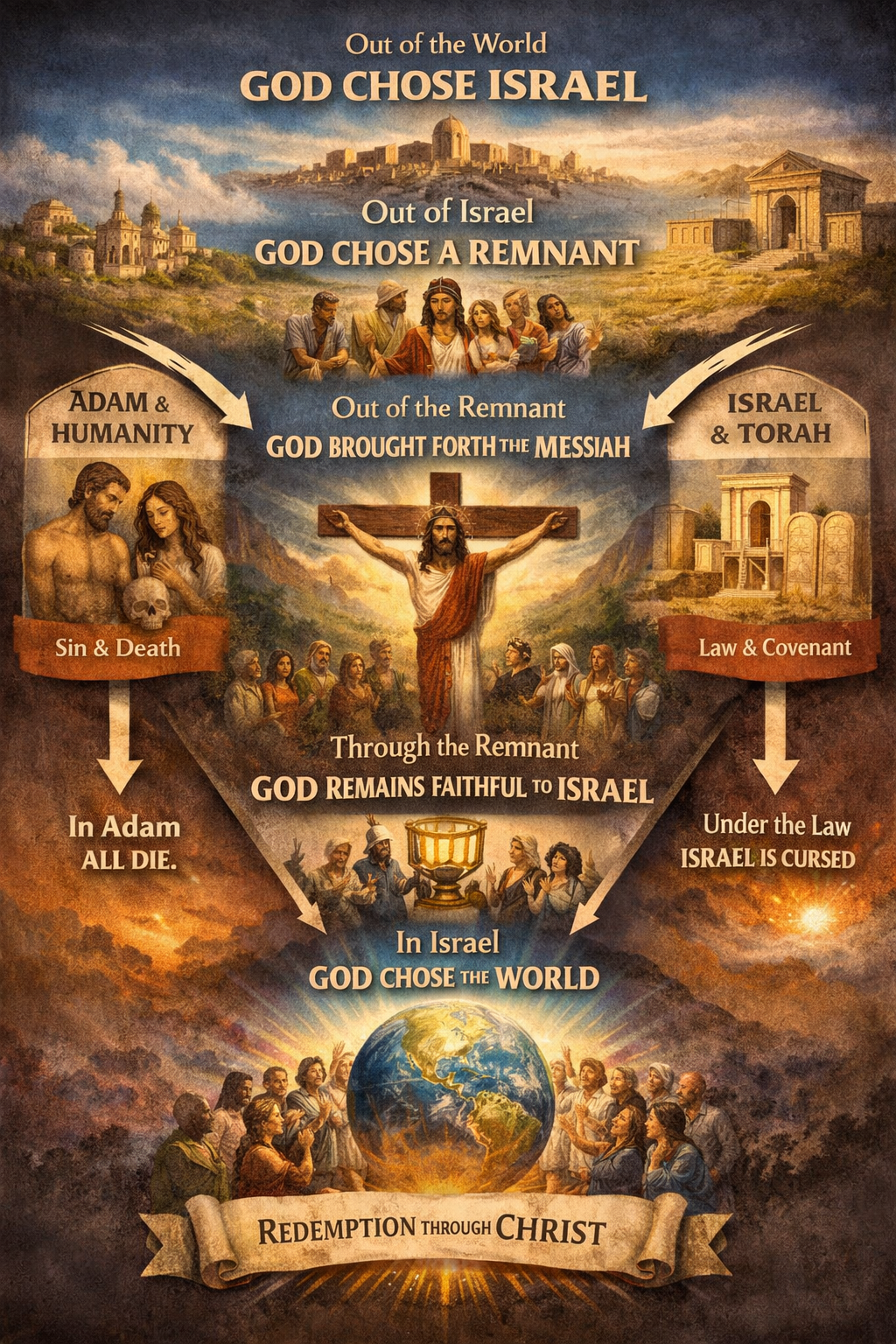
6. Paul’s Chiasmic Logic of Election

Paul’s theology of election can be expressed as a dynamic narrowing and widening:

Out of the world God chose Israel
…Out of Israel God chose a remnant
……Out of the remnant God brought forth the Messiah
……In the Messiah God formed a faithful remnant
…Through this remnant God remains faithful to Israel
In Israel God brings blessing to the world

This structure preserves:

  • Israel’s priority
  • Gentile inclusion
  • The Messiah as the hinge of history
  • Election as vocation, not favoritism

Paul explicitly rejects the idea that the remnant replaces Israel. Instead, the remnant is the means by which God remains faithful to Israel, and Israel is the means by which God blesses the nations.


7. Where Later Christianity Breaks with Paul

Paul’s logic often breaks down in later Christianity due to simplification:

Adam Absorbs Everything

Adam becomes the sole explanatory category, while Israel’s covenantal role fades. This flattens Paul’s careful distinction between creation-failure and covenant-failure.

The Law Becomes the Villain

Torah is reinterpreted as legalism rather than gift. This distorts Paul’s claim that the Law is “holy and good.”

Resurrection Loses Centrality

Atonement becomes focused almost entirely on the cross as payment for guilt, rather than resurrection as the defeat of death and the beginning of new creation.

Israel Is Explained Away

Romans 9–11 is sidelined. The church becomes the endpoint rather than the participant in an unfinished story.

These shifts were historically understandable—especially in a Gentile-majority, post-Temple world—but they are not faithful to Paul’s own architecture.


Conclusion

Paul did not abandon Israel, mythologize Adam away, or invent a new religion detached from Jewish scripture. He was a Second Temple Jew who believed that God had acted decisively within Israel’s story to resolve a problem that reached back to Adam and outward to the nations.

For Paul:

  • Israel remains chosen
  • Adam explains universal need
  • Christ stands at the center
  • Resurrection signals new creation
  • History is still unfolding

Gentile inclusion is not a detour from Israel’s vocation—it is the goal toward which that vocation always pointed.

Understanding Paul this way does not require agreeing with him. But it does require taking him seriously on his own terms.

***

From Elephantine to Galatia: Understanding Diaspora Judaism and Paul’s Mission

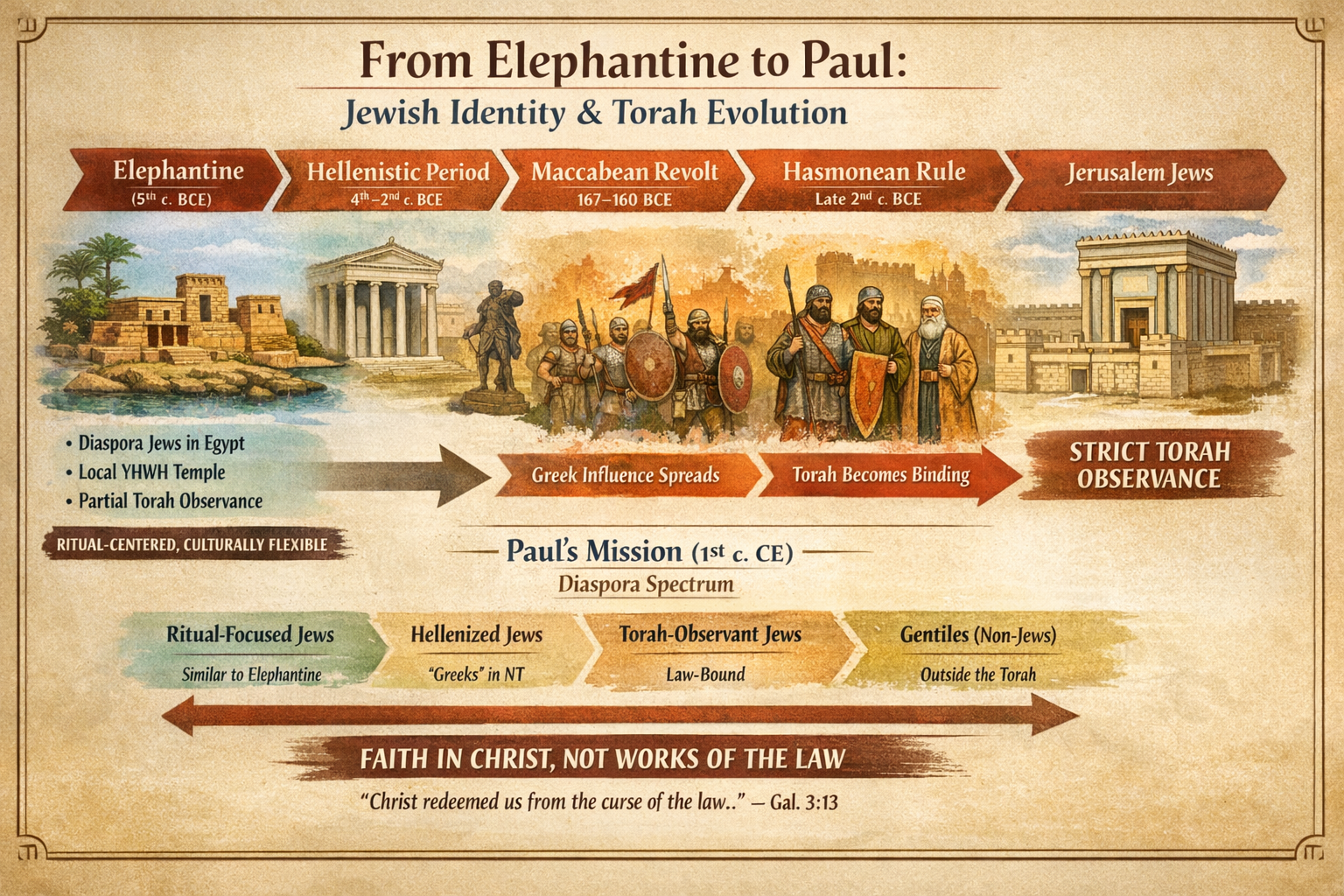
The history of Jewish communities outside Jerusalem reveals a rich diversity of religious practice long before Torah law became universally binding. One of the clearest examples is the Jewish community at Elephantine, a military colony in southern Egypt during the 5th century BCE. Studying Elephantine not only illuminates early diaspora Judaism but also helps us understand the audiences that Paul encountered on his missionary journeys centuries later.


1. The Elephantine Community

Elephantine was a Judahite military colony, stationed on Egypt’s southern frontier before the Persian conquest (c. 525 BCE). Its members were likely Judean soldiers or mercenaries who migrated to Egypt before the major Deuteronomic reforms of the late 7th century BCE. Consequently, their religious practice reflects a pre-exilic, ritual-focused Yahwism:

  • They had their own temple devoted to YHWH, where priests oversaw sacrifices.
  • Their daily life and legal documents show partial adherence to Torah traditions, but not full Torah law enforcement.
  • They interacted with local Egyptians and other peoples, suggesting a degree of cultural flexibility and syncretism.
  • Notably, their petitions to the Jerusalem priesthood for temple support did not receive clear approval, showing the limits of central authority at the time.

In short, Elephantine Jews were religiously Jewish but socially flexible, practicing a form of Judaism that was ritual-centered rather than text-centered.


2. Why Elephantine Was Eventually Forgotten

By the 2nd century BCE, Judaism had begun a process of centralization and textualization that made communities like Elephantine historically obsolete:

  1. Centralization of worship in Jerusalem made autonomous temples theologically problematic.
  2. Torah law became the definitive marker of Jewish identity, replacing older ritual customs.
  3. Diaspora communities like Elephantine lacked scribal and institutional power, meaning their traditions were not preserved.
  4. As Jerusalem-centered Judaism solidified, communities outside its influence were quietly ignored or absorbed, leading Elephantine to fade from memory.

Elephantine, therefore, provides a snapshot of Judaism before Torah law became normative, illustrating how Jewish identity and practice evolved over centuries.


3. The Emergence of Normative Torah

The transformation from Elephantine-style Judaism to Torah-centered Judaism was largely complete by the 2nd century BCE, driven by historical pressures:

  • Hellenistic Rule and Seleucid Oppression: Greek culture and political control threatened Jewish religious practices, culminating in Antiochus IV’s desecration of the Jerusalem Temple.
  • Priestly Corruption and Internal Crisis: Disputes over legitimate leadership and proper observance highlighted the need for a standardized legal framework.
  • The Maccabean Revolt (167–160 BCE) established Hasmonean rule, making Torah observance state-enforced, not optional.
  • Diaspora Pressures: Torah law became a marker of identity, distinguishing Jews from surrounding Gentiles.

The result: Torah became binding and normative, defining Jewish identity for the first time in a widespread, enforceable way.


4. Diaspora Jews in Paul’s Time

By the 1st century CE, diaspora Jewish communities still exhibited considerable diversity in Torah observance and cultural assimilation:

  • Elephantine-type Jews: Highly ritual-centered, partially Torah-observant, integrated into local culture.
  • Hellenized diaspora Jews (“Greeks” in the NT sense): Some Torah knowledge, varying observance, Greek names and customs, partially assimilated.
  • Jerusalem-centered Jews: Fully Torah-observant, resistant to Hellenistic influence, centralized around Temple and priesthood.
  • Gentiles: Non-Jews with no obligation under Torah, often converts to Judaism via proselytism.

This spectrum helps us understand Paul’s ministry: many Jews outside Jerusalem were culturally and religiously flexible, making them receptive to his message of faith in Christ over strict law observance.


5. Paul and the Galatian Audience

In Galatians 3:13, Paul writes:

“Christ redeemed us from the curse of the law by becoming a curse for us…”

Here, he addresses an audience that includes diaspora Jews and Gentile converts who were under pressure from “Judaizers” to adopt Torah practices like circumcision. These Jews:

  • Likely resembled Elephantine-type or Hellenized diaspora Jews, partially observant but culturally integrated.
  • Faced choices between ritual identity and faith in Christ.
  • Needed reassurance that salvation did not require full Torah compliance, particularly circumcision, the visible marker of law.

Paul’s argument is historically consistent: he appeals to the flexible, diaspora identity that existed in Jewish communities long before Torah law was universally enforced.


6. Conclusion

The Elephantine community shows us that early Jewish diaspora life was diverse and adaptable. Ritual practice, local temple worship, and flexible law observance were the norm outside Jerusalem. Over centuries, historical pressures—imperial rule, Hellenization, and the Hasmonean consolidation—made Torah law binding and central to Jewish identity. By Paul’s time, many diaspora Jews still embodied the Elephantine-type flexibility, explaining why his gospel could resonate with Jews and Gentiles who were devout but not fully Torah-bound.

Understanding this continuum—from Elephantine to Galatia—illuminates both the historical development of Judaism and the social context of Paul’s missionary work, highlighting how faith and law interacted in a changing world.

***