Playtime and Real Life

It seems the line between playtime and real life is fading these days. I see this everywhere, but here I want to focus on Bible College.

Here’s what I mean by playtime and real life:

In playtime, you decide when things will begin, and when they’ll end. Also, what you do in playtime has no impact on the outside world around you. For example, think of a paintball game. In a paintball game you’re playing war. You and your friends decide you will “fight” from 9am till 2pm, with a break for lunch in between. Even though you are shooting at each other, no one is going to die or be seriously injured. Your play war will have no impact on the outside world; no one cares what you are doing in your little arena. No one outside or inside your game is going to change their lives on account of it.

Real war, however, is different. No one knows when a real war begins or when it will end. Everyone’s lives, inside the war and around it, will be affected. There are great responsibilities in war, for the foot soldier and the general. Death is real.

In some Bible Colleges there is a thing called “practical ministry” — where the students are supposed to get “real world” experience. But that is not what they get…

  
In “practical ministry,” playtime is confused with real life. No one is living real life in school. Practical ministry should really be called “playtime ministry.” Playtime is sometimes good as a way to learn about real life, but only as long as everyone understands the difference between the two and does not get them confused.

Practical equals reality. We need schools like this…

  
This confusion of playtime and real life carry on after the student has finished school, which is when the student faces the harsh reality and finds it is not what they expected.

Rather than having “practical experience” I think it would better to have an apprenticeship program. Students remain in the classroom full days for the first two years, learning all the theory they need. Then, if they pass that stage, they are assigned to a real ministry and apprentice there for an additional two (or more) years. There they will be trained in a real world situation, complete with all the responsibilities that come with it. Once their apprenticeship is complete, they will be ready to go out on their own.

Why Would Any Christian Support Trump?

If you needed another reason not to read “Charisma News”, then click the link and read the article…

Prophetic Dream: From Trump to Triumph

It’s interesting — Several years ago, when Bill Clinton was messing around with interns, Christians were (rightfully) angry, and wanted him impeached. Now there is Donald Trump, who appears to be even more morally inferior than Clinton, and yet there are many American Christians who support him. (Although, I would argue that most American Christians do not support Trump.) But why would any Christian support Trump?

Listening to the Trump-supporting Christians lately, I’ve come to this conclusion: 

These Christians are no longer looking to the president to represent them, but are rather now looking to the president to protect them. 

Protect them from what? I’ve also noticed that the Trump-supporting Christians tend to be the Christians who believe the world is going to end in the next ten years or so. And so, they believe life is soon going to be much more difficult for Christians (and there may be some truth to that). But, because of their brand of eschatology, they believe there is no more work to be done, they’ve been rejected, and they see themselves as little more than victims until Jesus comes back. They’re angry as hell, and they’re not going to take it anymore.

They want to usher in the end. Their fascination with Trump is the same as their fascination with disaster movies. Despite the fact that they see Trump as the saviour of America, they really don’t care if Trump destroys the country — that’s really what they want. They see God as a revolutionary, who no longer has any influence in America other than to kill and destroy. They say they want to be triumphant in the current order of things, but secretly wish they won’t be.

If Trump does become president, and if God is behind that, then I believe that will be an act of judgement by God. An act of judgement on the American Church for selling its soul to politics. If God is using Trump, then of course it’ll lead to triumph, just in a very different way than the Trump-supporting Christians think.

Update: Here’s another recent “Charisma News” article which supports what I’ve written above…

Donald Trump is the New World Order’s Worst Nightmare

Past & Future

clock

We are all connected in relationship. Some relationships are more important than others. Some are close at hand while others are far away. But we also have relationship through time. We are connected to all those who came before us, and with all those who will come after us.

Below is a link to an article I wrote about how Christian philosopher Eugen Rosenstock-Huessy viewed relationships through time…

Click here: Past and Future

**Note: I’ve updated some of this article in a new blog post.

Bastardized Christianity

there-are-no-illegitimate-children-only-illegitimate-parents-quote-1

A new worldview which exists in the west these days is something called New Atheism. The main proponents are Richard Dawkins, the late Christopher Hitchens, and others like them.

New Atheists tend to believe that their worldview was created in a vacuum — that, in and of itself, it formed from nothingness and exists as a stand-alone philosophy on life.

Atheism is nothing new. Simple atheism has been around probably as long as simple religion has been around. But New Atheism is something different. It is a completely reactionary phenomenon.

New Atheism is a reaction to Christianity; it can not exist without Christianity; it carries with it many of the attributes of Christianity.

We can look at three attributes of New Atheism…

  1. Morality — New Atheists are very moral. They want fairness and equality. They care about the under-dog.
  2. Hope for a better future — New Atheists believe that, through natural evolution and social programs, life can and will get better for humanity.
  3. Evangelism — New Atheists believe that all must adopt their worldview in order to “save mankind.”

These three attributes can only be found previously in Christianity (and before that, Judaism). In no other religion will you find the moral concern for people that you find in Christianity. In no other religion will you find the concept of life getting better on a linear timeline. No other religion evangelizes.*

There is a belief that the world drastically changed in the 18th century. To some extent that may be true. But to the New Atheist, the 18th century is when humanity’s eyes were finally opened to the truth. The darkness of the past was swept away by the shining lights of science and reason. For the Christian, the darkness of the world was swept away two thousand years ago with the advent of Jesus Christ.

In the days of Jesus, when a new king came to power, heralds (called euaggelistēs in Greek, or evangelist in English) would proclaim this good news (or euaggelion in Greek) to all the people.** It was good news if you previously supported this king. It might not have been good news if you opposed him. But, if you had opposed him, you were give a chance to turn away (repent) from your previous allegiances and commit your loyalty to the new king.

New Atheists  believe that the event of the euaggelion occurred in the 18th century, and are very frustrated at the fact that not everyone has pledged their allegiance to the new prevailing  order.

With the euaggelion comes a hope for a better future. In Christianity, the belief is that, because Jesus is now king, the world will be restored to a state of purity with freedom, love, and eternal life.

The New Atheists also believe that humanity is progressing to a better existence, and that this will be brought about by our continued evolution, both in the natural sense and the social sense. The problem with this is that there is no reason to believe that humans will evolve into anything better than what we are currently. Suppose some natural disaster happens, limiting the food supply, drastically changing the environment, and only the physically strongest and those who have no problem with killing survive? What would humanity evolve into then? Back to apes?

Most of the world’s religions in the past, and the present, view time as cyclical. Life just keeps on going with no change, around and around forever. Only in Judaism and Christianity will you find a hope for a better future coming to pass on a linear timeline. This idea is now found in New Atheism.

Westerners love Buddhism. They love the peace and the meditation practices and whatnot. But all you have to do is spend some time living in a Buddhist country and you’ll see what it really is. Buddhists suppress emotion, they don’t control it, they suppress it — and as a result, there can be some unexplained, unpredictable violent outbursts. Buddhists do not help the poor. The poor are poor because of karma. They deserve it. To try to relieve them from poverty is to go against karmic fate. This is the morality of Buddhism. Only in Christianity and Judaism will you find a moral duty to help the poor, the under-dog, and the suffering.

New Atheists hold to the very same moral structure that Christians do, they just don’t know where they got it from.

As we can see above, New Atheism is defined by Christianity. All of its main attributes come from Christianity. New Atheism would not have arisen in a Buddhist culture. It is entirely a reaction to Christianity.

Another misconception of New Atheism is the belief that Christianity, and all other religions, are an attempt to explain the natural world, and now that we have science to do that, there’s no reason for anyone to continue to hold on to religion.  But no religious people throughout human history saw their religious beliefs in this way. In fact, not all religions, Buddhism for example, even believe in a creator.

So where did New Atheism come from? As I write above, it came from within Christianity itself. Who were the fathers? It was all those who, while still believing in God, figured that they could explain God with reason. They brought God, who is outside our universe, and pulled Him into our world, into a lab, and tried to study and define Him. They took reason itself off of the foundation of God, gave it its own foundation, and from there began to critique God. That was the birth on New Atheism.

It’s like a man, being born blind, taking the whole visible world, with all its colours, and limiting it to his own confining senses. If he doesn’t know he’s blind, he won’t know he’s doing anything wrong. Taking reason off of the foundation of God is like gouging our own eyes out, and then erasing our memories of anything we once saw.

I, as a Christian, of course cannot help but criticize New Atheism, but there are atheists who do so as well:

The Atheist Delusion by John Gray

The Closed Mind of Richard Dawkins by John Gray

Know Nothing: The True History of Atheism by Michael Robbins

* Muslims do not evangelize. The definition of the word implies “good news” and that’s not what Muslims proclaim. Muslims proselytize. Christians proselytize too, but only in conjunction with evangelism.

** The Greek words euaggelion and euaggelistēs both have the prefix eu (pronounced ‘you’) which means “joyful.” The second part of the word, aggelion (pronounced ‘ang-ghelion’) means messenger or message and is where the English word “angel” comes from.
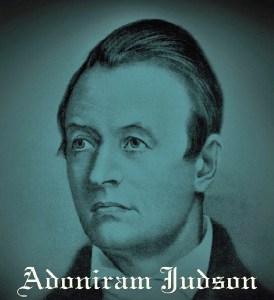
Adoniram Judson

adoniram-judson1I’m amazed at the story of Adoniram Judson. He was an American missionary to Burma in the early 1800’s.

Here are a few facts about his life after he arrived in Burma:

-During the voyage to Rangoon, Nancy (his first wife) suffered a stillbirth and had to be carried off the ship to their new land.

-He and his wife spent twelve hours a day studying the Burmese language.

-They had great difficulties sharing the Gospel as the Burmese people had no concept of an eternal God who cared about mankind.

-They slowly built a church up to about ten people by the summer of 1820. These believers began to evangelize to their own people even when the Judson’s were not around to supervise. One started a new school, one became an assistant pastor, and the others began distributing tracts.

-Their six month old son died from fever a year and a half after their arrival in Rangoon.

-In 1822 Nancy made the trip back home to the United States to recover from illness. While she was away Adoniram completed translating the New Testament into the Burmese language.

-In 1824 Nancy returned to join her husband. Their reunion was brief. War broke out between Burma and England, and all foreigners were suspected of being spies. Adoniram was arrested and confined in a death prison where he awaited execution.

-Life in the prison was very difficult. His ankles were bound with fetters. At night his ankle fetters were hoisted up on a pole so that only his shoulders touched the ground, and this is how he slept. Each day executions were carried out and no one knew who was to be next.

-In 1825 Nancy gave birth to their new daughter, Maria, while her husband was still in prison.

-At one point Nancy’s health became so deteriorated that she could no longer nurse their young daughter. Only at the mercy of the guards was the baby kept alive–they allowed Adoniram out of the prison twice daily so that he could carry the baby around the village so that she could suckle from Burmese nursing mothers.

-Near the end of 1825 Adoniram was released from prison so that he could work as an interpreter in the peace negotiations between the British and Burmese.

-Adoniram was able to spend a brief relaxing time with his family before he had to return to help with the negotiations. Before he was able to return to his wife again she died of fever. Several months after that, baby Maria died also.

-Adoniram buried his sorrow in his work. But soon his grief overpowered him and he became extremely depressed. He stopped socializing with the other missionaries and moved out into the jungle alone, where he built a small hut for himself. At one point he dug his own grave and sat in it for days on end filling his mind with morbid thoughts of death.

-Adoniram was able to break out of depression due to his solid faith in God, and from the love and support of his fellow missionaries and native Christians.

-Adoniram became greatly encouraged as he traveled around Burma and found many more people turning to Christ. With this new excitement for his work he spent the next several years completing the translation of the Bible into Burmese. In 1840 he completed his task of translating the entire Bible into Burmese.

-In 1834 he remarried a missionary widow named Sarah Boardman.

-During the first ten years of their marriage Sarah gave birth to eight children. The strain was too much for her. While she and Adoniram (and three of their children) were on their way home to the States for a medical leave, she died.

-By this time Adoniram had not been home to the States for thirty-three years.

-As Adoniram traveled around the States speaking to people about his work he met another woman named Emily Chubbock. They were married in 1846 and returned to Burma together (without the three children, who remained in the States with family) one month later.

-Upon their return to Burma, Emily became the mother to Adoniram’s other children (which at this point was only two, as the others had already died). She enthusiastically immersed herself into the work.

-The new couple served in Burma for three years together and had one child together as well.

-In the spring 1850, while Emily was pregnant with their second child, Adoniram became very ill and left on a sea voyage hoping to recover. He did not, and was buried at sea.

-Ten days later Emily underwent a stillbirth. She did not hear of her husband’s death until the following August.

-The following January Emily, along with the remaining children, set sail for the States. She died three years later at the age of thirty-six.

All of these facts, and most of them word for word, were taken straight out of the book “From Jerusalem to Irian Jaya” by Ruth Tucker, pages 121-131. This book is a must-read for all those interested in the history of missions.

Whenever I’m tempted to complain about my work in Cambodia I just need to think about the life of Adoniram Judson.

Our joy, hope, purpose, and meaning in life is not rooted in our circumstances. These things are rooted in Jesus.