Who Cares About the Resurrection?

The time is fulfilled, and the kingdom of God has come near; repent, and believe in the good news.

Jesus Christ

The New Testament gospel is quite straight forward:

  1. The kingdom of God is at hand.
  2. God’s anointed one, the flesh-and-blood-man Jesus, has defeated death by his own death and resurrection. This is an event that happened in history.
  3. This resurrection is available to all who put their faith (trust and loyalty) in Jesus.
  4. There is a coming judgment where the wicked will be cast out of the kingdom of God.
  5. All of this will happen within the first generation of Jesus followers.

The linchpin of this gospel is the resurrection of Jesus. Without that, there is no gospel.

Now if Christ is proclaimed as raised from the dead, how can some of you say there is no resurrection of the dead? If there is no resurrection of the dead, then Christ has not been raised, and if Christ has not been raised, then our proclamation is in vain and your faith is in vain. We are even found to be misrepresenting God, because we testified of God that he raised Christ—whom he did not raise if it is true that the dead are not raised. For if the dead are not raised, then Christ has not been raised. If Christ has not been raised, your faith is futile, and you are still in your sins. Then those also who have died in Christ have perished. If for this life only we have hoped in Christ, we are of all people most to be pitied.

1 Corinthians 15:12-19 (NRSV)

It would seem, then, that the best way to convince someone to embrace Jesus would be to convince them of the historical reality of the resurrection of Jesus. The resurrection of Jesus is an event that happened in real history; therefore, it is falsifiable.

For now, let’s ignore the New Testament’s eschatological expectations (No. 5 above) and assume the kingdom is still at hand, and that there is still a future resurrection and judgment. The role of the evangelist remains valid and important. What is the message of evangelists most heard today?

In my own experience, I usually hear two messages (or a combination thereof):

  1. If you don’t put your faith in Jesus, you will die in your sins and go to hell. If you do trust Jesus, you will go to heaven.
  2. If you give your life to Jesus, you will have purpose and meaning in your life.

But never do I hear: “Jesus Christ, a flesh-and-blood man, rose from the dead, and I can prove it (or at least sufficiently convince you of it).”

Again, it would seem that convincing people of Jesus’s resurrection would be a far more effective method of converting people to Christianity than the other two messages provide. Why don’t modern evangelists focus on Jesus’s resurrection then?

Many evangelists assume the resurrection rather than argue for it. Especially in Western societies, the resurrection of Jesus is an already familiar idea. It sits in the corner and is almost ignored. The evangelist often skips over it and jumps directly to the more familiar message—forgiveness of sins, salvation, heaven, purpose, escape from hell, etc. The resurrection remains a foundational background rather than the subject in the foreground.

I am currently reading Dale C. Allison’s The Resurrection of Jesus. It is clear from the book that convincing someone that a first-century man literally rose from the dead is a demanding intellectual task. To do so requires a deep dive into ancient sources, the dating of texts, eyewitness testimony, empty tomb traditions, Paul’s experiences, historical methodology, and the probability of miracles. Most evangelists are not trained historians, and many in their audiences are not interested in detailed historical discussions. It is easier to ask, “Do you feel empty?” or “Do you need forgiveness?” than to spend hours examining historical texts—which, in the end, will probably not be that convincing. Allison admits that the historical evidence for the resurrection of Jesus is insufficient on its own.

A shift occurred in the nineteenth and twentieth centuries. Whereas early Christianity focused on Christ’s victory over death, his resurrection, and the kingdom of God, modern revivalists shifted the focus toward a personal relationship with Jesus, inner transformation, individual salvation, and personal testimony. The modern new believer is more likely to exclaim, “Jesus changed my life,” rather than, “God raised Jesus from the dead and the age to come has begun!”

Many Christians have only a vague understanding of resurrection. If you ask the average churchgoer, “What happens when you die?” they will most likely respond, “Believers go to heaven when they die. Non-believers don’t.” Resurrection is not prominent in modern Christian thought, and therefore is not prominent in evangelism.

Finally, fear and personal benefit are more persuasive. A modern person can be more easily convinced to fear judgment and hell, and to hope for meaning and purpose, than to be convinced of a 2,000-year-old historical claim, which is extremely difficult to believe.

The simple fact is that the Christian gospel evolves to match its time and place—it is a cultural artifact.

Maybe then it is not so surprising that most who believe in Jesus’ resurrection, however exactly they understand it, have as little need for modern historical criticism as birds have for ornithology. When Christians, on Easter Sunday, greet each other with the acclamation, “Christ is risen,” the expected answer, “Christ is risen, indeed!” is not a statement about investigative results. … Although ignorance should not be the mother of devotion, true religion nevertheless involves realms of human experience and conviction that cannot depend upon or be undone by … historical doubts, probabilities, and conjectures…

Dale C. Allison, The Resurrection of Jesus, page 365

Related reading: Dale Allison’s Provocative Thoughts on the Resurrection
Reasons to Doubt the Supernatural Nature of Christianity

I’ve taught Apologetics before. I didn’t like it. I wouldn’t consider myself a Christian apologist as apologists are expected to come up with black and white answers to difficult issues. I do not believe there are black and white answers. Also, apologists seem less interested in discovering truth than they are defending presupposed dogmas.

However, as unlikely as it seems, there’s a chance I might teach the subject again. Therefore I thought, “What are some legitimate reasons why one would doubt the supernatural nature of Christianity?”

Here is my list…

  1. Unfalsifiability of Christianity
  • Claims about heaven, hell, or divine judgment rely on post-mortem experiences, which are unverifiable in life, aligning with critiques of supernatural claims lacking empirical testability.

Christians cannot claim that living a faithful Christian life guarantees success or well-being in this life, nor that rejecting the Christian life necessarily leads to hardship or misfortune here and now. We know this from simple observation. Plenty of non-religious people live happy fulfilling lives, and plenty of Christians live difficult unhappy lives. The promise of whether things go good or bad for you can apply only to the after-life, which is unfalsifiable.

The hope found in the New Testament is grounded on the soon return of Christ, the transformation of the world, and the transformation of the individual bodies of believers. This leads to my next reason…

  1. Failed Eschatological Expectations
  • New Testament passages suggest Jesus’ return was expected within the first century, which didn’t occur, undermining divine foresight.

Modern Christians have no clear explanation for what happens at death since the New Testament doesn’t teach it. The authors of the New Testament did not expect the world to continue on for thousands of years after Pentecost. The New Testament authors expected the Parousia (return of Christ, resurrection/transformation of bodies, judgement) to happen within their own lifetimes or shortly after.

The Parousia did not happen at that time, nor has it happened from that time till now. This calls into question the divine inspiration of the New Testament writings.

I can also include here the issue of the scripture’s focus on national Israel and the covenant promises. The New Covenant was promised only to Israel (Jeremiah 31:31-34; Hebrews 8:8-13). While it is true that Paul preached the gospel to the gentile world, his primary concern was Israel, which is why he always began his preaching in the synagogues. He clearly was passionate about Israel embracing their New Covenant gospel (Romans 9:1-5). And while I am not a proponent of the Israel Only movement, one can ask, “What if the original Jesus movement, a sect within Judaism, was only a failed Israelite eschatology?”

  1. Persistence of Evil Under Divine Rule/Absence of Physical Manifestation/Decline of Verifiable Miracles
  • If Jesus reigns as a divine king, the ongoing existence of suffering and injustice suggests a lack of observable supernatural governance or intervention.
  • Despite theological claims of Jesus’ ongoing divine presence, the lack of any verifiable physical manifestation calls into question the active role or power of a supernatural agent.
  • Whereas early Christian accounts abound with miracles, such as healings and resurrections, modern times lack consistent, empirically verified equivalents, raising doubts about the reliability of early miracle claims.

I’ve combined three reasons here into one as they all have to do with the tangible presence of Christ in the current world.

Since the Parousia did not happen in the first century, the Church had to adopt a new way of seeing things. For the most part the Church began to teach that the kingdom of Christ is partially manifest in the Church, and that Christ rules in the hearts of believers. There will still be a future Parousia and history as we know it will end.

One can ask then, “What has actually changed in the world post-Pentecost?” If Jesus is king, what exactly is he king over? The world? The Church? Heaven? He doesn’t appear to be ruling the world, at least not in any obvious way. Perhaps he is king over the Church, but the Church is so fragmented (see reason #7) that he could only be king over an invisible Church: the “true believers,” whoever they may be. Only God knows. We might say he reigns over heaven, which we presume to be perfect. Since we cannot see heaven, we cannot verify this.

  1. Spread of Christianity Through Natural Means
  • Christianity’s global expansion correlates with historical forces such as imperial conquest, colonialism, demographic trends, and migration—factors that suggest a sociopolitical rather than supernatural spread.

Has the spread of Christianity over the last two thousand years been remarkably different than the spread of any other religion?

  1. Syncretism with Pre-Christian Traditions/Parallels with Other Religious Traditions/Shift from Jewish Sect to Gentile Religion
  • Many Christian customs have clear roots in earlier pagan traditions, indicating a blending of cultural practices rather than the emergence of a wholly distinct revelation.
  • Christianity shares core motifs (such as virgin births and dying-and-rising gods) with older mythologies, implying that its supernatural claims may stem from universal myth-making rather than unique divine revelation.
  • Christianity’s shift from a Jewish Messianic sect to a Gentile-dominated religion suggests human-driven evolution rather than divine preservation.

I’ve again combined three points here to highlight the evolution of religion throughout time. Many scholars agree that pre-exilic Israel was shaped by the dominant cultures surrounding it in the formation of its theocratic system. Likewise, post-exilic Second Temple Judaism was significantly influenced by Zoroastrian and Hellenistic thought. Christianity, which began as a Jewish sect, is often seen as a synthesis of Jewish tradition and elements from first-century mystery religions. Over time, it evolved into a predominantly Gentile movement. These developments suggest a gradual, human-driven evolution of religious ideas rather than a singular, divinely revealed system.

  1. Theological Discontinuity Between Testaments/Moral Progress Beyond Scripture
  • The portrayal of God in the Old Testament (wrathful and nationalistic) differs markedly from the loving and universal God of modern Christianity, suggesting doctrinal evolution shaped by cultural change rather than consistent divine character.
  • Modern ethical stances (e.g., the condemnation of slavery) often diverge from or contradict biblical teachings, indicating that moral advancement may arise from secular humanism rather than scriptural guidance.

I am not comparing God as portrayed in the Old Testament to God as portrayed in the New Testament here as much as I am comparing God as portrayed in the Old and New Testaments to God as portrayed by modern Christians. Modern Christians tend to read the Old Testament allegorically, and even Fundamentalists struggle to reconcile the differences.

  1. Fragmentation Within Christianity/Subjectivity in Scriptural Interpretation
  • Theological and cultural divisions across denominations (e.g., Evangelical, Catholic, Eastern Orthodox) suggest Christianity is not a unified divine revelation but a diverse, evolving human tradition.
  • The need for personal or ecclesiastical interpretation of scripture underscores the role of human subjectivity in defining doctrine, weakening claims of an objective or universally clear divine message.

Christianity exhibits such a high degree of internal diversity that one expression of the faith may, in practice, function as a distinct religion from another. For example, American Evangelicalism and Syrian Orthodoxy differ so significantly in theology, worship, and worldview that they can be seen as fundamentally separate religious traditions.

Personality often plays a significant role in shaping the style of Christianity a person gravitates toward. For example, someone devoted to John MacArthur’s church is unlikely to transition to a Charismatic congregation. While he may claim his reasons are purely scriptural, it’s more likely that his theological preferences align with his personality (which, of course, includes his politics).

  1. Modern Biblical Scholarship and Archaeology
  • Scholarship questions the historicity of key biblical events (e.g., Exodus, Canaanite conquests), and textual criticism highlights inconsistencies in manuscripts, undermining claims of divine inspiration.

Did Moses write the Pentateuch? Or was it written by several authors and compiled later? Did the exodus out of Egypt actually happen? Did Daniel write Daniel? Did Daniel exist? Or was the book of Daniel Maccabean propaganda? Who wrote the gospels? Did Paul write all the letters attributed to him?

Modern scholars differ much in their opinions, and I find they often overstate their arguments. However, their work cannot simply be dismissed because it contradicts traditional Christian beliefs.

  1. Psychological and Sociological Explanations for Religious Experience
  • Neuroscience and psychology offer naturalistic explanations for spiritual experiences (e.g., visions, divine presence) as brain-based phenomena, and sociological factors like community bonding explain Christianity’s appeal.

Worship services with dimmed lighting and emotional music absolutely influence how a person feels about what they perceive to be Jesus. This isn’t just true of modern western services, but it is true of ancient style Orthodox services as well.

It’s easy to see, especially with productions like The Chosen, that Christians will form their religion to fit their specific needs and desires. One would think it would be impossible to turn Jesus into a false idol, but how can modern Christians be sure that’s not exactly what they’re doing?

Another Gospel? by Alisa Childers (Brief Book Review)

Another Gospel?: A Lifelong Christian Seeks Truth in Response to Progressive Christianity by Alisa Childers

My rating: 2.5 stars.

Apologetics is a western bird as it addresses two sick branches on the western Church’s tree: atheism, and what’s currently called progressivism. Alisa Childers is also very much a western bird, both in the deconstruction and reconstruction of her Christian faith.

I was once asked to teach a course on Apologetics in a bible college in India. I agreed, but as I was preparing the course I realized what a mistake I’d made. It was like going to the desert to teach a course on snowman building.

I don’t see anyone steeped in Progressive Christianity changing their mind from this book, but maybe that is not the book’s intention. I imagine it will mostly appeal to millennial western Christians struggling with the same issues Childers did.

I thought her sections on the atonement were good. Her thoughts on hell were lazy. Most of all her other thoughts can be found readily on apologetics blogs.

I did read the entire book cover to cover without getting bored, so that earns it a star or two.

View all my reviews

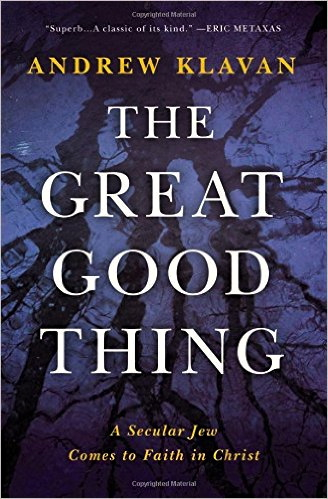
The Great Good Thing (Brief Book Review)

ggt
I discovered Andrew Klavan, not through his books, but through his conservative political podcast on the Daily Wire. I’ve since read two of his books: Don’t Say a Word and The Great Good Thing

The Great Good Thing is Klavan’s memoir — his life story focusing on his growth from secular Jew to agnostic/atheist to Christian. I say his “growth” as it is easy to see in this memoir that Klavan becomes a healthier and happier person in his life-long transition from empty religion to saving grace.

This book is for intellectuals and fans of literature. If you’re hoping for a bunch of touching mushy stories, you will be disappointed. Klavan is an author and political commentator — he lives in the realm of ideas. Therefore, Klavan’s discovery of God was through that realm. His journey began by reading and studying all the works which made western civilization what it is: the greatest culture the world has ever known. Underlying this culture all throughout is Christianity.

Andrew Klaven also discovered God through joy. At one point in the book he mentions how, with most people, their relationship with Christ leads them to joy, but with him it was the opposite — his joy led him to Christ. After many years of depression and hopelessness, Klavan was “cured” of his emptiness through the help of a psychiatrist and the growing realization that love really was the most important part of life. And, love is not just some vague idea in an uncaring universe — love comes from a real and living God.

Before becoming a Christian, Klavan began to pray regularly in his life, and through his prayers God told him to get baptized. He did, and ever since has been a devoted Christian.

Being a realist and a skeptic, Klavan makes it clear throughout the book that his conversion was never based on feelings or sentimentality — it was his reason which led him to Christ. This is why I say this book is for intellectuals: people who like things to make sense; people who like to reason their way through problems, and get annoyed when they’re expected to do otherwise.

I gave it 5/5 stars.

Further reading:

An Orthodox Jew Reviews Andrew Klavan’s ‘The Great Good Thing: A Secular Jew Comes to Faith in Christ’ 

Book of the Month/January 2017 by Douglas Wilson