Poipet Through the Ages

When the Khmer Rouge came to power in Cambodia in the ’70s they destroyed much infrastructure, including the railroad. And as Cambodia has been rebuilding, the railroad is coming back.

Poipet is the main crossing point between Cambodia and Thailand. Here is Lonely Planet’s description of Poipet…

Long the armpit of Cambodia, notorious for its squalor, scams and sleaze, Poipet (ប៉ោយប៉ែត, pronounced ‘poi-peh’ in Khmer) has recently splurged on a facelift and no longer looks like the post-apocalyptic place it once was. Thanks mainly to the patronage of neighbouring Thais, whose own country bans gambling, its casino resorts – with names like Tropicana and Grand Diamond City – are turning the town into Cambodia’s little Las Vegas. However, beyond the border zone it’s still a chaotic, trash-strewn strip mall sprinkled with dodgy massage parlours. The Khmers’ gentle side is little in evidence, but don’t worry, the rest of the country does not carry on like this.

As the railroad is being rebuilt, it will eventually link Bangkok to Phnom Penh. That railroad will run right through Poipet.

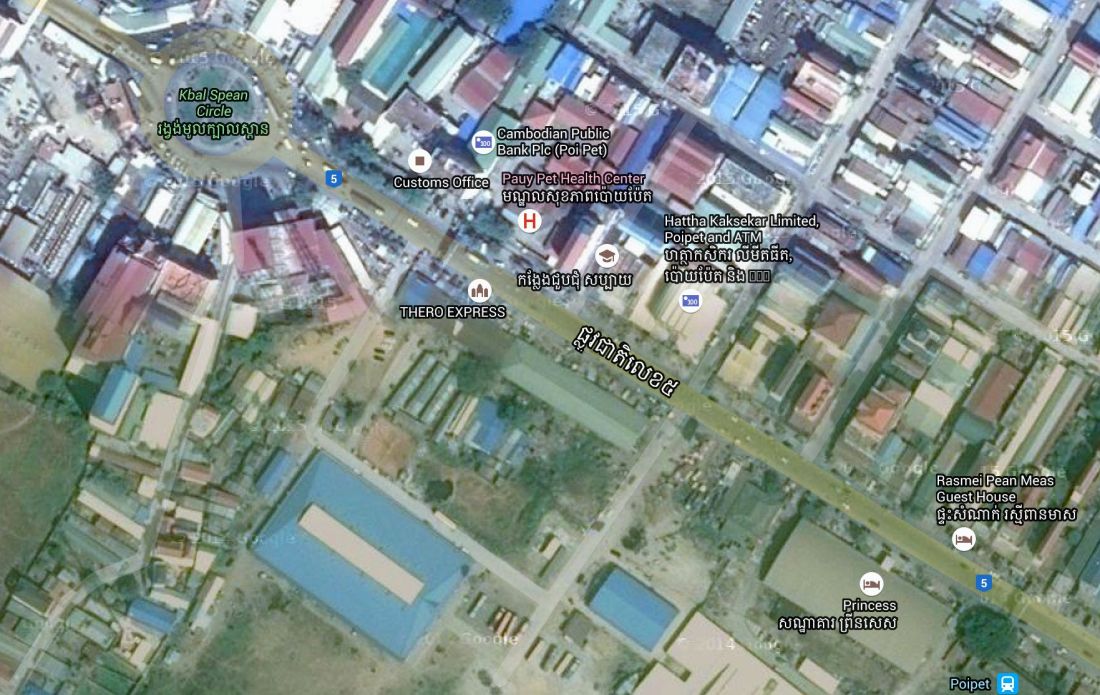
map 001

Just as you enter into Poipet from Thailand, there is a roundabout (Kbal Spean Circle in above picture) which then leads on to the main road through the city. The train will come straight through that roundabout (the busiest road in town) and then run south of the main road through the current slum area.

I don’t even want to think of how busy that border crossing area is going to be when the rail is finished and the train is running.

Here are some photos of that border crossing over the years….

1
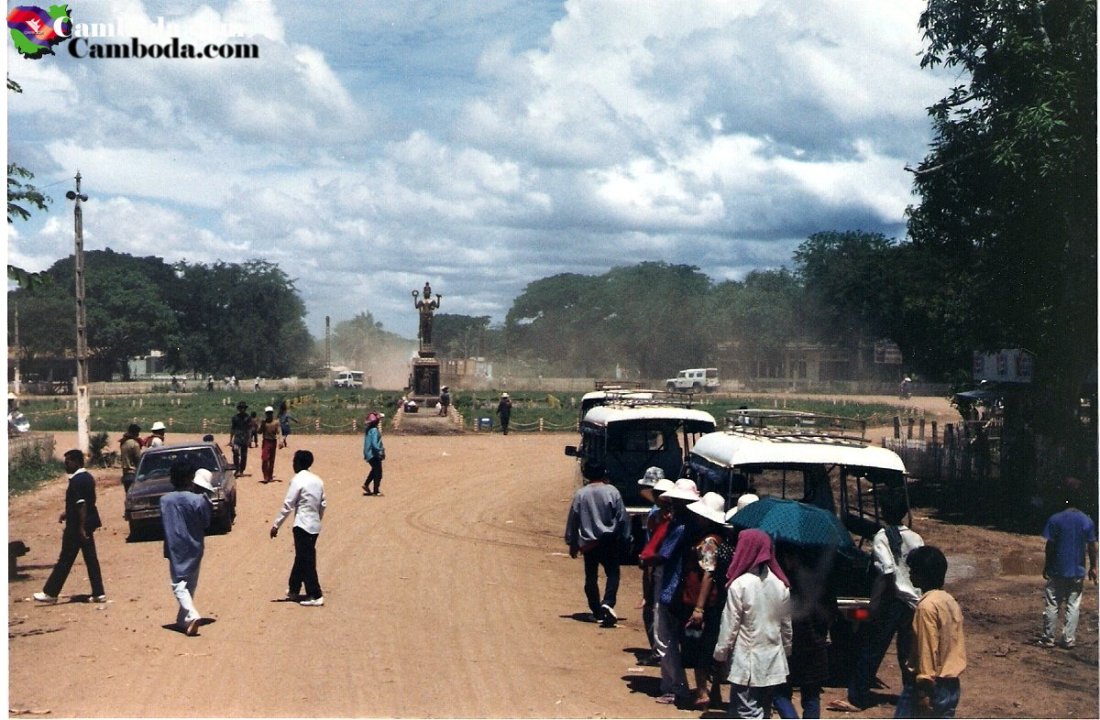
1) I don’t know how old this photo is, but it’s quite old I think. If you took this photo, your back would be towards Thailand, and you would be looking into the beginnings of Poipet and Cambodia. That’s a big idol standing in the middle of the Kbal Spean roundabout. All dirt roads.
2
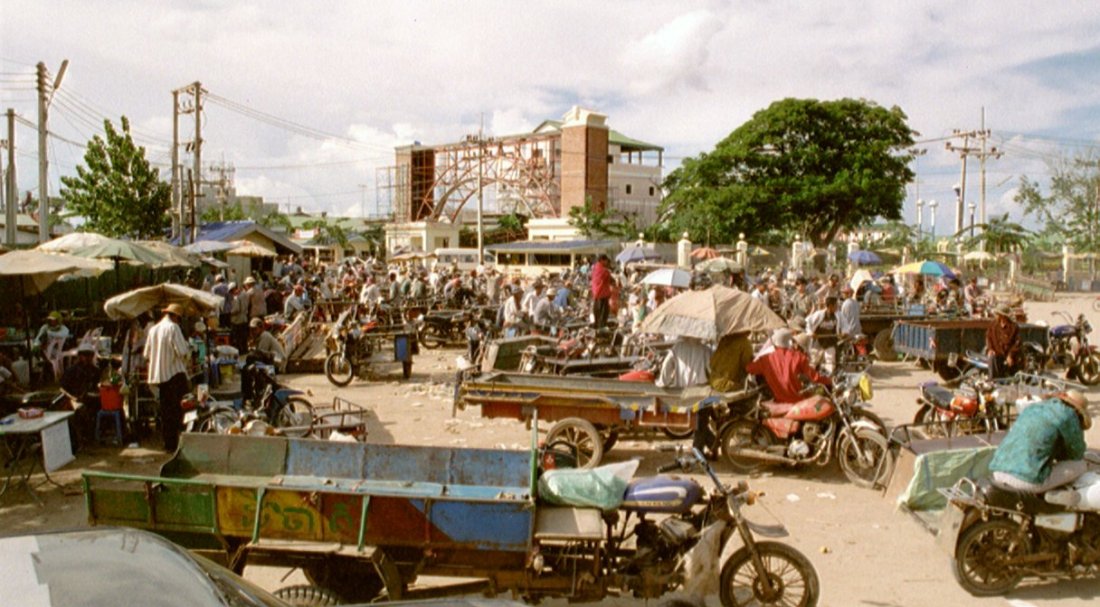
2) This photo is well over ten years old. Now we are looking towards Thailand while standing on the road of the round-about. That big idol is standing just off camera to the right. The first photo was taken from straight ahead of the view of this photo. That arch-way being constructed is the start of an entrance to a new casino.
3
3) This photo is taken from inside Poipet looking out towards Thailand (probably taken around 2006/2007 or so). The idol can be seen, but now we are seeing the reverse side from what we see in the first photo. The red brick pillar seen on the far right of this photo (centered from top to bottom) is the archway under construction in the last photo. Now we see the casinos are dominating the scene.
4
4) Now we are looking into Poipet again with Thailand at our back. Now we see there are lots of buildings, and the roads are paved. This is pretty much what Poipet looks like today, except that big idol is gone. The new railway is going to run straight through the roundabout.
5
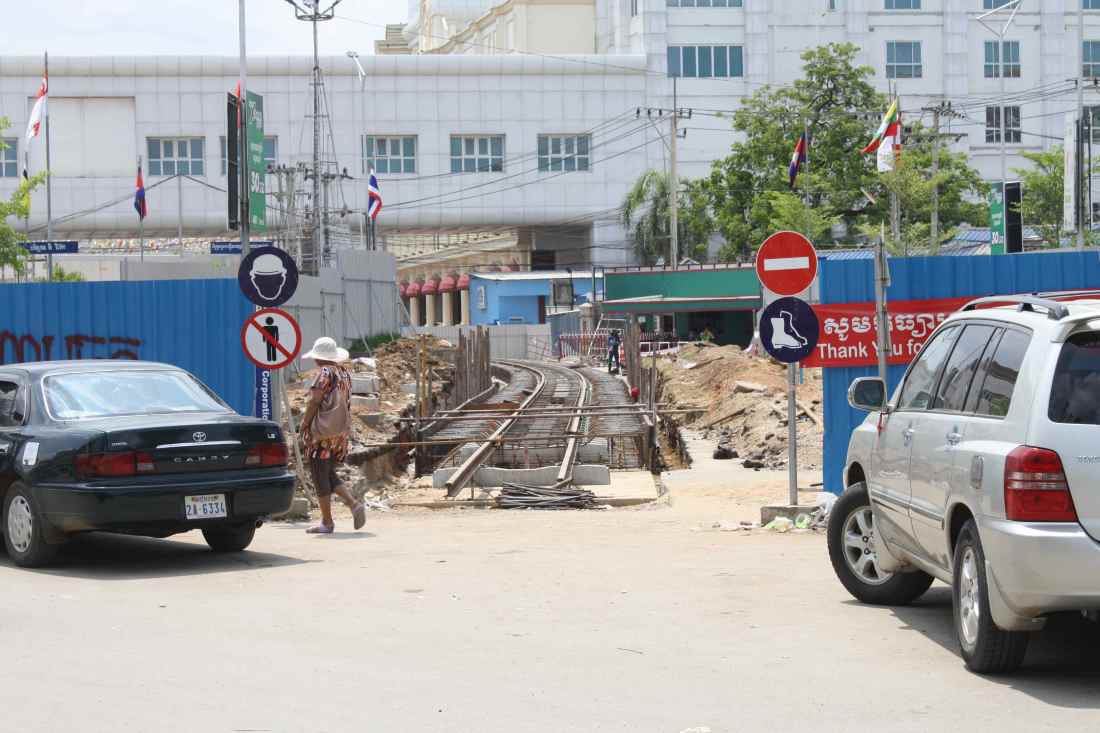
5) Here is the track being constructed. This photo was taken just a few days ago (May, 2016). The track is running right through where the roundabout used to be. Notice that the red brick archway from photos #2 and #3 has been torn down to make room for the train. Also notice the crane on the left is still there (from photo #3). I think that crane has become a permanent fixture.
6
6) A closer look. The casino builders knew the train would eventually come which is why they built the walkways up above the road to connect their buildings.

Sources…

Photo #1 is from Cambodia.com

Photo #2 is from this website.

Slum Dog Missionary Kid~Part Two

image

I’m writing up some articles about life in Cambodia. I don’t know when I’ll be done with them, so I’ll just keep posting them in these segments as I go. This article is number two. Click here to read part one.

Fast forward to the future, and I’m raising a family in Cambodia. Cambodia: one of the poorest countries, sub-standard schools, unnerving health care, corrupt law enforcement, and dirt roads.

In Cambodia I encounter a whole new kind of poverty. This is third world poverty. This poverty is deeply pervasive, affecting the whole culture. If western poverty were compared to a light sunburn on one’s arm, Cambodian poverty would be a full body, third degree, heretic’s execution burn. And it’s not just material poverty, in fact materialistic lack is the smallest part of the problem. This is a deep spiritual poverty. If you’re hungering for a spiritual experience, don’t waste your time at the Angkor Wat temple, just visit a slum. The material world and the spiritual world intersect more strongly at places of extreme poverty. The utter spiritual poverty of man is seen and understood most clearly in places riddled with garbage and open sewage.

But I don’t want to portray too dismal a picture. Here’s what else you’ll see in the slum…

image

image

I actually don’t live in the slum myself. My family and I live in a house that’s nicer than what we would live in if back in Canada. There are some missionaries who feel its necessary to live right in the mud with the locals, and that’s cool, I’m just not one of those missionaries. I don’t need to change who I am in order to share the gospel or make disciples. I’m not one of those prosperity gospel guys, but I’m not one of those poverty gospel guys either. Rich or poor, you’ve got to go where God calls you. Wealth is a relative concept anyways.

This brings me to my son, Noah–the slum dog missionary kid.

My wife’s parents, Noah’s grandparents do live in the slum, right in the heart of it. They have had opportunity to get out of it, but I think it is where they feel they belong for now. Noah’s grandmother, Srai Sim, serves God in her own way there. Noah spends a lot of his time at their home, eating, sleeping, playing with the oodles of kids in the area. He gets right into it and couldn’t care less about this place or that place. Noah, when he grows up, will be able to spend time with the rich and the poor, and not feel out of place in either situation. A long-term missionary friend told me recently that the US military likes to recruit missionary kids because they grow up in difficult, poverty stricken situations, and won’t be taken off guard when encountering it in some overseas combat mission. Makes sense.

It is not a sheltered life, thank God. Noah is being, and will be, exposed to things that the wisest of the west have never dealt with. I’ve seen near mega-church pastors mortifyingly stripped of their “know-it-all-ness” when crossing the Poipet border into Cambodia. It’s very refreshing. A well rounded wisdom–that’s what Noah is growing up into here in the third world.

to be continued…

Frame of Reference

image

In Cambodia I am a continuous outsider. This leads to a feeling of constant disconnect. I believe this comes from not having a point of reference for my experiences–I don’t know if what I’m seeing is normal or not. Therefore, I am neither surprised at, nor expectant to, what I experience.

My visitors from the west don’t have this issue. Their point of reference is back home in North America. To them everything is strange, or stupid, or smart…when compared to home. I used to use my home in Canada as that reference point as well, but I’ve been here too long to do that anymore. I have not been here long enough, though, to use the Cambodian way as my new reference point. I am caught between two cultures. This isn’t a negative thing and it gives me a unique perspective. Over time I will know more of what is normal and what isn’t, and this perspective will fade. But for now I can try to enjoy it, and maybe gain some wisdom from it.

image

Driving a vehicle is where one can experience this phenomenon most tangibly. In Canada people drive in straight lines between two straight lines. When I was driving in Canada, if I saw someone veering outside of the lines, I would pull up beside and give my dutiful look of disapproaval. Always I’d see that the driver was either drunk, a senior citizen, or an Asian. I know that sounds truly racist, but there are three reasons why it’s not: first, it’s true; second, I’m married to an Asian and my kids are Asian, so I can say things like that and not justly be called a hater; third, in Asia, to drive straight between two straight lines will only bring on the same looks of disapproval as mentioned above. It’s all relative and Asians are just driving like they’ve been taught. In Asia the lines on the road, if there even are any, are more of a suggestion, and to limit yourself to that restricted space is just bullheaded.

image

The problem of conflict is another interesting area to get confused about. Recently a guy in his early twenties living next door made a snide remark about my wife. My upset wife came inside and told me about it. I decided it would be good for him to answer for what he said by calling him over so that he could apologize to her. My wife didn’t like that and while the kid was walking over she was scolding me about how I was making problems. I thought I was fixing the problem, not making one. The boy stood like an idiot in front of my house until my wife told him to just go home. He got the point of what was going on though, and to this day, his facial expression goes from cocky to sheepish whenever he sees me. Afterwards my wife was clearly happy about what I did, even though I had violated some cultural taboo. Keep smiling. Bury your emotions. Don’t make problems.

image

A wise man once said, “If you’re not five minutes early, you’re late!”

In Canada, when I worked in construction, I would rail on the guys under me for showing up late, even if it was just five minutes. Some of them didn’t get why and suggested that working an extra five minutes at the end of the day would be a solution to showing up late five minutes in the morning. They didn’t get that it was a matter of integrity and respect. They would be shocked when I didn’t get angry when they screwed up on the job, and equally shocked at how angry I did get for being just a little late. I would explain that I expected them to screw up on the job because they were learning something new. Being on time, however, is something they should have learned when they were five years old. Usually the guys would get it quickly. As to the more thickheaded ones, I’d just start sending them home whenever they were late.

So, take that attitude into a culture that does not consider being on time important at all. Do I get angry when someone is late? Do I try to change this? Do I adapt? Do I just need to relax? When I schedule meetings for the parents of the kids in our school, I tell them to come an hour before I really want, and we still have to make phone calls about ten minutes before the meeting starts to remind many of them to come. Is this really a cultural thing? Or is it an integrity/respect thing?

One day I will figure it all out and my new frame of reference will ruin all the fun I’m having.