Frame of Reference

image

In Cambodia I am a continuous outsider. This leads to a feeling of constant disconnect. I believe this comes from not having a point of reference for my experiences–I don’t know if what I’m seeing is normal or not. Therefore, I am neither surprised at, nor expectant to, what I experience.

My visitors from the west don’t have this issue. Their point of reference is back home in North America. To them everything is strange, or stupid, or smart…when compared to home. I used to use my home in Canada as that reference point as well, but I’ve been here too long to do that anymore. I have not been here long enough, though, to use the Cambodian way as my new reference point. I am caught between two cultures. This isn’t a negative thing and it gives me a unique perspective. Over time I will know more of what is normal and what isn’t, and this perspective will fade. But for now I can try to enjoy it, and maybe gain some wisdom from it.

image

Driving a vehicle is where one can experience this phenomenon most tangibly. In Canada people drive in straight lines between two straight lines. When I was driving in Canada, if I saw someone veering outside of the lines, I would pull up beside and give my dutiful look of disapproaval. Always I’d see that the driver was either drunk, a senior citizen, or an Asian. I know that sounds truly racist, but there are three reasons why it’s not: first, it’s true; second, I’m married to an Asian and my kids are Asian, so I can say things like that and not justly be called a hater; third, in Asia, to drive straight between two straight lines will only bring on the same looks of disapproval as mentioned above. It’s all relative and Asians are just driving like they’ve been taught. In Asia the lines on the road, if there even are any, are more of a suggestion, and to limit yourself to that restricted space is just bullheaded.

image

The problem of conflict is another interesting area to get confused about. Recently a guy in his early twenties living next door made a snide remark about my wife. My upset wife came inside and told me about it. I decided it would be good for him to answer for what he said by calling him over so that he could apologize to her. My wife didn’t like that and while the kid was walking over she was scolding me about how I was making problems. I thought I was fixing the problem, not making one. The boy stood like an idiot in front of my house until my wife told him to just go home. He got the point of what was going on though, and to this day, his facial expression goes from cocky to sheepish whenever he sees me. Afterwards my wife was clearly happy about what I did, even though I had violated some cultural taboo. Keep smiling. Bury your emotions. Don’t make problems.

image

A wise man once said, “If you’re not five minutes early, you’re late!”

In Canada, when I worked in construction, I would rail on the guys under me for showing up late, even if it was just five minutes. Some of them didn’t get why and suggested that working an extra five minutes at the end of the day would be a solution to showing up late five minutes in the morning. They didn’t get that it was a matter of integrity and respect. They would be shocked when I didn’t get angry when they screwed up on the job, and equally shocked at how angry I did get for being just a little late. I would explain that I expected them to screw up on the job because they were learning something new. Being on time, however, is something they should have learned when they were five years old. Usually the guys would get it quickly. As to the more thickheaded ones, I’d just start sending them home whenever they were late.

So, take that attitude into a culture that does not consider being on time important at all. Do I get angry when someone is late? Do I try to change this? Do I adapt? Do I just need to relax? When I schedule meetings for the parents of the kids in our school, I tell them to come an hour before I really want, and we still have to make phone calls about ten minutes before the meeting starts to remind many of them to come. Is this really a cultural thing? Or is it an integrity/respect thing?

One day I will figure it all out and my new frame of reference will ruin all the fun I’m having.

Demagogue Democracy

image

Not too long ago I would teach English to a bunch of young Cambodians. These guys would ask me lots of questions about life in Canada. And through these questions I discovered that a lot of young Cambodians have no real idea what western democratic life is like at all. In fact, here’s what they thought democracy is: you only have to work three days a week, you will make anywhere between $100 000 to $1 000 000 per year (without paying taxes), and you get lots of free stuff from the government–woo hoo!

But then I would explain the reality of high taxes, and the requirement to get government permits to do stuff on your own land which you don’t really own, and how hard people really do work, and that many people are in serious debt, and that the government is in serious debt, and the lack of real freedom for most people.

Cambodia needs liberty and freedom, yes. But, democracy being introduced into this country by a guy who’s spent much of his life in France is not what this country needs. Just imagine the culture of corruption which already exists being combined with a European style democratic nanny state. And it’s laughable to think that democracy will eliminate corruption, it’ll just allow corruption to grow, especially when more foreign aid comes pouring in as a reward for the new democracy.

Cambodia needs a government that will back off, limit its own power, reject foreign aid, and let the people prosper on their own. Cambodia needs help with this, absolutely. Help will come through non-governmental organizations and, infinitely more important, help will come from the Christian church. Cambodia will find its true freedom through local Christians and foreign missionaries working together to spread the Good News.

The Gospel is pervasive, and it penetrates every crack, every dark place of a society. The Gospel brings true freedom as it brings people under the, very undemocratic, rule of Christ. This is a very realizable goal for Cambodia. Western style humanistic democracy will be one of its greatest obstacles, even more so, I’d say, than a brutal dictatorship would be.

My prayer for Cambodia will continue to be that Jesus takes this nation as His own, and that Cambodia will worship Him alone and not fall for any false gods introduced from the west disguising themselves as freedom, or equality, or prosperity, or whatever.

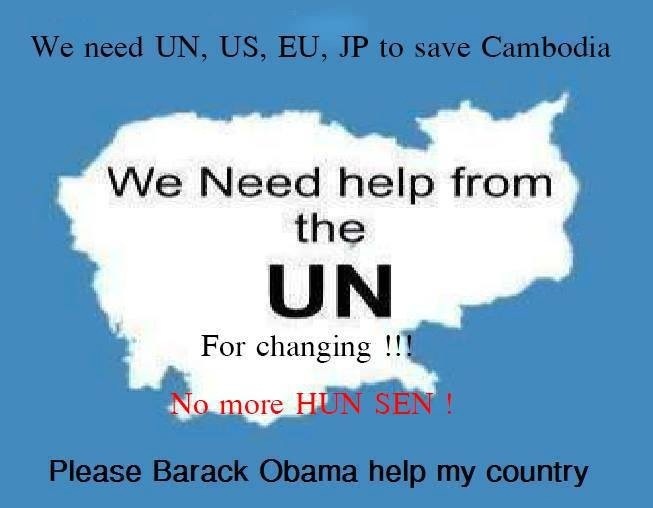
Who Will Save?~Added Note

image

The above picture, and others like it, is what I’m seeing floating around Facebook now.

In my last post I asked, “Who will save Cambodia?” And of course, being a Christian, my answer is God through His Son will save Cambodia. I also made mention of how we ought not to look to politicians or activists for some kind of political salvation.

It’s interesting how the apostle Paul was not an activist. He lived in a dictatorship and slavery was normal. But Paul never made it his mission to abolish slavery or incite change in the government. It wasn’t because Paul didn’t care about those things. Paul understood that the reason that our societies are such a mess is because we live in the darkness of sin.

As Christians, we need to think the same way in regards to our own societies. The gospel of Jesus Christ is what will transform whole nations. The political situation will be healed after a nation has embraced that gospel.

Paul and the other apostles were not activists and they never entered politics, but, because they stayed true to the gospel, they changed the world.

Anyways, that’s just a quick added note to my last post.

Who Will Save Cambodia?

Sam Rainsy, photo source: rfa.org
**Sam Rainsy, photo source: rfa.org**

We don’t know what the future holds, but we know who holds the future.

When Sam Rainsy returned to Cambodia from exile he said, “I have come to rescue the country!”*

His party did not win and Hun Sen still has majority power (although greatly reduced**). But this is okay, because Sam Rainsy is not the savior of Cambodia.

Is Hun Sen a good guy? Well, click here to read for yourself. But I am personally happy with the election results.

If you study Cambodia’s history you will see that ever since the fall of the Khmer empire this small country has always seemed to be in the middle of someone else’s conflicts–Vietnam and Thailand, France and Thailand, the USA and Vietnam, the USA and China. And then there was that whole Khmer Rouge thing. As a result, Cambodia has not enjoyed any kind of lasting stability for hundreds of years.

For the last fifteen years or so Cambodia has had some measure of stability, more than its had in a long time. Older Cambodians support Hun Sen because they remember well the Khmer Rouge days and they are very happy with where the country is at now, and they credit this to Hun Sen as he is the one who’s been in power for the last three decades. Younger Cambodians have no memory of the Khmer Rouge days as they were born afterwards. They only see Hun Sen as a brutish thug who needs to be replaced quickly.

But at this time an abrupt radical change in the Cambodian government would only bring more instability, and most likely more violence. Those of us who are Christians know and trust who is really in charge. And in trusting God we can be patient and not foolishly rush into a humanistic kind of radicalism which sees political figures (and the UN, and the USA) as saviors.

What about Hun Sen? God will judge Hun Sen. And as the Gospel spreads, and the Cambodian people are shown the light of the truth, the condition of the government will follow what the people believe.

“I exhort therefore, that, first of all, supplications, prayers, intercessions, and giving of thanks, be made for all men;
For kings, and for all that are in authority; that we may lead a quiet and peaceable life in all godliness and honesty.
For this is good and acceptable in the sight of God our Saviour;
Who will have all men to be saved, and to come unto the knowledge of the truth.”
1 Timothy 2:1-4

*Opposition Leader Sam Rainsy Returns to Cambodia

**Hun Sen’s Ruling Party Claims Victory

Further reading: Time to Stop the Rhetoric; Survey of Cambodian Public Opinion; Cambodia Strives for Credible Election