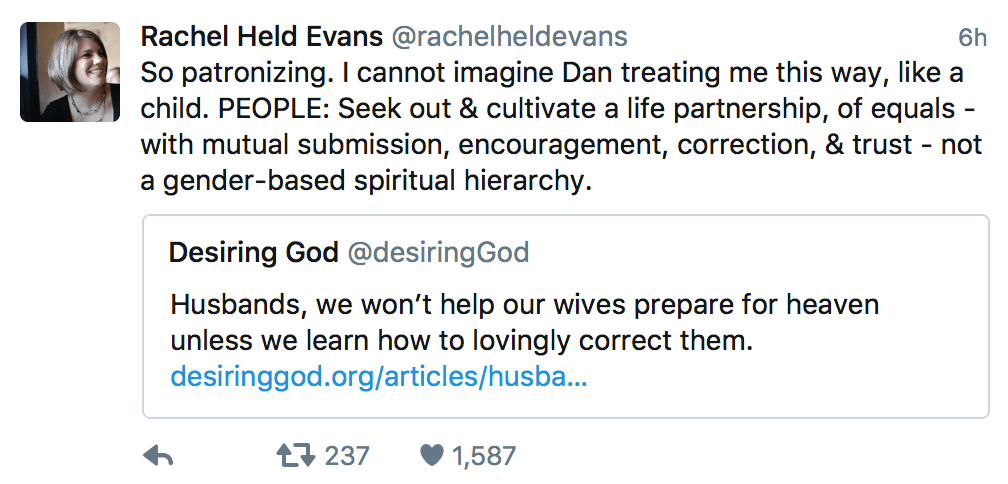
I suppose the article would be a lot less “offensive” if it were titled: Wives, Get Him Ready for Jesus. In fact, no one would be offended at that title, including the most conservative and patriarchal of Christian men. But because the article is calling men to be leaders in their marriages it is “so patronizing”. I wonder if RHE would be equally offended at this Desiring God article: Real Men Love Strong Women.
So what does the Bible have to say on the subject?
Submitting yourselves one to another in the fear of God. Wives, submit yourselves unto your own husbands, as unto the Lord. For the husband is the head of the wife, even as Christ is the head of the church: and he is the saviour of the body. Therefore as the church is subject unto Christ, so let the wives be to their own husbands in every thing. Husbands, love your wives, even as Christ also loved the church, and gave himself for it; That he might sanctify and cleanse it with the washing of water by the word, That he might present it to himself a glorious church, not having spot, or wrinkle, or any such thing; but that it should be holy and without blemish. ~Ephesians 5:21-27
Are husbands and wives commanded to submit to each other? Yes. In the same way? No.
The husband is the head of the wife just as Christ is the head of the Church. This is called Covenantal Headship, or Federal Headship. Adam was the federal head of the human race. Even though Eve was the first to eat of the fruit from the Tree of Knowledge, sin poisoned humanity through Adam. Jesus is the federal head of the Church and the New Creation. All who belong to Him have died to Adam and have been recreated in Jesus. Jesus is also a man. That’s how covenants work — the head of the covenant is responsible for the whole.
A man is the federal head of his family. Want to see a happy and healthy family? Find one with a strong man who lovingly takes charge. He is not a tyrant. He listens to his wife. Wisdom is, after all, personified as a woman in the Bible. He submits to his wife’s and childrens’ needs. He is not selfish. He would die for his family — he does die for them a little each day when he puts his own desires aside for them. He does not make decisions democratically as no one has the final word in a 50/50 relationship, but he listens to the counsel of the whole family before deciding. I have never heard a woman complain about a man like this, but I have heard women complain of men who are too timid to be like this.
I imagine RHE would not disagree with the description of a good man I’ve given above, but if she would, then who has the final word in her marriage? If it’s her, is that okay?
Vanity of vanities, saith the Preacher, vanity of vanities; all is vanity. ~King Solomon, Second Wisest Man Who Ever Lived
One thing I’ve learned about myself and other Christians is that our own theologies, as much as we would deny it, are not primarily based on careful biblical study. We think so, but even if you’ve read the Bible backward and forward 100 times, and can read Greek and Hebrew, there is another Christian out there who has studied the Bible just as much as you and rejects your theology.
I’m not talking about the essential beliefs of Christianity; I’m not talking heresy. I’m talking about all the many secondary issues which you will use to determine which church to go to and which other Christians to associate with.
The fact is, our theologies are more so based on personality, worldview, genetics, and IQ than on any biblical knowledge. Take a Charismatic, dancing in the aisle while singing in tongues, and ask him to biblically defend his practice. He might present a convincing case. Then take a Baptist, with his autographed copy of Strange Fire, sitting in the wooden church pew wearing his three piece Sunday suit, and ask the same of him. He will present a strong argument for why he does what he does and why he rejects what the Charismatic does.
According to Jesus, the wisest man who ever lived, the only theology that really matters is this….
And thou shalt love the Lord thy God with all thine heart, and with all thy soul, and with all thy might. ~Deuteronomy 6:5
Thou shalt not avenge, nor bear any grudge against the children of thy people, but thou shalt love thy neighbour as thyself: I am the Lord. ~Leviticus 19:18
I’m not suggesting that Christians should not debate theology. Good debate leads to truth (usually). But at least admit that the main reason you don’t follow a particular version of Christianity is simply because you don’t want to. There are many different Protestant denominations these days, and some would criticize that and say it is divisive. But, the different denominations are necessary at this point in Church history for the unity of the Church — everyone needs a place where they can worship.
Christians segregate themselves by personality, worldview, and even race. That segregation is not based on theology, although that might be the reason given. The truth is that we like to be around people who are the same as we are. There’s not anything necessarily wrong with that, but it does reveal how immature we are — and I don’t mean that in a negative judgmental way. Immaturity is a natural process in life. As Tim Keller puts it: You look back at yourself ten years ago and think of what a fool you were then. Well, that means you’re a fool now, you just won’t know it for another ten years.
So, the point I’m trying to make here is Theology is Vanity. You may indeed know more, and be closer to the truth, than most other Christians, but in regards to the Leviticus and Deuteronomy passages above, what will you do now?
When money is tight (as it often is at Christmas time), anxiety levels can get quite high. Reading a Charles Spurgeon devotional this morning, this is what God gave me…
It reminds me of a song my first grade teacher taught me way back in the day…
Trust and Obey – John H. Sammis (1887)
When we walk with the Lord in the light of His Word,
What a glory He sheds on our way!
While we do His good will, He abides with us still,
And with all who will trust and obey.
Refrain:
Trust and obey, for there’s no other way
To be happy in Jesus, but to trust and obey.
Not a shadow can rise, not a cloud in the skies,
But His smile quickly drives it away;
Not a doubt or a fear, not a sigh or a tear,
Can abide while we trust and obey.
Not a burden we bear, not a sorrow we share,
But our toil He doth richly repay;
Not a grief or a loss, not a frown or a cross,
But is blessed if we trust and obey.
But we never can prove the delights of His love
Until all on the altar we lay;
For the favor He shows, for the joy He bestows,
Are for them who will trust and obey.
Then in fellowship sweet we will sit at His feet,
Or we’ll walk by His side in the way;
What He says we will do, where He sends we will go;
Never fear, only trust and obey.
The gospel as presented in Acts and by the early Church took this form: “You are living in isolation, lowliness, despair, chaos, and bondage. But there is a New World! There is a New Creation! There is a New Kingdom! You can leave behind your old horrible life and come into the warmth of the Church. You can join us at the table and sing psalms with us. You can come under the oversight of our elders, and be part of a new family.” (Page 44)
The medieval Church taught our civilization what God’s law is. Faced with social anarchy on all sides, early European rulers heard the gospel this way: “You are living in hell. But God has given His law! God has shown the way to live! Christ is King! You can submit to His High-Kingship and lead your people into a new way of life!” (Page 45)
The medieval Church fell into sin when the law ceased to be a wonderful guide to life and became an oppressive threat demanding good works as a way of “meriting the merits of Christ.” … Thus, the Protestant Church taught our civilization what God’s freedom is. Faced with bondage to law, the Reformers preached the free conscience under Christ: justification by faith alone. We are familiar with this doctrine, but notice that it is only really “heard” by people who have some knowledge of God and of the law. Once that prior knowledge has drained out of society, the Protestant message no longer has the power it once had.” (Page 45-46)
The famous Protestant sermon Sinners in the Hands of an Angry God written by Jonathan Edwards was very effective in its day; a day when most of the American people were quite knowledgable of God, Christianity, and the bible; a day when the people should have known better than to turn away from God. But that day has obviously passed in the west, and a different presentation of the gospel is needed. James Jordan suggests looking back to the early Church and how they presented the gospel to people who were somewhat in the same situation as non-believers today: “You’re alone. You’re miserable. Come into the family of Jesus.” This message is what they’ll hear and understand.
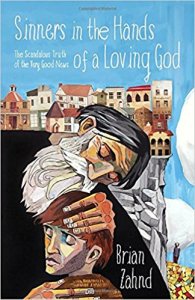
Brian Zahnd also understands this need for a fresh gospel presentation, and offers one with his book Sinners in the Hands of a Loving God. But, is he offering a truthful presentation? I would say no. Zahnd is, what I like to call, a “Postmodern Jesusist“. Another term I could use is “Neo-Marcionist”. According to his narrative in the video above, I think Zahnd has always been a Marcionist, although ignorantly so (listen from 1:00 – 1:25). And his solution now is not to dismiss Marcionism altogether, but to worsen it by creating a kind of “Postmodern Marcionism”. Zahnd writes on page 60, “I’m a million miles from the second-century heresy of Marcion … My approach to the Old Testament is nothing like Marcion’s. I call the Old testament sacred scripture.” That may be, but that’s why I will say Zahnd’s approach to the O.T. is a really just a new twist on the Marcion heresy.
In the first chapter, he mostly expands on what you see in the book trailer. But as he does so, he also builds up to the idea that the authors of the Old Testament simply did not have a full revelation of God. They had an inferior revelation and therefore not a true one. He quotes the apostle John: “No one has ever seen God. It is God the only Son, who is close to the Father’s heart, who has made him known.” So, since they didn’t have Jesus, they didn’t have a complete revelation. I can agree with Zahnd that their revelation of God was incomplete in the O.T., but I disagree with the idea that an incomplete revelation is necessarily false. There are some things that don’t change in their nature with an increase or decrease in size. Like truth. Truth is truth, whether known fully or not. When you take your kid to a restaurant, and order something for him from the kid’s menu, the food is the same food the adults eat, it just comes in a smaller portion. Truth’s nature is the same in large portions as it is in small portions. The revelation of God given to Israel was not in the fullness that would later be given in Christ, but it was still true.
In the second chapter, Zahnd constructs a couple of straw men for you to attack, or to identify with, depending on your agreement with him. For example, if you agree that God commanded the genocide of the Canaanites under Joshua, then you are open to Christians today committing genocide. In regards to the genocide, and other stories like it in the O.T., Zahnd gives three options on how to deal with the problem: 1) Question God’s morality; 2) Question God’s immutability; 3) Question how we read scripture. He rightly rejects options 1 & 2, but then goes on to give a method of reading scripture which is entirely based on postmodern philosophy: The O.T. authors wrote what they wrote not because they had a true revelation from God, but because of their biases and their warrior tribalistic worldview.
Zahnd seems to have little to no understanding of holiness, justice (apart from “social justice”), and covenant. He writes: If you’re going to imagine divinely endorsed genocide, you should not imagine yourself as Joshua but as the unfortunate Canaanite whose entire family and village have just been murdered. Instead of always seeing yourself as the cowboy, try being the Indian* sometime. (Page 44) First of all, was a holy God unjust in destroying the Canaanites?† Thankfully because of the person and work of Jesus, I don’t have to be destroyed like the Canaanite. I can be saved and created new. I can also enter into a covenant with God, just like Joshua was in covenant with God. Joshua wasn’t a blameless man, but he was in covenant, and that makes all the difference. I will imagine myself as Joshua.
(Note: If you read Jonathan Merritt’s article about this book, then you can skip the first two chapters. And before reading this book myself, I wrote a blog article about Merritt’s article, which I think is a good answer to the first two chapters as well.)
As I mention above, Zahnd is correct in writing that the O.T. Israelites did not have the fullness of revelation that would come with Jesus, but truth is truth, and we don’t read the bible like a Muslim reads the Quran; we don’t apply Naskh to the bible.‡ Before Jesus completed His work on the cross, God operated in the world a certain way, and after Jesus, God operated in a different way… and the O.T. is still a true account of who God is. Zahnd even applies Naskh to the sacrificial system — a system which is integral to Christianity. True, we don’t sacrifice animals anymore, but that’s because those sacrifices ended with Christ. But according to Zahnd, because of verses like Psalm 40:6 and Hosea 6:6, God never wanted the sacrificial system at all — so you can now ignore most of the Pentateuch.
As I read the third chapter, I found myself agreeing with most of what Zahnd says of Jesus being the greater revelation of the Word of God, but I kept asking, “But is the O.T. true? Does it truly portray God?” Zahnd says no, and for no good reason. He just doesn’t want it to be true — the O.T. doesn’t line up with his postmodern narrative. While he does believe that Jesus taught a new way to live, he doesn’t seem to believe that the world radically changed with the death and resurrection of Jesus — indeed, he doesn’t know the old world of the O.T. doesn’t exist anymore. Zahnd’s view of Jesus isn’t scandalous or radical; it isn’t radical enough!
In later chapters, Zahnd writes about hell and eschatology. I don’t have an issue with his take on hell, which is similar to C.S. Lewis and what you’d find in The Brothers Karamazov: Hell is an inability to love and be loved, and the gates are locked from within, not without. His view of eschatology and the book of Revelation is what you’d expect; something I think would be similar to what Rob Bell would teach — and I don’t have a huge issue with that either. But for the most part, these later chapters are more of the same of what I described above.
I find myself wondering: Why not just accept the O.T. at face value? What is the real reason Zahnd would reject so much of it? Is it because of years of theological study? No. Most people’s theology (if not all people’s theology) is not based on biblical study. It is based on personality and worldview. In order for Zahnd to believe what he wants to believe about Jesus, he has to reject the O.T. portrayal of God. He is offended at the O.T., and this is his way of dealing with it. Is he correct though? No, I don’t think so. He takes too much liberty in deciding which parts of the bible are true, and which are not, and he bases his exegesis on unreliable ground. For two thousand years Christians have understood that Jesus’ death on the cross was an atoning work satisfying God’s wrath towards sin and sinners. Why must we change that belief now? Because of postmodern philosophy?
I do agree that there is more to the cross than just Jesus dying for sin. N.T. Wright has written a lot of good stuff on the whole idea of the righteousness of God. I am happy that someone like Zahnd can write the book he’s written and this conversation can continue. I agree with Zahnd that the goal of Jesus is to restore the world (and not destroy it). And I do agree that the Sinners in the Hands of an Angry God approach to sharing the gospel doesn’t work these days, and something fresh is needed. But Zahnd compromises too much.
I’m going to give the book 3/5 stars.
A book I recommend people read instead of Zahnd’s is the above mentioned Crisis, Opportunity, and the Christian Future by James B. Jordan. James B. Jordan is an excellent Old Testament scholar and he explains much of the issues people might have about the difficult sections of the Old Testament. You can listen to his lectures by clicking here.
* I wonder if he’s referring to the Comanche Indians.
† When you come into the land that the Lord your God is giving you, you shall not learn to follow the abominable practices of those nations. There shall not be found among you anyone who burns his son or his daughter as an offering, anyone who practices divination or tells fortunes or interprets omens, or a sorcerer or a charmer or a medium or a necromancer or one who inquires of the dead, for whoever does these things is an abomination to the Lord. And because of these abominations the Lord your God is driving them out before you. (Deuteronomy 18:9-12 ESV)
‡ See the Quran 2:106
Some pacifists indulge in calling war murder. Ever since men could speak, murder and war stood approximately at opposite ends of the scale of social processes. The murderer was and is pre-tribal; he expresses his will against another will. War defends the order to which the warrior has surrendered part of his will because he believes in a higher, supernatural peace and order between men which depends for its existence on his acts. Not to go to war, means to desert the peace which my body politic has established. Not to murder means to respect the continuity which my body politic has built up.

![hot-sun[4]](https://harleyvoogd.com/wp-content/uploads/2017/12/hot-sun4.jpg?w=300&h=225) Vanity of vanities, saith the Preacher, vanity of vanities; all is vanity.
Vanity of vanities, saith the Preacher, vanity of vanities; all is vanity.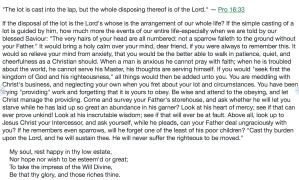
 Brian Zahnd also understands this need for a fresh gospel presentation, and offers one with his book
  Pursuit of Percipience