
Tag: Covenant Theology
Matthew 25: Understanding the Sheep and Goats Judgment
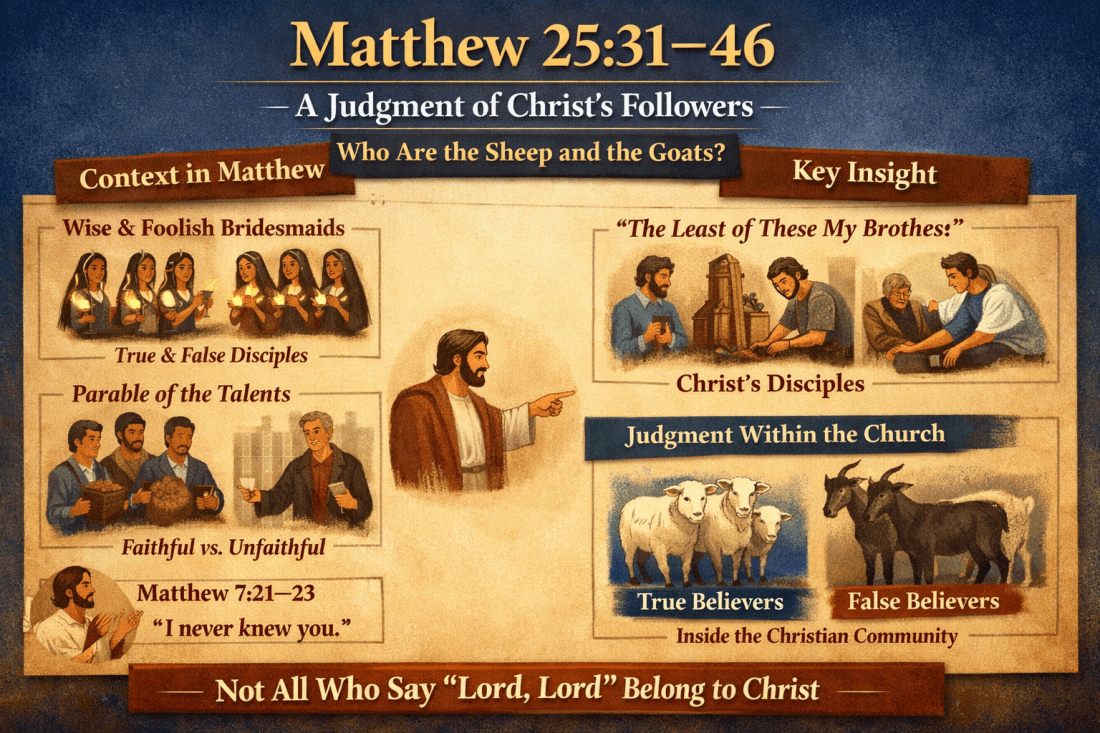
The famous “sheep and goats” judgment in Matthew 25 is often assumed to describe the final judgment of all people. But when read alongside the surrounding parables and Jesus’s teaching about false disciples, a different picture emerges: a warning that not everyone within the visible community of Christ truly belongs to him.
Consider the text…
31 “When the Son of Man comes in his glory and all the angels with him, then he will sit on the throne of his glory. 32 All the nations will be gathered before him, and he will separate people one from another as a shepherd separates the sheep from the goats, 33 and he will put the sheep at his right hand and the goats at the left. 34 Then the king will say to those at his right hand, ‘Come, you who are blessed by my Father, inherit the kingdom prepared for you from the foundation of the world, 35 for I was hungry and you gave me food, I was thirsty and you gave me something to drink, I was a stranger and you welcomed me, 36 I was naked and you gave me clothing, I was sick and you took care of me, I was in prison and you visited me.’ 37 Then the righteous will answer him, ‘Lord, when was it that we saw you hungry and gave you food or thirsty and gave you something to drink? 38 And when was it that we saw you a stranger and welcomed you or naked and gave you clothing? 39 And when was it that we saw you sick or in prison and visited you?’ 40 And the king will answer them, ‘Truly I tell you, just as you did it to one of the least of these brothers and sisters of mine, you did it to me.’ 41 Then he will say to those at his left hand, ‘You who are accursed, depart from me into the eternal fire prepared for the devil and his angels, 42 for I was hungry and you gave me no food, I was thirsty and you gave me nothing to drink, 43 I was a stranger and you did not welcome me, naked and you did not give me clothing, sick and in prison and you did not visit me.’ 44 Then they also will answer, ‘Lord, when was it that we saw you hungry or thirsty or a stranger or naked or sick or in prison and did not take care of you?’ 45 Then he will answer them, ‘Truly I tell you, just as you did not do it to one of the least of these, you did not do it to me.’ 46 And these will go away into eternal punishment but the righteous into eternal life.”
This, and all following scripture references are from the NRSV
This passage is often seen as Christ’s judgement of all humanity at the end of days. But, I disagree. To me this is a judgement of those who claim to be followers of Christ.
First, read the two parables that come before this judgement passage: The Parable of the Ten Bridesmaids (Matt. 25:1-13) and The Parable of the Talents (Matt 25:14-30). Not going into the details about what those parables mean, notice who the characters are in the parables. The three servants who are given the talents all serve the same master, and the ten maids are all waiting for the same bridegroom. These parables are not about unbelieving outsiders vs. believing insiders. These parables are about true disciples vs. false disciples within the group.
Next, read what Jesus says in Matthew 7…
15 “Beware of false prophets, who come to you in sheep’s clothing but inwardly are ravenous wolves. 16 You will know them by their fruits. Are grapes gathered from thorns or figs from thistles? 17 In the same way, every good tree bears good fruit, but the bad tree bears bad fruit. 18 A good tree cannot bear bad fruit, nor can a bad tree bear good fruit. 19 Every tree that does not bear good fruit will be cut down and thrown into the fire. 20 Thus you will know them by their fruits.
Matthew 7:15-23
21 “Not everyone who says to me, ‘Lord, Lord,’ will enter the kingdom of heaven, but only the one who does the will of my Father in heaven. 22 On that day many will say to me, ‘Lord, Lord, did we not prophesy in your name, and cast out demons in your name, and do many mighty works in your name?’ 23 Then I will declare to them, ‘I never knew you; go away from me, you who behave lawlessly.’
Here we see something similar to Matthew 25. There are people claiming to be prophets of God, who call Jesus “Lord,” just as the goats do in Matthew 25. They are not rejected because they are outside of the Jesus group, but because they are false disciples within the Jesus group.
Next, consider Matthew 10. Here, Jesus sends out the twelve, his closest disciples…
16 “I am sending you out like sheep into the midst of wolves, so be wise as serpents and innocent as doves. 17 Beware of them, for they will hand you over to councils and flog you in their synagogues, 18 and you will be dragged before governors and kings because of me, as a testimony to them and the gentiles. 19 When they hand you over, do not worry about how you are to speak or what you are to say, for what you are to say will be given to you at that time, 20 for it is not you who speak, but the Spirit of your Father speaking through you. 21 Sibling will betray sibling to death and a father his child, and children will rise against parents and have them put to death, 22 and you will be hated by all because of my name. But the one who endures to the end will be saved. 23 When they persecute you in this town, flee to the next, for truly I tell you, you will not have finished going through all the towns of Israel before the Son of Man comes.
24 “A disciple is not above the teacher nor a slave above the master; 25 it is enough for the disciple to be like the teacher and the slave like the master. If they have called the master of the house Beelzebul, how much more will they malign those of his household!
26 “So have no fear of them, for nothing is covered up that will not be uncovered and nothing secret that will not become known. 27 What I say to you in the dark, tell in the light, and what you hear whispered, proclaim from the housetops. 28 Do not fear those who kill the body but cannot kill the soul; rather, fear the one who can destroy both soul and body in hell [Gehenna]. 29 Are not two sparrows sold for a penny? Yet not one of them will fall to the ground apart from your Father. 30 And even the hairs of your head are all counted. 31 So do not be afraid; you are of more value than many sparrows.
32 “Everyone, therefore, who acknowledges me before others, I also will acknowledge before my Father in heaven, 33 but whoever denies me before others, I also will deny before my Father in heaven.
This passage contains one of the five times the word Gehenna (Hell) is used in Mathew, and it’s directed at Jesus’s closest twelve disciples.
Paul also explains in Romans 9 that within the covenant group of Israel there is the true Israel and the false Israel…
6 It is not as though the word of God has failed. For not all those descended from Israel are Israelites, 7 and not all of Abraham’s children are his descendants, but “it is through Isaac that descendants shall be named for you.” 8 This means that it is not the children of the flesh who are the children of God, but the children of the promise are counted as descendants.
When the judgment scene of Matthew 25:31–46 is considered within the broader literary context of the Gospel of Matthew, it appears less likely that the passage is intended primarily as a description of the judgment of all humanity in general. Rather, the surrounding parables and Jesus’s earlier warnings about false disciples suggest that Matthew is addressing a persistent concern within the covenant community itself: the distinction between those who genuinely belong to Christ and those whose allegiance is only outward.
Eschatological Drift

Theology often adapts to historical events, which helps explain the different views on the end times (eschatology) even among early Christians. For instance, in letters written before the destruction of the Jerusalem temple in AD 70, Paul never links Christ’s return (the Parousia), the resurrection, or judgment to that event. Instead, he focuses on a general, future hope for all believers (e.g., 1 Corinthians 15:23; 1 Thessalonians 4:16), without mentioning the temple, which was still standing at the time.
In contrast, the Synoptic Gospels (Mark, Matthew, and Luke), likely written after the temple was destroyed, directly connect its fall to the Parousia. They portray the temple’s destruction as a sign of coming judgment and a lead-up to Christ’s return (Mark 13:2, 24–27; Matthew 24:2, 29–31; Luke 21:6, 20–28). Even so, they still view the resurrection as a future event, hinted at through symbols like the trumpet (Matthew 24:31) and affirmed in other teachings (Mark 12:25; Matthew 22:30; Luke 20:36).
Later still, the Gospel of John (written around AD 90–100) does not mention the temple’s destruction in relation to the Parousia or resurrection. Instead, it emphasizes a more spiritual or “realized” view of Christ’s presence now, while still affirming a future bodily resurrection (John 5:24–29). This reflects a shift toward a more universal theological perspective, no longer centered on the events of AD 70.
This development—from Paul’s silence on the temple, to the Synoptics’ focus on it, to John’s move beyond it—shows how early Christian beliefs about the end times evolved in response to historical changes.
Why Israel-Only Should be Rejected — Thoughts and Research

If you’ve come across this article I am assuming you’ve been looking into Israel-Only and already have a good idea of what it teaches, but here is my definition:
Israel Only is a fringe hermeneutical system which reduces the biblical narrative to a hyper-fundamentalist interpretive construct, portraying an exclusive, Israelite-only redemption that ended in AD 70. It redefines “gentiles” as estranged Israelites to fit a prophetic framework. This narrative, largely detached from historical realities, functions more as a doctrinal lens than a credible historical account. Prioritizing a selective reading of scripture over historical evidence, IO reflects an extreme literalism and insularity that surpasses traditional fundamentalism.
However, that definition would probably be rejected by an IO proponent. Here is a definition by an actual IO proponent…
IO (Israel Only) is a hermeneutic that applies a consistent application of audience relevance across the biblical domains of soteriology and eschatology. IO shows that the entire bible’s redemptive narrative pertains only to the twelve tribes of old covenant Israel. IO rightly concludes that the end of the bible story happened in AD70 and that none of that story involves people today.
IO returns biblical words and phrases to their original Israelite context, showing that in many cases words like “world” (kosmos) referred to the covenant world of Israel (not the entire planet )and that “gentiles” (ethnos) who were saved were descendants of the tribes of Israel who had been dispersed among the nations.
IO also defends the view that Israel’s redemptive narrative ended in AD70, along with the need for the gospel. It is a view that is scriptural, adheres faithfully to audience relevance and has consideration for the exclusively Hebrew cultural and religious milieu the scriptures came from.
IO shows from the scriptures that salvation and redemption were only meant for old covenant Israel, which means nobody today is saved and redeemed, nor has anyone needed salvation and redemption since the first century. IO essentially destroys the premises upon which the post-AD70 version of Christianity relies on.
To disprove IO, one would have to show from the scriptures that non-Israelite nations had and were under the law of Moses, were judged at the end of the age, that Paul believed his audiences were non-Israelites, that there was a metanarrative involving restoration of non-Israelites, that non-Israelites were referred to as an olive tree, as the elect, as the sheep, that Jesus died for people outside of the 1st covenant, that non-Israelites were part of Christ’s new covenant and that the need for the gospel was expected to extend past the end of the age. To date, no one has been able to show any of those.
IO offers people the opportunity to understand why they were never sinners and why Jesus never needed to save them. This is good news! It can also save people money every Sunday, which can improve their quality of life. IO tends to be a great relief for people who have suffered mental and emotional anguish from the false premises of post-AD70 Christianity’s contrived narrative (like all are sinners on the way to a judgement and need salvation) and all the religious nonsense that comes with it.
Michael Bradley, 2025 (‘Preterist Perspectives Discussion & Debate’ Facebook group)
Israel Only (IO) theology is an outlier in Christian thought, requiring a specific and rare set of beliefs to even engage with it. Adherents must be Protestant, fundamentalist, Sola Scriptura-affirming, and preterist—a combination most Christians, historically and today, do not share. Upon arriving at IO, one finds a narrative that renders the modern believer’s role irrelevant, potentially leading to disillusionment or even atheism. However, no atheist would approach the Bible with the same rigid framework as an IO proponent, rendering the theology self-contained and insular. IO relies on unprovable claims detached from broader reality.
IO theology constructs a compelling narrative, but Judaism and Christianity are not mere stories—they are grounded in historical reality. Paul, a historical figure, preached a tangible gospel to real communities. IO’s assertion that all of Paul’s Gentile converts were descendants of uncovenanted Israelites fits its narrative but lacks historical evidence. In practice, Paul could not have distinguished between Israelite and non-Israelite Gentiles. This claim, while central to IO, remains unprovable and disconnected from the documented realities of early Christian history.
Furthermore, IO’s arguments falter logically. IO proponents can only claim that Gentile converts were proven to be Israelites after they converted, which is circular reasoning, assuming the conclusion within the premise (Gentiles converted because they were Israelites, and they were Israelites because they converted). Similarly, arguing that Paul’s Gentiles must have been Israelites due to Old Testament prophecies about the reunification of Judah and Ephraim is a non sequitur. Paul’s reinterpretation of scripture and his challenges to Jewish norms demonstrate he was not bound by such prophecies in a literal sense, undermining IO’s reliance on them.
Lastly, the notion that the Bible forms a single, cohesive narrative, as if penned by one author, may resonate within fundamentalist circles, but biblical scholarship tells a different story. Scholars recognize that each book of the Bible carries distinct themes, messages, and perspectives, with some books even presenting conflicting viewpoints. Moreover, Israel’s theology demonstrably evolved over time, reflecting changing cultural and historical contexts. This diversity and development challenges the Israel Only idea of the Bible as a singular, perfectly unified story.

Through interacting with IO proponents and reading Richard Carrier’s article refuting IO, and with the help of AI, I composed the following critique of IO…
The Israel-Only (IO) movement claims that Paul’s gospel targeted only estranged Israelites (northern tribes exiled in 721 BC) as covenant-bound gentiles (ethnē), identified by faith (Gal. 3:29) and Holy Spirit manifestations (Acts 10:44-46, 19:2-6), with salvation exclusive to Israel and ending in AD 70 (Acts 13:23-24, Rom. 9:4-5). They argue genealogies (Numbers 1, Ezra 2) preserved covenant eligibility, enabling identification. This essay refutes IO, arguing it is unbiblical, unhistorical, and logically flawed, as Paul could not distinguish Israelite from non-Israelite gentiles, per Richard Carrier’s critique.
IO’s logic is circular, assuming gentiles like Cornelius were Israelites because only Israelites could receive faith and the Spirit, then claiming these traits prove Israelite status. Carrier calls this “circular reasoning,” as IO provides no independent evidence that faith or Spirit were Israelite-exclusive. Without such evidence, their claim collapses. Biblical texts like Acts 10 describe Cornelius as a gentile (ethnē), with no indication of Israelite descent, undermining IO’s premise. Faith and Spirit were spiritual, not ethnic, criteria, incapable of verifying lineage, leaving Paul without a mechanism to identify Israelites.
Estranged Israelites were unidentifiable in the first century. Carrier argues they were fully assimilated post-721 BC, indistinguishable from other gentiles due to intermarriage and paganism. Josephus (Antiquities 11.133) places any remnant “beyond the Euphrates,” not in Paul’s mission areas like Corinth or Ephesus. Genealogical records, unlike Judeans’ in Ezra 2, were lost, making lineage-based identification impossible. Numbers 1 and Ezra 2 applied to active covenant communities, not future estranged descendants. Moreover, estranged Israelites were not in covenant, having “ceased to be Israelites” as pagans. The Mishnah (Sanhedrin 10) excludes them from salvation, and Romans 11:23 requires their reconversion, confirming they were not covenant-bound. IO’s claim that they remained covenantally significant is anachronistic, projecting modern biological notions onto ancient covenantal theology.
Paul’s gospel was universal, not Israelite-exclusive. Romans 11:13-24 describes ethnē as “wild olive shoots” grafted into Israel’s tree through faith, not descent, showing Paul targeted diverse audiences. Romans 9:6-8 redefines “Israel” as spiritual, including ethnē via faith. Galatians 3:8-9 cites Genesis 18:18, promising salvation to “all nations,” not just Israelite tribes. IO’s AD 70 cutoff is a preterist fallacy; Paul expected a cosmic end (1 Cor. 15:23-26), not temple destruction. These texts refute IO’s restrictive salvation model.
IO’s position is untenable. Its circular logic, reliance on unidentifiable Israelites, and denial of Paul’s universal mission contradict biblical evidence, historical reality, and Carrier’s analysis. Paul could not distinguish Israelite ethnē, as his criteria were spiritual, not ethnic, affirming the gospel’s broader scope.
Below is a video in which Jen Fishburne (a foremost IO proponent) defines IO. The section in which she does this is from 58:27 to 1:15:32…
Why Paul’s Gentiles in Romans 11 Were Not Estranged Israelites
The Israel-Only (IO) movement presents a tidy narrative, claiming that Paul’s Gentiles (ethnē) grafted into the olive tree in Romans 11:17-24 were estranged Israelites—descendants of the northern tribes exiled in 721 BC—restored to Israel’s covenant through faith and the Holy Spirit, with salvation exclusive to Israel and fulfilled by AD 70. While this story wraps biblical history neatly, it relies on unproven assumptions about Paul’s intentions, contradicts his clear teachings, and ignores historical realities. Scripture shows that non-Israelites could join Israel’s covenant, that Paul redefined “Israel” beyond ethnicity, and that Gentile converts became the majority of his covenant community. Thus, the ethnē in Romans 11 could not be estranged Israelites but were non-Israelites integrated through faith, refuting IO’s restrictive view.
IO’s Assumption About Paul’s Thinking Lacks Evidence
IO claims Paul’s ethnē were estranged Israelites, but Paul never states this. In Romans 11:13, he declares, “I am the apostle to the Gentiles,” addressing ethnē as distinct from Jews, but not as lost Israelite tribes. His olive tree analogy calls ethnē “wild olive shoots” grafted into Israel’s “cultivated olive tree,” contrasting them with “natural branches” (ethnic Israelites, Rom. 11:17, 24). The phrase “wild by nature” (11:24) emphasizes their foreign, non-Israelite origin. If ethnē were Israelites, they would be “natural branches,” not wild shoots requiring unnatural grafting. IO assumes Paul secretly viewed ethnē as Israelites, but this relies on unproven presuppositions, not Scripture. No text—neither Romans 11, Galatians 3:29, nor Acts 10:44-46—identifies ethnē as northern tribes. IO’s claim projects their theology onto Paul, ignoring his explicit language. As Scripture-focused readers, you must demand evidence, which IO cannot provide.
Non-Israelites Could Join Israel’s Covenant
Scripture and history confirm that non-Israelites could become covenant members, undermining IO’s claim that ethnē were exclusively Israelites. In the Old Testament, foreigners joined Israel through covenant adherence, not descent. Exodus 12:48 allows circumcised foreigners to partake in Passover, integrating them into Israel’s worship. Ruth, a Moabite, became an Israelite by faith and loyalty (Ruth 1:16, 4:13-17), and Ezra 6:21 includes “all who had separated themselves from the impurity of the nations” in Israel’s covenant community, regardless of lineage. In the Second Temple period, Gentiles converted to Judaism through circumcision, Torah observance, and immersion, as seen with figures like Achior in Judith 14:10. Josephus records conversions (Antiquities 20.38-39), showing non-Israelites could join Israel’s covenant. Paul’s ethnē, grafted by faith (Rom. 11:20), follow this pattern, entering the covenant as non-Israelites, not as presumed Israelite descendants. IO’s restriction to biological Israel ignores this biblical precedent.
Paul Redefined Israel Beyond Ethnicity
Paul explicitly redefines “Israel” as a spiritual, not ethnic, entity, contradicting IO’s biological focus. In Romans 9:6-8, he states, “Not all who are descended from Israel are Israel… it is the children of the promise who are regarded as Abraham’s offspring.” This spiritual definition includes ethnē via faith, not descent. Romans 11:17-24 reinforces this, as “wild olive shoots” (ethnē) are grafted into the covenant tree alongside “natural branches” (Israelites), united by faith, not ethnicity. Galatians 3:29 declares, “If you belong to Christ, then you are Abraham’s seed,” extending covenant membership to believers, regardless of lineage. Romans 4:11-17 calls Abraham “father of many nations,” including ethnē without Israelite descent. IO’s claim that ethnē were estranged Israelites misreads Paul’s theology, which transcends ethnicity to form a new covenant community. Scripture demands we accept Paul’s redefinition, not impose a tribal limit.
Gentile Converts Became the Majority of Paul’s Israel
Over time, Gentile converts dominated Paul’s covenant community, proving ethnē were not estranged Israelites. In Acts 13:46-48, Paul turns to ethnē after Jewish rejection, and “all who were appointed for eternal life believed,” suggesting a broad, non-Israelite audience. His mission in diverse cities like Corinth and Ephesus (1 Cor. 1:14-16, Acts 19:10) targeted mixed populations, not identifiable Israelite enclaves. By the late first century, early Christian communities were predominantly Gentile, as seen in Ignatius’ letters (e.g., Magnesians 10:3), reflecting Paul’s success among ethnē. Romans 11:25-26 (“all Israel will be saved”) includes these grafted ethnē, not just ethnic Israel, per Paul’s spiritual redefinition (Rom. 9:6-8). IO’s claim requires an unprovable Israelite diaspora, but historical assimilation—after 750 years of intermarriage (2 Kings 17:24-34, Hos. 1:9)—made northern tribes indistinguishable from Gentiles. The Mishnah (Yadayim 4:4) notes Sennacherib “mixed up all the nations,” erasing identities. Paul’s ethnē were non-Israelites, as their majority in his churches confirms.
Refuting the IO Proponent’s Covenantal Resurrection
The IO proponent’s forum response, claiming the resurrection in Matthew 22:30 was a corporate, spiritual transition for Israel from the Old to New Covenant, illustrates their flawed approach. Matthew 22:30 describes a future, physical resurrection where individuals are “like angels,” not marrying—a transformed state, not a covenantal shift (1 Cor. 15:42-44). The IO view misreads this as Israel’s liberation from marriage laws, ignoring that NT ethics uphold marriage universally (Eph. 5:22-33). Their pre-AD 70 focus contradicts post-70 CE texts like Matthew, written for ongoing relevance (Matt. 28:19-20). By assuming ethnē were Israelites, IO imposes an unproven narrative, mirroring their circular logic in Romans 11: claiming ethnē were Israelites because only Israelites were saved, without evidence. Scripture (Rom. 11:13, Acts 15:8) shows Paul’s universal gospel, not an Israel-only story.
Conclusion
IO’s narrative, while neatly packaged, crumbles under scrutiny. Paul never identifies ethnē as estranged Israelites, and IO’s assumption about his thinking lacks scriptural support. Non-Israelites could join Israel’s covenant (Exod. 12:48, Ruth 1:16), Paul redefined “Israel” spiritually (Rom. 9:6-8), and Gentile converts dominated his churches (Acts 13:46-48), proving ethnē were non-Israelites grafted by faith (Rom. 11:17-24). Assimilation erased northern tribes’ identities (Hos. 1:9), making IO’s claim impossible. I urge you to examine Romans 11 and Galatians 3:29. Paul’s universal gospel welcomes all into God’s covenant, not just a presumed Israelite remnant.
***
Below is some AI research…
In The Incompetent Crankery of the Israel Only Movement, Richard Carrier discusses rabbinic views on Gentile converts to Judaism briefly, primarily to counter the Israel-Only (IO) movement’s claim that Paul’s Gentiles (ethnē) were estranged Israelites and that salvation was exclusive to Israel. Carrier’s references to rabbinic thought focus on how Gentiles could become part of Israel through conversion, challenging IO’s ethnic exclusivity, and how estranged Israelites were viewed as covenantally insignificant. Below, I summarize everything Carrier says about what rabbis thought about Gentile converts, with precise page references and context, ensuring a comprehensive yet concise response that ties to your broader inquiry into IO theology and Paul’s Gentiles in Romans 11.
Carrier’s Discussion of Rabbinic Views on Gentile Converts
Carrier’s comments on rabbinic perspectives are drawn from Second Temple and early rabbinic sources, particularly the Mishnah, to illustrate that Gentile conversion was an established practice and that covenant membership was not strictly biological. His points are:
- Gentiles Could Become Israelites Through Conversion (pp. 4, 15):
- Context: Carrier argues that IO’s claim—that only ethnic Israelites could be saved—ignores historical evidence that Gentiles could join Israel’s covenant. He cites the Second Temple period’s acceptance of Gentile converts to show that Paul’s ethnē (e.g., in Rom. 11:17-24) could be non-Israelites grafted into Israel’s covenant, not estranged Israelites.
- Rabbinic View: Carrier notes that “Gentiles could become Israelites by conversion” (p. 15), referencing practices like circumcision and Torah observance. He points to Ezra 6:21, where non-Israelites joined Judah’s covenant community through adherence, not descent, reflecting a proto-rabbinic openness to converts (p. 4). While not directly citing the Mishnah here, Carrier’s broader argument aligns with later rabbinic texts (e.g., Mishnah Bikkurim 1:4), which treat converts as full Israelites upon circumcision and immersion.
- Implication for IO: This refutes IO’s assumption that ethnē were Israelites, as Gentiles could enter the covenant without ethnic ties, aligning with Paul’s inclusion of ethnē as “wild olive shoots” (Rom. 11:17, pp. 19-20). Rabbinic acceptance of converts shows covenant membership was not biologically exclusive, undermining IO’s premise.
- Estranged Israelites Were Not Considered Covenant Members (pp. 5-6):
- Context: Carrier counters IO’s claim that estranged northern tribes remained covenant-bound, arguing that rabbis viewed them as having “ceased to be Israelites” due to paganism and assimilation.
- Rabbinic View: He cites the Mishnah (Sanhedrin 10:3, implicitly on p. 5), which excludes uncircumcised or apostate descendants from salvation, stating that “Israelites who have no share in the world to come” include those who reject the covenant. Carrier interprets this to mean that rabbis considered estranged Israelites “not in covenant” (p. 6), as they were indistinguishable from Gentiles after 750 years of intermarriage and pagan practices (p. 25).
- Implication for IO: This challenges IO’s view that ethnē were covenant-bound Israelites. If rabbis excluded estranged Israelites, Paul’s ethnē were more likely Gentile converts (per rabbinic conversion norms) than a presumed Israelite diaspora. In Romans 11:23, estranged Israelites need regrafting through faith, like Gentiles, not automatic inclusion (p. 19).
- Rabbinic Conversion Context Supports Paul’s Universal Mission (p. 15):
- Context: Carrier connects rabbinic conversion practices to Paul’s theology, arguing that Paul’s inclusion of ethnē in Romans 11:17-24 and Galatians 3:29 (“Abraham’s seed” through faith) reflects a broader covenant accessible to Gentiles, not restricted to Israelites.
- Rabbinic View: He notes that “in the very era of Paul, Gentiles were converting to Judaism” (p. 15), citing examples like Josephus’ accounts of conversions (Antiquities 20.38-39). This shows rabbis and Jewish communities accepted Gentiles as Israelites through conversion, supporting Paul’s grafting of ethnē as non-Israelites (p. 19). Carrier implies that rabbis viewed converts as covenant members, akin to Paul’s spiritual redefinition of “Israel” (Rom. 9:6-8, p. 18).
- Implication for IO: IO’s claim that ethnē were Israelites ignores this context. Rabbinic openness to Gentile converts aligns with Paul’s mission to ethnē (Rom. 11:13), who dominate his churches (Acts 13:46-48), not an Israelite remnant.
Summary of Carrier’s Points
Carrier’s discussion of rabbinic views on Gentile converts includes:
- Conversion Allowed Covenant Membership: Rabbis accepted Gentiles as Israelites through conversion (circumcision, Torah observance), per Second Temple practices (Ezra 6:21, Josephus; pp. 4, 15). This shows covenant access was not ethnically exclusive.
- Estranged Israelites Excluded: The Mishnah (Sanhedrin 10) excludes uncircumcised or apostate Israelites from salvation, viewing them as non-covenantal, not distinct from Gentiles (pp. 5-6).
- Support for Paul’s Theology: Rabbinic conversion norms align with Paul’s inclusion of ethnē as non-Israelites in the covenant (Rom. 11:17-24, Gal. 3:29; p. 15), refuting IO’s Israelite-only claim.
***
Question: Were non-Israelite/non-Jewish circumcised converts allowed into the temple’s Court of Israel (also known as the Court of the Jews) in Paul’s time?
Answer: Yes, Non-Israelite/Non-Jewish Circumcised Converts Were Allowed into the Court of Israel
In Paul’s time (c. 30–60 CE), non-Israelite/non-Jewish circumcised converts to Judaism, known as proselytes, were generally permitted to enter the Temple’s Court of Israel (or Court of the Jews), provided they had fully converted through circumcision, immersion, and Torah observance, achieving the status of a full Jew. This court, restricted to Jewish men, was distinct from the outer Court of the Gentiles, which allowed non-Jews. The evidence below supports this conclusion, addressing the Temple’s structure, conversion practices, and rabbinic views, while refuting IO’s ethnic exclusivity.
1. Temple Structure and Access Rules
- Court of Israel Description: The Second Temple in Jerusalem had a hierarchical layout, described by Josephus (War 5.190–200) and the Mishnah (Middot 2:1–6). The Court of the Gentiles was open to all, but the Court of Israel (also called the Court of the Jews in some sources, e.g., Josephus, War 5.194) was restricted to Jewish men who were ritually pure. This court surrounded the Court of the Priests and was where Jewish men could approach for worship and sacrifices.
- Warnings Against Non-Jewish Entry: Inscriptions on the balustrade separating the Court of the Gentiles from inner courts warned: “No foreigner may enter within the balustrade around the sanctuary… whoever is caught will be responsible for his own death” (Josephus, War 5.193–94; Antiquities 15.417; cf. archaeological evidence of the “Soreg” inscription). “Foreigner” (ἀλλογενής) typically meant uncircumcised non-Jews, not converts, as proselytes were considered Jews post-conversion.
- Evidence for Convert Access: The Mishnah (Shekalim 1:5) implies that proselytes, as full Jews, paid the Temple tax and participated in worship, suggesting access to the Court of Israel. Josephus notes that converts like Achior (Judith 14:10) were integrated into Israel, implying Temple access for sacrifices (Antiquities 20.38–39). Acts 21:28–29, where Paul is accused of bringing an uncircumcised Gentile (Trophimus) into the Temple, underscores that only Jews (including converts) were allowed, reinforcing that circumcised proselytes were not “foreigners.”
2. Conversion Practices in Paul’s Time
- Process of Conversion: In Second Temple Judaism, non-Israelites could become Jews through circumcision (for men), immersion, and Torah observance, as evidenced by texts like Judith 14:10 and Josephus (Antiquities 13.257–58, 20.38–39). Carrier notes, “In the very era of Paul, Gentiles were converting to Judaism” (p. 15), citing these practices. The Mishnah (post-Paul, but reflecting earlier traditions) treats converts as full Israelites upon conversion (Bikkurim 1:4).
- Status of Converts: Once converted, proselytes were legally and socially Jews, not Gentiles. Philo (Special Laws 1.51–52) equates proselytes with native-born Jews in religious duties, including Temple worship. Ezra 6:21, cited by Carrier (p. 4), shows non-Israelites joining Judah’s covenant community through adherence, not descent, a precedent for proselyte integration. This status allowed converts access to the Court of Israel, as they were no longer “foreigners” under Temple law.
3. Rabbinic and Biblical Support
- Rabbinic Views: Carrier cites the Mishnah (Sanhedrin 10:3, p. 5) to show rabbis excluded uncircumcised Israelites from salvation, implying circumcised converts were included as Jews. Later rabbinic texts (Yevamot 47a–b) confirm converts’ full Jewish status, including Temple access, reflecting Second Temple norms. In Paul’s time, proselytes like the Ethiopian eunuch (Acts 8:27, if a convert) likely accessed inner courts for worship, as circumcision granted covenant membership.
- Biblical Precedent: Exodus 12:48 allows circumcised foreigners to partake in Passover, integrating them into Israel’s worship, a practice extended to Temple access. Ruth, a Moabite convert (Ruth 1:16), was fully Israelite, implying eligibility for covenantal worship spaces. These texts, echoed in Paul’s theology (Gal. 3:29, Rom. 4:11–17), show non-Israelites could join Israel, supporting their access to the Court of Israel.
4. Implications for IO and Paul’s Gentiles
- Refuting IO’s Ethnic Exclusivity: IO claims Paul’s ethnē were estranged Israelites, as only ethnic Israelites could enter the covenant (Staples, p. 4). However, the ability of non-Israelite converts to access the Court of Israel shows covenant membership was not ethnically exclusive. Carrier argues that Gentiles became Israelites through conversion (p. 15), aligning with Paul’s grafting of ethnē as “wild olive shoots” (Rom. 11:17–24, pp. 19–20). Staples notes Paul’s gospel re-creates Israel from ethnē, not by lineage (p. 5), reflecting this inclusive tradition.
- Paul’s Context: Paul’s mission to ethnē (Rom. 11:13) included proselytes and God-fearers, many of whom were non-Israelites (Acts 13:46–48). His rejection of circumcision for Gentiles (Gal. 5:2–6) doesn’t negate that circumcised converts in his era accessed the Temple as Jews, supporting your argument that ethnē weren’t estranged Israelites. The Court of Israel’s openness to converts mirrors Paul’s spiritual redefinition of “Israel” (Rom. 9:6–8; Carrier, p. 18).
5. Addressing Potential Objections
- Objection: Some argue only ethnic Jews entered the Court of Israel, citing strict purity laws. Response: Purity laws applied to all Jews, including converts, who were ritually pure post-immersion (Mishnah Pesachim 8:8). Josephus and Philo confirm converts’ full integration, and no text excludes them from the Court of Israel.
- Objection: The “Soreg” inscription barred all non-Jews, including converts. Response: The inscription targeted uncircumcised “foreigners,” not proselytes, who were Jews post-conversion (Philo, Special Laws 1.51). Acts 21:28 implies circumcised Jews (including converts) were permitted.
Conclusion
In Paul’s time, non-Israelite/non-Jewish circumcised converts, as full Jews, were allowed into the Temple’s Court of Israel, provided they were ritually pure. Josephus, the Mishnah, and biblical precedents (Exod. 12:48, Ruth 1:16) confirm proselytes’ covenant status, granting access to worship spaces restricted to Jews. This refutes IO’s claim that covenant membership was ethnically exclusive, supporting Carrier’s point that Gentiles could become Israelites (p. 15) and your argument that Paul’s ethnē were non-Israelites (Rom. 11:17–24). The Temple’s inclusivity for converts aligns with Paul’s universal gospel, challenging IO’s restrictive narrative.
***
Israel Only is basically just Two House Theology (aka Ephraim Movement) without the Preterism…
Overview of Two-House Theology (THT)
Two-House Theology posits that the ancient division of Israel into the Northern Kingdom (Israel/Ephraim, comprising ten tribes) and the Southern Kingdom (Judah, primarily Judah and Benjamin) has ongoing significance. After the Assyrian captivity (circa 721 BCE), the Northern tribes were scattered among the nations, losing their identity. THT proponents, like Batya Wootten and Moshe Koniuchowsky, argue that many modern Gentiles who come to faith in Yeshoua (Jesus) are descendants of these “lost tribes” (Ephraim), being regathered alongside Judah to fulfill prophecies of Israel’s restoration (e.g., Ezekiel 37:15–28). This theology emphasizes a physical and spiritual reunion of the two houses, often within a Messianic or Hebrew Roots context, and typically holds a futurist eschatology where the restoration is ongoing or future.
Overview of Israel Only Preterism (IOP)
Israel Only Preterism is a subset of preterism, a view that interprets most biblical prophecies as fulfilled in the past, particularly around the destruction of Jerusalem in 70 CE. IOP specifically asserts that the Bible’s redemptive narrative, including the New Testament, is exclusively about Israel—meaning the covenant people of God, often defined as the physical descendants of Jacob or the faithful remnant thereof. Proponents argue that salvation, the New Covenant, and eschatological promises (like the “coming” of Christ in Matthew 24) were for Israel alone, fulfilled in the first century. Gentiles are either excluded from salvation or understood as dispersed Israelites (from the Northern tribes) who were regathered through the Gospel, as seen in the chart you provided earlier (e.g., Romans 9:25–26 interpreted as Gentiles being Northern Israel).
Similarities Between Two-House Theology and Israel Only Preterism
Both theological frameworks share a focus on Israel’s central role in biblical prophecy and salvation, often interpreting Gentiles as part of Israel’s covenant identity. Below is a chart outlining their similarities, focusing on shared themes, interpretations, and implications:
| Aspect | Two-House Theology (THT) | Israel Only Preterism (IOP) | Similarity |
|---|---|---|---|
| Focus on Israel’s Identity | Emphasizes the division of Israel into two houses (Judah and Ephraim) and their reunification. | Views the Bible’s redemptive narrative as exclusively for Israel (physical or covenantal descendants of Jacob). | Both prioritize Israel as the central focus of God’s covenant and redemptive plan, rejecting a universalist view of salvation. |
| Gentiles as Israel | Many Gentiles are seen as descendants of the lost tribes (Ephraim), regathered through faith in Yeshoua. | Gentiles in the New Testament are often interpreted as dispersed Israelites (e.g., Northern tribes), not ethnic outsiders. | Both interpret Gentiles as part of Israel, either as lost tribes (THT) or dispersed covenant Israel (IOP), rather than distinct ethnic groups. |
| Regathering of Israel | Focuses on the regathering of the two houses, often seen as an ongoing or future event tied to the Messianic age. | Sees the regathering of Israel as fulfilled in the first century, with the Gospel calling back dispersed Israelites (e.g., Acts 2:5–11). | Both emphasize the biblical theme of Israel’s regathering, though differing on the timing (future/ongoing vs. past). |
| Use of Old Testament Prophecies | Relies on prophecies like Ezekiel 37 (two sticks), Hosea 1–2, and Isaiah 11 to argue for the restoration of all Israel. | Uses similar prophecies (e.g., Hosea 1–2 in Romans 9:25–26) to argue that the regathering occurred in the first century for Israel alone. | Both heavily draw on Old Testament prophecies to support their views on Israel’s restoration, often citing the same passages (e.g., Hosea, Isaiah). |
| Covenant Continuity | Views the New Covenant (Jeremiah 31:31) as applying to both houses of Israel, with Gentiles included as Ephraim. | Interprets the New Covenant as exclusively for Israel (Jeremiah 31:31), fulfilled in the first century for the covenant people. | Both see the New Covenant as tied to Israel, not a universal replacement of Israel with a new “Church” (anti-supersessionist stance). |
| Rejection of Replacement Theology | Rejects supersessionism; the Church does not replace Israel but includes regathered Israelites (Ephraim). | Also rejects supersessionism; the New Testament is about Israel’s redemption, not a new entity replacing Israel. | Both oppose the traditional Christian view that the Church universally replaces Israel, maintaining Israel’s enduring covenant role. |
| Interpretation of “Nations” (Goyim) | “Nations” in Scripture often refer to the scattered Northern tribes (e.g., Genesis 17:4–5, “multitude of nations”). | “Nations” in the New Testament (e.g., Matthew 24:14) are often seen as dispersed Israelites, not all ethnic Gentiles. | Both interpret the biblical “nations” (goyim) as including or primarily referring to dispersed Israelites, not all humanity. |
| Theological Lens on New Testament | Reads New Testament passages (e.g., Ephesians 2:13–17) as including Gentiles as part of Israel’s restoration. | Similarly interprets passages like Romans 9–11 or Ephesians 2 as addressing Israel’s remnant, including dispersed tribes. | Both use a hermeneutical lens that sees New Testament references to Gentiles as part of Israel’s covenant narrative, not a separate entity. |
Analysis and Critical Notes
- Shared Emphasis on Israel’s Covenant Role: Both THT and IOP center Israel as the sole recipient of God’s covenant promises, rejecting the idea that the Church universally replaces Israel (a hallmark of supersessionism). This is evident in their interpretations of the New Covenant (Jeremiah 31:31) as being for Israel, whether extended to regathered Ephraim (THT) or fulfilled for Israel in the first century (IOP).
- Gentiles as Israelites: A key similarity is their shared view that many “Gentiles” in the New Testament are actually dispersed Israelites. THT sees this as a physical lineage (lost tribes), while IOP often frames it covenantally (Israelites by covenant status, not necessarily ethnicity). This aligns with the chart you provided, where verses like Romans 9:25–26 equate Gentiles with Northern Israel.
- Differing Eschatology: While they share thematic elements, their eschatological timelines diverge significantly. THT typically holds a futurist view, seeing the regathering as ongoing or future, whereas IOP, as a preterist framework, sees these prophecies as fulfilled by 70 CE. This difference affects how they apply their interpretations but doesn’t negate the shared focus on Israel’s restoration.
- Potential Overlap in Scripture Use: Both rely on similar Old Testament passages (e.g., Hosea 1–2, Isaiah 11) to argue for Israel’s regathering, though IOP applies them to first-century fulfillment, while THT sees a broader timeline. Their use of New Testament texts (e.g., Romans 9–11, Ephesians 2) also overlaps, as seen in the chart’s interpretations.
Critical Examination
- Strength of Similarities: The strongest similarity lies in their anti-supersessionist stance and their view of Gentiles as part of Israel’s covenant identity. This challenges mainstream Christian theology, which often sees the Church as a new entity distinct from Israel. Their shared hermeneutic of reading “nations” as dispersed Israel also provides a consistent interpretive thread.
- Limitations and Differences: Despite these similarities, their implications differ. THT often includes a broader soteriology, where Gentiles (as Ephraim) join Judah in a future restoration, potentially allowing for non-Israelite inclusion through faith. IOP, however, can be more exclusivist, limiting salvation to Israel alone, with Gentiles only included if they are covenantally Israel. This exclusivism in IOP can conflict with THT’s more inclusive restoration vision.
- Historical Context: Both views have roots in reactions against traditional Christian theology. THT evolved from British Israelism and gained traction in the late 20th century through Messianic movements, while IOP is a more recent development within preterist circles, often associated with online communities on platforms like X, where users debate eschatology and soteriology.
Conclusion
Two-House Theology and Israel Only Preterism share significant similarities in their focus on Israel’s covenant identity, their interpretation of Gentiles as part of Israel, and their rejection of replacement theology. However, their eschatological frameworks (futurist vs. preterist) and soteriological scope (broader inclusion vs. Israel-only) create distinct applications of these shared themes. The chart above highlights their common ground, which aligns with the earlier discussions about the chart of New Testament verses and their implications for Israel’s identity.
***
Judaism, Mystery Cults, and Christianity
It is implausible that gentiles in the first century thought of themselves as estranged Israelites, even if Paul told them they were (which he didn’t). No gentile becoming a follower of Christ thought he was doing so because he could trace his lineage back 750 years to northern Israel, or because he thought he was bound to some covenant he had no knowledge of, or participation in.
There is strong evidence that early Christianity was similar to Greco/Roman savior mystery cults in many ways. Mystery cults offered personal salvation, often in the form of eternal life, rebirth, or a blessed afterlife. New members had to undergo secret initiation ceremonies, which often involved symbolic death and rebirth, purification, or the revealing of sacred knowledge. Many cults centered around a divine figure who suffered, died, and was resurrected or triumphant over death (e.g., Osiris in the Isis cult, Dionysus in Orphic traditions, or Mithras slaying the bull as a life-giving act). Initiates were often expected to live by higher moral or ethical standards, sometimes with promises of judgment in the afterlife (especially in the Orphic and Isis traditions). Many cults celebrated ritual meals that symbolized unity with the god and among the members. The cults often provided a deeply emotional and mystical experience, sometimes including visions, ecstasy, or trance states.
Richard Carrier notes in his “Jesus from Outer Space,” on page 51: “Christianity is unmistakably a Jewish version of this same Western cultural trend [Greco/Roman savior mystery cults]—and was such from its very founding. This already-popular savior-cult model was simply Judaized—and very quickly (under Paul) made even more alike, rendering it even more popular. Thence the Christianity we know was born. The ‘differences’ from all those other cults are the Jewish element. The similarities are the Western cultural influences that brought forth something new.”
Thus, the appeal of Christianity to gentiles was not some kind of reintegration into a long-lost covenant with Yahweh, which would have been entirely foreign to them. Rather, the appeal was a universal salvation from death, as the mystery cults offered it. Robert Turcan writes in his book: “A religion is successful only if it can monopolize the individual totally: body and soul, mind and senses. If the impoverishment, indigence or inanity of the liturgy engender indifference, divorce between knowledge and religion undermines or relativizes belief. In order to be stimulating and full of dynamism, a faith must provide an all-embracing explanation of man, the world and life.” (The Cults of the Roman Empire – page 22) No gentile would care about some lost covenant or a dead people they themselves had no tangible connection to. Christianity would never have spread throughout the gentile world if that’s what they were expected to believe.

***
The Israel Only (IO) narrative, as defined by its proponents, is the view that the entire Bible’s redemptive narrative pertains only to God’s covenant people—Jews, Gentile descendants of the tribes of Israel, and non-descendant proselytes under the law—ending in AD 70 with a scriptural focus on Hebrew culture and consistent preterism (Michael Bradley). But IO proponents claim it’s just a story, a fictional narrative. This is where IO falls apart. Unless IOers argue that Paul is a fictional character, it’s not just a story. Paul was a real person, preaching a real gospel to real people. Two questions must be answered: 1. Did Paul believe the same thing IO Preterists believe? 2. Did first-century Gentiles believe the same thing IO Preterists believe? Historical evidence answers ‘no’ to both. Paul’s universal gospel, cosmic eschatology, and mission to non-Israelites contradict IO’s Israel-only, AD 70-limited narrative. First-century Gentiles saw themselves as non-Israelites, adopted through faith, following a law-free gospel with cosmic hopes, not as covenant-bound Israelites. IO’s narrative, while claiming scriptural consistency, imposes a fictional framework on historical reality, disconnected from early Christianity.
***
Analysis of the Apostolic Fathers’ Writings
1. Clement of Rome (1 Clement, c. 96 AD):
• Eschatology: Clement does not explicitly address the destruction of Jerusalem (70 AD) as a fulfillment of prophecy. In 1 Clement 23–27, he speaks of future resurrection and judgment, suggesting an unfulfilled eschatology. For example, he writes, “Let us consider the glorious gifts which He has promised to those who love Him” (1 Clem. 34), implying future expectation.
• Israel and the Church: Clement uses Old Testament imagery (e.g., Israel as God’s people) but applies it to the Church universally, not limiting salvation to ethnic Israel (1 Clem. 29–31). He sees Christians as heirs of God’s promises, suggesting a continuity model where the Church inherits Israel’s role.
• IO Preterism Relevance: No clear preterist framework or Israel-only focus. His eschatology is futuristic, and his view of the Church is inclusive of Gentiles.
2. Ignatius of Antioch (Letters, c. 108–140 AD):
• Eschatology: Ignatius focuses on martyrdom and personal eschatology, with little reference to apocalyptic events or 70 AD. In Epistle to the Ephesians 11, he speaks of Christ’s work as defeating death but does not tie this to a specific historical event like Jerusalem’s fall. His eschatology seems partially realized but not explicitly preterist.
• Israel and the Church: Ignatius emphasizes the unity of the Church as the new people of God, transcending Jewish-Gentile distinctions (Magnesians 8–10). He critiques Judaizing practices, suggesting Christianity supersedes Judaism, not that it is exclusively for Israel.
• IO Preterism Relevance: Ignatius shows no Israel-only focus or preterist interpretation of 70 AD. His theology is universal, and eschatology is not tied to a completed event.
3. Polycarp of Smyrna (Epistle to the Philippians, c. 110–140 AD):
• Eschatology: Polycarp emphasizes future resurrection and judgment (Phil. 2, 7). He does not mention 70 AD or suggest prophecies were fulfilled then. His focus is on enduring faith for a future reward.
• Israel and the Church: Polycarp does not explicitly address Israel’s role but speaks of Christians (Jew and Gentile) as God’s people, implying a universal Church (Phil. 3).
• IO Preterism Relevance: No evidence of preterism or an Israel-only covenant. His eschatology is futuristic and inclusive.
4. Epistle of Barnabas (c. 80–130 AD):
• Eschatology: The Epistle allegorizes Old Testament prophecies, focusing on Christ’s fulfillment of the Law (Barn. 2–6). It does not explicitly reference 70 AD as a prophetic endpoint but interprets the Temple’s destruction as evidence of Judaism’s obsolescence (Barn. 16). The author sees the physical Temple’s end as signaling a spiritual temple (the Church), not a final eschatological event.
• Israel and the Church: The Epistle strongly argues that the Church has replaced Israel as the recipient of God’s covenant (Barn. 4, 14). It claims Jews misunderstood the Law, and Christians (including Gentiles) are the true heirs of God’s promises. This supersessionist view is incompatible with IO Preterism’s Israel-only focus.
• IO Preterism Relevance: The Epistle comes closest to a preterist-like view by linking the Temple’s destruction to covenantal shift, but it lacks an explicit claim that all prophecies were fulfilled by 70 AD. Its universal view of the Church contradicts IO Preterism’s exclusivity.
5. Papias of Hierapolis (Fragments, c. 100–130 AD):
• Eschatology: Papias, preserved in Eusebius (Ecclesiastical History 3.39), describes a future millennial kingdom with vivid material blessings, suggesting a futuristic eschatology. He does not connect 70 AD to prophetic fulfillment.
• Israel and the Church: Papias’ fragments focus on Jesus’ teachings and apostolic traditions, not Israel’s role. His eschatology implies a universal scope, not an Israel-only framework.
• IO Preterism Relevance: Papias’ chiliastic (millennial) expectations rule out preterism, and there’s no indication of an Israel-only focus.
6. The Shepherd of Hermas (c. 100–150 AD):
• Eschatology: Hermas emphasizes repentance in light of an impending judgment (Visions 1–3). He does not reference 70 AD or suggest prophecies were fulfilled. His eschatology is futuristic and ethical.
• Israel and the Church: Hermas uses imagery from Israel (e.g., the vine, Similitudes 9) but applies it to the Church as a universal body, not ethnic Israel.
• IO Preterism Relevance: No preterist or Israel-only elements. The focus is on future judgment and universal salvation.
7. Didache (c. 80–120 AD):
• Eschatology: The Didache includes an eschatological section (Did. 16), warning of future trials, the “deceiver,” and the Lord’s coming. This suggests an unfulfilled eschatology, with no mention of 70 AD as a fulfillment.
• Israel and the Church: The Didache is a practical manual for a mixed Jewish-Gentile Christian community, with no emphasis on Israel alone. It assumes the Church as God’s people.
• IO Preterism Relevance: No preterist or Israel-only themes. Eschatology is futuristic, and the community is universal.
Key Observations
• Preterism: None of the Apostolic Fathers explicitly interpret the destruction of Jerusalem (70 AD) as the fulfillment of all biblical prophecies, a core tenet of IO Preterism. The Epistle of Barnabas comes closest by linking the Temple’s destruction to a covenantal shift, but it frames this as a transition to the Church, not a final eschatological event. Most Fathers (e.g., Polycarp, Papias, Didache) express futuristic eschatological hopes, expecting a future return of Christ, resurrection, or judgment.
• Israel-Only Focus: The Fathers consistently present the Church as the new people of God, incorporating Gentiles and often superseding or fulfilling Israel’s role (Barnabas, Clement, Ignatius). This universalism directly contradicts IO Preterism’s claim that God’s promises were exclusively for physical Israel.
• Covenantal Views: The Fathers lean toward supersessionism or continuity, where the Church inherits or fulfills Israel’s covenant promises. None limit salvation or prophecy to ethnic Israel alone.
Conclusion
There is no clear evidence of Israel Only Preterism in the writings of the Apostolic Fathers. While the Epistle of Barnabas notes the Temple’s destruction as significant, it interprets this as a shift to the universal Church, not a fulfillment of all prophecy for Israel alone. The Fathers’ eschatology is generally futuristic, expecting a future return of Christ, and their theology is inclusive, viewing the Church as the heir of God’s promises for both Jews and Gentiles. IO Preterism, as a modern construct, finds no direct parallel in these early texts.
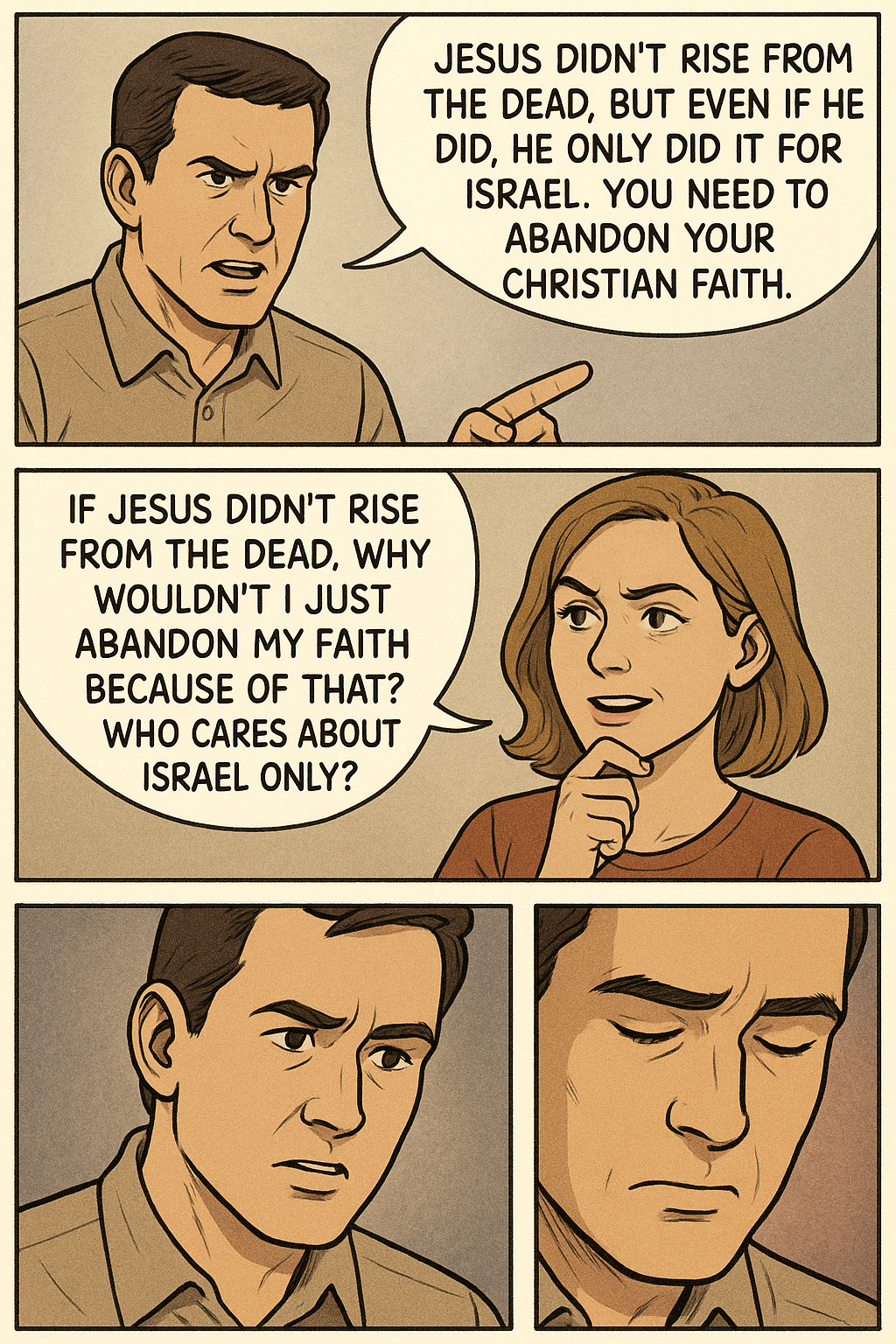
Little Gods
Any religion that cannot move beyond “we’re bad, God gets mad” is unworthy of devotion. Imagine a world in which a law was unnecessary. What would have to happen to humanity for that to be possible? We would have to become like God. Judaism will always require a law (and Jews bend over backwards trying to find loopholes to that law). Eastern religions teach you can grow beyond the need of a law, but your individuality will be obliterated in the process. Only Christianity teaches that we can grow beyond the need of a law while still maintaining our identities. How? God becomes like us so that we can become like Him. We become little gods.
 Pursuit of Percipience