The Interpretive Method of New Testament Authors

  1. Typological Interpretation (or Typology):
  • Definition: Typology involves seeing OT events, figures, or institutions as “types” (patterns or foreshadowings) that prefigure or are fulfilled by Christ, the church, or other NT realities. The NT author interprets the OT text as pointing to a greater fulfillment in Jesus or the Christian community.
  • Example: In Matthew 2:15, Hosea 11:1 (“Out of Egypt I called my son”) originally refers to Israel’s exodus but is applied typologically to Jesus as the true Israel who recapitulates and fulfills the nation’s story.
  • Characteristics: Typology assumes historical correspondence and escalation, where the OT event is real but finds a deeper, often messianic, significance in the NT.

2. Pesher Interpretation:

  • Definition: Pesher (from Hebrew, meaning “interpretation”) is a method where OT texts are applied directly to contemporary events or figures, often with an eschatological (end-times) focus. This was common in Jewish exegesis, notably in the Dead Sea Scrolls, and is used by NT authors to show how OT prophecies are fulfilled in their time.
  • Example: Matthew 2:17–18 applies Jeremiah 31:15 (Rachel’s weeping) to the Bethlehem massacre, treating the OT text as prophetically fulfilled in Jesus’ era.
  • Characteristics: Pesher often reads OT texts as cryptic predictions that find their true meaning in the present, sometimes stretching the original context.

3. Midrashic Interpretation:

  • Definition: Midrash (from Hebrew, meaning “to search” or “expound”) is a Jewish interpretive method that creatively elaborates on OT texts to draw out moral, theological, or allegorical meanings. NT authors, especially Paul, use midrashic techniques to apply OT texts to new situations.
  • Example: In 1 Corinthians 9:9–10, Paul uses Deuteronomy 25:4 (“Do not muzzle an ox”) midrashically to argue for supporting Christian ministers, extending the law’s principle beyond its literal meaning.
  • Characteristics: Midrash often involves allegory, analogy, or recontextualization to make the text relevant to a new audience.

4. Allegorical Interpretation:

  • Definition: Allegory treats OT texts as having hidden or symbolic meanings that point to spiritual truths, often beyond the literal sense. While less common in the NT than typology, it appears in some instances, particularly in Paul’s writings.
  • Example: In Galatians 4:21–31, Paul allegorizes the story of Hagar and Sarah (Genesis 16–21) to represent the old and new covenants, respectively, a clear departure from the historical narrative.
  • Characteristics: Allegory seeks deeper, symbolic meanings, sometimes detaching from the original context.

5. Fulfillment Citation:

  • Definition: This term is used specifically for NT quotations introduced with phrases like “this was to fulfill” (common in Matthew) or “as it is written.” It reflects the NT authors’ belief that OT texts find their ultimate purpose or completion in Christ and the church, even if the original context was not explicitly prophetic.
  • Example: Matthew 1:23 quotes Isaiah 7:14 (“the virgin shall conceive”) as fulfilled in Jesus’ virgin birth, despite its original context as a sign for King Ahaz.
  • Characteristics: The focus is on Christological fulfillment, often reinterpreting non-prophetic texts as messianic.

Chart of Some NT Reinterpretations of OT Passages

NT ReferenceOT SourceOT ContextNT UsageShift in MeaningMethod
Matthew 2:15Hosea 11:1God’s historical deliverance of Israel from Egypt, called His “son.”Jesus’ return from Egypt, fulfilling Israel’s role.Historical event becomes a typological prophecy about Jesus.Typology/Fulfillment Citation
Matthew 1:23Isaiah 7:14Sign for King Ahaz about a child named Immanuel, born to a young woman.Jesus’ virgin birth, using Septuagint’s “virgin.”Historical sign becomes a messianic prophecy.Pesher/Fulfillment Citation
Matthew 2:17–18Jeremiah 31:15Rachel’s mourning for Israel’s exile, with hope for restoration.Bethlehem infants’ massacre.Historical lament reframed as a fulfilled tragedy.Pesher/Fulfillment Citation
Matthew 3:3Isaiah 40:3Preparing a way for God’s deliverance of Israel from exile.John the Baptist preparing for Jesus.Exile restoration prophecy fulfilled in John’s ministry.Pesher
John 19:36Psalm 34:20 (possibly Exodus 12:46)God’s protection of the righteous or Passover lamb regulations.Jesus’ unbroken bones at crucifixion.General protection or ritual rule becomes a specific prophecy.Typology/Fulfillment Citation
Acts 15:16–18Amos 9:11–12Restoration of Israel’s kingdom, dominance over Edom.Gentile inclusion in the church, using Septuagint’s “mankind.”National restoration becomes universal salvation.Pesher
Romans 9:25–26Hosea 2:23, 1:10Restoration of Israel after judgment, called “my people.”Gentiles becoming God’s people through faith.Israel’s restoration extended to Gentiles.Midrash/Typology
Romans 10:6–8Deuteronomy 30:12–14Accessibility of the Torah for obedience.“Word of faith” in Christ, accessible through faith.Torah’s accessibility becomes salvation through Christ.Midrash
1 Corinthians 9:9–10 / 1 Timothy 5:18Deuteronomy 25:4Law against muzzling an ox while treading grain.Material support for Christian ministers.Agricultural law reinterpreted for human laborers in ministry.Midrash/Allegory
2 Corinthians 6:16–18Leviticus 26:12, Ezekiel 37:27, 2 Samuel 7:14God’s covenant presence with Israel or Davidic king.Church as God’s temple and people, including Gentiles.Israel/Davidic promises applied to the church.Pesher/Midrash
Galatians 3:16Genesis 12:7Promise of land to Abraham’s descendants (plural).“Offspring” as Christ, the singular heir.Collective promise narrowed to Jesus.Midrash/Typology
Galatians 4:21–31Genesis 16–21Historical narrative of Hagar and Sarah, Abraham’s sons.Allegory of old (law) and new (faith) covenants.Family story becomes allegory for law vs. faith.Midrash/Allegory
Hebrews 1:5Psalm 2:7God’s adoption of the Davidic king at coronation.Jesus’ eternal divine sonship.Royal coronation becomes Christ’s divinity.Typology/Fulfillment Citation
Hebrews 10:5–7Psalm 40:6–8Obedience over sacrifice in personal worship.Jesus’ incarnation and sacrificial death.General worship statement becomes messianic prophecy.Midrash/Typology
1 Corinthians 15:54–55Isaiah 25:8, Hosea 13:14God’s future defeat of death or taunt against death.Christ’s resurrection defeating death.General/judgmental texts become resurrection triumph.Pesher

Notes on the Chart

  • Columns:
    • NT Reference: The NT passage where the OT is quoted or alluded to.
    • OT Source: The specific OT verse(s) or passage(s) referenced.
    • OT Context: The original meaning or historical setting of the OT text.
    • NT Usage: How the NT author applies the OT text.
    • Shift in Meaning: How the NT usage differs from or expands the original OT meaning.
    • Interpretive Method: The primary method(s) used (typology, pesher, midrash, allegory), based on the definitions provided earlier.
  • Interpretive Methods:
    • Typology: OT events/figures as patterns fulfilled in Christ or the church.
    • Pesher: OT texts as prophecies fulfilled in the NT era.
    • Midrash: Creative elaboration to draw out new theological meanings.
    • Allegory: Symbolic reinterpretation, often detaching from the literal sense.
    • Fulfillment Citation: OT texts seen as completed in Christ, often with “this was to fulfill” phrasing.

Four Gospels Parallel Reading Chart in Chronological Order

I had AI create this simplified chart so that I could read the four gospels in parallel…

This chart organizes the four Gospels (Matthew, Mark, Luke, and John) in parallel, arranged in chronological order to facilitate reading the accounts of Jesus’ life and ministry side by side. Each row represents a key event or teaching, with corresponding passages listed for each Gospel. Blank cells indicate that a Gospel does not include that event. Read each row’s passages to follow the narrative chronologically across all four accounts.

Event/PericopeMatthewMarkLukeJohn
Prologue and Early Life
Genealogy of Jesus1:1-173:23-38
Annunciation to Mary1:26-38
Birth of Jesus1:18-252:1-7
Shepherds Visit2:8-20
Magi Visit2:1-12
Flight to Egypt2:13-15
Return to Nazareth2:19-232:39
Jesus at Age 12 in Temple2:41-52
Preparation for Ministry
John the Baptist’s Ministry3:1-121:1-83:1-181:19-28
Baptism of Jesus3:13-171:9-113:21-221:29-34
Temptation of Jesus4:1-111:12-134:1-13
Early Judean Ministry (Mostly John)
Wedding at Cana2:1-11
First Temple Cleansing2:13-22
Nicodemus Visits Jesus3:1-21
Samaritan Woman at the Well4:1-42
Galilean Ministry
Call of the First Disciples4:18-221:16-205:1-11
Healing of Official’s Son4:46-54
Rejection at Nazareth4:16-30
Healing of Peter’s Mother-in-Law8:14-151:29-314:38-39
Sermon on the Mount5:1–7:296:20-49
Healing of the Centurion’s Servant8:5-137:1-10
Raising of Widow’s Son7:11-17
Sending of the Twelve10:1-426:7-139:1-6
Beheading of John the Baptist14:1-126:14-299:7-9
Feeding of the 5,00014:13-216:30-449:10-176:1-15
Walking on Water14:22-336:45-526:16-21
Peter’s Confession of Christ16:13-208:27-309:18-21
Transfiguration17:1-139:2-139:28-36
Later Judean and Perean Ministry
Healing of Blind Bartimaeus20:29-3410:46-5218:35-43
Parable of the Good Samaritan10:25-37
Mary and Martha10:38-42
Raising of Lazarus11:1-44
Plot to Kill Jesus11:45-54
Passion Week
Triumphal Entry21:1-1111:1-1119:28-4412:12-19
Second Temple Cleansing21:12-1311:15-1919:45-48
Cursing of the Fig Tree21:18-2211:12-14, 20-25
Olivet Discourse24:1–25:4613:1-3721:5-36
Anointing at Bethany26:6-1314:3-912:1-8
Last Supper26:17-3014:12-2622:7-3813:1–17:26
Betrayal by Judas26:47-5614:43-5222:47-5318:2-12
Peter’s Denial26:69-7514:66-7222:54-6218:15-18, 25-27
Trial Before Pilate27:11-2615:1-1523:1-2518:28–19:16
Crucifixion27:32-5615:21-4123:26-4919:16-37
Burial27:57-6115:42-4723:50-5619:38-42
Resurrection and Post-Resurrection
Resurrection Morning28:1-1016:1-824:1-1220:1-18
Road to Emmaus16:12-1324:13-35
Appearance to Disciples28:16-2016:14-1824:36-4920:19-29
Ascension24:50-53

How to Use This Chart

  • Daily Reading: Read the passages listed in each row across all four Gospels to compare accounts of the same event. Skip blank cells where a Gospel does not cover the event.
  • Chronological Flow: The events are ordered to reflect the likely sequence of Jesus’ life, starting with his birth and ending with the Ascension.
  • Study Notes: For deeper study, note differences in details (e.g., Matthew’s emphasis on fulfilled prophecy, John’s focus on theological dialogues) as you read parallel passages.
  • Time Estimate: Reading one row per day (approximately 70 rows) would take about 2–3 months, depending on reading speed and reflection time.

1 Maccabees and Daniel 11

Below is a comparative list of 1 Maccabees and Daniel 11…

Comparative List and Chronological Alignment

1 Maccabees EventDaniel 11 ReferenceChronological Alignment (Approximate Dates)Notes
Seleucid oppression begins under Antiochus IV Epiphanes (1 Macc 1:10–20): Antiochus IV becomes king (175 BCE) and plunders Jerusalem, taking temple treasures.Dan 11:21–24: A “contemptible person” (Antiochus IV) seizes the kingdom through intrigue, plunders wealth, and distributes spoil.c. 175–170 BCEBoth texts describe Antiochus IV’s rise and early actions. Daniel’s prophecy symbolically portrays his deceit and greed, matching 1 Maccabees’ historical account of his looting.
Antiochus IV’s religious persecution (1 Macc 1:20–64): Antiochus bans Jewish practices (c. 167 BCE), desecrates the temple with a pagan altar (“abomination of desolation”), and enforces Hellenistic worship.Dan 11:31: “Forces from him shall profane the sanctuary… and set up the abomination that makes desolate.”c. 167 BCEThe “abomination of desolation” in Daniel aligns with the temple desecration in 1 Maccabees, often identified as the altar to Zeus in the Jerusalem temple.
Maccabean Revolt begins (1 Macc 2:1–70): Mattathias and his sons (Judas Maccabeus) resist Seleucid oppression, sparking the revolt (c. 167–166 BCE).Dan 11:32: “The people who know their God shall stand firm and take action.”c. 167–166 BCEDaniel’s reference to a faithful remnant resisting aligns with the Maccabean uprising, though Daniel is less specific about the revolt’s leaders or details.
Judas Maccabeus’ victories (1 Macc 3:1–4:35): Judas wins battles against Seleucid generals (e.g., Apollonius, Seron, Gorgias) and recaptures Jerusalem, rededicating the temple (164 BCE).Dan 11:32–33: The faithful “shall receive a little help” and continue to resist, though some fall.c. 166–164 BCEThe “little help” in Daniel may allude to Judas’ early successes, though the prophecy remains vague. The temple rededication (Hanukkah) is not explicitly mentioned in Daniel.
Antiochus IV’s campaigns and death (1 Macc 6:1–16): Antiochus IV campaigns in the east, falls ill, and dies (164 BCE).Dan 11:40–45: The King of the North engages in campaigns, faces turmoil, and dies with “no one to help him.”c. 164 BCEBoth texts describe Antiochus IV’s eastern campaigns and death, though Daniel’s account is more symbolic and debated (some see Dan 11:40–45 as future or unfulfilled prophecy).
Continued Seleucid conflicts (1 Macc 6:18–9:57): After Antiochus IV’s death, the Maccabees face ongoing wars under Antiochus V and Demetrius I, with Judas dying (160 BCE).Dan 11:35–39: Ongoing struggles for the faithful, with some falling, until “the time of the end.”c. 164–160 BCEDaniel’s vague reference to continued persecution may correspond to post-Antiochus IV conflicts in 1 Maccabees, but the prophecy shifts toward an eschatological tone.
Hasmonean consolidation (1 Macc 10:1–16:24): Jonathan and Simon establish Hasmonean rule, achieving relative independence (c. 160–134 BCE).No clear parallel in Daniel 11c. 160–134 BCEDaniel 11 does not clearly address the later Hasmonean period, focusing instead on earlier Seleucid conflicts or possibly an eschatological future.

    Daniel 9:25 Confusion

    Below is a comparison of different translations rendering Daniel 9:25 (emphasis mine)…

    There are some things to notice:

    1. The NKJV uses the word “command,” while the other translations use “word.”
    2. The NKJV capitalizes “Messiah the Prince,” while the others do not.
    3. Artscroll does not use the term “messiah” or “anointed one.”
    4. The NKJV writes “seven weeks and sixty-two weeks” consecutively, without a break, while the other translations do include a break–a period for the ESV, a semi colon for the NRSV, and a comma for Artscroll.

    Firstly, the decision whether to the use “command” or “word” may depend on the translator’s bias. Do they want a decree from a king? Or a prophesy from a seer?

    Secondly, the NKJV apparently wants the reader to believe this messiah is Jesus.

    Third, I’ll include a possible explanation from AI as to why the Artscroll translation omits “messiah” below.

    Fourth, the NKJV seems to want the reader to see the seven weeks and sixty-two weeks as occurring one right after the other, a straight sixty-nine week time period. However, the Hebrew may not allow for that. Consider the text below in Hebrew…

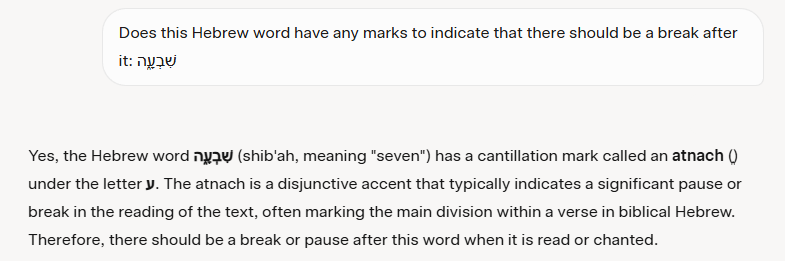
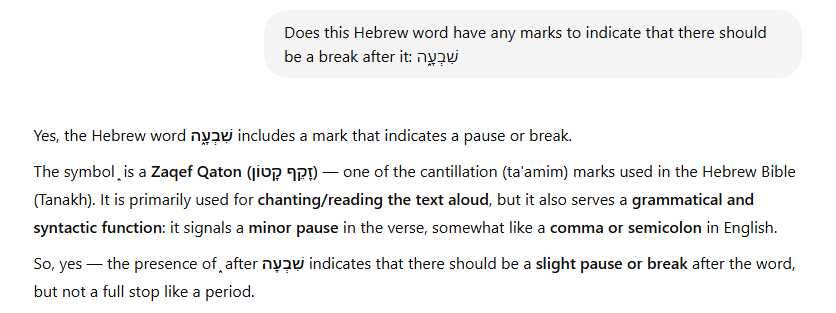
    I asked AI (Grok and ChatGPT) if there was any mark with the word “seven” which would indicate a break after that word. This was the response…

    Grok
    ChatGPT

    So, there should be a break after the seven weeks*, which means that, according to the prophesy, the messiah mentioned in the verse likely should have appeared in history directly after the first seven weeks, or forty-nine years. If that’s correct, this messiah is not Jesus (although it can be seen as a type of Christ). The commentary in my Artscroll bible suggests it was Cyrus, and the commentary in my NRSV suggests it was the high priest Joshua (see Haggai 1:12; Ezra 2:2, 3:2; Zechariah 4:14, 6:10-12). Therefore, according to these commentaries, the “word” going out was not a kingly decree, but rather a prophesy–possibly spoken by Jeremiah (the NRSV suggests Jeremiah 25:11). Also notice how the NRSV refers to the “word” in the past tense, meaning that for Daniel it would have already been past tense and thus not a future decree of Cyrus. Daniel 9 begins with Darius the Mede still in power, which was before Cyrus.

    Carol A. Newsom, in her commentary, suggests the author of Daniel 9 was not trying to pin down precise dates, but rather “to connect important events in history by means of a symbolic heptadonal system of time.”** We must take note of the seven weeks as being a time of jubilee (see Leviticus 25:8ff), and also the 490 years as being ten jubilee periods. It doesn’t necessarily matter when the 70 weeks began as long as we can connect the right events together, and since the theme of jubilee (freedom) is being focused on we can assume the events have to do with Jews regaining their autonomy and purpose as God’s people.

    James B. Jordan, in his commentary, reads the 70 weeks as consecutive.*** He makes no mention of the apparent pause in the text after the first seven weeks. He also insists that the 70 weeks began with the decree of Cyrus in 537 BC. But, if the 70 weeks are read literally and consecutively, the prophesy takes us only to the year 47 BC. Jordan’s solution to this is to say that the first seven weeks were literal (from Cyrus’s decree to Nehemiah’s return to Jerusalem). The following sixty-two weeks were symbolic, resulting in the last week being postponed. And the last week, or 70th week, was again literal, which started with the ministry of Jesus and ended with the death of Stephen in Acts 7. Jordan takes a few paragraphs to explain why the sixty-two weeks were symbolic, but basically he argues that God postpones judgement throughout scripture to be merciful, and also to harden the rebellious ones.

    * There is no cantillation mark in the Hebrew which indicates there is any pause or break after the “sixty-two weeks” as the NKJV has it. There should be no period, semi colon, or comma after “sixty-two weeks.”

    ** Newsom, Carol A. Daniel: A Commentary. Westminster John Knox Press, 2014, p. 619.

    *** Jordan, James B. The Handwriting on the Wall: A Commentary on the Book of Daniel. American Vision, 2007, p. 469ff. I am quite certain Jordan’s translation of choice is the NASB, which renders Daniel 9:25 as: “So you are to know and understand that from the issuing of a decree to restore and rebuild Jerusalem, until Messiah the Prince, there will be seven weeks and sixty-two weeks; it will be built again, with streets and moat, even in times of distress.” (emphasis mine)

    ***

    Below is an explanation from AI as to why the Artscroll translation omits “messiah.”

    1. The Hebrew Text and Translation Choices

    The Hebrew of Daniel 9:25 reads:
    וְתֵדַע וְתַשְׂכֵּל מִן-מֹצָא דָבָר לְהָשִׁיב וְלִבְנוֹת יְרוּשָׁלִַם עַד-מָשִׁיחַ נָגִיד שִׁבְעָה שָׁבֻעִים וְשִׁבְעִים וּשְׁנַיִם שָׁבֻעִים תָּשׁוּב וְנִבְנְתָה רְחוֹב וְחָרוּץ וּבְצוֹק הָעִתִּים
    Translated literally, this is:
    “Know and understand: From the going forth of the word to restore and build Jerusalem until an anointed one, a leader/prince (mashiach nagid), seven weeks; and for sixty-two weeks, it will be rebuilt, street and moat, but in troubled times.”

    The key phrase here is mashiach nagid. The ArtScroll translation you cited appears to focus on nagid (“leader” or “prince”) and omits or reinterprets mashiach (“anointed one”). This could stem from the following considerations:

    • Emphasis on Nagid: The term nagid means “leader,” “ruler,” or “prince” and is often used in the Hebrew Bible to denote a person of authority, such as a king or governor (e.g., Saul in 1 Samuel 9:16). In Daniel 9:25, nagid modifies mashiach, suggesting the “anointed one” is a leader or ruler. ArtScroll may have chosen to translate mashiach nagid as “the prince” to emphasize the leadership role and avoid the potentially loaded term mashiach.
    • Omission of Mashiach: By rendering mashiach nagid as “the prince,” ArtScroll may be simplifying the phrase to focus on the functional role (nagid) rather than the ritual status (mashiach, i.e., one anointed with oil). This could reflect a desire to avoid any messianic connotations associated with mashiach, especially given Christian interpretations that link this verse to Jesus as “the Messiah.”

    2. Jewish Interpretive Tradition

    Jewish exegesis of Daniel 9:25 varies widely, and ArtScroll, as an Orthodox Jewish translation, likely draws on traditional commentators like Rashi, Ibn Ezra, or Saadia Gaon. These scholars often interpret the mashiach nagid as a historical figure rather than an eschatological Messiah:

    • Rashi: Suggests the mashiach nagid could be Cyrus, King of Persia, who is called God’s “anointed” (mashiach) in Isaiah 45:1 and who issued the decree to rebuild Jerusalem (Ezra 1:1-3). Rashi emphasizes Cyrus as a nagid (leader) who facilitated the return from exile.
    • Ibn Ezra: Proposes the mashiach nagid might refer to Zerubbabel, a Davidic prince who led the rebuilding efforts, or Joshua, the high priest (Zechariah 6:11-12).
    • Saadia Gaon: Views the mashiach as a high priest or leader during the Second Temple period.

    By translating mashiach nagid as “the prince,” ArtScroll aligns with interpretations that identify the figure as a historical leader (e.g., Cyrus, Zerubbabel, or a high priest) rather than an eschatological “Messiah.” The term “prince” captures the leadership aspect (nagid) while sidestepping the theological weight of mashiach.

    3. Avoiding Messianic Connotations

    As noted in my previous response, the term mashiach is sensitive due to Christian interpretations of Daniel 9:25 as a prophecy about Jesus. ArtScroll’s choice of “prince” instead of “anointed one” may be a deliberate move to:

    • Distance from Christian Readings: Christian translations, like the King James Version, render mashiach as “Messiah” to support the idea that the verse predicts Jesus’ arrival. By using “prince,” ArtScroll avoids any implication that this figure is the eschatological Messiah, aligning with Jewish theology that the Messiah has not yet come.
    • Neutralize Eschatological Implications: In Jewish thought, the ultimate Messiah (Messiah ben David) is associated with redemption, peace, and rebuilding the Temple, not with being “cut off” or the destruction of Jerusalem (Daniel 9:26). Translating mashiach nagid as “the prince” keeps the focus on a historical or temporal leader, avoiding confusion with Jewish messianic expectations.

    4. ArtScroll’s Translation Philosophy

    ArtScroll’s Tanach (Stone Edition) aims to provide a translation that is both accessible to modern readers and faithful to traditional Jewish exegesis. This involves:

    • Simplification for Clarity: The phrase mashiach nagid is complex, combining two terms with overlapping but distinct meanings. Rendering it as “the prince” simplifies the text for readers while conveying the idea of an authoritative figure, which nagid emphasizes.
    • Reliance on Rabbinic Commentary: ArtScroll often incorporates interpretations from classical Jewish sources (e.g., Rashi, Talmud) into its translation. By choosing “prince,” ArtScroll may be reflecting a specific rabbinic interpretation that prioritizes the historical context of Daniel 9:25 over a literal rendering of mashiach.
    • Consistency with Other Verses: In Daniel 9:26, the same mashiach is mentioned as being “cut off.” ArtScroll may avoid “anointed one” in 9:25 to maintain consistency with 9:26, where the term is similarly interpreted as a leader or prince, not the Messiah.

    5. Textual and Grammatical Nuances

    The ArtScroll translation you cited—”until the appointment of the prince”—suggests an interpretive addition. The Hebrew ad mashiach nagid (“until an anointed one, a leader”) does not explicitly include “appointment,” but this may reflect:

    • Masoretic Punctuation: The athnach (a disjunctive accent) in the Masoretic Text separates the “seven weeks” from the “sixty-two weeks,” implying the mashiach nagid appears after the seven weeks (49 years), possibly Cyrus or another early figure. ArtScroll’s “appointment” may interpret this as the moment the leader is designated or rises to prominence.
    • Dynamic Equivalence: ArtScroll sometimes opts for dynamic equivalence (conveying meaning over word-for-word translation) to make the text clearer. “Appointment of the prince” may be an attempt to clarify that the mashiach nagid is a divinely ordained leader, consistent with Jewish readings of the verse.

    Conclusion

    The ArtScroll Bible’s translation of Daniel 9:25 as “until the appointment of the prince” instead of “anointed one” reflects a combination of factors:

    1. A focus on nagid (“leader/prince”) over mashiach (“anointed one”) to emphasize the figure’s role as a historical leader (e.g., Cyrus, Zerubbabel, or a high priest).
    2. Alignment with Jewish interpretive traditions that reject eschatological or Christian messianic readings of the verse.
    3. A translation philosophy that prioritizes clarity and rabbinic exegesis over literal rendering, avoiding the theologically charged term mashiach.
    4. Sensitivity to Jewish theology, which reserves the term “Messiah” for the future redeemer, not a figure associated with destruction (Daniel 9:26).

    This choice underscores ArtScroll’s commitment to presenting the text through the lens of Orthodox Jewish scholarship, avoiding interpretations that could be misconstrued as supporting Christian claims about Jesus.

    AI’s Hypothetical Religion

    I asked AI this question: If someone were to combine second temple messianic Judaism with the mystery religions and Greek mythology in order to create their own religion, what do you think that made up religion would look like?

    AI’s response…

    Creating a syncretic religion by blending Second Temple Messianic Judaism, mystery religions (like those of Mithras, Isis, or Dionysus), and Greek mythology would result in a fascinating and complex belief system. Let’s imagine what this might look like by drawing on the core elements of each tradition and weaving them together into a cohesive framework.

    Core Components of the Hypothetical Religion

    1. Messianic Foundation (Second Temple Judaism)
      • Central Figure: A divine Messiah, akin to the expected redeemer in Second Temple Judaism, who brings salvation and restores the world. This figure might be seen as both a human king (like David) and a cosmic savior, reflecting the eschatological hopes of the period (e.g., from texts like the Dead Sea Scrolls or Daniel).
      • Monotheism with a Twist: While Second Temple Judaism emphasizes one God (Yahweh), the influence of Greek mythology and mystery religions might soften this into a henotheistic structure, where the Messiah is a divine emanation of the supreme God, surrounded by lesser divine beings or angels.
    2. Mystery Religion Elements
      • Initiation and Secret Knowledge: Like the mystery cults, this religion would feature secretive rituals—perhaps a baptism or a symbolic death-and-rebirth ceremony (echoing Mithraism or the cult of Isis)—to grant adherents esoteric knowledge of the cosmos and their salvation.
      • Sacramental Meals: Drawing from Dionysian rites or the Mithraic taurobolium (bull sacrifice), the religion might include a communal meal symbolizing unity with the Messiah, possibly involving wine (Dionysus) or bread (foreshadowing Christian Eucharist-like practices).
      • Personal Salvation: The mystery religions’ focus on individual redemption would merge with Messianic Judaism’s communal restoration, creating a dual emphasis: personal enlightenment and the collective arrival of a utopian age.
    3. Greek Mythology Influence
      • Pantheon Integration: The supreme God (Yahweh) could be equated with Zeus as a sky-father figure, while the Messiah might resemble a hero-god like Hercules or Apollo—born of divine and human origin, tasked with overcoming chaos (e.g., a Hades-like figure representing evil or death).
      • Cosmology: The Greek concept of the cosmos, with its layers of heavens, earth, and underworld, might blend with Jewish apocalyptic visions (e.g., Enochic literature), creating a vivid multi-tiered universe populated by angels, demons, and mythological creatures like the Chimera or Hydra as agents of divine will or chaos.
      • Oracular Practices: Inspired by the Oracle at Delphi, this religion might include prophetic figures or priestesses who channel divine messages from the Messiah or God, guiding followers through visions or riddles.

    Beliefs and Practices

    • Theology: The religion might teach that the Messiah, a semi-divine figure born of God and humanity, descended to earth to defeat a primordial serpent (combining the Jewish Satan with the Greek Typhon or Python) and usher in a golden age. After a sacrificial death (mystery cult influence), the Messiah ascends to the heavens, promising to return and judge the world.
    • Rituals:
      • A rite of passage involving a symbolic labyrinth (Greek Minotaur myth) where initiates confront their mortality, emerging “reborn” into the Messiah’s light.
      • Festivals celebrating the Messiah’s victories, blending Jewish harvest feasts (like Sukkot) with Dionysian revelry—think processions with music, dance, and offerings of wine and grain.
    • Ethics: A moral code combining Jewish law (e.g., the Ten Commandments) with Greek virtues (e.g., courage, wisdom, temperance), emphasizing loyalty to the Messiah and preparation for his return.
    • Afterlife: A hybrid eschatology where the righteous join the Messiah in a celestial banquet (mystery cult reward) within a restored Eden-like earth (Jewish hope), while the wicked face a Tartarus-like underworld punishment (Greek influence).

    Narrative Example

    Imagine a sacred text describing the Messiah as “the Son of the Most High, clad in the armor of light, who wrestled the Leviathan of the abyss and bound it with chains forged by the heavenly smith (Hephaestus-like figure).” Initiates would reenact this battle in a subterranean temple, emerging to a hymn praising the Messiah’s triumph over death, celebrated with a feast of bread, wine, and olives under starlit skies.

    Cultural Flavor

    This religion would feel both familiar and exotic: the solemnity of Jewish temple worship infused with the ecstatic fervor of mystery rites and the poetic grandeur of Greek epic. Temples might resemble synagogues with added altars for offerings and statues of the Messiah depicted as a youthful warrior with a lyre (Apollo) or laurel crown (victory).

    I then asked: Regarding this hypothetical religion, how similar is it to Christianity?

    AI’s response…

    This hypothetical religion—blending Second Temple Messianic Judaism, mystery religions, and Greek mythology—shares striking similarities with early Christianity, but also diverges in notable ways. Since Christianity itself emerged from Second Temple Judaism and developed within the Greco-Roman world, some overlap is inevitable. Let’s break it down by comparing key elements.

    Similarities to Christianity

    1. Messianic Figure
      • Hypothetical Religion: A divine-human Messiah who defeats evil, dies sacrificially, ascends to the heavens, and promises to return for judgment and restoration.
      • Christianity: Jesus Christ, the Messiah, defeats sin and death through his crucifixion, rises from the dead, ascends to heaven, and will return to judge the living and the dead.
      • Overlap: The core narrative of a savior figure with a redemptive mission and a second coming aligns closely with Christian theology. Both emphasize the Messiah as a bridge between God and humanity.
    2. Salvation and Eschatology
      • Hypothetical Religion: Offers personal salvation through initiation and a collective utopian age, with a multi-tiered cosmos and an afterlife of reward or punishment.
      • Christianity: Promises individual salvation through faith in Christ, culminating in a new heaven and new earth, with heaven for the righteous and hell for the damned.
      • Overlap: The dual focus on personal redemption and cosmic renewal, plus a stratified afterlife, mirrors Christian eschatology, especially as it developed in the New Testament (e.g., Revelation).
    3. Rituals
      • Hypothetical Religion: Features sacramental meals (bread and wine), initiation rites (symbolic death and rebirth), and festivals celebrating the Messiah’s victories.
      • Christianity: Includes the Eucharist (bread and wine as Christ’s body and blood), baptism (death to sin, rebirth in Christ), and celebrations like Easter and Christmas.
      • Overlap: The communal meal and initiation through a transformative ritual are strikingly similar to early Christian practices, which some scholars argue were influenced by mystery cults (e.g., Mithraism’s shared meals).
    4. Moral Framework
      • Hypothetical Religion: Combines Jewish law with Greek virtues, emphasizing loyalty to the Messiah.
      • Christianity: Builds on the Jewish Law (e.g., love God and neighbor) while adding virtues like faith, hope, and love, centered on devotion to Christ.
      • Overlap: Both retain a Jewish ethical core while adapting it to a broader Greco-Roman audience.

    Differences from Christianity

    1. Theological Structure
      • Hypothetical Religion: Leans toward henotheism, with the Messiah as a divine emanation and lesser beings (angels, mythological figures) in a cosmic hierarchy.
      • Christianity: Strictly monotheistic (Trinitarian), with Jesus as fully God and fully human, part of the Trinity, and no subordinate pantheon.
      • Divergence: Christianity rejects the incorporation of other divine figures (e.g., Zeus, Apollo) and maintains a sharper distinction between God and creation, whereas this religion integrates Greek mythological elements more overtly.
    2. Cosmology and Mythology
      • Hypothetical Religion: Features a vivid, multi-tiered cosmos with creatures like Leviathan or Typhon, and oracular practices inspired by Delphi.
      • Christianity: While it includes angels, demons, and a cosmic battle (e.g., Satan in Revelation), it avoids the fantastical creatures and oracular traditions of Greek mythology, focusing instead on prophetic scripture.
      • Divergence: The Greek mythological flair—labyrinths, serpentine chaos monsters, and priestesses—gives this religion a more eclectic, polytheistic texture absent in Christianity.
    3. Ritual Tone
      • Hypothetical Religion: Emphasizes ecstatic, Dionysian revelry and elaborate symbolic reenactments (e.g., battling in a labyrinth).
      • Christianity: Early rituals were simpler and more subdued (e.g., house church gatherings), evolving into formalized liturgy later, but lacking the theatrical mystery-cult intensity.
      • Divergence: Christianity’s rituals, even with some mystery-cult parallels, prioritize solemnity and accessibility over secretive, esoteric spectacle.
    4. Cultural Context
      • Hypothetical Religion: Fully embraces Greco-Roman aesthetics—temples with statues, laurel crowns, and epic poetry.
      • Christianity: Initially resisted Greco-Roman paganism, though it later adopted some cultural forms (e.g., church architecture), while condemning idolatry and mythology.
      • Divergence: This religion leans into Greek culture more enthusiastically, whereas Christianity maintained a tension with paganism, especially in its formative years.

    How Close Is It?

    This hypothetical religion could be seen as a parallel cousin to early Christianity—sharing a Messianic core, salvific rituals, and an eschatological hope—but with a more pronounced Greco-Roman flavor. It’s as if Christianity had fully embraced the mystery religions and Greek mythology rather than selectively adapting or rejecting them. For example:

    • The Eucharist and baptism have parallels, but this religion’s labyrinthine initiations and oracular prophecies feel more like Mithraism or the Eleusinian Mysteries.
    • The Messiah’s narrative echoes Jesus, but his depiction as a Hercules-like warrior with a lyre or crown leans into Greek heroism rather than the suffering servant of Isaiah 53.

    In essence, it’s Christianity with the dial turned up on syncretism—less restrained by monotheistic boundaries and more infused with the theatricality and pluralism of its Hellenistic context. If early Christianity had taken this path, it might have looked like a mystery cult with Jewish roots and a Greek epic overlay, appealing to a broader Mediterranean audience but potentially losing its distinct identity over time.