
Any religion that cannot move beyond “we’re bad, God gets mad” is unworthy of devotion. Imagine a world in which a law was unnecessary. What would have to happen to humanity for that to be possible? We would have to become like God. Judaism will always require a law (and Jews bend over backwards trying to find loopholes to that law). Eastern religions teach you can grow beyond the need of a law, but your individuality will be obliterated in the process. Only Christianity teaches that we can grow beyond the need of a law while still maintaining our identities. How? God becomes like us so that we can become like Him. We become little gods.
Tag: Hell
A Christian Missionary in China ~ Part One
Missionary (M): You have sinned against God and are under His wrath. Hell awaits you.
Chinese Man (C): Oh my! Please tell me: What is sin?
M: Sin is an offense against God. It is falling short of His standard.
C: How can I measure my sin? What is the standard?
M: The standard is God’s law.
C: Please show me this law so that I can know how to live up to God’s standard.
M: You are incapable of following the law perfectly and will never meet God’s standard. You must trust another to do so for you: a perfect Man who never sinned, and whose righteousness can be imputed to you.
C: That’s sounds interesting, but I don’t quite understand. Please, show me this law first so that I can see if I am capable of following it myself.
M: Here, I have a copy of the Old Testament in the Chinese language. In there you will find the law I speak of. I will leave it with you. I will be back to visit your village in two months. Please read it before I return and I will answer all your questions.
***Two Months Later***
M: Have you read the book I gave you?
C: Yes, all of it. I am confused though and have some questions.
You said that I had sinned against God according to the law found in this book. But, what I see in this book is that the law was a covenantal law between a God named Yahweh and a people named Israel. I am not in that covenant. How can I be guilty of breaking a law I was never under? That is like saying I am guilty of breaking laws in a country I’ve never visited.
Also, assuming I actually am under this law, you said that I could not keep it even if I tried. But, in the story of this book, Yahweh fully expected the people to be obedient, and when they were disobedient He disciplined and punished them. If they repented and turned back to Him, He forgave them. If they were obedient, He blessed them. You said I needed to trust in the perfect righteousness of another, but I don’t come to that conclusion from reading this book. If I were an Israelite, I would try my best to follow the law, and if I failed I would confess my failing, turn back to Yahweh, and trust he would forgive me. Where does it say that I need to trust in the righteousness of another?
David Bentley Hart on Theology, Philosophy, Heresy, History, and More (Video)
Dr. David Bentley Hart on That All Shall Be Saved (Video Series)
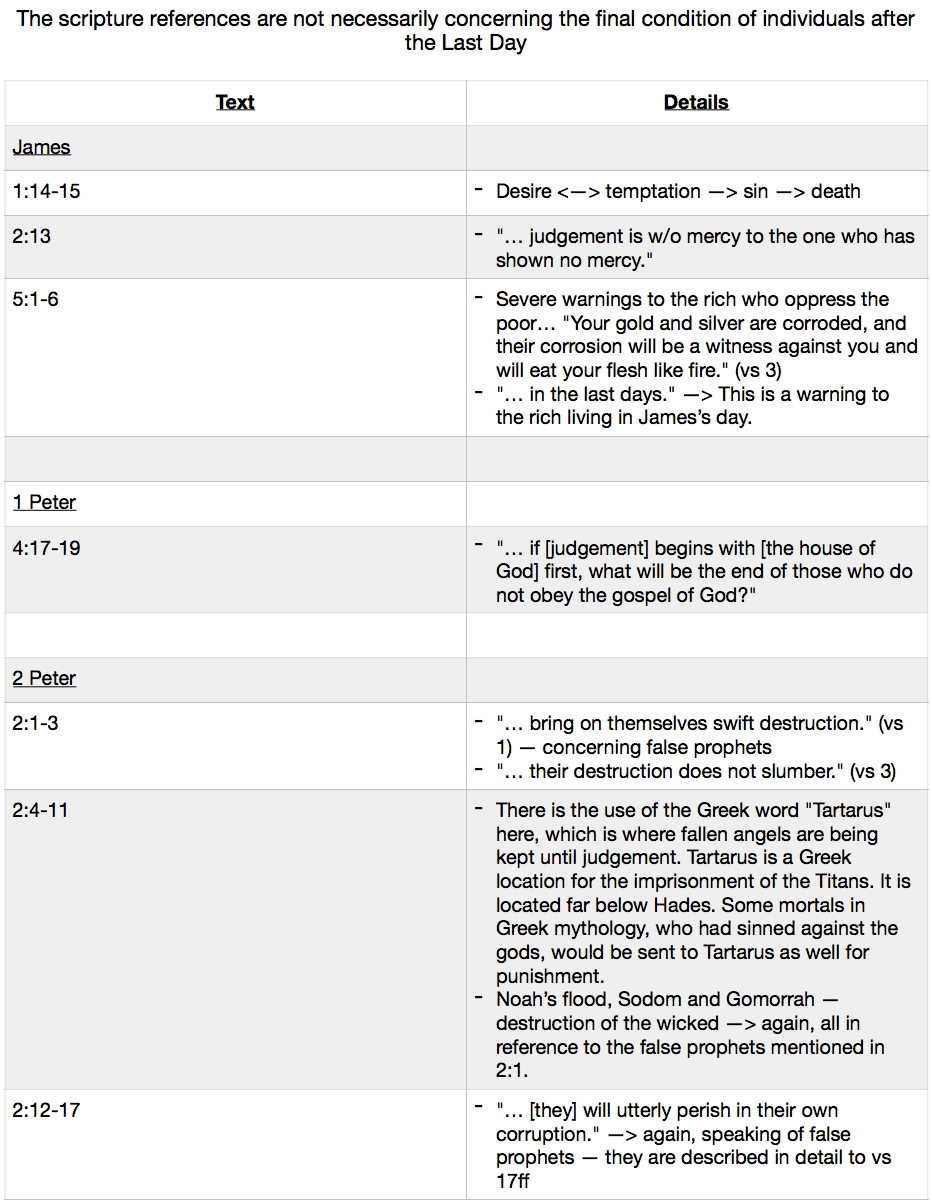
The Destination/Condition of the Wicked in the New Testament Writings Other Than Paul and the Gospels


~~~
 Pursuit of Percipience