A Warning to the West

Following is an excerpt from a speech given by Alexander Solzhenitsyn in New York City in 1975….

July 9, 1975

Is it possible or impossible to transmit the experience of those who have suffered to those who have yet to suffer? Can one part of humanity learn from the bitter experience of another or can it not? Is it possible or impossible to warn someone of danger?

How many witnesses have been sent to the West in the last 60 years? How many waves of immigrants? How many millions of persons? They are all here. You meet them every day. You know who they are: if not by their spiritual disorientation, their grief, their melancholy, then you can distinguish them by their accents or their external appearance. Coming from different countries and without consulting with one another, they have brought to you exactly the same experience; they tell you exactly the same thing: they warn you of what is now taking place and what has taken place in the past. But the proud skyscrapers stand on, jut into the sky and say: It will never happen here. This will never come to us. It’s not possible here.

It can happen. It is possible. As a Russian proverb says: “When it happens to you, you’ll know it’s true.”

But do we really have to wait for the moment when the knife is at our throat? Couldn’t it be possible, ahead of time, to assess soberly the world-wide menace that threatens to swallow the whole world? I was swallowed myself. I have been in the dragon’s belly, in its red-hot innards. He wasn’t able to digest me. He threw me up. I have come to you as a witness to what it’s like there, in the dragon’s belly.

It’s an astonishing phenomenon that communism has been writing about itself in the most open way — in black and white — for 125 years, and even more openly, more candidly in the beginning. The Communist Manifesto, for instance, which everyone knows by name, and which almost no one ever takes the trouble to read, contains even more terrible things than what has actually been done. It’s perfectly amazing. The whole world can read, everyone is literate, but somehow no one wants to understand. Humanity acts as if it does not understand what Communism is, as if it does not want to understand, is not capable of understanding.

I think it isn’t only a question of the disguises which communism has assumed in the last decades. It’s rather that the essence of communism is quite beyond the limits of human understanding. It is hard to believe that people could actually plan such things and carry them out. And precisely because its essence is beyond comprehension, communism is so difficult to understand.

In my last address in Washington I spoke a great deal about the Soviet state system, how it was created and what it is today. But it’s perhaps more important to discuss with you the ideology that inspired the system, that created it, and that still governs it. It’s much more important to understand the essence of this ideology, and above all its legacy which hasn’t changed at all in 125 years. It hasn’t changed since the day it was born.

That Marxism is not a science is something which is entirely clear to intelligent people in the Soviet Union. One would feel awkward to refer to it as a science. Leaving aside the exact sciences, such as physics, mathematics, and the natural sciences, even the social sciences can predict an event — when, in what way, and how an event might occur. Communism has never made any such forecasts. It has never said where, when, and precisely what is going to happen. Nothing but declamations. Rhetoric to the effect that the world proletariat will overthrow the world bourgeoisie and the most happy and radiant society will then arise. The fantasies of Marx, Engels, and Lenin break off at this point, not one of them goes any further to describe what this society would be like. They simply said: the most radiant, most happy society. Everything for the sake of man.

~Excerpt taken from Warning to the West, by Alexander Solzhenitsyn. Farrar, Straus and Giroux, New York, 1976, pg 52-55

Seven Revolutions (Book Review)

7 revs

Seven Revolutions: How Christianity Changed the World and Can Change it Again was written by Mike Aquilina and James L. Papandrea.

It teaches an idea which I strongly agree with: that Christianity, since its beginnings, has changed the whole world for the better and continues to do so.

The authors focus on seven revolutions; seven ways in which Christianity rearranged the world in new and positive methods.

The first revolution is concerned with Human Dignity. Unwanted life, be it children, or slaves, or cripples, was thrown away in the ancient world, and no one thought much of it. It was the first Christians who condemned this behaviour and openly spoke out against abortion, child murder, gladiatorial violence, and the overall low view of “inconvenient” persons.

The second revolution, which builds on the first, is on Family. In contrast to the Roman culture, Christian homes had husbands and wives who loved each other, and children who were valued and cared for. The marriage was not just a contract, and the wife was not just the property of the husband (she was, but he was her property now too). Sex was seen in a new light as well: not just something for the physical pleasure of the man, but a sacred activity to both marriage partners. As one second century author wrote:

“They [Christians] marry, as everyone does; they beget children, but they do not destroy their offspring. They have a common table, but not a common bed. They are in the flesh, but they do not live after the flesh. They pass their days on earth, but they are citizens of heaven. They obey the prescribed laws, and at the same time surpass the laws by their lives. They love all men, and are persecuted by all.” (Epistle to Diognetus, 5)

The third revolution addressed is that of Work, and how labour became holy. “Shoemakers, cleaners, weavers — these were the people who called themselves Christians. How could a religion made up of such lowly people be anything but contemptible?” (Page 80) Manual labour was despicable to the upper classes in the ancient world, and that type of work was best left to slaves. But Christians welcomed and treated as equal both manual labourers and slaves in relation to the upper class Christians. Manual labour is seen as holy in the Christian faith. God Himself worked with His hands in creating the world. How could a religion like this lead people to salvation when clearly the physical world is dirty and disgusting while the spiritual world is beautiful and pure?

The fourth was a revolution of Religion. Whereas the pagan religions of the past were more so contracts between patron (the god) and people and were seen as a patriotic duty, Christianity focuses on having an actual relationship with God and with fellow believers. A Christian, rather than trying to guess at what makes the gods happy, receives divine revelation which allows for a direct and intimate knowledge of God. And then there is the monotheistic/trinitarian nature of God: God is one, but He is three persons in relationship, and that relationship of love spills over into humanity causing Christians to not only love God, but also to love people. And don’t leave out the Christian view of morality — living a life which pleases God, not to earn salvation, but to live out the salvation already received.

Number five: a revolution of Community. The authors, perhaps unnecessarily, start this chapter with an overview of the Augustine/Pelagius controversy. Augustine believed in original sin and total depravity, while Pelagius believed in free will and humanity’s ability to live a perfect life. The Church (the Catholic Church) decided the truth was somewhere down the middle of those extremes — not all depends on God, and not all depends on us. Therefore we must work with God in His mission to “extend His love to others.” (page 137) The debate of free will vs. original sin still rages on in Protestant circles, but the point of the book is clear: “the revolution of the community is that God calls us to love our neighbour.” (Page 137) The focus here is on working with the poor, and the contrast of Christian charity (loving others for the sake of love) against pagan charity (doing good to others to be seen doing good). Christians are not to build up treasure in this world, but rather in heaven, and “the storehouses of heaven are the stomachs of the hungry.” (Page 141)

Next, a revolution in Death. This is a Catholic book, and while I don’t think it’s too Catholic for non-Catholic readers, this chapter on death does hold much of the theology, particularly concerning relics and patron saints. While I’m not Catholic myself, I do agree with the premise of this chapter, which has to do with resurrection and Christianity’s conquering of death itself. Death has no more sting and the horrors of death are nothing more than a temporary sadness. A new body and a new life await those who belong to Christ.

The final and seventh revolution is about the State and Religious Freedom. Again, being a  Catholic book, there is no mention of the Reformation’s contribution to the western world and to how individual liberty grew out of that movement influencing so much of western politics. The book mainly focuses on the influence of Constantine and his edict of religious tolerance. “By the time the Church was in a position to influence government in the fourth century, a Christian idea of government had emerged — that those who governed should be the protectors of those whom they govern. Leadership was not a right; it was a responsibility — one that included serving the ‘least’ of society. To govern was to be entrusted with something very valuable — human beings created in the image of God and the resources to sustain them. In other words, Christian leadership is a form of stewardship” (page 183). That’s good in theory, but fast forward 1000 years and the Church’s rule wasn’t doing so great. Much was corrected by the Reformation.

The final two chapters talk about how the Church can change the world again. Several “to-do” items are given for the Church:

  • Reject isolationism
  • Respect the value of every human life
  • Reject the culture of celebrity and humiliation as entertainment
  • Respect the humble, the labourer, and the poor
  • Reject the creation of a secular religion of the state
  • Respect religious freedom (freedom of religion, not from religion)
  • Reject a defeatist attitude
  • Respect your neighbours

All in all I thought it was a good book. I give it 3.5 out of five stars. I think the Catholic authors focused too much on ancient history, neglecting the huge changes made in the last 500 years. But, there is much to be learned from those ancient centuries as well so that we need not repeat the mistakes of the past.

“The seven revolutions of the Church can be broadly grouped into two categories: the protection of all human life, and the protection of each person’s dignity and freedom.” (Page 204)

“Just like the early Christians, we may find ourselves facing a choice between two kinds of sacrifice. We will either sacrifice our place of comfort within society to speak up for life and freedom, or we will sacrifice our convictions and accept the current definition of freedom (that is, absolute freedom of convenience for the individual, and freedom from having to be confronted with expressions of religious faith that may convict one of selfishness).” (Page 217)

***

Jesus and Godel’s Theorem by Richard Bledsoe (Re-blog)

babel

Here is a thought provoking article written by Richard Bledsoe on Theopolis Institute….

Jesus and Godel’s Theorem

“Religion” is an attempt to create or build a tower with a top, or to build a temple that is self-contained. The story of The Tower of Babel in Genesis 11 is the story of mankind’s attempt to create a world that is self-contained and does not need God. All ancient pagan temples were renewed attempts to complete the Tower of Babel. These were termed “ziggurats,” and were viewed as connecting points, or umbilical cords between heaven and earth. Heaven and earth were in the ancient pagan cosmology, part of one eternal entity.

The Temple in Israel was purposely built with a similarity to the ancient ziggurat, and as an answer to the ziggurat. It was built on the top of a mountain, and was a “connecting” place to the God of Israel. But the God of Israel was not encompassed or contained within it, nor was His liberty compromised by it, as were pagan gods by their temples. Never-the-less, Israel was constantly tempted to believe that their temple was like the temples of the nations. The destruction of Shiloh, the capture of the Ark in Samuel’s time (1 Samuel 4), and the destruction of Solomon’s Temple (2 Chronicles 36:15-21) contradicted Israel’s constant temptation to “religion”. The theology of Steven Spielberg’s Raiders of the Lost Ark is quite accurate. The Nazis, like Israel at Shiloh, believed that possession of the Ark entailed possession and control of Jehovah. In this they were wrong.

Arend Theodoor van Leeuwen says that the destruction of Herod’s Temple in 70 A.D. was in principle the destruction of all temples. The last 20 centuries of Christian history have progressively undone one temple after another. But, Christians themselves are tempted to new temples. Byzantine was an attempt to recreate on a Christian basis, at least a partial “ontocratic” or self-contained church/state, to use van Leeuwen’s terminology. The Roman Catholic Church has constantly been tempted in this way, and Protestant sectarianism is guilty in these ways as well.

Hopefully, it is increasingly clear that there is no top to the towers of this world, as we saw demonstrated in the 20th century when we saw all of the great ideologies fall. This opens the door to nihilisms, but also makes more clear than ever that it is only the Sovereign Triune God who is the I Am that I Am, and I Will Be that I Will Be. Only He is self-contained.

The modern city, and indeed, the modern world as a “global village,” is a “tower without a top.” Religion is done for. Bonhoeffer glimpsed this possibility in what he termed a “religionless Christianity. The story of The Tower of Babel sets the theme for all of God’s redemptive work in history. Fallen man’s idolatrous desire is to make for himself a self-contained world of complete adequacy.

When Carl Sagan says, “The Cosmos is all there is, or all there ever will,” he is stating the sentiments of the builders of the Tower of Babel. For them, the upper emporium was the realm of the gods, but it was by human effort and construction, a reachable realm, and that was itself a part of one cosmos. As one moved up the tower to the realm of the gods, one’s own being could also be “divinized”. Man’s being was potentially divine, given the right techniques and methods, amongst which “tower construction” was foremost. But God frustrated them and left them off with an incomplete tower, a tower without a top.

Click here for full article (2400 more words)

Letters to the Third Millennium (Book Review)

Letters to the Third Millennium: An Experiment In East West CommunicationLetters to the Third Millennium: An Experiment In East West Communication by Clinton C. Gardner

My rating: 4 of 5 stars

If you’re into Eugen Rosenstock-Huessy you’ll like this one. This book goes well with ERH’s Out of Revolution and certain sections of his I Am an Impure Thinker.*

Gardner focuses much on ERH’s ideas of The Four Phases of Speech and The Cross of Reality.

The Four Phases of Speech

4 phase

When I read literature from the past, I am not just reading it in a detached analytical way. Take the book of Isaiah for example. When I read it, I am there with Isaiah when he says, “Here am I! Send me.” I am there when Isaiah carries out his calling, preaching to and warning the people of Israel. I am there when Isaiah completes his task and is able to say, “Lord, for better or for worse, we have completed our task and have spoken to the people.” And I am there to see Israel dragged off into captivity into Assyria because they did not heed the words of the prophet, and I can stand back and analyze that result. I am connected and in relationship with Isaiah and Israel. I am the last part of the story.

“Human speech never was intended for expressing platitudes like ‘the weather is bad,’ or ‘come,’ or ‘I am happy,’ or ‘the moon rises.’ Human speech corresponds to the construction of our brain so as to permit the transfer of acquired experiences to the race. Speech enables us to gain times and spaces for ‘settling’ a question. Speech connects the departments of experience. The event which is expressed can only be expressed in four phases.”†

“Thou must” is looking forward to the event. “I am” is living in the event. “We have” looks back on the event. “He did” looks at past, present, future as one.

In the first stage, one sees himself, not as “I”, but as “Thou”. My four year old son often refers to himself in the third person: “Noah ate a lot today!” He does this because he sees himself through the eyes of others, namely me – his father. But, as he grows and matures, and his ego develops, he will see himself more and more from within: the “I”. However, no matter how old or mature he gets, whenever a higher power calls on him, he will at those times see himself from the point of view of the higher power — he will see himself from without: the “Thou”. “The hero never is: he is prejective because he is made over into a new realm of experience and has not yet any ‘feelings’; hence the hero is ‘Thou’; to himself the hero appears as the instrument of God…”‡

When one is called by a higher power (which might be God, a powerful idea, a passion, lust for a woman, or whatever drives a person), one is singled out for the calling, he is alone, but it can’t stay this way — he must bring others into his world. He does this by courting, convincing, pleading, and prophesying. He doesn’t know if he will be successful, but he must try. He goes from being the “Thou” to being the “I”, driven by his own emotions and ego. He calls people into his own experience.

If he is successful, he reaches the perfectum. “The subjective pressure of a deep emotion is transformed into the narrative of a past whenever the hero’s ‘thou’ and the subject’s ‘I’ can be tranquillized into a ‘we’.”§ He can now look back and say, “We have accomplished something together.” His declaring of an event completes the event. “Thus, the tale of an event is the tail light of the event. Nothing has happened which is not reported back as having happened. History is not arbitrary staring at bygone things. History is the articulation of the event itself in its participants; as the event goes by. It proves its passing by being told as a tale. The historian certainly is not the onlooker of an event but the last man whom the event produces.”||

“The fourth phase of speech is the spirit’s death.”¶ Once I’ve completed my task, what left is there to do but to look at it objectively from the outside? There is no more calling from the higher power, there is no one left to convince, there is no job left undone. I am free now from the first calling. “If we call the impetus by which a total experience subjects one man to the four phases through which the experience is realized ‘spirit,’ i.e., a breath of life, then phase four is the phase in which the spirit dies but the specimen recovers. If phase four did not abstract us from our spells, freedom could not exist to start a new phase. In phase four we expire one act of faith so that we may be inspired again.”#

These days, especially in western thought, we tend to live in the fourth phase. We look at light and analyze it scientifically — “Light is made of waves and particles.” But we ignore the first three phases: 1) “Let there be light;” 2) “Let us praise the light;” 3) “The sun has risen.” When we do this, we disconnect ourselves from the relationship we have with the past, and consequently the future as well.**

A helpful illustration is to think of a great piece of music, like Beethoven’s 5th symphony. Most people I think have never listened to the whole symphony, but I’m sure everyone would recognize the opening notes. Those opening notes are a powerful call: People! Listen to this. When you hear those notes for the first time you are not analyzing, you are not feeling anything yet — your reaction is much like Moses’ reaction when seeing the burning bush: What is this? I will turn to see. Then, once you’ve settled in to listen, your emotions come into play; you are drawn into the music and you feel the passion of Beethoven with Beethoven, with the orchestra. Thirdly, the piece comes to an end, and it does not end on a strange note leaving you wondering what happened to the flow of music — it ends precisely when it should end; the final notes cry out, We are finished! It is complete! And finally, the fourth phase allows you to look back on the whole piece and say, That was good. What’s next?

You cannot enjoy Beethoven’s 5th if you don’t experience the piece through all four phases. You cannot be connected in relationship to the past if you do not experience the lives and events of your ancestors through the four phases of speech. Speech connects us all.

Every time I study history, if it is good history, I relive the four phases with those people who came before me, and because of that I am connected in relationship to those people. This is why stories are so good for learning history. This is why the Bible is written as story.

Unfortunately, most western history books written today are written by historians who believe that they can have no bias. They are stuck only in the fourth phase. It’s not possible to have no bias, so, to hide their bias, they use the most dry and unimaginative language possible in their writings. For example, here is an excerpt from a contemporary history book describing the introduction of Christianity into the Roman world:

“In the first centuries of the Christian era, while Christianity was expanding in the Empire, it was increasingly the speech of much of the population on the western borders of the Mediterranean. A religion which employed Greek and Latin, and especially Greek, had advantage over rivals which did not and might gain an Empire-wide hearing. Important also was the religious and moral hunger which characterized much of the populace of the basin of the Mediterranean in the centuries in which Christianity was having its early development.”††

Now, here is another excerpt from a history book, concerning the same time in Christian history as the example above, written in the 19th century, by an author who didn’t care about his bias:

“In the cheerless waste of pagan corruption the small and despised band of Christians was an oasis fresh with life and hope. It was the salt of the earth, and the light of the world. Poor in this world’s goods, it bore the imperishable treasures of the kingdom of heaven. Meek and lowly in heart, it was destined, according to the promise of the Lord, without a stroke of the sword, to inherit the earth. In submission it conquered; by suffering and death it won the crown of life.”‡‡

Notice how the second history draws you into the story and life of the early Church. In this one excerpt we see the call of God on the Church, we see how the Church would carry it out, and we see what the final result will be, and putting that all together we can objectively analyze it. In the first excerpt, however, all we see is the analysis.

There is a lot of good information in the first history book, but how long can one read a book like that and stay awake? To be forever trapped in the fourth phase is to be forever dead.

In his essay, Politics and the English Language,§§ George Orwell points out this problem much better than I have…

I am going to translate a passage of good English into modern English of the worst sort. Here is a well-known verse from Ecclesiastes:
I returned, and saw under the sun, that the race is not to the swift, nor the battle to the strong, neither yet bread to the wise, nor yet riches to men of understanding, nor yet favour to men of skill; but time and chance happeneth to them all.

Here it is in modern English:

Objective considerations of contemporary phenomena compel the conclusion that success or failure in competitive activities exhibits no tendency to be commensurate with innate capacity, but that a considerable element of the unpredictable must invariably be taken into account.

This type of speech is purely objective. When the living experience of time is ignored, and the only goal is to objectively analyze in the present “objectivity (becomes a) god. It would treat all realities as things external to the mind, things in which we as thinkers have no roots, and which may accordingly be touched, weighed, measured, and manipulated without reference to the common destiny in which we and they are jointly bound. This may do for physics. It will not do for human society.”||||

God could have just written the Bible as a textbook, explaining everything we need to know and do objectively. But instead, He wrote a story. When one reads the Bible, he is put into that story. He becomes a part of the story. The story’s past is his past, the story’s future is his future. And when one knows his past and future, one knows what to do in the present.

“When man rises above his future, which is imminence of his death, and beyond his past, which is reminiscence of his origins, he enters the present. From the conflict of end and origin, of death and birth, the present results for those who have the courage not to blink but face the abyss before and in back of them… Without participation in the life of the Word through the ages, we remain ephemeral.”¶¶

I am constantly in relationship with all those who came before me, and all those will come after me. This relationship spans across and conquers time through my speech and everyone else’s speech. We are all connected through the stories of our lives told and retold, lived and relived, throughout all the ages.

The Cross of Reality

Cross of Reality Diagram 002

The Cross of Reality shows us the four parts of life pulling on us in four different directions. You stand in the middle of the Cross and each element is pulling at you. In order to have a healthy life you need to be pulled equally by each element. If you are pulled by one or two too strongly your life will be unbalanced and confused. For example, a 35 year old single man who lives in his mom’s basement and has a video game and porn addiction is a man who is pulled much too strongly by the Past and Inner Life elements. While another man, being very charismatic and well loved by many people, but can’t commit to anything, is a man being pulled too strongly by the Outer Life and Future elements.

Also, as illustrated above with the Four Phases of Speech, one must progress through each element in its turn to have a healthy balanced life. Starting with the Future, then moving to Inner (subjective), then Past, and finally Outer (objective): one hears the call, contemplates the options, makes the decision, and observes the results. If one element is skipped over, there will be conflict.

“Emotional disturbances may be described as getting stuck in one particular phase [or element] or the result of an attempt to skip one. The speech method reveals four basic phases in any significant experience: 1. Inspiration  2. Communication  3. Institutionalization, finally,  4. History… [W]e see this sequence when we fall in love and get married. Our falling in love cannot be an objective or logical experience. We must be swept off our feet, inspired. Then we enter a subjective phase in which we must communicate our new relationship through love letters, singing, and talking. In the third phase, institutionalization, when we marry before witnesses, our experience has begun to enter recorded history. Finally, usually after our first child is born, we experience ourselves as an objective family unit. In each phase we had new and different emotions.”##

The book was published in 1980, and the “East” referred to in the subtitle is the U.S.S.R., which of course doesn’t exist anymore. The author is too sympathetic to Marxism for my taste, and he actually takes it seriously enough to think it works. Well, the fall of the U.S.S.R, and other communist/socialist failed experiments, have taught us otherwise.

Good book.

Notes

* I Am an Impure Thinker can be read free with PDF download here.
† Eugen Rosenstock-Huessy, I Am an Impure Thinker: The Four Phases of Speech, pg. 55
‡ Ibid., pg. 57
§ Ibid. pg. 57
|| Ibid. pg. 58
¶ Ibid. pg. 59
# Ibid. pg. 59
** Ibid. some of this taken from pg. 59
†† Latourette, Kenneth Scott, A History of Christianity (Peabody, MA.: Hendrickson Publishers, 2003), pg. 22
‡‡ Schaff, Philip, History of the Christian Church, Vol. II (Peabody, MA.: Hendrickson Publishers, 2002, originally published in 1858), pg. 335
§§ Read Orwell’s essay here
|||| I Am an Impure Thinker: Teaching Too Late, Learning Too Early, pg. 93
¶¶ Ibid. pg. 94
## Gardner, Clinton C., Letters to the Third Millennium, pg. 131

View all my reviews

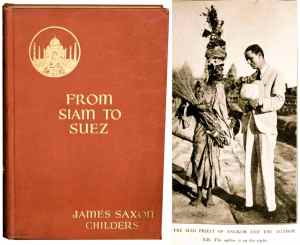
From Siam to Suez ~ Angkor

suez-001
Photo caption: THE MAD PRIEST OF ANGKOR AND THE AUTHOR – N.B. The author is on the right.

From Siam to Suez is a rare old book written by James Saxon Childers (1899-1965) detailing his journey from China to Egypt in the early 20th century. Childers was an American writer and traveller who wrote several fiction books as well as travel books. His fiction did not do too well, but his travel books were popular.

Here I’m sharing chapter two of the book where Childers visits Angkor. I have been to Angkor several times and it never ceases to amaze me. I agree with Childers though: Angkor is a foreign mystery to the westerner — cut off from our history, culture, and religion.

Chapter II, From Siam to Suez by James Saxon Childers (Public Domain Book)

aw007
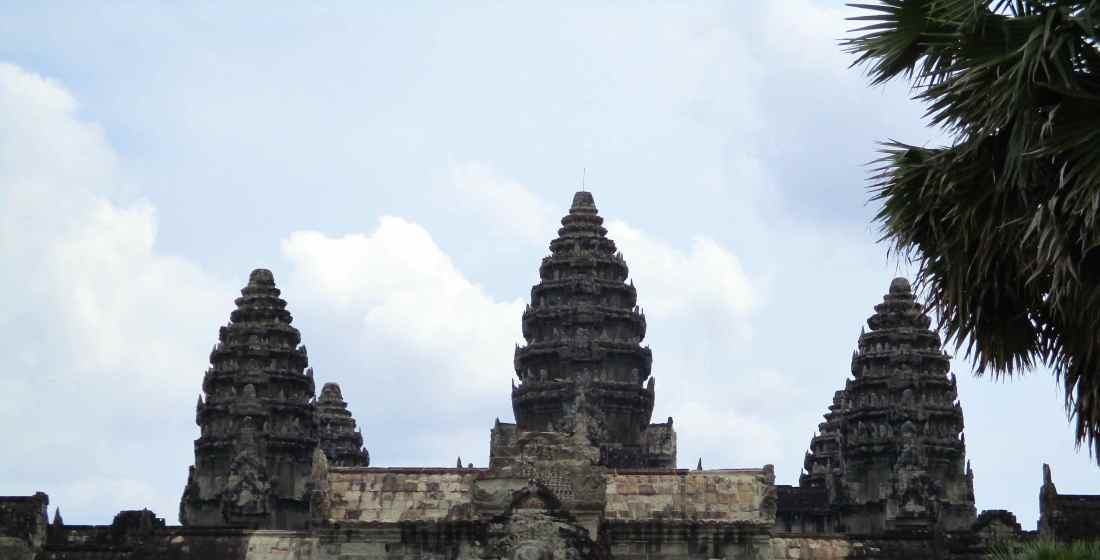
The towers of Angkor Wat temple

DEAR OCTAVUS ROY COHEN: You asked me to write to you about the ruins of Angkor. I’m sorry you did; for I’ve been in Angkor a week, yet can find out nothing about it. At night I prowl through the temple and in the day I ride elephants through the town, but the stones are only stones and I hear nothing.

In Athens I can see Socrates in his ragged old coat, forever talking, forever making his soul as good as possible. In Rome I hear the tramp of the legions and Cato shout, “Delenda est.” In Paris I see Villon staggering, staggering just a little as he searches for the snows of yesteryear. In the streets of London, Doctor Johnson shambles along with Boswell at his side. I hear him say: “Sir, when a man is tired of London, he is tired of life.” But Angkor is silent. The lips of the four-faced god are mute; even the spirit of his devotees has gone into the awful jungle.

I would not have you feel that Angkor prompted me to ask Cleopatra’s famous question: “Is this the mighty ocean? Is this all?” In a way, I have not been disappointed in Angkor, but the place has not set me on fire; I have not felt as I did when looking at the Great Wall of China, or at the Parthenon, or at the Forum: Genghis Khan never stormed these gates, Phidias never worshipped in this temple, Cæsar never walked these streets…

aw003

I arrived at Angkor after a week’s visit to Saigon, the real capital of Indo-China, a French city set in a jungle. The French own Saigon: they dominate it; one sees the native only as a servant, or as a soldier in the troupes coloniales. The architecture of Saigon is French. The paved boulevards are French. The big shops are French. There is a Hôtel de Ville, a Théâtre Municipal, a Musée, a Jardin Botanique. Saigon in its buildings, parks, and streets is definitely a counterpart of Paris, but the buildings are merely masquerade; even a transient detects a noxious decadence in the lives of the haggard officers of the Foreign Legion, of the white-faced government employees, of the red-faced rubber planters–Frenchmen forced to live in daily contact with the jungle and its diseases, the heat and its diseases, the sullen hatred of the natives, opium, the nostalgic realization of exile, and the insidious enervation of the Orient.

After a week’s visit in Saigon–seven days of ghastly heat and of torment from mosquitoes, seven nights of tennis and absinthe frappés, of late dinners and champagnes and brandies, of visits to opium houses and to other houses where depravity in its most vicious form is commonplace–I was glad to hire an automobile for the two-hundred-mile ride over the jungle road to the ruins of Angkor.

aw001

Three times he spoke his name and three times I tried to repeat it. He laughed as I stumbled through the confusion of syllables, and when at last I called him Rollo, he didn’t seem to object. He was a white-haired old man of eighty-four years, and his entire international vocabulary was this: “Angkor Thom,” “Angkor Vat” (pronounced Angkor Wot), “Buddha,” “Vishnu,” “soldat,” “le roi,” “madame le roi,” “Naga,” and “all right.” For a week we talked with each other daily, and we used no other words than these. A stranger might have been puzzled had he seen us in conversation, for he might not have comprehended the gestures of our arms, the contortions of our bodies, and the significant grimaces by which we discussed history, art, and curious practices.

I found Rollo late one afternoon squatting on his haunches, chewing betel nut, and spitting the blood-red juice upon the stone causeway that leads to the temple of Angkor.

“You speak English?” I asked.

Rollo stood, bowed to me, raised his arm and swept it before him, encompassing by his gesture the entire façade of the mighty temple.

“Angkor Vat,” he said.

“Yes, I know, but do you speak English, and could you tell me where I could find a guide?”

Again the inclusive gesture and again: “Angkor Vat?”

“Good, but you speak French peut-être? Oui? Vous parlez français?

But the habit was on him: once more I learned that at the distant limit of the great arc described by his hand stood the temple of Angkor.

“Righto, old chap.” I nodded and smiled to him. “Merci bien.

I started along the causeway. Rollo trotted beside me, his little wooden clogs tap tapping upon the stones.

“Where are you going?” I demanded.

“Angk–”

“So I gather, but why are you following me?”

He looked at me and smiled. Absurdly enough I thought of wrinkled copper.

“All right,” he said, and startled me by his linguistic versatility. He struck his chest, touched my arm, and, clasping his hands, showed that we were friends.
Afterward he pointed ahead at the temple. Crouching low, peering all about him, he stood on tiptoe, gazing with keenest interest. Finally, with two forefingers ever moving one before the other, he signalled our advance.

“But, see here, you don’t speak any language I understand. How can you–”

Already he was tap-tapping toward the temple. I could only follow. And so, led by this venerable Cambodian, this graybearded ancient of infinite gentleness, of wisdom to leap the barrier of language, I began a tour of architectural wonders wrought more than a thousand years ago.

aw004

Cambodia is a kingdom in French Indo-China, and in the center of Cambodia are the famous ruins of Angkor, once capital of the most powerful nation of Asia. Angkor was built by a people called the Khmers–whence they came nobody knows, where they went nobody knows, but at one time more than a million men lived in Angkor; and its grandeur shamed the Rome of Augustus, the Athens of Pericles, and the Babylon of Nebuchadnezzar. To-day there is nothing except the shell of the mighty city and a silent temple of infinite majesty–a city and a temple, gray stone ghosts in a jungle of green.

aw006
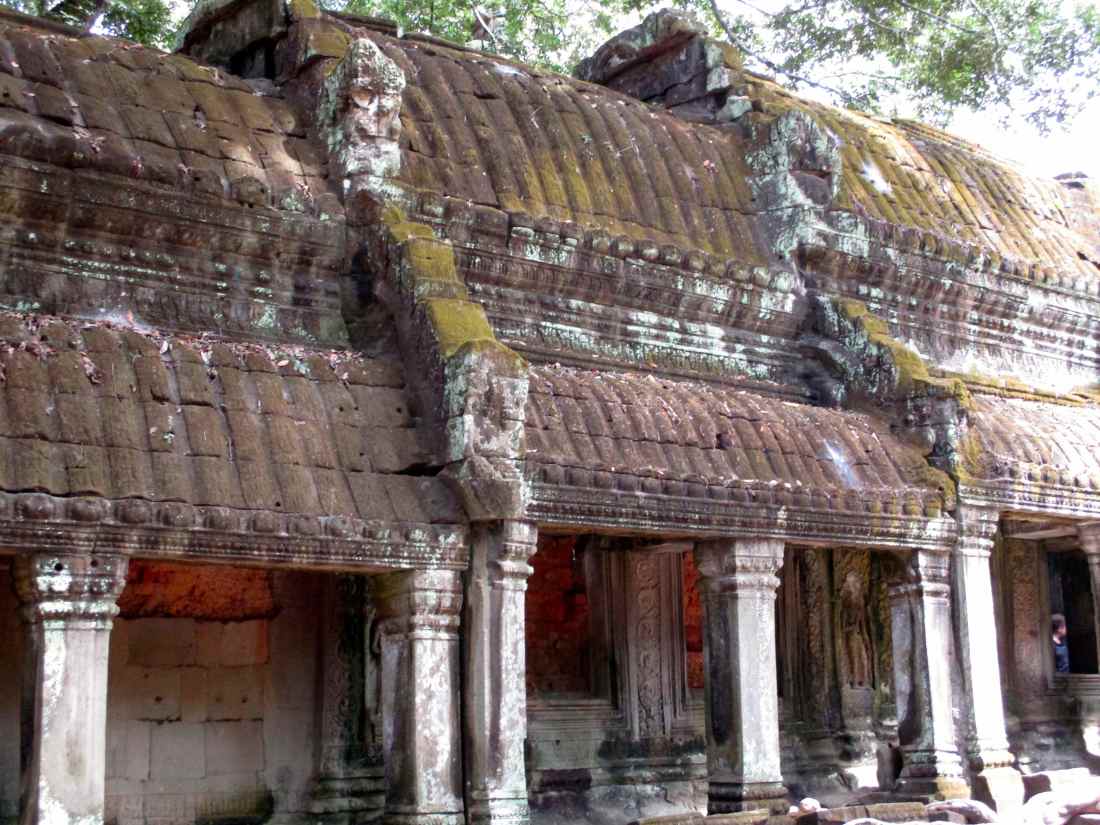
Ta Prohm temple

Some writers have declared that the Khmers were driven from their capital after a war in which their enemies combined against them. Others believe the Khmers were blotted out by a swift plague. French scholars who have spent years studying the ruins and their inscriptions contend that in the fourteenth century the slaves of Angkor suddenly fell upon their masters and destroyed them. Chaos followed. Gradually the slaves reverted to savagery, and gradually the savages degenerated into the decayed peoples who live their shabby lives near the ruins to-day.

“Angkor Vat,” said Rollo, pausing at the entrance of the famous temple, then leading me into the outer corridor. “Vishnu,” he said, pointing at a giant figure with hundreds of arms. Upon the wall was an unbroken bas-relief depicting wars, battles, and fearful exploits of wondrous men. “Soldats,” Rollo explained.

“And a bloodthirsty lot–eh, Rollo?”

“Soldats,” he answered, solemnly.

We turned a corner and the subject of the bas-relief changed to tortures used by the Khmers. One man’s eyes were being plucked out by vultures. Another writhed between two stones that were slowly pushed together. A third was hacked in pieces with great axes. One miserable wretch was surrounded by a number of ladies who cut tidbits from his body.

Whenever we arrived opposite a particularly gruesome carving, Rollo demonstrated. I shall always remember his graphic depiction of a disemboweled man whose entrails were used as a skipping rope–Rollo danced about with the happy abandon of a child whirling a daisy chain. In the middle of his danse macabre I caught his little white jacket and pulled at it, stopping him. He bowed, and, hurrying past the other torture scenes, led me around the great square, more than a mile in length.

aw002

Angkor was built with gray sandstone that takes a polish almost like marble. In the middle of the twelfth century when the temple was built by the architect Visvakarman, thousands of tons of this stone were brought in huge blocks from quarries nineteen miles away. The outer gallery and inner gallery are connected by a stone causeway thirty-six feet wide. In the center of the temple are five huge domes, the middle one thrusting its rude splendour six hundred feet into the air. The walls, columns, entablatures, and pilasters are all marvelously decorated with carvings of the heavenly dancers, the monkey gods, and the divine tevadas with lotus flowers in their hands. When the moon touches them with silver, the carvings look like lace lying lightly upon stone.

The temple now is deserted save for Buddhist priests and sightseers, and millions of bats that defile the floor and pollute the air with the gagging smell of their bodies–besides these, there is nothing alive in a temple where once a million men bowed before their gods.

“Angkor Thom,” said Rollo on the second morning of my visit, as he made signs for me to mount one of the two elephants he had hired to take us to “The Great Capital,” the deserted city that lies one mile from the temple. We could have gone in automobiles, but Rollo insisted I ride as rulers had ridden, and because of his insistence I climbed to the howdah where I watched the mahout kick the elephant and strike it with an iron hook until at last the great beast heaved itself toward Angkor Thom.

sr002
Elephant ride from the entrance gate of Angkor Thom to the Bayon Temple

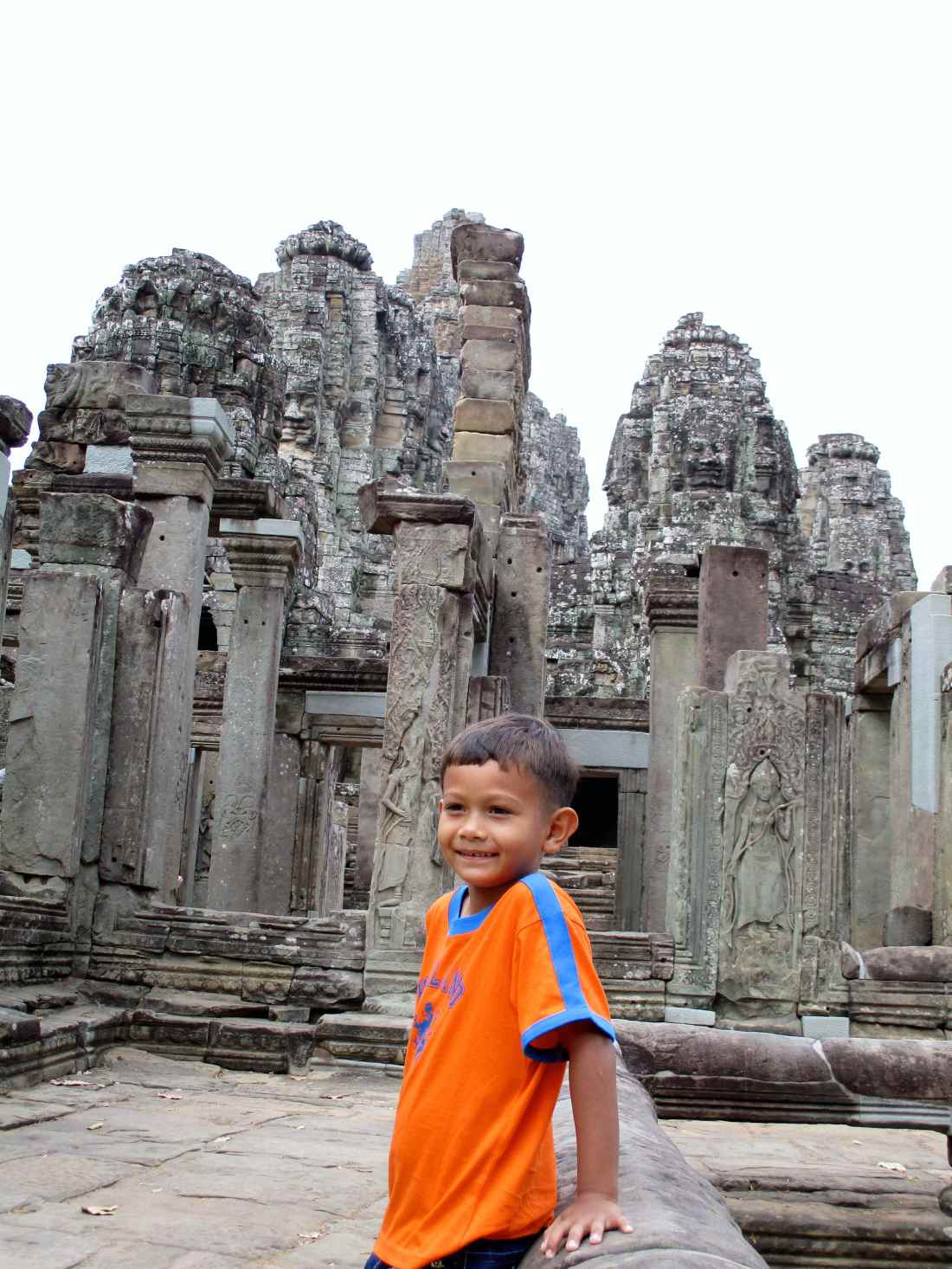
The boundaries of the old city are marked by a wall, its massive stone gates arching high in primitive splendor above the roadway. Within the boundaries are the remains of a dozen buildings with enormous square towers still standing, each side of each tower cut as a huge Brahmanic face. In all parts of the city are terraces adorned with figures of startling beauty, treasures of sculpture.

sr006
My son at the Bayon Temple (the temple of the Brahmanic faces)

The time may come when I forget the towers and the terraces and the carvings, but I shall never forget the dreadful silence of that dead city. In Angkor Thom, “The Great Capital,” one hears only the occasional call of a bird; the awful stillness sings the saga of departed pomp and power.

A thousand years ago the jungle was cut away and Angkor Thom was built. To-day the jungle is taking back its own, crumbling and swallowing proud buildings erected by proud men. Seeds dropped by birds have grown into trees and their roots have split the heads of the ancient gods. Other trees send their roots above ground and over all barriers more than a hundred feet to wrap about blocks of stone and tear them from their moorings. Myriads of small plants, the jungle’s infantry, advance in almost solid formation. A thousand years the jungle has waited, watching the aspiration of man. Then man died. The living jungle crawled in to blot out the scar of civilization.

I am writing you this letter, Roy, in the modern hotel built by the French at Angkor. I have just returned from wandering through the temple alone. Far back in the inner sanctum, I heard the liquid notes of the bamboo xylophone, played in the native village, join with the low chant of the Buddhist priests and come softly over the lake. The great temple stretched away from me, its stones silver in the moonlight, its shadows hiding the brooding souls of millions of men dead for centuries. . . . Long I sat listening to the xylophone and to the chanting. Long I peered at the ancient stones. And yet when I left the temple at midnight, the souls of the builders were still hidden in shadows.

aw005

aw008
A wedding at the Angkor Wat courtyard

Buy the book on Amazon

Or, read it free online

Related article

*Photos are my own.