The Hebrew Bible: Septuagint and Masoretic Texts

In this space I am going to store research concerning all things Hebrew Scriptures, focusing much on the Masoretic Text (MT) and the Septuagint (LXX): videos, articles, essays, Dead Sea Scroll (DSS) research, AI research, etc… So, if you are studying the MT and/or the LXX, and you’ve stumbled across this post, I hope you find something useful.

Part 1 of 3
Part 2 of 3
Part 3 of 3

***

Dating the Hebrew Scriptures

***

Dating the Scriptures (AI Research – Grok, ChatGPT, and Claude)

Torah (Pentateuch)

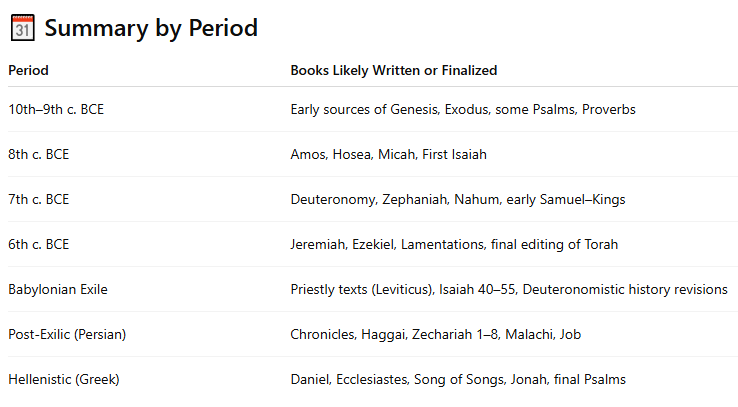
The first five books—Genesis, Exodus, Leviticus, Numbers, and Deuteronomy—are traditionally attributed to Moses but are now understood by most scholars as composite works from multiple sources (Yahwist, Elohist, Priestly, and Deuteronomic) compiled over centuries. Final redaction likely occurred during or after the Babylonian Exile (6th century BCE).

  1. Genesis: Likely compiled in its current form during the Persian period (538–332 BCE), though it incorporates earlier oral and written traditions from the 10th–6th centuries BCE. The creation stories, patriarchal narratives, and flood accounts reflect ancient Near Eastern motifs, with some elements possibly dating to the early monarchy (10th century BCE). The final shaping likely occurred post-Exile to address the needs of the returning community.
  2. Exodus: Composed over time, with narrative cores (e.g., the Exodus event, covenant at Sinai) possibly rooted in 13th–10th-century BCE traditions. The Priestly and Deuteronomic elements were likely added during the 7th–5th centuries BCE, with final redaction in the Persian period (5th century BCE).
  3. Leviticus: Primarily a Priestly work, likely composed between the 6th and 5th centuries BCE during or after the Exile, though some ritual laws may reflect earlier practices (8th–7th centuries BCE). Its focus on purity and temple worship suggests a post-Exilic context.
  4. Numbers: A composite text with narrative and legal material, likely compiled in its final form during the Persian period (538–332 BCE). It incorporates earlier traditions, such as wilderness wanderings and census accounts, potentially from the 10th–7th centuries BCE, with Priestly and Deuteronomic additions in the 7th–5th centuries BCE. The final redaction reflects post-Exilic concerns about community identity and land allocation.
  5. Deuteronomy: Likely composed in stages, with a core tied to the reforms of King Josiah (late 7th century BCE, c. 622 BCE), based on its alignment with the “Book of the Law” found in 2 Kings 22:8–10. Additional material was added during the Babylonian Exile (597–538 BCE) and finalized in the Persian period (5th century BCE). Its covenantal theology and legal code reflect both pre-Exilic and post-Exilic contexts.

Nevi’im (Prophets)

The Nevi’im include the Former Prophets (historical narratives: Joshua – 2 Kings) and Latter Prophets (prophetic oracles: Isaiah – Malachi). The Former Prophets form part of the Deuteronomistic History (DtH), likely compiled during the Babylonian Exile (6th century BCE) with earlier sources. The Latter Prophets’ dates are tied to the historical periods of the named prophets, though redaction often occurred later.

  1. Joshua: Part of the Deuteronomistic History, compiled in the 6th century BCE during the Exile. It incorporates earlier traditions about the conquest of Canaan (potentially 13th–10th centuries BCE), but its final form reflects Exilic theology, emphasizing obedience to the covenant.
  2. Judges: Also part of the Deuteronomistic History, finalized c. 6th century BCE. Stories of the judges likely stem from oral traditions of the pre-monarchic period (12th–11th centuries BCE), but the text’s structure and theological framing suggest Exilic redaction.
  3. 1 Samuel: Part of the Deuteronomistic History, compiled c. 6th century BCE. It includes traditions about Samuel, Saul, and David from the early monarchy (11th–10th centuries BCE), redacted to emphasize divine kingship and covenant fidelity.
  4. 2 Samuel: Continues 1 Samuel, part of the Deuteronomistic History, finalized c. 6th century BCE. It draws on court records or oral traditions about David’s reign (10th century BCE), shaped by Exilic concerns about leadership and divine judgment.
  5. 1 Kings: Part of the Deuteronomistic History, compiled c. 6th century BCE, with possible updates in the Persian period. It incorporates royal annals and temple records from the monarchic period (10th–7th centuries BCE), framed to explain the Exile as divine punishment.
  6. 2 Kings: Completes the Deuteronomistic History, finalized c. 6th century BCE, with a possible secondary redaction (Dtr2) post-562 BCE to account for Judah’s fall. It uses earlier sources from the divided monarchy (9th–7th centuries BCE).
  7. Isaiah: A composite work spanning centuries. Chapters 1–39 (First Isaiah) are largely from the 8th century BCE (c. 740–700 BCE), attributed to Isaiah of Jerusalem. Chapters 40–55 (Second Isaiah) date to the late Exilic period (c. 550–538 BCE), and chapters 56–66 (Third Isaiah) to the early Persian period (c. 538–500 BCE). Redaction continued into the 5th century BCE.
  8. Jeremiah: Core oracles from Jeremiah’s ministry in the late 7th–early 6th centuries BCE (c. 627–587 BCE). The book was likely edited during the Exile (6th century BCE) and finalized in the Persian period, incorporating prose narratives and later additions.
  9. Ezekiel: Primarily from Ezekiel’s prophetic activity during the Exile (c. 593–571 BCE). The book’s final form, with its priestly and visionary content, was likely completed shortly after, c. 550 BCE.
  10. Hosea: Oracles from Hosea’s ministry in the Northern Kingdom (c. 750–725 BCE), with possible redaction in Judah during or after the fall of Israel (722 BCE). Final form likely 7th–6th centuries BCE.
  11. Joel: Difficult to date precisely due to lack of historical markers. Likely post-Exilic (5th–4th centuries BCE), though some argue for a pre-Exilic core (8th–7th centuries BCE). Its apocalyptic tone suggests a later composition.
  12. Amos: Oracles from Amos’ ministry in the Northern Kingdom (c. 760–750 BCE), with possible Judahite redaction after 722 BCE. Final form likely 7th–6th centuries BCE.
  13. Obadiah: Likely post-Exilic (5th century BCE), addressing Edom’s role in Judah’s fall (587 BCE). Some suggest an earlier core (7th–6th centuries BCE).
  14. Jonah: Likely a post-Exilic composition (5th–4th centuries BCE) due to its narrative style and universalist themes. Some argue for a 6th-century BCE origin, but its fictional nature suggests a later date.
  15. Micah: Oracles from Micah’s ministry (c. 740–700 BCE), with possible Exilic or post-Exilic additions (6th–5th centuries BCE). Final form likely 5th century BCE.
  16. Nahum: Oracles concerning Nineveh’s fall (612 BCE), likely composed shortly after, c. 612–600 BCE, with possible later redaction.
  17. Habakkuk: Oracles from the late 7th century BCE (c. 605–598 BCE), addressing Babylon’s rise. Final form likely early 6th century BCE.
  18. Zephaniah: Oracles from Zephaniah’s ministry (c. 640–622 BCE), with possible Exilic redaction. Final form likely 6th–5th centuries BCE.
  19. Haggai: Dated precisely to 520 BCE, based on internal references to the second year of Darius I. Minimal redaction, likely finalized shortly after.
  20. Zechariah: Chapters 1–8 from Zechariah’s ministry (c. 520–518 BCE). Chapters 9–14 (Second Zechariah) are likely later, from the 5th–4th centuries BCE, due to distinct style and historical context.
  21. Malachi: Post-Exilic, likely 5th century BCE (c. 450–400 BCE), addressing temple and social issues in the Persian period.

Ketuvim (Writings)

The Ketuvim include diverse genres (wisdom, poetry, history), with composition spanning a wide range. Many reached their final form in the Persian or Hellenistic periods.

  1. Psalms: A collection spanning centuries, with individual psalms potentially from the 10th century BCE (Davidic period) to the 5th century BCE. The collection was likely finalized in the Persian period (5th–4th centuries BCE).
  2. Proverbs: Contains older sayings (some possibly from Solomon’s time, 10th century BCE), but the collection was likely compiled in the Hellenistic period (c. 332–198 BCE), with final redaction in the 3rd century BCE.
  3. Job: Likely composed in the 6th century BCE, post-Exile, though its poetic core may reflect earlier traditions (7th–6th centuries BCE). Its philosophical tone suggests a post-Exilic context.
  4. Song of Songs: Possibly rooted in earlier love poetry (8th–7th centuries BCE), but likely compiled in the Persian or Hellenistic period (5th–3rd centuries BCE).
  5. Ruth: Likely post-Exilic (5th–4th centuries BCE), reflecting Persian-period concerns about identity and inclusion. Some argue for an earlier monarchic setting (8th–7th centuries BCE).
  6. Lamentations: Likely composed shortly after Jerusalem’s fall (587 BCE), with final form in the early 6th century BCE. Its poetic structure suggests rapid composition.
  7. Ecclesiastes: Likely composed in the Hellenistic period (c. 3rd century BCE, possibly 250–200 BCE), due to its philosophical tone and linguistic features. Some suggest a 4th-century BCE origin.
  8. Esther: Post-Exilic, likely 5th–4th centuries BCE, reflecting events in the Persian court. Its narrative style suggests a later date, possibly 4th century BCE.
  9. Daniel: Chapters 1–6 likely from the 6th century BCE (Exilic), but chapters 7–12, with apocalyptic visions, date to the 2nd century BCE (c. 167–164 BCE), during the Maccabean revolt. Final form c. 164 BCE.
  10. Ezra: Likely compiled in the Persian period (5th century BCE, c. 450–400 BCE), with sources from the return from Exile (538 BCE onward).
  11. Nehemiah: Companion to Ezra, compiled c. 450–400 BCE, with memoir material from Nehemiah’s governorship (c. 445 BCE).
  12. 1 Chronicles: Likely 4th century BCE, post-Exilic, retelling Israel’s history with a focus on Davidic lineage and temple worship. Draws on earlier sources (e.g., Samuel, Kings) from the 10th–6th centuries BCE.
  13. 2 Chronicles: Companion to 1 Chronicles, also 4th century BCE, with similar sources and theological focus on Judah’s temple and monarchy.

Notes on Scholarship and Evidence

  • Earliest Evidence: The Dead Sea Scrolls (c. 2nd century BCE) provide the oldest surviving Hebrew manuscripts, confirming that many books were in near-final form by then. Earlier inscriptions, like the Khirbet Qeiyafa ostracon (c. 1000 BCE), suggest Hebrew writing existed by the early monarchy, supporting the possibility of early written traditions.
  • Challenges: Dating relies on internal evidence (historical references, linguistic features) and external evidence (archaeology, ancient Near Eastern texts). The Documentary Hypothesis, though less dominant, informs Pentateuchal studies, while the Deuteronomistic History model shapes understanding of Joshua–Kings.
  • Debates: Conservative scholars (e.g., Edwin R. Thiele) argue for earlier dates, especially for Pentateuchal traditions (15th–13th centuries BCE), citing Mosaic influence. Critical scholars (e.g., John J. Collins, Israel Finkelstein) favor later dates, emphasizing Exilic and post-Exilic redaction. Archaeological evidence, like the Ketef Hinnom scroll (7th century BCE), supports pre-Exilic writing but not necessarily full texts.
  • Compilation Over Time: Most books evolved through oral traditions, written sources, and multiple redactions. For example, the Pentateuch’s final form reflects post-Exilic priorities, but earlier traditions may date back centuries. Prophetic books often combine a prophet’s oracles with later editorial framing.

***

📜 The Torah / Pentateuch (Genesis – Deuteronomy)

Traditional attribution: Moses
Scholarly view: A compilation of sources over centuries

BookDateNotes
Genesis10th–5th century BCEContains material from the J (Yahwist, ~950 BCE), E (Elohist, ~850 BCE), P (Priestly, ~6th century BCE), and D (Deuteronomist, ~7th century BCE) sources. Final form likely post-exilic (5th century BCE).
ExodusSame as GenesisComposite from J, E, P, and D traditions.
Leviticusca. 6th–5th century BCEPrimarily Priestly material, likely written or compiled during the Babylonian Exile.
Numbers10th–5th century BCEComposite like Genesis and Exodus. Final form post-exilic.
Deuteronomyca. 7th century BCE, with later editsCore written during Josiah’s reforms (~620 BCE). Final form edited in exile or post-exile.

📘 Historical Books (Joshua – Esther)

BookDateNotes
Joshua7th–6th century BCEPossibly Deuteronomistic History; post-Josiah, edited in exile.
Judges7th–6th century BCEPart of the Deuteronomistic History (DtrH).
1 & 2 Samuel7th–6th century BCEEarlier sources from 10th–9th c. BCE; edited by Deuteronomistic historians.
1 & 2 Kings6th century BCEFinalized during Babylonian Exile; strong Deuteronomistic theology.
Ruth5th–4th century BCESet in Judges era, but written later; some see it as a response to Ezra-Nehemiah’s exclusionary policies.
1 & 2 Chroniclesca. 400–350 BCEPost-exilic; retelling of Samuel–Kings from a priestly perspective.
Ezra–Nehemiahca. 400–350 BCE (some argue slightly later)Compiled from earlier memoirs and edited in post-exilic period.
Esther4th–3rd century BCEPossibly fictional court tale with Persian setting; no direct mention of God.

🎙️ Wisdom and Poetry (Job – Song of Songs)

BookDateNotes
JobCore: 6th–5th century BCE; edits laterPossibly written in exile; explores innocent suffering.
Psalmsca. 10th–3rd century BCECollected over centuries; some psalms trace to Davidic era, others are post-exilic.
ProverbsCore: 10th–6th century BCE; final: ~4th c.Some sayings may be Solomonic; final compilation likely late Persian period.
Ecclesiastesca. 3rd century BCEPhilosophical reflections, traditionally attributed to Solomon.
Song of Songsca. 4th–3rd century BCELove poetry; possibly allegorical or secular; final form Hellenistic.
Lamentationsca. 586–500 BCELikely written after the destruction of Jerusalem by Babylon.

📢 Major Prophets (Isaiah – Daniel)

BookDateNotes
IsaiahParts from 8th–5th century BCEDivided into First Isaiah (1–39) ~740–700 BCE, Second Isaiah (40–55) ~540 BCE (exilic), Third Isaiah (56–66) ~500–450 BCE (post-exilic).
Jeremiah7th–6th century BCEContains autobiographical materials, later edited.
Ezekielca. 593–571 BCEWritten during exile in Babylon.
Danielca. 167–164 BCESet in Babylon, but written during Antiochus IV’s persecution; earliest example of apocalyptic literature in Bible.

📣 Minor Prophets (The Twelve)

Often collected as one book in the Hebrew Bible. Dates vary per prophet:

BookDate
Hosea8th century BCE (before 722 BCE)
Joelca. 500–350 BCE (disputed: some say earlier)
Amosca. 760–750 BCE
Obadiahca. 6th century BCE
Jonahca. 4th–3rd century BCE
Micahca. 740–700 BCE
Nahumca. 620–610 BCE
Habakkukca. 610–597 BCE
Zephaniahca. 640–609 BCE
Haggai520 BCE
ZechariahChapters 1–8: 520–518 BCE; 9–14: ~4th century
Malachica. 450–400 BCE

***

Based on the latest scholarly consensus, here’s a comprehensive list of when each Old Testament book is thought to have been written:

Torah (Five Books of Moses)

Genesis, Exodus, Leviticus, Numbers, Deuteronomy

  • The majority of modern biblical scholars believe that the Torah reached its present form in the post-exilic period (5th century BCE)
  • However, these books contain material from various periods, with some traditions potentially dating much earlier

Historical Books

Joshua, Judges, 1-2 Samuel, 1-2 Kings

  • This group of books, plus Deuteronomy, is called the “Deuteronomistic history” by scholars, appearing in two “editions”, the first in the reign of Judah’s King Josiah (late 7th century BCE), the second during the exile (6th century BCE)
  • Final form: 6th century BCE (Babylonian exile period)

1-2 Chronicles

  • Chronicles was composed between 400 and 250 BCE, probably in the period 350–300 BCE

Ezra-Nehemiah

  • Ezra–Nehemiah may have reached its final form as late as the Ptolemaic period, c. 300–200 BCE

Ruth

  • The Book of Ruth is commonly dated to the Persian period (538-332 BCE)

Esther

  • Esther to the 3rd or 4th centuries BCE

Poetic/Wisdom Literature

Job

  • It is generally agreed that Job comes from between the 6th and 4th centuries BCE

Psalms

  • The psalms making up the first two-thirds of the psalter are predominantly pre-exilic and the last third predominantly post-exilic. The collected book of Psalms was possibly given its modern shape and division into five parts in the post-exilic period, although it continued to be revised and expanded well into Hellenistic and even Roman times

Proverbs

  • Proverbs is a “collection of collections” relating to a pattern of life which lasted for more than a millennium, and impossible to date
  • Contains material from various periods, making precise dating difficult

Ecclesiastes

  • Ecclesiastes can be no earlier than about 450 BCE, due to the presence of Persian loan-words and Aramaic idioms, and no later than 180 BCE

Song of Songs

  • The Song of Songs could have been composed at any time after the 6th century BCE

Lamentations

  • It is generally accepted that the destruction of Jerusalem by Babylon in 586 BCE forms the background to the Book of Lamentations

Major Prophets

Isaiah

  • Scholars recognise three “sections” in the Book of Isaiah
  • First Isaiah (chapters 1-39): 8th century BCE
  • Second Isaiah (chapters 40-55): 6th century BCE (exile period)
  • Third Isaiah (chapters 56-66): 5th century BCE (post-exilic)

Jeremiah

  • The Greek version was probably finalised in the early Persian period and translated into Greek in the 3rd century BCE, and the Hebrew version dates from some point between then and the 2nd century BCE

Ezekiel

  • Internal evidence dates the visions to between 593 and 571 BCE. While the book probably reflects much of the historic Ezekiel, it is the product of a long and complex history, with significant additions by a “school” of later followers

Daniel

  • The Book of Daniel can be dated more precisely to 164 BCE thanks to its veiled prophecy of the death of a Greek king of Syria

Minor Prophets

In the Hebrew Bible the Twelve Minor Prophets are a single collection edited in the Second Temple period, but the collection is broken up in Christian Bibles. With the exception of Jonah, which scholars regard as fictional, there exists an original core of prophetic tradition behind each book

The individual books span from the 8th century BCE (Amos, Hosea) to the post-exilic period (Haggai, Zechariah, Malachi).

Key Points:

  • Much of the Hebrew Bible/Old Testament may have been assembled in the 5th century BCE
  • Many books underwent complex editorial processes over centuries
  • Dating relies primarily on internal evidence and historical references
  • The final canonical form of most books was established during or after the Babylonian exile (6th-5th centuries BCE)

This represents the current scholarly consensus, though individual scholars may hold different views on specific books, and new archaeological discoveries continue to refine our understanding of biblical composition dates.

***

The Two Will Become One

15 Again a message came to me from the Lord: 16 “Son of man, take a piece of wood and carve on it these words: ‘This represents Judah and its allied tribes.’ Then take another piece and carve these words on it: ‘This represents Ephraim and the northern tribes of Israel.’ 17 Now hold them together in your hand as if they were one piece of wood. 18 When your people ask you what your actions mean, 19 say to them, ‘This is what the Sovereign Lord says: I will take Ephraim and the northern tribes and join them to Judah. I will make them one piece of wood in my hand.’

20 “Then hold out the pieces of wood you have inscribed, so the people can see them. 21 And give them this message from the Sovereign Lord: I will gather the people of Israel from among the nations. I will bring them home to their own land from the places where they have been scattered. 22 I will unify them into one nation on the mountains of Israel. One king will rule them all; no longer will they be divided into two nations or into two kingdoms. 23 They will never again pollute themselves with their idols and vile images and rebellion, for I will save them from their sinful apostasy. I will cleanse them. Then they will truly be my people, and I will be their God.

24 “David My servant shall be king over them, and they shall all have one shepherd; they shall also walk in My judgments and observe My statutes, and do them. 25 Then they shall dwell in the land that I have given to Jacob My servant, where your fathers dwelt; and they shall dwell there, they, their children, and their children’s children, forever; and My servant David shall be their prince forever. 26 Moreover I will make a covenant of peace with them, and it shall be an everlasting covenant with them; I will establish them and multiply them, and I will set My sanctuary in their midst forevermore. 27 My tabernacle also shall be with them; indeed I will be their God, and they shall be My people. 28 The nations also will know that I, the Lord, sanctify Israel, when My sanctuary is in their midst forevermore.” ’ ”

Ezekiel 37:15-28 (NKJV)

Israel was broken into two: Judah and the northern ten tribes of Israel. This happened when the ten northern tribes were sent into exile into Assyria. Those ten tribes never came back, but were scattered in among the Gentile nations. God promised to gather the two back together again under one King, in one land.

I say then, has God cast away His people? Certainly not! For I also am an Israelite, of the seed of Abraham, of the tribe of Benjamin. God has not cast away His people whom He foreknew. Or do you not know what the Scripture says of Elijah, how he pleads with God against Israel, saying, “Lord, they have killed Your prophets and torn down Your altars, and I alone am left, and they seek my life”? But what does the divine response say to him? “I have reserved for Myself seven thousand men who have not bowed the knee to Baal.” Even so then, at this present time there is a remnant according to the election of grace.

Romans 11:1-5 (NKJV)

The breaking of the two allowed Gentiles to be grafted in (see Romans 11:16ff), with the 10 tribes being scattered as seed among the nations. Romans 11 is not only referring to Jews who had rejected Jesus. The rejection goes all the way back to the Assyrian exile and that which led up to it. But God would be faithful and call back His people…

Then I will sow her [the northern tribes] for Myself in the earth,
And I will have mercy on her who had not obtained mercy;
Then I will say to those who were not My people,
‘You are My people!’
And they shall say, ‘You are my God!’

Hosea 2:23 (NKJV)

And the grafted in Gentiles would be saved as well…

22 What if God, wanting to show His wrath and to make His power known, endured with much longsuffering the vessels of wrath prepared for destruction, 23 and that He might make known the riches of His glory on the vessels of mercy, which He had prepared beforehand for glory, 24 even us whom He called, not of the Jews only, but also of the Gentiles?

25 As He says also in Hosea:

“I will call them My people, who were not My people,
And her beloved, who was not beloved.” [Hosea 2:23]
26 “And it shall come to pass in the place where it was said to them,
‘You are not My people,’
There they shall be called sons of the living God.”

Romans 9:22-26 (NKJV)

Gentiles are grafted into the New Covenant from the first century onward, included in the blessings of Abraham…

13 Christ has redeemed us from the curse of the law, having become a curse for us (for it is written, “Cursed is everyone who hangs on a tree”), 14 that the blessing of Abraham might come upon the Gentiles in Christ Jesus, that we might receive the promise of the Spirit through faith.

Galatians 3:13-14 (NKJV), emphasis mine — compare to Ephesians 2:14-18 below

All this is laid out in Ephesians…

11 Therefore remember that you, once Gentiles in the flesh—who are called Uncircumcision by what is called the Circumcision made in the flesh by hands— 12 that at that time you were without Christ, being aliens from the commonwealth of Israel and strangers from the covenants of promise, having no hope and without God in the world. 13 But now in Christ Jesus you who once were far off have been brought near by the blood of Christ.

14 For He Himself is our peace, who has made both one, and has broken down the middle wall of separation, 15 having abolished in His flesh the enmity, that is, the law of commandments contained in ordinances, so as to create in Himself one new man from the two, thus making peace, 16 and that He might reconcile them both to God in one body through the cross, thereby putting to death the enmity. 17 And He came and preached peace to you who were afar off and to those who were near. 18 For through Him we both have access by one Spirit to the Father.

19 Now, therefore, you are no longer strangers and foreigners, but fellow citizens with the saints and members of the household of God, 20 having been built on the foundation of the apostles and prophets, Jesus Christ Himself being the chief cornerstone, 21 in whom the whole building, being fitted together, grows into a holy temple in the Lord, 22 in whom you also are being built together for a dwelling place of God in the Spirit.

Ephesians 2:11-22 (NKJV), emphasis mine

Power Religion (aka 666)

disney-666
In Deuteronomy 17 God gave instructions to the Israelites about their future king. God said that the king must never multiply horses for himself, not multiply wives for himself, and not multiply gold for himself.

To not multiply wives and gold means God did not want the heart of the king to be drawn away from God.

To not multiply horses means that God never intended Israel to be a conquering empire. They were to be a nation of priests to the Gentile nations. The surrounding Gentile nations were to protect Israel. God’s people always had a “Gentile sponsor” — someone to support and protect them. For Abraham it was Melchizedek, for Joseph’s family (the Hebrews) it was Egypt, for Moses and the people (now called Israel) it was Jethro, For David and Solomon it was Hiram of Tyre, and for the post-exile Jews it was Babylon, Persia, Greece, and Rome (the four beasts of Daniel 7 called up out of the Gentile sea to protect God’s people). Each time a beast went bad, God replaced it.

The Roman beast protected God’s people (now called Christians) all throughout the book of Acts. It was only the apostate Jews who wanted to destroy the Church, and the Romans always protected the Church. But after the events of Acts, the Roman beast went bad and turned on the Church — so God killed it.

The first century apostate Jews worshipped the religion of power. They wanted their Messiah to come with a sword and establish a Jewish empire. Jesus offered a religion of righteousness and self-sacrifice, but the apostate Jews rebelled against that and said, “We have no king but Caesar!” The Jewish leadership caused the people to worship the Roman beast — power religion.

We read about this in Revelation 13. The Land Beast (the Herods and the High Priesthood — two horns) caused all the people on the land (Israel) to worship the Sea Beast (the power of the Roman empire). The Land Beast caused all the people to put the mark of the Sea Beast on their foreheads — 666. That’s in direct contrast to the mark of God put on the foreheads of the faithful Jews in Revelation 7. No one could buy or sell without the mark. Buying and selling refers to worship, which is why Jesus says, “I counsel you to buy from Me gold…” (Revelation 3:18).

Solomon, at the peak of his career, did exactly as God intended for Israel. He built the temple and people from the surrounding nations came to Israel to see the glory of God and to learn from the kingdom of priests. But, Solomon went bad and began to worship power religion. We can read of his downfall in 1 Kings.

In 1 Kings chapters 10 & 11 we read that Solomon multiplied for himself horses, wives, and gold — exactly what he was not supposed to do as king. And we know he became a harsh king because when his son, Rehoboam, took power, the people asked for a more lenient rule (1 Kings 12).

When we read about Solomon multiplying gold (1 Kings 10:14), the bible says that he had 666 talents of gold coming to him each year. There’s more to that number than just this, but anyone “with understanding” reading the book of Revelation in the first century would have seen that the number 666 directly tied the Jewish worship of power religion to the fall of Solomon and his worship of power religion.

There is no need to go outside the bible to understand the number 666 or any of the other symbols in Revelation. 666 does not refer to Barak Obama, George W Bush, three W’s, or any of that stuff. It can all be understood by looking back into the Old Testament.

*This explanation of 666 is derived from James B Jordan’s teaching on the book of Revelation, which you can buy here.