
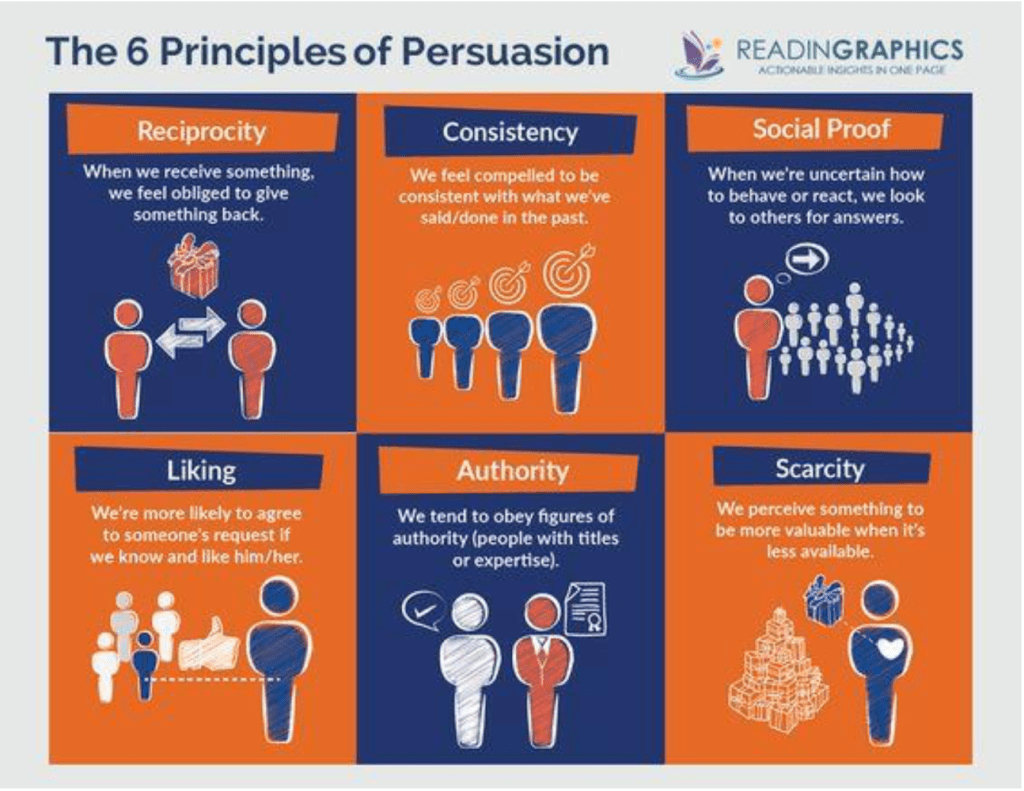
Six Principles of Persuasion
I’m sharing an article from Vasili Shynkarenka. Check it out…
When our startup failed, I didn’t know what to do next.
I’ve always been busy running somewhere but never had the time to think hard about where I was heading.
Now I had all the time in the world. So I embarked on a journey to figure out what to work on.
I dug deep. Over the past six months, I devoured hundreds of books, articles, and videos on how to choose what to work on (or, more generally, what the f**k should I do with my life).
Most of them sucked. But the winners changed my life.
Instead of you wasting years searching for the best stuff, I’ve created this curriculum of the 13 essential reads to choosing what to work on.
These are less the 1% that made the cut. I’ve read virtually all of these twice or more….
***
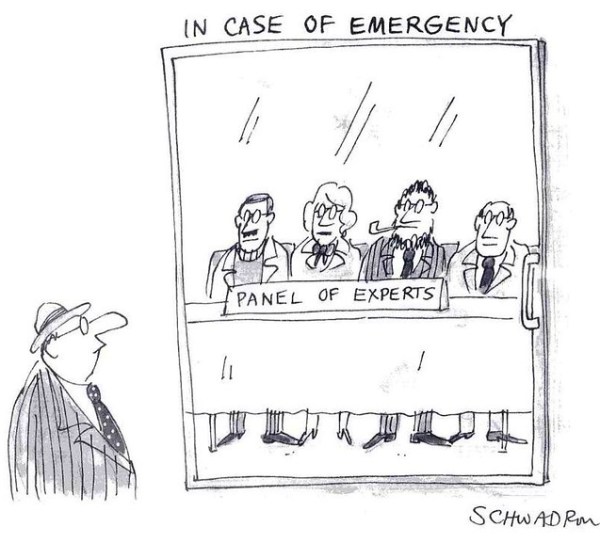 If I am trying to sell you one of two cameras which, although different brands, are exactly the same in quality and functionality, and I tell you that professional photographers prefer camera A over camera B, there’s a good chance you will then purchase camera A. And what I said about professionals preferring camera A doesn’t even have to be true, because you’ve already switched off the part of your brain in charge of critical-research thinking.
An actor playing a dentist in a toothpaste commercial will be trusted as an authority on which toothpaste to buy even when you know he’s just an actor. You ignore that fact because it’s not the focus of your thinking in the moment. The focus of your thinking is on making the decision.
 It’s difficult for us to make decisions, especially when we are ignorant on the subjects of choice. What do you know about cameras? How much research are you going to have to do in order to make an informed decision? How much time do you have for that? So isn’t it nice when someone has done all the research for you and can simply tell you which option is better? Those people are the experts. Experts range in occupation from Technicians to Pastors.
And it’s great when you can trust the experts; when they’re not BS’rs. But you have to be careful when the expert, or the person in authority, may be using your ignorance and trust as a way to manipulate you.
How can you know?
Recommended reading: Influence: The Psychology of Persuasion by Robert B. Cialdini
Were you, like myself and thousands of others, duped by the Gillette ad?
How do you know if you were duped?
You took sides.
And if you took sides, and defended the ad, I’m guessing you are liberal leaning. And if you hated the ad, you’re probably conservative leaning.
Here is the problem with that: Does a liberal’s definition of a good man and a conservative’s definition of a good man differ a whole lot? I’m guessing not. If you asked a conservative to write a list of ten things describing what a good man is, and asked a liberal to do likewise, I’m pretty sure those lists would be nearly exact.
Then why did the Gillette ad cause so much division?
Because it was designed to.
If Gillette truly cared about encouraging men to act as good men, could they not have created an ad which would offend no one and create no division? Of course they could. It’s not hard. Simply portray a variety of men acting in a variety of good ways in a variety of situations: A man holding a door open for a woman; a man defending someone against bullying; a man working with inner city kids; etc…. Create an ad like that, but do not infuse into it any accusatory or preachy tone. That ad would encourage men to act well and it would offend no one.

Gillette does not care about men behaving well. Like an arms dealer making millions selling weapons to both sides of a war, Gillette is playing the culture war hoping to increase its profits. If, in ten years, Gillette believes it can increase profits by appealing to conservative men, you can be sure it will create the appropriate ads to do that. With this latest ad, Gillette seems to be targeting progressive liberals.
So lets all agree that there are both good men and bad men out there, on both the left and the right, and that most men are trying to be good men. And also, lets all agree that a multi-billion dollar corporation, like Gillette, is not the best place to look to for our moral standards.
Related reading: Rough-and-Tumble Play and the Regulation of Aggression
PS… Why are men buying Gillette razors anyway? They’re a rip off! Go and get yourself a Merkur safety razor, along with a box of a hundred blades, and you’re set for decades.
Update July 2019… “…P&G reported a net loss of about $5.24 billion, or $2.12 per share, for the quarter ended June 30, due to an $8 billion non-cash writedown of Gillette.”
Update August 2019… “‘We will continue to represent men at their best’: Gillette’s backflip after ‘toxic masculinity’ backlash”
 Pursuit of Percipience