
Romans 9–11 and the Reconstitution of Israel: Election, Faith, and the Covenant People of God

Romans 9–11 stands as a sustained theological reflection on the status of Israel in light of the Messiah. The apostle Paul addresses an apparent crisis. The people to whom the covenants, law, and promises were given have, in significant measure, not embraced Jesus as the Christ. Paul’s argument unfolds across these chapters as a reconfiguration of Israel’s identity, grounded in divine election, centered in the Messiah, and expanded to include the nations.

1. Israel and the Question of Promise (Romans 9)

Paul begins with an expression of deep anguish for his fellow Israelites, described as his own flesh and blood. Their privileges are unparalleled: adoption as God’s children, the divine glory, the covenants, the giving of the law, the worship, and the promises. These gifts recall Israel’s formation through the exodus and covenantal relationship, where God named Israel as his son and established a unique identity among the nations.

The central question emerges: how can these covenantal privileges be reconciled with the widespread rejection of Christ? Paul responds by distinguishing within Israel itself. Descent from Abraham does not automatically define participation in the promise. Rather, a differentiation exists between those who are merely descended according to the flesh and those who are constituted as children of promise.

This distinction is illustrated through the patriarchal narratives. Isaac, rather than Ishmael, embodies the line of promise. Jacob, rather than Esau, is chosen prior to any works. These examples establish that divine election operates according to God’s purpose and mercy. The identity of the covenant people is therefore determined by God’s calling rather than human exertion.

Paul further develops this theme by contrasting “objects of mercy” with “objects of wrath,” drawing on the example of Pharaoh. Divine hardening serves a purpose within the unfolding of God’s plan. The question of justice is addressed by affirming God’s freedom as creator. The divine prerogative in election is not subject to external criteria.

At this point, Paul introduces the inclusion of the Gentiles. God’s call now extends beyond ethnic Israel to encompass people from among the nations. Those who did not pursue righteousness have attained it, while Israel, in seeking a law-based righteousness, has not reached its goal. The failure lies not in effort itself but in the absence of faith. Thus, within Israel there exists a distinction between those who pursue righteousness through faith and those who rely on works of the law. The former, together with believing Gentiles, constitute the people of promise.

2. Righteousness and the Fulfillment of the Law (Romans 10)

Paul reiterates his desire for Israel’s salvation, acknowledging their zeal for God while identifying a lack of proper understanding. The issue centers on the nature of righteousness. Righteousness in this context concerns covenant membership, being recognized as belonging to the people of God. The “righteousness of God” refers to God’s faithfulness in fulfilling covenant promises, especially those given to Abraham.

Israel’s error lies in seeking to establish its own covenant status through observance of the law. In contrast, Paul declares that Christ represents the culmination and fulfillment of the law. The law reaches its intended goal in the Messiah, who embodies and completes its purpose. Consequently, righteousness is now marked by faith in Christ.

Faith is not merely intellectual assent but involves trust, loyalty, and allegiance. It is a response to the faithfulness of Jesus, whose obedient life, death, and resurrection accomplish God’s covenant purposes. The identity of the true covenant people is therefore defined by alignment with the Messiah through faith.

Paul interprets key scriptural texts to support this claim. Leviticus 18:5 describes a mode of life centered on doing the law. Deuteronomy 30, which speaks of the accessibility of the commandment, is reread in light of Christ. The “word” is now the proclamation concerning Jesus as Lord and his resurrection. This message is near and available, calling for confession and belief.

The universality of this message is emphasized through the citation of Joel 2:32, where calling on the name of the Lord brings salvation. The identification of Jesus with the Lord of Israel underscores the theological claim being made. Yet a problem remains: not all have responded in obedience. Israel has heard the message, as affirmed through the language of Psalm 19, but has not universally embraced it. Prophetic texts such as Deuteronomy 32:21 and Isaiah 65 interpret this situation. God’s engagement with the Gentiles provokes Israel to jealousy, while those who did not seek God have found him. Israel, by contrast, is depicted as disobedient and resistant.

3. The Remnant and the Olive Tree (Romans 11)

Romans 11 returns to the question of Israel’s status with a renewed perspective. Paul denies that God has rejected his people. Instead, he identifies the existence of a remnant chosen by grace. This remnant represents the continuation of true Israel within the broader ethnic community.

Those who do not believe are described as hardened, a condition that aligns with earlier discussions of divine purpose. However, this hardening is neither total nor final. The transgression of unbelieving Israel has led to salvation for the Gentiles, and this development is intended to provoke Israel to jealousy and eventual restoration.

The metaphor of the olive tree provides a framework for understanding this dynamic. The tree represents the covenant people of God, rooted in the promises given to the patriarchs. Natural branches correspond to ethnic Israel, while wild branches represent Gentiles who have been grafted in. Some natural branches have been broken off due to unbelief, and Gentiles now share in the nourishing root.

This imagery carries both assurance and warning. Gentile inclusion depends on faith and does not negate the possibility of Jewish restoration. Natural branches can be grafted in again if they do not persist in unbelief. The unity of the tree underscores the continuity of God’s covenant purposes.

Paul culminates this section with a statement concerning the mystery of Israel’s partial hardening. A portion of Israel has experienced hardening until the fullness of the Gentiles enters. In this manner, all Israel will be saved. This phrase is best understood corporately, referring to the totality of God’s covenant people as defined by election and faith. It includes both Jewish and Gentile believers, as well as those within Israel who come to faith over time. The emphasis lies on the fulfillment of God’s covenant promises through the Messiah.

Conclusion

Romans 9–11 presents a coherent vision of God’s faithfulness in the face of apparent discontinuity. Israel’s story is not abandoned but brought to its intended goal in Christ. The identity of the covenant people is redefined around divine election and faithful response. Within Israel, a distinction emerges between those who embody the promise through faith and those who rely on the law apart from faith. The inclusion of the Gentiles expands the scope of God’s people while remaining rooted in the patriarchal promises.

Paul’s argument ultimately affirms that God’s purposes have not failed. The covenant remains intact, now realized in a community shaped by the Messiah and marked by faith. The interplay between Israel and the nations reveals a dynamic process through which divine mercy extends to all, forming a single people grounded in God’s enduring promises.
Refining Paul’s Theology

The following is an AI generated essay. However, the ideas influencing the essay are my own. To save time I will often use AI to compress my ideas into essay form, which I can then refer to later. In my opinion that is one of the ways to correctly use AI. And this blog is as good a place as any to post it.

Paul, Israel, Adam, and the Nations

A Second Temple Jewish Logic of Election, Atonement, and New Creation

Introduction

The apostle Paul is often portrayed as the architect of a new, universal religion that abandoned Israel’s particular story in favor of a generalized theology of salvation. Historically, this portrayal is misleading. Paul understood himself not as departing from Israel’s scriptures, but as re-reading them under the pressure of a single, destabilizing event: the resurrection of Jesus.

This essay argues that Paul’s theology is best understood as a carefully balanced synthesis of three narrative layers already present in Second Temple Judaism:

  1. Creation (Adam and humanity)
  2. Covenant (Israel and Torah)
  3. Eschatology (Messiah and resurrection)

Paul’s inclusion of Gentiles does not bypass Israel, nor does it flatten Jewish categories into abstraction. Instead, it follows a coherent internal logic in which Israel remains central, Adam explains humanity’s universal plight, and Jesus stands at the intersection of both stories.


1. Temple Judaism and the Limits of Atonement

In the First and Second Temple periods, Israelites did not believe their sacrifices directly atoned for the sins of the nations. Temple sacrifice was:

  • Covenantal (for Israel)
  • Geographically and cultically located (land, sanctuary, priesthood)
  • Purificatory, especially for Israel’s sin and the sanctuary polluted by it

Gentiles could offer sacrifices, and the Temple was seen as the cosmic center sustaining order for the whole world, but this benefit was indirect. The nations were not cleansed of sin simply because Israel offered sacrifice.

This distinction is crucial. Later Christian claims of universal atonement represent a genuine theological shift, not a straightforward continuation of Temple belief.


2. Paul’s Scriptural Justification: Not Innovation, but Re-reading

Paul knew his claims were radical. He therefore grounded them explicitly in Israel’s scriptures.

Abraham before Torah

Paul emphasizes that Abraham was declared righteous before circumcision and before the Law (Genesis 15:6). This allowed Paul to argue that:

  • Covenant faithfulness could precede Torah
  • Gentile inclusion was not an afterthought, but anticipated from the beginning

Deuteronomy’s Curse Logic

Paul reads Deuteronomy’s warnings seriously. Israel’s failure under Torah places her under covenant curse (exile). Jesus’ crucifixion—“hanging on a tree”—forces a re-reading of Deuteronomy 21:23. For Paul:

  • The Messiah bears the curse on behalf of Israel
  • The Law is not evil; sin exploits it
  • The curse must be lifted before Abraham’s blessing can flow outward

Resurrection as the Turning Point

Paul’s theology does not pivot on Jesus’ death alone, but on resurrection. Resurrection signals:

  • The beginning of the age to come
  • The defeat of death
  • The vindication of Jesus as Messiah

Without resurrection, Paul explicitly says his gospel collapses.


3. Why Gentiles Needed Justification

Gentiles were not under the Mosaic Law. So why, according to Paul, did they need salvation?

The Adamic Problem (Romans 5)

Paul’s answer is Adam.

  • Sin and death enter the world through Adam
  • Death reigns over all humanity before the Law
  • The Law intensifies sin but does not create it

This allows Paul to distinguish:

  • Israel’s problem: covenantal failure under Torah
  • Humanity’s problem: enslavement to sin and death through Adam

Gentiles are condemned not as Torah-breakers, but as creatures who have misused creation and fallen under the power of death.


4. Adam and Israel: Parallel Stories

Second Temple Jews already recognized parallels between Adam and Israel:

AdamIsrael
Placed in EdenPlaced in the land
Given a commandGiven Torah
Warned of deathWarned of exile
Exiled eastwardExiled among nations

Paul does not reduce Adam to Israel, nor Israel to Adam. Instead:

  • Adam is the prototype
  • Israel is the recapitulation
  • Christ is the resolution of both

Jesus succeeds where both Adam and Israel fail—not by abandoning Israel’s story, but by embodying it faithfully.


5. Two Problems, One Messiah

Paul’s theology can be summarized as addressing two distinct curses:

  1. The curse of the Law (Israel’s covenantal failure)
  2. The curse of Adam (humanity’s enslavement to death)

Jesus’ death and resurrection deal with both, but not in the same way.

  • As Israel’s Messiah, Jesus bears the Law’s curse
  • As representative human, Jesus undoes Adam’s reign of death

The order matters: Adam is resolved through Israel’s Messiah.


6. Paul’s Chiasmic Logic of Election

Paul’s theology of election can be expressed as a dynamic narrowing and widening:

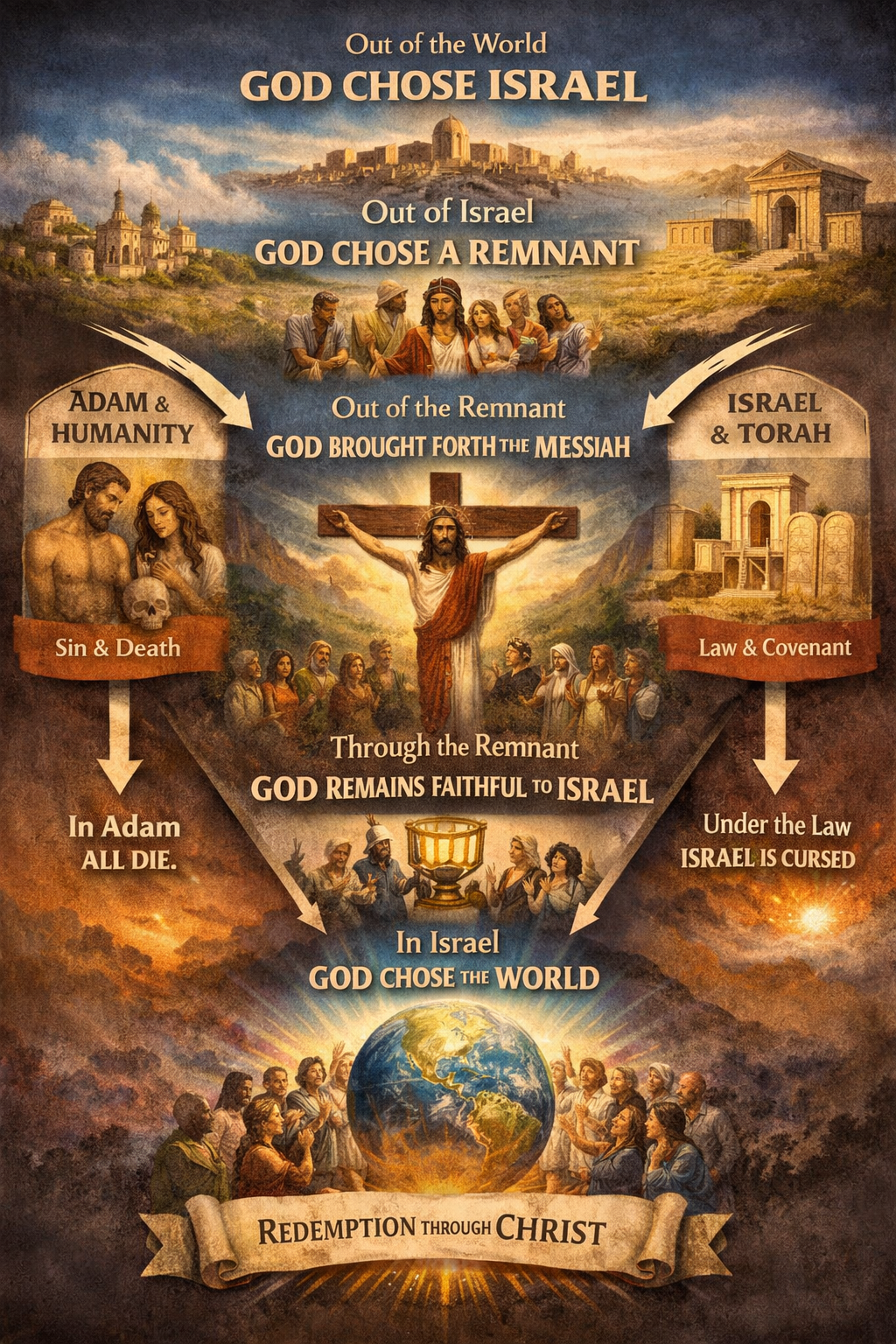
Out of the world God chose Israel
…Out of Israel God chose a remnant
……Out of the remnant God brought forth the Messiah
……In the Messiah God formed a faithful remnant
…Through this remnant God remains faithful to Israel
In Israel God brings blessing to the world

This structure preserves:

  • Israel’s priority
  • Gentile inclusion
  • The Messiah as the hinge of history
  • Election as vocation, not favoritism

Paul explicitly rejects the idea that the remnant replaces Israel. Instead, the remnant is the means by which God remains faithful to Israel, and Israel is the means by which God blesses the nations.


7. Where Later Christianity Breaks with Paul

Paul’s logic often breaks down in later Christianity due to simplification:

Adam Absorbs Everything

Adam becomes the sole explanatory category, while Israel’s covenantal role fades. This flattens Paul’s careful distinction between creation-failure and covenant-failure.

The Law Becomes the Villain

Torah is reinterpreted as legalism rather than gift. This distorts Paul’s claim that the Law is “holy and good.”

Resurrection Loses Centrality

Atonement becomes focused almost entirely on the cross as payment for guilt, rather than resurrection as the defeat of death and the beginning of new creation.

Israel Is Explained Away

Romans 9–11 is sidelined. The church becomes the endpoint rather than the participant in an unfinished story.

These shifts were historically understandable—especially in a Gentile-majority, post-Temple world—but they are not faithful to Paul’s own architecture.


Conclusion

Paul did not abandon Israel, mythologize Adam away, or invent a new religion detached from Jewish scripture. He was a Second Temple Jew who believed that God had acted decisively within Israel’s story to resolve a problem that reached back to Adam and outward to the nations.

For Paul:

  • Israel remains chosen
  • Adam explains universal need
  • Christ stands at the center
  • Resurrection signals new creation
  • History is still unfolding

Gentile inclusion is not a detour from Israel’s vocation—it is the goal toward which that vocation always pointed.

Understanding Paul this way does not require agreeing with him. But it does require taking him seriously on his own terms.

***

From Elephantine to Galatia: Understanding Diaspora Judaism and Paul’s Mission

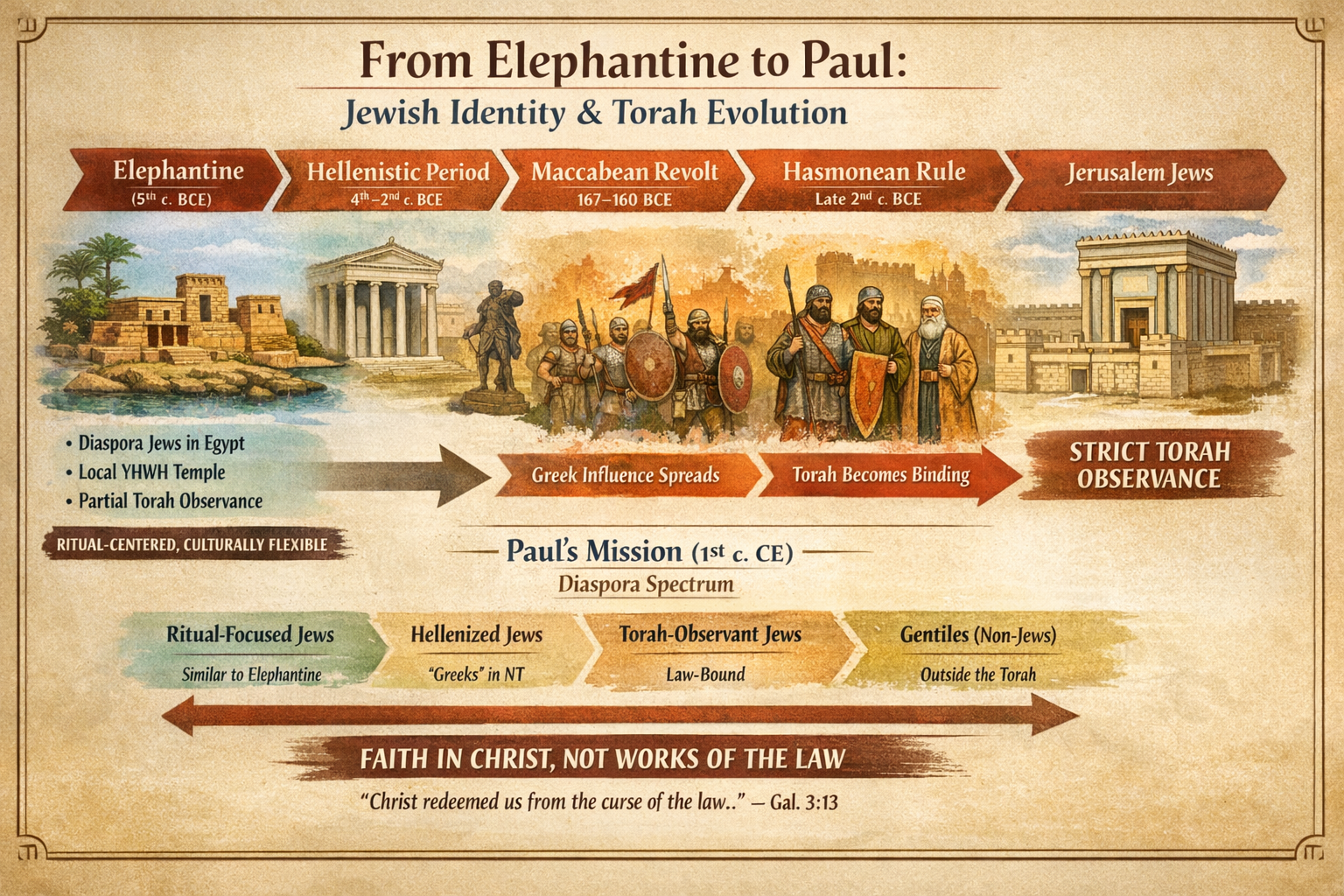
The history of Jewish communities outside Jerusalem reveals a rich diversity of religious practice long before Torah law became universally binding. One of the clearest examples is the Jewish community at Elephantine, a military colony in southern Egypt during the 5th century BCE. Studying Elephantine not only illuminates early diaspora Judaism but also helps us understand the audiences that Paul encountered on his missionary journeys centuries later.


1. The Elephantine Community

Elephantine was a Judahite military colony, stationed on Egypt’s southern frontier before the Persian conquest (c. 525 BCE). Its members were likely Judean soldiers or mercenaries who migrated to Egypt before the major Deuteronomic reforms of the late 7th century BCE. Consequently, their religious practice reflects a pre-exilic, ritual-focused Yahwism:

  • They had their own temple devoted to YHWH, where priests oversaw sacrifices.
  • Their daily life and legal documents show partial adherence to Torah traditions, but not full Torah law enforcement.
  • They interacted with local Egyptians and other peoples, suggesting a degree of cultural flexibility and syncretism.
  • Notably, their petitions to the Jerusalem priesthood for temple support did not receive clear approval, showing the limits of central authority at the time.

In short, Elephantine Jews were religiously Jewish but socially flexible, practicing a form of Judaism that was ritual-centered rather than text-centered.


2. Why Elephantine Was Eventually Forgotten

By the 2nd century BCE, Judaism had begun a process of centralization and textualization that made communities like Elephantine historically obsolete:

  1. Centralization of worship in Jerusalem made autonomous temples theologically problematic.
  2. Torah law became the definitive marker of Jewish identity, replacing older ritual customs.
  3. Diaspora communities like Elephantine lacked scribal and institutional power, meaning their traditions were not preserved.
  4. As Jerusalem-centered Judaism solidified, communities outside its influence were quietly ignored or absorbed, leading Elephantine to fade from memory.

Elephantine, therefore, provides a snapshot of Judaism before Torah law became normative, illustrating how Jewish identity and practice evolved over centuries.


3. The Emergence of Normative Torah

The transformation from Elephantine-style Judaism to Torah-centered Judaism was largely complete by the 2nd century BCE, driven by historical pressures:

  • Hellenistic Rule and Seleucid Oppression: Greek culture and political control threatened Jewish religious practices, culminating in Antiochus IV’s desecration of the Jerusalem Temple.
  • Priestly Corruption and Internal Crisis: Disputes over legitimate leadership and proper observance highlighted the need for a standardized legal framework.
  • The Maccabean Revolt (167–160 BCE) established Hasmonean rule, making Torah observance state-enforced, not optional.
  • Diaspora Pressures: Torah law became a marker of identity, distinguishing Jews from surrounding Gentiles.

The result: Torah became binding and normative, defining Jewish identity for the first time in a widespread, enforceable way.


4. Diaspora Jews in Paul’s Time

By the 1st century CE, diaspora Jewish communities still exhibited considerable diversity in Torah observance and cultural assimilation:

  • Elephantine-type Jews: Highly ritual-centered, partially Torah-observant, integrated into local culture.
  • Hellenized diaspora Jews (“Greeks” in the NT sense): Some Torah knowledge, varying observance, Greek names and customs, partially assimilated.
  • Jerusalem-centered Jews: Fully Torah-observant, resistant to Hellenistic influence, centralized around Temple and priesthood.
  • Gentiles: Non-Jews with no obligation under Torah, often converts to Judaism via proselytism.

This spectrum helps us understand Paul’s ministry: many Jews outside Jerusalem were culturally and religiously flexible, making them receptive to his message of faith in Christ over strict law observance.


5. Paul and the Galatian Audience

In Galatians 3:13, Paul writes:

“Christ redeemed us from the curse of the law by becoming a curse for us…”

Here, he addresses an audience that includes diaspora Jews and Gentile converts who were under pressure from “Judaizers” to adopt Torah practices like circumcision. These Jews:

  • Likely resembled Elephantine-type or Hellenized diaspora Jews, partially observant but culturally integrated.
  • Faced choices between ritual identity and faith in Christ.
  • Needed reassurance that salvation did not require full Torah compliance, particularly circumcision, the visible marker of law.

Paul’s argument is historically consistent: he appeals to the flexible, diaspora identity that existed in Jewish communities long before Torah law was universally enforced.


6. Conclusion

The Elephantine community shows us that early Jewish diaspora life was diverse and adaptable. Ritual practice, local temple worship, and flexible law observance were the norm outside Jerusalem. Over centuries, historical pressures—imperial rule, Hellenization, and the Hasmonean consolidation—made Torah law binding and central to Jewish identity. By Paul’s time, many diaspora Jews still embodied the Elephantine-type flexibility, explaining why his gospel could resonate with Jews and Gentiles who were devout but not fully Torah-bound.

Understanding this continuum—from Elephantine to Galatia—illuminates both the historical development of Judaism and the social context of Paul’s missionary work, highlighting how faith and law interacted in a changing world.

***

Little Gods

Any religion that cannot move beyond “we’re bad, God gets mad” is unworthy of devotion. Imagine a world in which a law was unnecessary. What would have to happen to humanity for that to be possible? We would have to become like God. Judaism will always require a law (and Jews bend over backwards trying to find loopholes to that law). Eastern religions teach you can grow beyond the need of a law, but your individuality will be obliterated in the process. Only Christianity teaches that we can grow beyond the need of a law while still maintaining our identities. How? God becomes like us so that we can become like Him. We become little gods.

Notes on Romans – Part II

Chapter Two

Vs. 1-3 — Continuing from chapter 1, where in verse 32 the Israelites who know the truth are approving of non-Israelites who practice all the evil things listed in the previous verses, the Israelites who practice the same evil things are without excuse and are unfit to judge non-Israelites. The judgement of God is true against all who practice such evil things, therefore even Israel cannot escape that judgement.

Vs. 4-6 — God is patient, and His goodness leads people to repentance. But Israel has a hardened heart, and is storing up wrath rather than mercy. They will answer for their deeds.

Vs 7-8 — Eternal life is for those who patiently continue in doing good, seek for glory, honor, and immortality. Doing good is to honor Yahweh, and to follow His commandments; to live righteously. But those who do not live righteously only have wrath to look forward to.

Vs. 9-11 — Jew and Greek = Judean and Hellenist = Judean Israelites and Hellenistic Israelites

Vs 12-16 — Remembering that the law here is the law of Moses, let me remove the parenthesis — “For as many as have sinned without the law will also perish without the law … in the day when God will judge the secrets of men…” Those who did not have the law would still perish because of their sin on judgement day, even though they were not judged by the law. But yet, Paul says they had the work of the law written on their hearts. This is confusing. Were these people guilty of sinning against the law or not? Did they know the law or not? Did Paul not say, “Where there is no law there is no transgression, and sin is not imputed when there is no law?” (Romans 4:15b; 5:13b) Who were these people then, who had the law written on their hearts, when only Israel was given the law? The only conclusion that seems to make sense is that these people did indeed have the law of Moses written on their hearts, and thus were descendants of Israel, but were so far gone from the covenant that they lived without the law. However, the fact that their own consciences approved or accused their actions proved that they had the law of Moses written on their hearts. They mostly lived no differently than the rest of all the non-Israelite nations, but were still under the law’s curse.

Vs. 17-24 — Judeans know the law and rest upon it. They trust they are in the right with Yahweh because of this. Therefore they also believe they are guides to the blind. The Hellenists are the blind. The non-Israelites are the blind. But, the Judeans are hypocrites, and they actually dishonor the name of God.

Vs 25-29 — A righteous uncircumcised Greek is better than an unrighteous circumcised Judean.