
Scholars employing the historical-critical method and the Third Quest for the historical Jesus have reconstructed the origins of the movement centered on Jesus of Nazareth as an apocalyptic, messianic, and eschatological expression firmly rooted within Second Temple Judaism. This article focuses primarily on the development of early Christianity and its transformation into modern western Protestant Evangelicalism, tracing key adaptive processes that carried the movement from its Jewish apocalyptic beginnings to contemporary forms. This reconstruction aligns with the perspective that Jesus functioned as an apocalyptic prophet who announced the imminent arrival of God’s kingdom and called Israel to repentance in light of coming judgment and resurrection. Early Christianity exhibited diversity from its beginnings, encompassing apocalyptic emphases alongside wisdom-oriented teachings evident in traditions such as the hypothetical Q source and portions of the Sermon on the Mount. High Christology also emerged at an early stage, as Richard Bauckham has demonstrated in his analysis of the inclusion of Jesus within the divine identity. Pauline writings preserve an early hymn in Philippians 2:6-11 that reflects this elevated view of Jesus as existing in the form of God and receiving universal acknowledgment.
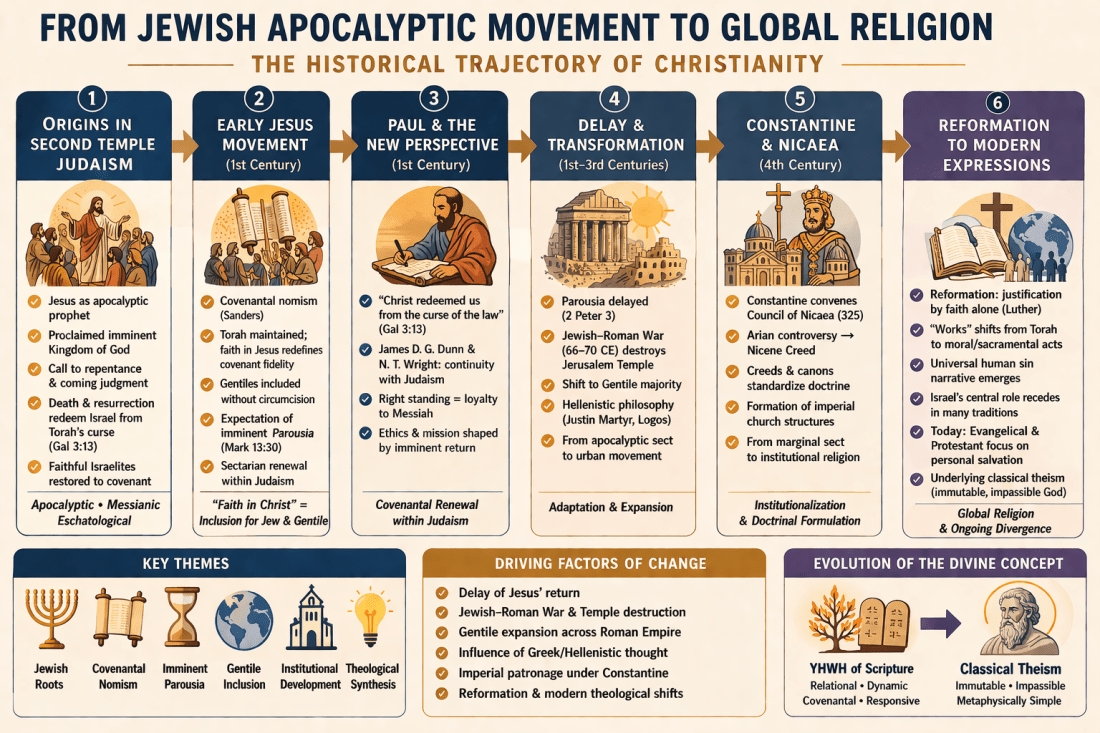
The earliest followers understood Jesus’ death and resurrection as the decisive act that delivered Israel from the curse pronounced by the law. As the apostle Paul expressed in Galatians 3:13, “Christ redeemed us from the curse of the law by becoming a curse for us.” Through this event, faithful Israelites attained right standing within the covenant that YHWH had established with Israel. Gentiles, who had long possessed the option of full conversion to Judaism, gained access to covenant membership without the requirement of circumcision or comprehensive observance of Torah regulations. Faith in Christ served as the sole criterion for inclusion among both Jews and Gentiles. The entire movement anticipated the swift return of Jesus, which would inaugurate a general resurrection and final judgment. Texts such as Mark 13:30 preserve this expectation that “this generation will not pass away until all these things have taken place.”
E. P. Sanders’ seminal work Paul and Palestinian Judaism (1977) established the framework of “covenantal nomism” as the prevailing pattern of first-century Jewish soteriology. In this model, entry into the covenant rested on divine election and grace, while Torah observance maintained one’s position within it. The Jesus movement operated within this framework, reinterpreting covenant fidelity through loyalty to Jesus as the Messiah. James D. G. Dunn and N. T. Wright further developed this New Perspective on Paul, demonstrating that the early community did not represent a departure from Judaism but a sectarian renewal movement within it. The expectation of an imminent Parousia remained central, shaping ethics, mission, and community life.
As decades passed without the anticipated return of Christ, the movement underwent gradual transformation. The delay of the Parousia, acknowledged even within New Testament writings such as 2 Peter 3, prompted theological reflection. The Jewish-Roman War of AD 66–70 and the subsequent destruction of the Jerusalem Temple accelerated the shift toward a predominantly Gentile constituency. Jewish Christian leadership diminished, and the movement’s center moved to urban centers across the Roman Empire. This expansion into new cultural contexts brought the community into contact with popular mystery cults, such as those of Isis and Osiris, Mithras, Cybele and Attis, Dionysus, or the Eleusinian rites. These cults offered secret initiation rites, ritual participation in a deity’s death and renewal, and promises of personal salvation and afterlife benefits. While some earlier scholarship proposed that such cults directly shaped Christian practices like baptism and the Eucharist, contemporary critical analysis emphasizes that any parallels arise from shared Hellenistic cultural vocabulary and convergent religious aspirations rather than derivation. Christianity’s primary framework and rituals retained their Jewish roots, yet the encounter facilitated further adaptation in ritual expression and theological articulation alongside continued engagement with Jewish apocalyptic traditions. Hellenistic philosophical concepts began to shape theological expression. Early apologists such as Justin Martyr presented Christianity as the fulfillment of true philosophy, incorporating notions of the divine Logos and metaphysical attributes drawn from Greek thought. Richard J. Bauckham and other scholars have documented how this period witnessed both continuity with Jewish apocalyptic traditions and the emergence of distinctively Christian adaptations to the prolonged interval before the end.
The reign of Emperor Constantine and the Council of Nicaea in AD 325 represented a decisive stage in institutional development. Constantine convened the council to resolve the Arian controversy concerning the relationship between the Father and the Son. The resulting Nicene Creed established a standardized doctrinal formulation, while the council issued canons that regulated church discipline and practice. Although the council did not determine the biblical canon, which evolved through a longer process involving figures such as Athanasius in the fourth century, Nicaea contributed to the formation of an imperial church characterized by creeds, hierarchical structures, and official theological norms. Christianity transitioned from a marginalized apocalyptic sect to a stabilized religion integrated within the structures of empire.
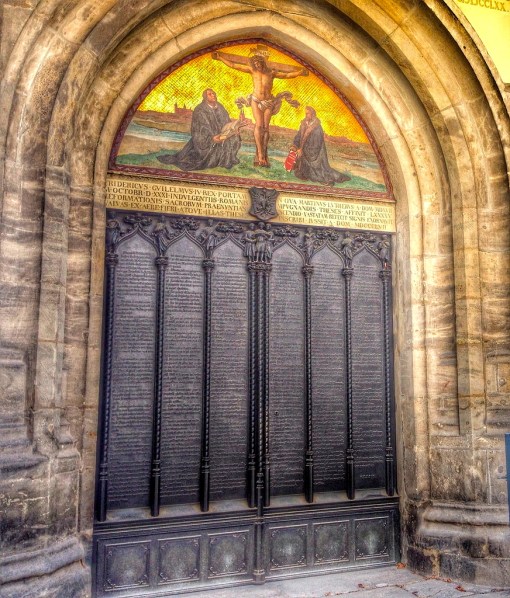
Subsequent centuries witnessed further evolution in the understanding of key theological categories. The concept of righteousness, originally denoting right standing within the covenant between YHWH and Israel, acquired broader connotations. During the Reformation, Martin Luther’s engagement with Romans 1:17 and related texts emphasized justification by faith alone. In this framework, the shift of “works” from observance of Torah boundary markers to general moral conduct or sacramental participation continued. The Reformation reframed soteriology around individual salvation from universal human sinfulness, further diminishing the original covenantal focus on Israel. What led to this was Luther’s response to late medieval theological developments that emphasized infused grace through penitential practices and works (penitential works and acts of satisfaction within the late medieval sacrament of penance). Luther reframed justification by faith alone as a gift of Christ’s righteousness imputed to the believer, addressing pastoral concerns of individual guilt and assurance of salvation. This reinterpretation emerged under the pressures of the era’s theological and practical questions while building upon earlier scriptural foundations.
In contemporary expressions, particularly within Evangelical Protestant circles, the Christian message frequently centers on a universal human predicament. God is portrayed as holding all humanity accountable for sin, with personal faith in Jesus providing deliverance from final judgment. The central role of Israel in the original covenant has vanished, and the narrative emphasizes a generalized offer of salvation. Many believers, often unconsciously, operate with the attributes of classical theism—an immutable, impassible, and metaphysically simple deity synthesized from patristic and medieval engagement with Greek philosophy. This conception contrasts with the dynamic, relational portrayal of YHWH in the Hebrew Scriptures, where God responds to human actions, grieves, and engages in covenantal dialogue. Scholars such as J. Richard Middleton have highlighted this divergence, noting that biblical depictions of divine adaptability differ markedly from the philosophical categories of classical theism. However, scholars have noted that both relational adaptability and more unchanging aspects coexist within the biblical texts themselves, and early theologians sought to harmonize these through philosophical reflection.
The historical trajectory traced here reveals a movement that began as an internal renewal within Judaism and developed into a global institutional religion. Critical scholarship, drawing on the Third Quest and the New Perspective on Paul, affirms the Jewish apocalyptic origins while documenting the adaptive processes driven by the non-occurrence of the Parousia, cultural expansion, imperial patronage, and philosophical synthesis. These developments produced the forms of Christianity observable today, yet they also invite ongoing reflection on the continuity and transformation of the original proclamation. The evidence from scripture, Second Temple literature, and patristic sources supports this reconstruction as a coherent account of Christianity’s emergence and evolution within its historical contexts.
Related reading: Romans 9–11 and the Reconstitution of Israel: Election, Faith, and the Covenant People of God