Eugen Rosenstock-Huessy Quotes #19

“Jesus … would have been nothing but a fanatic dreamer had He not carried within His own soul the full time span from Adam and Moses to Himself. Only because He did was He later accorded a corresponding power to shape the future. That power reaches from Him — through the Church and Christendom — to the end of the world, and is undeniably still being revealed to us every day since we are still fighting about Him as much as ever before.”

~from Practical Knowledge of the Soul, page 13

One

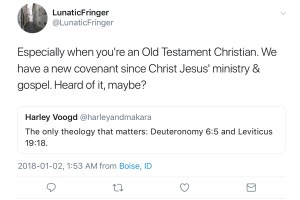
I recently tweeted: The only theology that matters: Deuteronomy 6:5 and Leviticus 19:18.

A Progressive/Liberal Christian responded….

IMG_0260

Obviously LunaticFringer didn’t bother to look up the two O.T. verses, in which she would have discovered what Jesus was quoting when He said, “And thou shalt love the Lord thy God with all thy heart, and with all thy soul, and with all thy mind, and with all thy strength: this is the first commandment. And the second is like, namely this, Thou shalt love thy neighbour as thyself. There is none other commandment greater than these.” (Mark 12:30-31)

As I have young children, I have been thinking a lot lately about how I will successfully pass on my Christian faith to them. It is not a guaranteed thing when mom and dad are Christian that the kids will be too. I’ve seen it too often when children, even raised by pastors, reject the faith when they’re old enough to be allowed to do so.

This passing on of the faith can be looked at in relation to a whole society in much the same way as individual families. The Deuteronomy passage tells us what to do…

Hear, O Israel: The Lord our God is one Lord:
And thou shalt love the Lord thy God with all thine heart, and with all thy soul, and with all thy might.
And these words, which I command thee this day, shall be in thine heart:
And thou shalt teach them diligently unto thy children, and shalt talk of them when thou sittest in thine house, and when thou walkest by the way, and when thou liest down, and when thou risest up.
And thou shalt bind them for a sign upon thine hand, and they shall be as frontlets between thine eyes.
And thou shalt write them upon the posts of thy house, and on thy gates.
(Deut. 6:4-9)

First we are told to love God with all our hearts, souls, and minds — everything we are. Second, we are told that these words need to be in, or on, our hearts. That doesn’t happen automatically. If we want the faith to continue to the next generation we must teach God’s word, and make His word foundational to all aspects of our lives — our children need to hear us talking about God and living what we are saying. Whatever we do with our hands and with our minds is submitted to God (compare to Revelation 13:16). Our family life (thy house) and our political sphere (thy gates) are shaped by His word.

If we don’t do these things we are guaranteeing that our children will either become atheists directly or Liberal Christians, which leads to the same place. Liberal Christianity, both its fading modernist version and its new progressive/post-modernist version, with its worship of the zeitgeist god and its false mission to “save” the Church from itself, has always been and will always be a direct road to atheism.

Today we live in an overly feminized culture. If you say or do anything which offends people and makes them feel bad, you are in the wrong. Truth, when offensive (as it often is), is rejected. God’s word is truth; God’s word is offensive. The strong father figure is no longer respected and is seen as “toxic masculinity”.

God is one — He is not divided. He is not tossed to and fro in His thinking. He was not different in the Old Testament as He is in the New Testament. His word does not change meaning over time (as post-modern philosophy teaches). What He said to the O.T. Israelites as recorded in the Bible was not just their confused understanding of His word muddied by their tribalistic warrior worldview.

Christian fathers need to grow some backbones and pass on the uncompromised word of God to their children and the entire next generation.

Further reading…

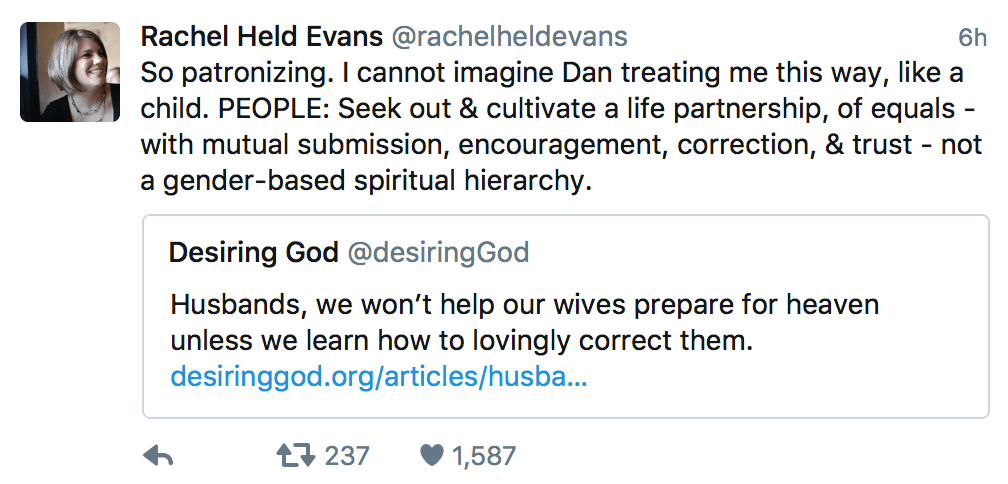
Men in Charge?! So Patronizing!

Sinners in the Hands of a Loving God (Book Review)

Postmodern Jesusism

Men in Charge?! So Patronizing!

Screen Shot 2017-12-29 at 7.57.49 AM

Rachel Held Evans is speaking of this article: Husbands, Get Her Ready for Jesus.

I suppose the article would be a lot less “offensive” if it were titled: Wives, Get Him Ready for Jesus. In fact, no one would be offended at that title, including the most conservative and patriarchal of Christian men. But because the article is calling men to be leaders in their marriages it is “so patronizing”. I wonder if RHE would be equally offended at this Desiring God article: Real Men Love Strong Women.

So what does the Bible have to say on the subject?

Submitting yourselves one to another in the fear of God.
Wives, submit yourselves unto your own husbands, as unto the Lord.
For the husband is the head of the wife, even as Christ is the head of the church: and he is the saviour of the body.
Therefore as the church is subject unto Christ, so let the wives be to their own husbands in every thing.
Husbands, love your wives, even as Christ also loved the church, and gave himself for it;
That he might sanctify and cleanse it with the washing of water by the word,
That he might present it to himself a glorious church, not having spot, or wrinkle, or any such thing; but that it should be holy and without blemish.
~Ephesians 5:21-27

Are husbands and wives commanded to submit to each other? Yes. In the same way? No.

The husband is the head of the wife just as Christ is the head of the Church. This is called Covenantal Headship, or Federal Headship. Adam was the federal head of the human race. Even though Eve was the first to eat of the fruit from the Tree of Knowledge, sin poisoned humanity through Adam. Jesus is the federal head of the Church and the New Creation. All who belong to Him have died to Adam and have been recreated in Jesus. Jesus is also a man. That’s how covenants work — the head of the covenant is responsible for the whole.

A man is the federal head of his family. Want to see a happy and healthy family? Find one with a strong man who lovingly takes charge. He is not a tyrant. He listens to his wife. Wisdom is, after all, personified as a woman in the Bible. He submits to his wife’s and childrens’ needs. He is not selfish. He would die for his family — he does die for them a little each day when he puts his own desires aside for them. He does not make decisions democratically as no one has the final word in a 50/50 relationship, but he listens to the counsel of the whole family before deciding. I have never heard a woman complain about a man like this, but I have heard women complain of men who are too timid to be like this.

I imagine RHE would not disagree with the description of a good man I’ve given above, but if she would, then who has the final word in her marriage? If it’s her, is that okay?

Theology is Vanity

hot-sun[4]Vanity of vanities, saith the Preacher, vanity of vanities; all is vanity.
~King Solomon, Second Wisest Man Who Ever Lived

One thing I’ve learned about myself and other Christians is that our own theologies, as much as we would deny it, are not primarily based on careful biblical study. We think so, but even if you’ve read the Bible backward and forward 100 times, and can read Greek and Hebrew, there is another Christian out there who has studied the Bible just as much as you and rejects your theology.

I’m not talking about the essential beliefs of Christianity; I’m not talking heresy. I’m talking about all the many secondary issues which you will use to determine which church to go to and which other Christians to associate with.

The fact is, our theologies are more so based on personality, worldview, genetics, and IQ than on any biblical knowledge. Take a Charismatic, dancing in the aisle while singing in tongues, and ask him to biblically defend his practice. He might present a convincing case. Then take a Baptist, with his autographed copy of Strange Fire, sitting in the wooden church pew wearing his three piece Sunday suit, and ask the same of him. He will present a strong argument for why he does what he does and why he rejects what the Charismatic does.

According to Jesus, the wisest man who ever lived, the only theology that really matters is this….

And thou shalt love the Lord thy God with all thine heart, and with all thy soul, and with all thy might. ~Deuteronomy 6:5

Thou shalt not avenge, nor bear any grudge against the children of thy people, but thou shalt love thy neighbour as thyself: I am the Lord. ~Leviticus 19:18

I’m not suggesting that Christians should not debate theology. Good debate leads to truth (usually). But at least admit that the main reason you don’t follow a particular version of Christianity is simply because you don’t want to. There are many different Protestant denominations these days, and some would criticize that and say it is divisive. But, the different denominations are necessary at this point in Church history for the unity of the Church — everyone needs a place where they can worship.

Christians segregate themselves by personality, worldview, and even race. That segregation is not based on theology, although that might be the reason given. The truth is that we like to be around people who are the same as we are. There’s not anything necessarily wrong with that, but it does reveal how immature we are — and I don’t mean that in a negative judgmental way. Immaturity is a natural process in life. As Tim Keller puts it: You look back at yourself ten years ago and think of what a fool you were then. Well, that means you’re a fool now, you just won’t know it for another ten years.

So, the point I’m trying to make here is Theology is Vanity. You may indeed know more, and be closer to the truth, than most other Christians, but in regards to the Leviticus and Deuteronomy passages above, what will you do now?


The Origin of Speech (Book Review)

1915557B-5A2F-4D38-A988-9FFBFE43EB97
Eugen Rosenstock-Huessy wrote some amazing books, and this might be my favourite so far. In The Origin of Speech, ERH illustrates that speech, and its creation, is the power which holds a civilization together.

For this book review, I’ll start by copying the Editor’s Postscript found on page 128…

Speech begins with vocatives and imperatives. It begins with formal speech which moves men to action and is embodied in ritual. Our grammar books on the other hand begin with the nominative and the pronoun I. The nominative is only usable when an experience is over. I can only respond as an I after I have been addressed as thou. I is the last pronoun a child learns to use.

We discovered that our systems of formal logic are skewed by accepting this distortion of our grammarians. The beginning vocative and lyric stages of all experience are thus called illogical even though they are essential before the narrative and nominative (abstract) modes can be applied. Common sense or daily talk is a derivative of formal speech.

Gender identifies the required participants in living interaction and is not synonymous with sex. Neuter is not a third sex but refers to all dead things. Thus grammar is a mirror of the stages of human experience. Inspiration through a vocative or imperative addresses us as thou, then forces us to respond as an I, makes us report as we, and at the end a story speaks of us as they. Thus we are conjugated through the stages of experience.

Instead of mental health, we propose grammatical health. Grammatical health requires the ability of command, the ability to listen, the ability to act, and finally the ability to free ourselves from the command by telling our story. Only then are we ready to respond again. We demonstrated that grammatical ill health can lead to war, dictatorship, revolution and crisis — and showed how formal speech can overcome these four.

We used the image of a time cup created to be fulfilled and to be discarded in time. All social order depends on the power of invoked names to create never-ending series of such time cups.

The grammatical method does not supply a rule book for our behaviour but a method to help us understand our history, to differentiate between valid and invalid names, and to determine the response appropriate to the stage of a particular experience or event. It should create a whole series of new social sciences unhampered by our skewed logic which has been dominated by nominatives and I’s.

Grammatical experience changes us. In the world of today, there are people at many different stages of grammatical development, and our method offers them the hope of more successful cooperation and understanding. It gives us all a common history, a history aware of timing, and a foundation for a possible peace among men.

***

Rosenstock-Huessy describes the difference between “pre-formal” speech, “formal” speech, and “informal” (or post-formal) speech. Pre-formal speech is akin to animal speech: grunting and growling, pointing and nodding. Formal speech is man’s high speech: the naming of things, ceremonies, political structures. Informal speech is somewhat of a combination of pre-formal and formal, in which we relax things a bit to make it more “low brow”. In formal speech I call my parents Mother and Father; in informal speech I can call them mama and papa. Pronouns are then considered informal speech as well. The informal is founded on the formal.

ERH lists four diseases of speech: war, revolution, decay, and crisis. These diseases arise when speech is no longer possible, or is being suppressed. War occurs when two sides are no longer willing to speak to each other and the tension between them grows to violence. Revolution occurs when a young generation, wanting change, is not yet able to articulate through speech the change it wishes, and so turns to shouting, protests, and violence. Where the young create revolutions, the old create counter-revolutions. The values of the past are held up against the revolution, but they have grown hollow and meaningless. Those praising the old values do not themselves live them out, and haven’t for some time. This leads to decadence and decay. A crisis in society occurs when those with knowledge do not speak to those who have no knowledge — they do not tell them what to do.

Of course all four of these diseases are interrelated. The unwillingness of the revolutionary to respect the “old ways” is countered by the old genaration’s unwillingness to embrace the new. The unwillingness of two parties to speak in war, but yet still willing to speak within their own communities, is met with the unwillingness of the “haves” (re: knowledge) to speak with the “have-nots” within their own communities.

ERH offers remedies to these diseases: to the deafness of war, a willingness to listen; to the incoherent shouting of revolution, the ability to articulate; to the crisis of muteness, a willingness to entrust; and to the decadence of hollow lip service, the rejuvenation of values through new representatives. “If this is true,” ERH writes, “the original character of all language should be connected with man’s victory over these evils.” (Page 17) New speech is generated when one or more of these diseases occurs. In fact, it must if a solution to the disease is to be found.

ERH covers many other topics related to speech in this book. All of it is quite illuminating, and I highly recommend giving it a read. I give the book 5/5 stars.

For a set of notes covering the whole book, click here: ERH Fund, Notes on The Origin of Speech

Related reading…

Past & Future ~ Connected by Speech

The Relevance of Eugen Rosenstock-Huessy

One Miracle of Speech