The Reformation ~ 500 Years

luther door

In honour of the Reformation’s 500th birthday, here is an excerpt from Clinton C. Gardner’s book Letters to the Third Millennium describing the Reformation’s influence on the western world….

Before the Reformation we had assumed that either the church or state was ultimately responsible, and therefore we need not be excessively concerned with creating the future. Now we sensed that “I am responsible, not only for myself but also for the outcome of history.” We could no longer “let George do it.” Ultimate authority, we perceived, was not in institutions but in individuals. Only we give validity to the organizations or nations which we create and uphold. The revolutionary implications of this perception are still being worked out in the 20th century. Many of us relapse into the pre-Reformation belief in the sanctity of such institutions as churches or nations. Examples are hardly needed.

As conscientious laymen living under the imperative of personal responsibility, we began to speak a language never heard before: the purely lay and secular. Until this moment, throughout history, all government and art — indeed, every human institution — had been inextricably connected with institutional religion. As followers of Luther we began to break the connection. Actually, the Papal Revolution had initiated this separation of religious and secular power but only by setting the religious on top. Now we heirs of the bold monk appropriated “religion” inside each lay person. Quite logically this led to the translation of everything “religious” into lay and secular terms, from government to science, education, and the arts.

Let us start with the last. Giotto had already painted us as real individuals, but he and even the artists of the Italian Renaissance — Leonardo, Raphael, and Michelangelo — still showed us acting out salvation history. Now, some fifty years after Luther’s death, the thoroughly “reformed” Dutch painters suddenly plunked us down in our kitchens and living rooms. From Franz Hals to Rembrandt to Vermeer, we became increasingly visible as just lay people going about our daily work.

About a century after Luther, One of the most marvellous “translations” occurred in the music of Johann Sebastian Bach. Why is it that we listen to German music with more “reverence” than to any other? Because it transforms the resounding Reformation church hymns — say Luther’s “A Mighty Fortress is our God” — into a universal language. In Bach the religious origins are clear, but even as German music became increasingly secular, with Mozart, Beethoven, and Brahms, it has always remained true to its origins. It strikes the deepest chords. It carries the breath of the spirit through us, quickening our sense of belonging to the human enterprise. An eloquent testimony to the staying power of this new Reformation “speech” comes from a later revolutionary. In a conversation with Gorky, after listening to Beethoven’s Appasionata, Lenin said, “I know nothing the is greater than the Appasionata; I’d like to listen to it everyday. It is marvellous superhuman music.” And it’s not only “Westerners” that are so moved One of the first things that happened in China after “the Gand of Four” had fallen was the playing of Beethoven again in Peking.

Of course there was no point in having “freedom of conscience” if we were illiterate, as over 95% of us were before the Reformation. Fortunately Gutenberg’s newly invented printing presses gave Luther a vital weapon: a Bible for each of us to read and interpret for ourselves. Along with the Bible thousands of books poured into our hands as we all began to read on any subject. Public school systems, education for everybody, and a global campaign for literacy, were born out of the Reformers imperative that each of us work out our own salvation.

With the new theological doors that Luther had opened, universities “became” the church, the secular institution to nourish both our science and our con-science. The first American college, Harvard, was started in 1636 for the education of Protestant ministers. Yale, Princeton, and Dartmouth followed in the next century, all founded by devout Protestants, as were most private U.S. colleges.

But we miss the full import of the Reformation’s new language if we concentrate only on Luther. The Czech Jan Has had been a martyr for the “Reformation” faith before it burst out in Germany. And the Reformation’s most creative “scientist” was probably the alchemist and doctor Paracelsus, who opposed the new “bookish” humanism of his century but also opposed Protestant and Papal parties. In many ways he was a loner, but in retrospect he seems to have been, as much as anyone, the founder of “contemporary” science. He was certainly the first biochemist. Rosenstock-Huessy hailed him as the man whose turbulent life and vision embodied the transition from medieval to “modern” times.

Until Paracelsus, not only medicine but all “science” was largely theoretical, based on the “logic” of abstract ideas derived from Greek and Latin sources. Now the eccentric Swiss doctor rejected this scholastic approach. He trusted his own personal observations and experiments, asking us to read the book of nature in much the same way Luther had asked us to read the Bible. Among those who shared Rosenstock-Huessy’s enthusiasm for him is J. Brinowski, who wrote that Paracelsus marked that “instant in the ascent of man when he steps out of the shadowland of secret and anonymous knowledge into a new system of open and personal discovery…..”

Finally, the Reformation created a vital new government institution: an incorruptible civil service. You may laugh but you are wrong. The exceptions prove the rule. Watergate and the Lockheed bribery are as good as examples as any. You can’t launder your money through Mexico and remain in government service. A Japanese premier, or any other, will fall if they betray the public trust. Teddy White called his book on Watergate Breach of Faith. It was a breach of our Reformation faith in the public servant. As Rosenstock-Huessy puts it:

Civil Service as a purely mechanical organization will never work efficiently. To understand the real inner justification for the strict discipline of a civil service, we must turn to the German revolution; for it alone gave the civil servant a religious position in his country. In the German revolution the drab, grey life of the average bureaucrat was suddenly transformed, as if by great volcanic eruption. Graft, bribery, the spoils-system, stain the character of the civil servant in every country which has not been touched by this great revolution. (ERH, Out of Revolution, page 362)

To sum up, the secular city created by the Reformation doesn’t mean a city where people have lost all interest in the purposes once expressed by religion. Just the opposite: it means the effective incorporation of those purposes into changed persons and new institutions capable of maintaining the standards once set by the church.

However, in replacing church by state, Luther went to unfortunate extremes. He positively exalted the power of the princes and the state as he depreciated the role of the visible church. He was anything but a populist. When his revolution’s left wing, the Anabaptists, inspired the Peasant’s Revolt of 1525, he urged the princes to crush it. In Ideology and Utopia Karl Mannheim calls that revolt “the decisive turning point in modern history.” He says it began contemporary “politics” because it was a “more or less conscious participation of all strata of society in the achievement of some mundane purpose, as contrasted with a fatalistic acceptance of events as they are, or of control from ‘above.'”

Reading his Bible, particularly St. Paul’s letter to the Romans, Luther didn’t mind control from above, but he saw it as exercised by many princes rather than a church hierarchy. Thus the Reformation set the mold of German national character, with both its virtues and its most outstanding defect, what Rosenstock-Huessy called its “lust for obedience.”

~taken from Letters to the Third Millennium, by Clinton C. Gardner, pages 35-38

Related reading: German Reforvolution by Peter Leithart


Revolutions & Counter-revolutions

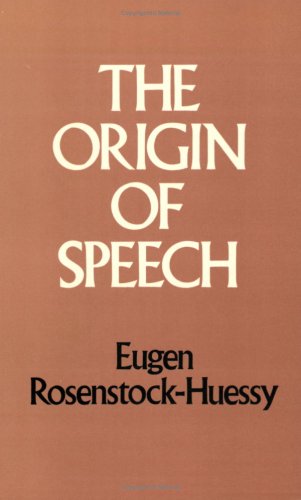
In his book, The Origin of Speech, Eugen Rosenstock-Huessy lists four diseases of speech. Two of those diseases are revolution and counter-revolution.

The disease of speech in revolution is manifest when the revolutionaries, wanting change, are unable to articulate exactly what that change looks like, and so resort to shouting, protests, and violence. We can see this today with groups like Antifa….

The counter-revolution today can be summed in the phrase “Make America great again!” The counter-revolution, according to ERH, will be full of meaningless “lip service,” praising the values of the past while not practicing those values itself. This can be seen when President Trump, and all like him, holds up family values while he himself is working on a third marriage.

So the disease of speech in revolution is inarticulation, and in counter-revolution, insincerity and meaninglessness.

The remedies, according to ERH, to these two diseases are: articulation of the needs and wants of the revolutionaries, and new representation of existing values coming from the counter-revolutionaries. Someone with wisdom needs to come forward to correctly define and explain what the revolutionaries are truly seeking, and someone also needs to come forward to correctly define and freshly explain the tried and tested values of the past.

This is why I like Jordan Peterson. He is actually performing both remedies, and both young and old westerners would be wise to listen to him.

Related reading: Campus Shout-Down Rate Nearly Quadruples

Informalities and Frivolties

My dad used Old Spice. He also grew up in WW2 Germany and emigrated to Canada alone when he was sixteen. He started up his own business after dropping out of high school, got married, and had kids.

He grew up in a time when the formal and the informal had their proper places. The informal stems from the formal, and the formal is foundational. We don’t always want to live in formal mode — life would be too serious then. We want to be able to lighten things up a bit in our day to day lives. I don’t want to call my dad “father” all the time; I want to call him dad or papa most of the time. However, my ability to call my dad “dad” rests on the fact that first I call him “father”.

These days in the west, informality, and thus frivolity, have taken over. The foundation of the formal is crumbling and no one takes life seriously enough. (No one, that is, except the revolutionaries we see yelling and screaming at the universities. But they too have no formal foundation to build upon.) Even a product like Old Spice has to embrace the shallow video game culture in order to sell….

img_0032
Old Spice deodorant

I suppose the West will have to create a new formal foundation before it can mature to its next stage of development.

Further reading: Fatherlessness and the Rise of the Shaving Industry

There’s No Going Back

Once a person, or a group of persons, enters into a covenant with Jesus, there are only two paths forward: progressing from glory to glory, or progressing to become something worse than what you were before entering the covenant. One path that is not available is to go back to a previous stage of development.

Today in the West, Christian morality has become an autoimmune disease. Whereas is the past, Christian morality was a cure to the disease of sin, now that same morality is being used to justify all kinds of destructive and evil ideologies.

The way forward now is not to try and get back to the days when people respected Christian beliefs, although did not believe themselves. The way forward now is either to become something worse than we were before ever hearing of Christianity, or to move on to a more glorious state. To move on to a more glorious state requires a newer and stronger dedication to Jesus. Will it happen? Is it too late?

The Age of Empires

stages of empire

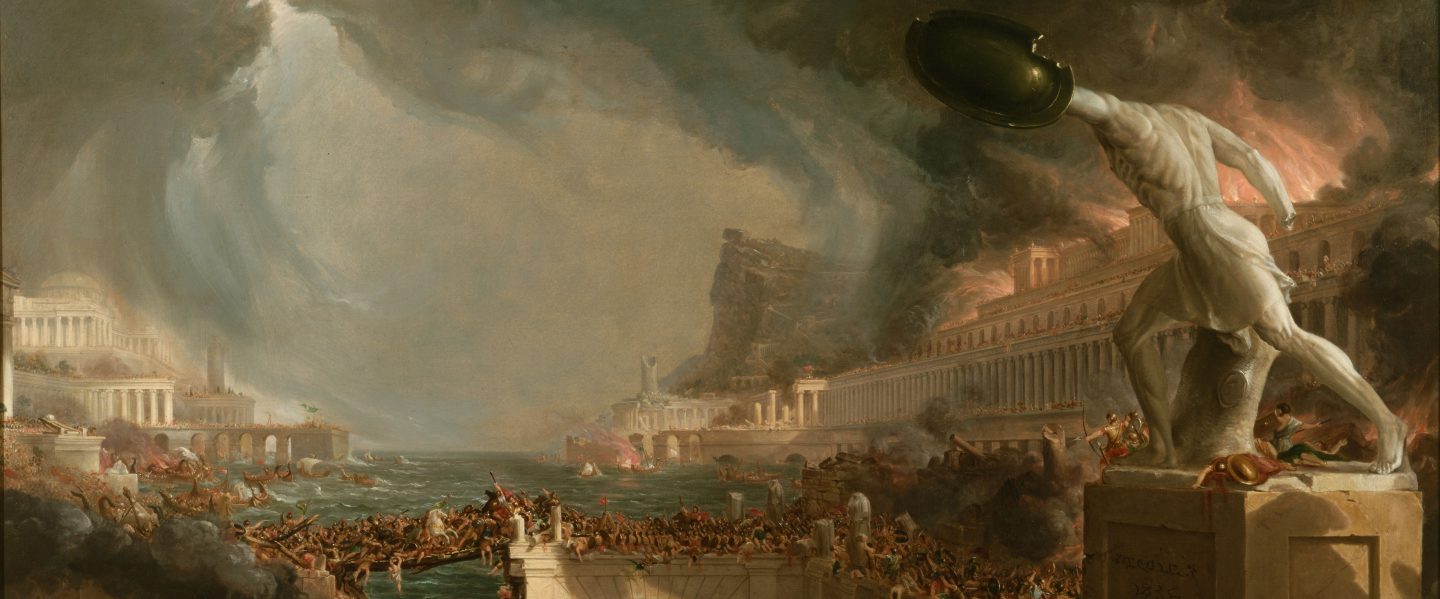
The Fate of Empires written in 1978 by Sir John Glubb (1897-1986) is an illuminating essay on the life cycle of empires, which turn out to be very much the same for different empires around the world and through the centuries.

You can read the essay for yourself here, and I highly recommend that you do. But in this article I will try to give you a brief overview of what Glubb writes.

First, Glubb argues that the life span of empires tend to be the same: about 250 years, or ten generations (if a generation is considered to be 25 years)….

Screen Shot 2017-09-21 at 12.53.32 PM

Each empire seems to progress through four main stages: 1) The Age of Outburst/Pioneering/Conquest; 2) The Age of Affluence; 3) The Age of Intellect; 4) The Age of Decadence.*

First, in the Age of Outburst, often a group of hard working, aggressive people, who are not in any strong position of power already, rise up and take control. Perhaps they move in and take the power over from an older empire which is far along into its decadence stage, or perhaps they move in on a less developed culture and dominate it. This age is characterized by exploring men with fearless initiative and military conquest of older orders.

Second, there is commercial expansion ushering in the Age of Affluence. With one power controlling many sections of land comes ease of travel, common currency, common language, law and order — all of which allow people to trade extensively. If the empire is large, it will cover several different cultures in different climates making available many various goods to consumers all over the empire. Great wealth grows during this age.

Third is the Age of Intellect. With affluence comes a decline in “courage, enterprise, and a sense of duty … [and] the first direction in which wealth injures the nation is a moral one.” (Glubb) The general outlook of the citizens of the empire move from one of service to one of selfishness. While the Age of Intellect creates advances in science and technology, and while it also creates a culture of reason, debate, and argument, it also leads to division in the empire as the common good obvious in the previous ages becomes muddied in the endless chatter of the intellectuals. While the problems created by the selfish culture can only be solved by renewed selfless service, the intellectuals believe they can solve the problems with their new ideas. It doesn’t work and the culture weakens and loses self-esteem.

When the system holding the empire begins to degrade, the empire enters its final stage: Decadence. The people have lost sight of why the empire should even exist and have little to no desire to preserve it. Glubb gives some signs which show an empire has entered this last stage: civil dissension, an influx of foreigners (who do not conform to the host culture), frivolity, a decline in religious belief and morals, and a welfare state. The heroes of the first ages of the empire, warriors and leaders, are replaced by pop-stars and celebrity chefs. Glubb also points out that in the age of decline more and more women want to enter into positions of power previously only held by men. He doesn’t go into why, but it is interesting to point out. (A confusion of gender seems to be a factor in the Decadence stage.)

Glubb asks the important question: Can we learn from history? His answer is yes, if we actually study it — if we actually study world history instead of only our own empire’s history. Only when we learn to prevent the Age of Decadence by not becoming selfish and lazy in the Age of Affluence can we hope to break through the continuing fate of empires.

Further reading…

First Things: Camille Paglia’s Teaching

The Case Against Western Civilization by James B. Jordan

I also highly recommend James B. Jordan’s book Crisis, Opportunity, and the Christian Future

*Glubb divides the life span of the empire into six stages: 1) Pioneers; 2) Conquest; 3) Commerce; 4) Affluence; 5) Intellect; 6) Decadence. I’ve compressed it to four for the sake of simplicity.