“What is the secret of eldership? It lies in the fact that an old man is through with his own life but not at all through with life. On the contrary, like a grandfather he watches all the later generations with a loving wisdom, which alone can reconcile their strife. He is the great pacifier, the guardian of life’s continuity, because people know that he alone is free from personal partisan aims. Therefore he is peculiarly the regenerative force in society; he sees to it that the full cycle of life is re-begun in the proper order. And it is the expectation of one day becoming elders that should carry us through the full cycle of our own lives.”
The lesser culture is always drawn to the higher culture (or the perceived higher culture).
Christianity always creates the higher culture, and as long as Christians hold strong to their beliefs, that higher culture will remain strong.
Sin is the disease of the world and Christianity is the immune system. But what happens when a previously Christian society turns it back on its beliefs? The immune system becomes an autoimmune disease — which is worse than the original disease that society suffered from before Christianity came in.
Today in the west, progressive leftist ideology is seen as the new higher culture. It is nothing more than a counterfeit Babel though. Nobody 30 years ago was thinking that we needed things like gay marriage (as one example). But now, if you speak out against gay marriage you will be labeled a hateful homophobic knuckle-dragger who is stuck in the primitive wasteland known as “The Wrong Side of History” where there is weeping and gnashing of teeth.
If Christians want to shape the future of the western world and plant more churches, they will have to rise up to the difficult call of creating the higher culture once again. It’s harder now than before. To bring a higher culture into a pagan culture is easier than doing it in a post-Christian culture where the blessings and benefits of Christianity are still enjoyed by the very people who are ignorantly rejecting its foundations.
Every once and a while I come across a bizarre negative attitude towards the white western missionary. I’m not referring to atheists or multiculturalists criticizing western missions; that’s to be expected. Rather, I am talking about missionaries criticizing other missionaries.
I’ll read or hear terms such as “white privilege” and “cultural appropriation” being used by missionaries to criticize white missionaries and accuse them of things they are simply not guilty of: colonialism, white supremacy, and negative paternalism. They get upset at the fact that white missionaries will presume to teach, rather than learn, in non-western nations. They lament at how white missionaries don’t seek to empower the local peoples. In most cases, these accusations are are all unfounded.
Western missionaries have access to resources which non-western nations simply don’t have yet. Western Christianity is also older and more experienced. Of course westerners will come as teachers. That does not mean they don’t respect the native culture, are unwilling to learn, or are unwilling to empower local people.
The terms “white privilege” and “cultural appropriation” did not evolve in the common market of language and ideas. They come straight out of the minds of leftist, Marxist university professors. And they certainly have no place on the mission field.
I like this definition of “white privilege” from the Urban Dictionary:
The racist idea that simply being white benefits people in some unexplainable way, and that discriminating against white people is not only okay, but enlightened and necessary. The excuse some extremists use to justify pretty much any level of racism, as long as it is coming from people of color. A young American woman died because in college she was brainwashed into believing that her white privilege would protect her from being run over by a bulldozer.
I understand, and agree with, the idea that missions is not about introducing western culture into non-western nations. There are few things I dislike more that hearing Hillsong music being sung by locals in their own language, when there own native music is so much more beautiful. But, I’ve met many missionaries, and I’ve never met one who was trying to push western culture into their host nation. (In fact, when I do hear the Hillsong music, it’s because the youth in the church wanted it – Hey you guys! Stop trying to appropriate sub-standard Australian worship music!) Many new missionaries come with western ideas, which they try to implement, but they soon learn what doesn’t work and they adapt. This whole idea of “white privilege,” “white supremacy,” and neo-colonialism is, in most cases, not true. (By the way, western culture is indeed moving in on Asian nations, but it’s anything but the missionary’s fault. Blame Coca Cola, Pizza Hut, or Ariana Grande.)
So first, let’s address the “white privilege” claim. All who live in the west are privileged – the rich and the poor – the natives and the immigrants. No other culture in human history provides the opportunities, safety, and freedom that the west provides. And this privilege did not fall from the sky. It is the result of centuries of hard work by all the men and women who built the western nations. It is the result of Christianity (which is really the elephant in the room when it comes to white privilege). Historically, the western nations have been predominantly white, and although that’s still true, it is changing now.
I live in Cambodia, but spent most of my life in Canada. There are many races and cultures in Canada, and all of them are privileged to be there. Many first generation immigrants do very well for themselves. That’s true today and it’s true historically. Good culture creates privilege. It’s nothing negative and it’s nothing to feel guilty about. Yes, privileged people can use their advantages to oppress others, but is that what white missionaries are doing? Do western missionaries misunderstand the host culture simply because of their privilege? That’s strange reasoning. Is a doctor only fit to heal people if he himself has suffered their sickness?
Where you start in life is not necessarily where you’ll end up. The decisions you make today determine where you’ll be tomorrow. Snapshot views of cultures are meaningless if you ignore the past and the future. Missionaries, white and brown, enter into other cultures, and bring their privilege with them, to create new opportunities for the native peoples – opportunities which include both the spiritual and the physical. When Jesus said, “For everyone to whom much is given, from him much will be required; and to whom much has been committed, of him they will ask the more,” was He trying to make His listeners feel guilty? Or, was He telling them to use their “privilege” to the benefit of others?
Western privilege is a direct result of Christianity. What would you expect to happen to a culture which adopts the Christian faith and submits to Jesus? Poverty and war? The missionary’s job is to expand that culture to the nations. Yes, some cultures really are better than others.
As for “cultural appropriation”, I’ll start by posting this video to show how stupid that idea is…
In the video the black girl is angry because the white guy has dreadlocks, which is a black hairstyle. It’s obviously stupid and the girl is just being a bully. This is an extreme example, but extreme examples best illustrate how stupid some ideas really are.
If I see a Cambodian wearing jeans and a t-shirt, should I be upset that he’s trying to appropriate western culture? If I learn the Khmer language and dress in Cambodian traditional clothes at a wedding, am I wrongfully trying to appropriate the culture? I though we were supposed to learn to understand the culture. What if I marry a Cambodian woman? I did, by the way. And have kids who are half white and half Asian? Which we did. Now I’m really confused.
Ideas like cultural appropriation only work to divide rather than unite. Just like calling racism where there is none. Just like labelling privilege as negative and something to feel guilty about. Like using broad meaningless terms such as “systemic racism” or “white supremacy”.
If we are going to combat things like racism, we can’t just use broad terms like “systemic racism”. Which systems are racist? Who, in those systems, are making them racist?
Protestors often don’t have the answers to those questions. They just know that racism is everywhere, and it has to be stopped, and it is the result of white privilege. But when asked where specifically the racism is, they don’t know.
When I saw this picture, posted by Christian author Michael Frost on Facebook, someone in the comments posted a picture of the KKK in a church with a banner saying, “Jesus Saves,” in the background. So, a decades old photo of white racists is an example of systemic racism today? Can we have a more recent example? I’m not saying it doesn’t exist, but you can’t fight your enemy if you don’t know where he is.
I sincerely hope that the leftist, Marxist ideology which is corrupting much of western culture today doesn’t find a home in the mission field. We are above racial distinctions out here. Our racial differences are merely a background reality – it’s not a forefront issue. Don’t make it one. We work together, missionaries and locals, to build the kingdom of God on earth as it is in heaven.
My article here is far from perfect, and as I think about the issue more, I’ll probably add more. For now I’ll just publish it as it is (no one reads this blog anyway).
August 27, 2016 ~ A Brief Addition…
Something else came to mind that I wanted to add.
I think it is apparent to all now that the center of Christianity is shifting away from the west and toward the south and the east. If you need statistical evidence of that you can read Philip Jenkins’ work The Next Christendom. Here’s a quote from the first couple of pages of that book:
We are currently living through one of the transforming moments in the history of religion worldwide. Over the last five centuries, the story of Christianity has been extricably bound up with that of Europe and Europe-derived civilizations overseas, above all in North America. Until recently, the overwhelming majority of Christians have lived in white nations, allowing some thinkers to speak of ‘European Christian’ civilization…
Over the last century, however, the center of gravity in the Christian world has shifted inexorably southward, to Africa and Latin America. Today, the largest Christian communities on the planet are to be found in those regions. If we want visualize a ‘typical’ contemporary Christian, we should think of a woman living in a village in Nigeria, or in a Brazilian favela. In parts of Asia too, churches are growing rapidly, in numbers and self-confidence. As Kenyan scholar John Mbiti has observed, ‘the centers of the church’s universality [are] no longer in Geneva, Rome, Athens, Paris, London, New York, but Kinshasa, Buenos Aires, Addis Ababa, and Manila.’ Whatever Europeans or North Americans may believe, Christianity is doing very well indeed in the global south — not just surviving but expanding.
This doesn’t mean that western Christianity is doomed to destruction; perhaps we’ll see a revival sooner than we think. But, I believe it’s safe to say that Christianity will grow much more in the south and east before it makes a comeback in the west.
Perhaps in the future, Asian missionaries will travel to the west and do the very same things western missionaries do today, but better. They will have matured in the Christian faith far beyond where we’re at today and they will be greater teachers as a result.
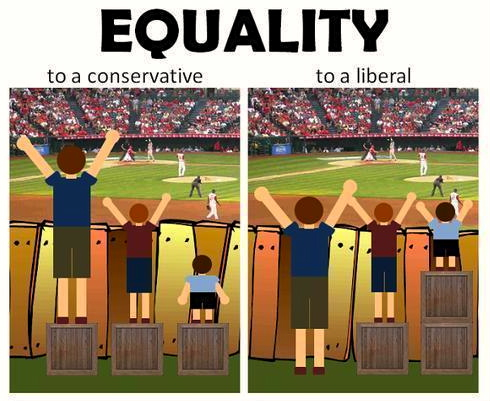
Sometimes we can use simple illustrations to explain more complex ideas. That is fine if the illustration is in fact used to explain the more complex idea. Often that’s not what happens – often we’re just shown the illustration, and because it’s simple, we think we understand the more complex situation automatically.
Take the picture above: On the left, they all have a box, but still the short guy can’t see. So, on the right, the tall guy gives him his box and all is well. That’s justice, see? Simple.
Well, if I were at a game watching over the fence and some guy needed my box to stand on, and I didn’t need it myself, of course I would give mine to him – I’m not a complete jerk. But of course, a baseball game is not what’s really the issue here. We’re talking about wealth, poverty, and social politics – much more complex issues.
How can we translate the simple illustration to the real complex problem?
We ask what each item in the illustration represents.
What do the boxes represent? Money? Power? Knowledge? All three? Something else? Why are there only three boxes? They can’t get more? Why do they all start off with one box each? Why is one guy taller than the other? Do these guys always stay the same height over the course of their lives? How is time illustrated in this picture, if at all?
What does the fence represent? Why is it the height it is? Is it shorter in other places where the short guy could see over with only one box? Why are all three guys standing right next to each other? In the real world, does the tall guy even know the short guy exists? Could the tall guy simple pass his box over to the short guy without someone else getting involved? What if the tall guy doesn’t want to give up his box? What if he’s going to need it to look over a taller section of fence further down?
What does the baseball game represent? Happiness? A house, car, and a flatscreen TV? Or just basic living needs? Who determines what poverty is? What’s being compared to what? Is the standard of living the same for all three guys? Is it essential to watch the game at all? Why don’t they buy tickets and watch inside?
These are just starter questions. As they’re answered more questions will come.
So, try answering all these questions and you’ll see that the situation is much more complicated than what the picture suggests.
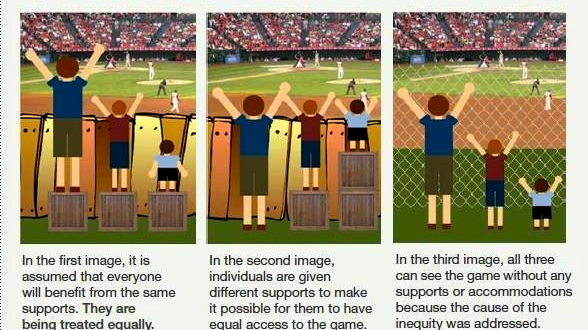
Here’s a couple of other versions of the picture I found online…

 The lesser culture is always drawn to the higher culture (or the perceived higher culture).
 If we are going to combat things like racism, we can’t just use broad terms like “systemic racism”. Which systems are racist? Who, in those systems, are making them racist?


 Pursuit of Percipience