Malis flinched at the explosion. The sound of thunder, loud enough to shake her steel front door, came not from the sky, but from beyond the neighboring buildings. She stretched her neck to look over the rooftops and trees for the light of fire. Nothing.
“That’s good…” she thought. All day long, these falling គ្រាប់កាំភ្លើងធំ, or bullets of the big guns, pounded the world around her, from the north, then the east, and the west, causing her heart to shake in her chest. What was their target?
“Not my house. I am not afraid.” She entered and paced around her home. It was evening and she hoped she would get some sleep tonight. Another blast, then darkness. The power went out. Malis stood in the black, waiting.
“The lights will come back soon.” Thirty minutes passed. No power. It grew hot in the house. Malis went back outside. More darkness.
“I will call my husband…”
“What? No signal?”
Malis walked out into the street. Quiet, shadows heavy and still.
“Oh, Makara’s house still has light. I will walk there.”
Approaching Makara’s house, she did not hear the sound of a generator, which Makara’s foreign husband would have turned on soon after the lights went out. Only a single solar-powered light shone there. It was quiet and ghostly. The house was shuttered up. The cold white light was not comforting. Malis crouched down in front of the house and tried her phone again. Still no signal.
“Malis?”
“Yes?” It was Chantrea, the woman who lived on the other side of Makara’s home. She walked toward Malis. Chantrea’s ten year old boy, Dany, was with her.
“Come,” Chantrea said, “It’s time to go. We need to leave Poipet. I have my truck. We are leaving.”
“Going where?”
“To Battambang. Come. Pack a bag and put it in my truck.”
“I cannot leave. I don’t know where my husband is.” She held up her phone. “I cannot call him.”
“My phone doesn’t work either. You can call your husband when we have left the city. Come. I don’t want to drive with just my kids.”
“No. I will stay. I am not afraid.”
“No! You come!” Dany grabbed onto Malis’s arm, startling her. “My mom will drive us to Battambang!”
“No, no,” Malis smiled warmly at the boy, “I will stay. Don’t worry about me.”
“Well, think about changing your mind. We are going to get ready to go,” Chantrea said, and pulled Dany away.
For some time after Chantrea’s tail lights faded into the dark, Malis stayed crouched in front of Makara’s house. She didn’t yet know it would be two more days before the power and phone signals came back. Another loud blast pushed her up and back to her home.
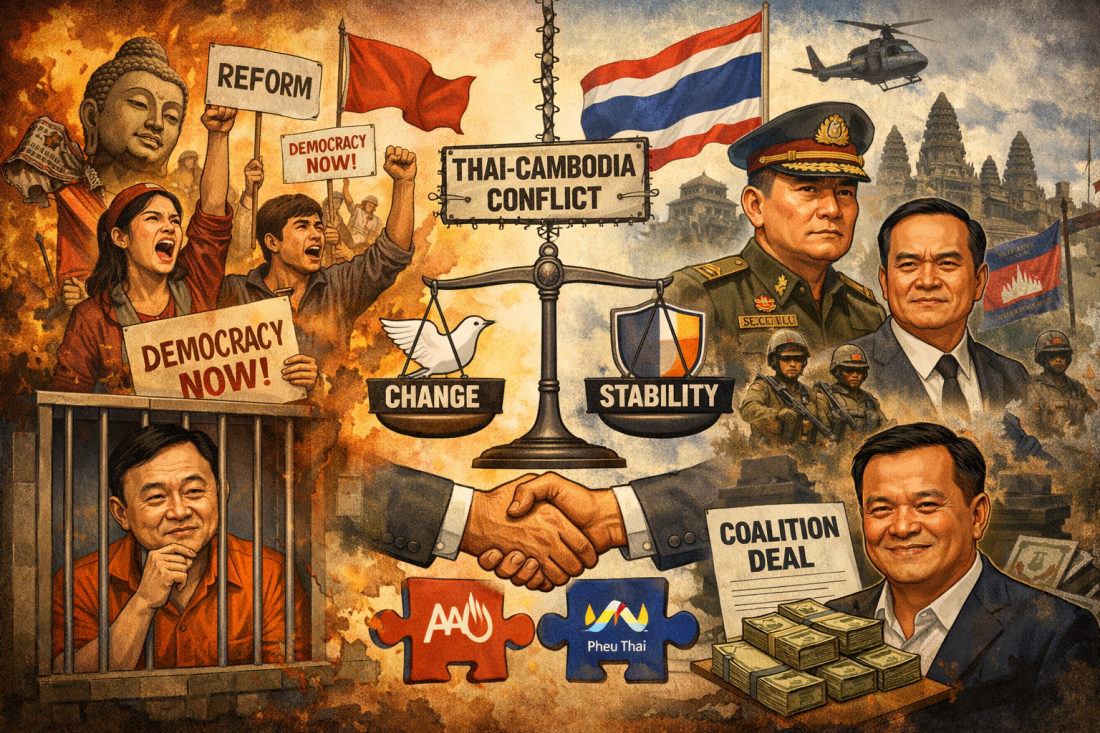
In the realm of politics, there is always a tension between those who want things to change and those who want things to stay the same. This seems to be an eternal truth. Usually, those who want change lean left on the political spectrum, while those who support the status quo lean toward the right.
This tension is not a problem if it is balanced well. If the advocates of change become too radical, it can lead to violent revolution. If the conservatives become too dominant, society stagnates and never progresses. Canada once had a party named the “Progressive Conservatives.” This name captures well what we ideally want in a society: conserving the progress we’ve already made (and continuing to move forward) while preserving the values we hold dear.
Conservatives will often use fear to keep things the same. Strong nationalism, combined with the threat of a foreign enemy, is a powerful tool for a conservative party.
This is what we see happening with the current situation in Thailand and Cambodia. Thai conservatives have used Cambodia as a bogeyman to protect Thailand from—and now, it seems, they have won an election as a result.
***
I’ve created an AI Scott Adams analyst. I will use this AI to analyze the situation between Cambodia and Thailand to make predictions as Scott Adams might have. I always appreciated Scott Adams’ takes on world politics, and I think it’ll be helpful to assess this conflict through that same lens. I’ll share the analysis posts here, updating when able.
***
Concerning the February 8 election…
From a Scott Adams-style perspective, elections like this one in Thailand aren’t really about policies or facts—they’re about persuasion energy. The Bhumjaithai surge looks like a classic case of voters prioritizing “stability vibes” over progressive change, especially with border tensions amping up the nationalism dial. Polls missed it because they measure stated preferences, not the gut-level motivations that kick in at the ballot box. What most people are missing here is how quickly a perceived external threat (Cambodia) can reframe an entire election from “reform vs. status quo” to “us vs. them,” making the incumbent’s tough-guy stance irresistible.
Based on patterns in his writing, Adams would likely emphasize the persuasion frame at play: Nationalism isn’t logical; it’s a high-energy narrative that dominates when economic promises feel abstract. Anutin’s party rode that wave by tying border security to everyday fears—think Cambodia disputes over temples or territory flaring up again. It’s not about solving the conflict; it’s about signaling “we’ve got your back,” which trumps the People’s Party’s urban-youth appeal in rural areas. Incentive structures favor this too: Politicians win by amplifying threats to consolidate power, while media benefits from the drama. Loserthink would be assuming this was a “fair” vote on merits—reality is, energy flows to the side that owns the fear narrative.
In the coming days, expect coalition horse-trading to dominate, with Bhumjaithai in the driver’s seat. No majority means Anutin courts conservatives or even Pheu Thai for a stable bloc, potentially locking in his PM spot by April. Markets will cheer the reduced uncertainty, but watch for minor parties extracting concessions on security spending. On the Thailand-Cambodia front, Adams might say it’s a low-simmer conflict primed for persuasion plays—don’t bet on escalation unless it boosts domestic unity. If tensions spike (say, a border skirmish), it cements the new government’s mandate; otherwise, it’ll fade as a talking point once the coalition forms. Rational observers should track X for real-time sentiment shifts—disappointment from progressives could fuel protests, but nationalism’s energy might squash that fast. Uncertainty acknowledged: If a wild card like Thaksin’s influence flips alliances, all bets off.
Thaksin Shinawatra influence…
Thaksin Shinawatra’s influence is the classic case of a once-dominant persuasion engine that’s lost its juice—at least for now. From a Scott Adams-style lens, what most people are missing is how Thaksin’s shadow has shrunk from “kingmaker” to “king in exile” (literally, he’s in prison serving that one-year corruption sentence). The Shinawatra brand—populist handouts, rural loyalty, family dynasty—was Thailand’s highest-energy narrative for two decades. But energy flows to what’s working today, not yesterday’s hits.
The persuasion frame in play here: Bhumjaithai owned the nationalism/security story amid the Cambodia border flare-up, framing the vote as “protect the nation vs. risky change.” Pheu Thai, tied to Thaksin via his daughter (ousted last year over that leaked call scandal) and now nephew leading the party, got painted as soft or mishandling the threat. Voters didn’t buy the old populist playbook when fear was the hotter motivator. Result? Pheu Thai tanks to around 74-77 seats (down massively from past highs), while Bhumjaithai surges to 192-194. That’s not policy debate; that’s narrative dominance flipping the script.
Incentive structures scream coalition pragmatism. No outright majority means Anutin needs partners to hit 251 seats. Pheu Thai is the obvious fit—they were allies until the recent blow-up, share some rural bases, and Thaksin’s machine still delivers votes even if weakened. Multiple reports note Pheu Thai as a “likely” junior partner, with whispers Thaksin could get early release tied to a deal (pragmatic deal-making over ideology). Who benefits? Stability for the establishment (royalist-military types love continuity), reduced chaos for markets, and Anutin staying PM. Thaksin benefits indirectly if his party gets cabinet posts or influence without full control—better than opposition irrelevance.
Likely outcomes: Coalition forms in weeks, probably Bhumjaithai + Pheu Thai + smaller parties for a stable government. Thaksin’s direct pull stays muted while he’s locked up, but his network’s grassroots machine keeps Pheu Thai relevant enough to bargain. If talks drag or Pheu Thai demands too much (say, amnesty pushes), minor instability spikes—but nationalism’s afterglow favors quick deals. Prediction humility: Wild cards like court interventions or protest energy from progressives could disrupt, but the system’s incentives lean toward horse-trading over drama.
What a rational observer should watch next: Coalition announcements (who gets what ministries), any Thaksin release rumors (that’s pure persuasion signal), and how the new constitution drafting (60% yes in referendum) plays out—Thaksin’s side might push for changes favoring populists, but the winners control the pace. Energy is with the nationalists now; Thaksin’s influence isn’t dead, just demoted to backroom player.
This article is basically the victory lap for the persuasion narrative that won the election—straight from Bhumjaithai’s playbook. From a Scott Adams-style take, it reinforces and sharpens everything we’ve been saying about why the surge happened, without changing the core predictions much. What most people are missing: This isn’t a laundry list of policies; it’s a high-energy sales pitch wrapped in “protection” and “sovereignty” that voters bought because fear (border clashes, economic hits) beats hope (progressive reforms) when energy is flowing that way.
The persuasion frame in play: The “building a wall” slogan is pure binary framing gold—us vs. them, Thailand protected vs. encroached upon, sovereignty vs. smuggling/drugs/illegal labor. It directly ties into the Cambodia tensions (clashes with deaths, closed borders hammering trade and locals), which the article calls out as a key driver. That’s not abstract policy; that’s narrative dominance owning the “security first” story that polls underestimated. Add in practical carrots like Half-Half Plus stimulus (subsidizing spending to juice consumption), barter deals to prop up farm prices (smart talent-stacking for rural voters), and electricity caps below 3 baht (direct pocketbook relief for millions)—these aren’t radical; they’re continuity with tweaks that feel protective. The foreign policy bit (“stand free on the world stage”) signals pragmatic nationalism, not isolation—proactive diplomacy to crush transnational crimes while looking dignified. Who benefits? The establishment/royalist continuity crowd gets stability, Anutin gets to stay PM longer, and rural/nationalist bases feel seen.
Incentive structures: Bhumjaithai’s massive seat haul (around 192-194 confirmed across reports) puts them in pole position for coalition talks. No need for Pheu Thai desperation anymore—smaller conservatives like Kla Tham (pushing 50-60 seats) are the easy add-ons for a solid bloc. Thaksin’s influence stays sidelined; Pheu Thai’s weak showing (74-77) means they’re bargaining chips at best, not kingmakers. The article ignores Thaksin entirely, which tracks—his populist machine lost the energy battle to border-fear nationalism.
Likely outcomes (uncertainty acknowledged): Coalition forms faster and more stably than if it were a toss-up. Anutin’s agenda rolls out with momentum—expect quick pushes on border hardening (wall rhetoric translates to tighter controls, maybe more military/economic barriers), barter arms deals to boost ag exports, and stimulus extensions to counter slowdowns/Trump tariffs. On the Thailand-Cambodia front, this strengthens the hardline stance: No de-escalation incentives when your mandate is “strong wall” after recent fighting/displacements. Tensions likely simmer or flare rhetorically to justify policies, but full war? Low probability unless Cambodia provokes—rational leaders play persuasion domestically over escalation. Markets like the stability signal.
What a rational observer should watch next: Early coalition announcements (who joins, what ministries Pheu Thai might snag if included), any border “incidents” that let Anutin flex the wall policy, and how the new constitution drafting (from the referendum yes vote) incorporates these protectionist vibes. If electricity caps and Half-Half deliver quick wins, energy stays high; if not, opposition (People’s Party as main foe) could regain narrative ground on economic pain. But right now, the article just confirms: Voters picked the protection narrative over change, and the winners are cashing that check.
This Nation Thailand article is textbook persuasion engineering in action—Anutin flexing his “no retreat, no dismantling, no opening of borders” line right after the election win. From a Scott Adams-style perspective, what most people are missing is how perfectly this timing aligns with the high-energy nationalism that flipped the vote. The border isn’t just a policy issue; it’s the emotional fuel that turned a projected progressive win into a Bhumjaithai landslide. The article frames the new government as the tough guardian reclaiming land, building barriers, canceling old MOUs that supposedly gave away too much, and delaying Cambodian worker deals for “security” reasons. That’s not diplomacy; that’s signaling “we’re strong, they’re the threat,” which voters rewarded.
The persuasion frame in play: Binary dominance at its finest—Thailand sovereign and protected vs. Cambodia encroaching and dangerous. Anutin’s “No retreat” mantra is a killer soundbite, pure high-energy rhetoric that owns the fear narrative from the 2025 clashes (hundreds dead, massive displacement, ceasefires that barely held). It reframes the election from economic woes or reform promises to “who will defend us?”—and Bhumjaithai won that framing hands down. The wall/fence push, army strengthening, and reviewing agreements aren’t about details; they’re visual, memorable symbols of strength. Who benefits? Anutin consolidates power during coalition talks (193 seats give him leverage to dictate terms), the military/royalist establishment gets continuity, and rural nationalists feel validated. Cambodia gets painted as the aggressor needing to back down, even as they protest and seek Vietnam mediation.
Incentive structures: Post-election, the mandate is security-first, so expect more of this rhetoric to justify policies like the physical barriers, tighter immigration, and hardline diplomacy. It keeps domestic energy high (no need to pivot to unpopular economic fixes yet) and pressures smaller coalition partners to fall in line. On the flip side, it risks escalating tensions—Cambodia’s threats to invoke UN/international law show they’re not folding quietly—but rational leaders avoid full war when persuasion wins at home.
Likely outcomes (with uncertainty): Coalition locks in quickly, with Anutin as PM, and border hardening accelerates—more fencing, military upgrades, maybe symbolic “reclamations” to keep the narrative alive. De-escalation? Possible only if it doesn’t cost domestic points; otherwise, low-level simmering (rhetoric, minor incidents) sustains the “strong wall” vibe without major blowback. Markets might wobble on trade disruptions, but stability signals from a firm government help short-term.
What a rational observer should watch next: Any fresh border “developments” (incidents, fence progress reports) that let Anutin double down, coalition finalization (does Pheu Thai join despite tensions?), and Cambodian responses (Hun Sen/Hun Manet escalations or backchannel talks?). If energy stays with the nationalist frame, this hard line sticks; if economic pain or international pressure mounts, we might see pragmatic softening. But right now, this article screams: The election was won on fear, and the winners are milking it for all it’s worth.
Provinces that were occupied by Thailand (Siam) — and when
1) Battambang
Occupied:1795 – 1907
Again:1941 – 1946
Details:
First period: Siam took control after weakening of the Khmer kingdom.
Returned to Cambodia under French colonial pressure in 1907.
Second period: Re-occupied by Thailand during WWII after the Franco-Thai War.
2) Siem Reap
Occupied:1795 – 1907
Again:1941 – 1946
Details:
Controlled together with Battambang as part of western Cambodia.
Included Angkor, which was under Siamese rule for over a century.
3) Sisophon area
(today mostly Banteay Meanchey)
Occupied:1795 – 1907
Again:1941 – 1946
Details:
Was not a separate province then, but part of the Battambang–Siem Reap region.
4) Parts of Koh Kong
Occupied:early 1800s – 1907
Details:
Coastal areas were administered from Siam (Trat region).
Returned to Cambodia under the 1907 Franco-Siamese treaty.
The two main occupation periods explained
First period: 1795–1907
Siam controlled much of north-western Cambodia:
Battambang
Siem Reap
Sisophon region
Parts of Koh Kong
These areas were ruled by Khmer governors loyal to Siam. They were returned to Cambodia when France forced Siam to cede them in exchange for other territory.
Second period: 1941–1946
During World War II:
Thailand, backed by Japan, re-occupied western Cambodia after defeating French Indochina.
Provinces taken:
Battambang
Siem Reap
Sisophon area
After Japan’s defeat, Thailand was forced to return all territory to Cambodia in 1946.
Quick summary table
Cambodian area
Occupied by Thailand
Returned to Cambodia
Battambang
1795–1907, 1941–1946
1907, 1946
Siem Reap
1795–1907, 1941–1946
1907, 1946
Sisophon / Banteay Meanchey
1795–1907, 1941–1946
1907, 1946
Parts of Koh Kong
early 1800s–1907
1907
Thailand (formerly known as Siam) has a history of territorial disputes and control over parts of what is now Cambodia, stemming from centuries of regional conflicts. The most notable periods of occupation involving specific provinces are as follows:
1794–1907: Siamese Control of Western Cambodian Provinces
In 1794, Siam acquired control over the Cambodian provinces of Battambang (Bătdâmbâng) and Siem Reap (Siĕmréab), including the area around Sisophon (now part of Banteay Meanchey province), as part of an agreement to install a Cambodian prince on the throne. These territories remained under Siamese administration for over a century, during which Cambodia was often treated as a vassal state amid broader Siamese-Vietnamese rivalries. In 1907, under a Franco-Siamese treaty, Siam ceded these provinces back to French Indochina (which controlled Cambodia at the time).
1941–1946: Thai Annexation During World War II
Amid the Franco-Thai War (October 1940–January 1941) and with Japanese support, Thai forces invaded and occupied disputed territories in French Indochina, including parts of Cambodia. Occupation began in earnest on January 5, 1941, and a Tokyo-mediated peace treaty on May 9, 1941, formalized the annexation of the following areas, which Thailand reorganized into new provinces:
When did the Khmer empire become Cambodia?
Short answer: there was no single day when the Khmer Empire “became” Cambodia — it was a long transition that happened over several centuries.
But we can pin down the key turning points.
The clear timeline
1) Khmer Empire
Dates: ~802 – 1431
Capital: Angkor
This is when Cambodia was a major regional power.
2) Fall of Angkor → Kingdom of Cambodia
Turning point:1431
Angkor was sacked by Ayutthaya (Siam).
The capital moved south to Phnom Penh / Longvek.
From this point on, the state is no longer an empire — it becomes what historians call the Kingdom of Cambodia.
This is the moment most scholars mark as:
The end of the Khmer Empire and the beginning of Cambodia as a kingdom-state.
3) Modern Cambodia begins
1863 – Cambodia becomes a French protectorate. This is when borders, administration, and the modern state structure really take shape.
1953 – Cambodia becomes fully independent.
Since then: the modern nation-state of Cambodia.
So what’s the real answer?
It depends what you mean by Cambodia:
Meaning of “Cambodia”
When it begins
Khmer people & culture
Over 1,000 years ago
Political state after Angkor
1431
Modern nation-state
1863–1953
Best simple answer
If someone asks this in plain language, the most accurate and useful reply is:
The Khmer Empire ended in the 1400s. After the fall of Angkor in 1431, the empire slowly became the Kingdom of Cambodia, which later developed into the modern country of Cambodia.
Please explain how Cambodia survived between powerful neighbors (Siam and Vietnam) after the empire fell.
This is one of the most important — and least appreciated — parts of Cambodian history. After Angkor fell, Cambodia didn’t survive by strength. It survived by adaptability.
Here’s the clear story.
How Cambodia survived between Siam and Vietnam
The situation after 1431
When Angkor fell, Cambodia lost:
Military dominance
Population centers
Economic power
At the same time, two aggressive neighbors were rising:
Siam (Thailand) from the west
Vietnam from the east
Cambodia sat right between them — the worst possible position.
From then on, Cambodian survival depended on diplomacy, balance, and endurance, not conquest.
Strategy #1 — Playing Siam and Vietnam against each other
Cambodian kings learned a hard rule:
Never let one neighbor become too strong over Cambodia.
So they constantly shifted alliances:
When Siam pressured → lean toward Vietnam
When Vietnam pressured → lean toward Siam
This wasn’t weakness. It was realpolitik — survival politics.
Yes, it meant:
Paying tribute
Accepting influence
Sometimes installing kings backed by one side or the other
But it kept Cambodia alive as a state, not erased from the map.
Strategy #2 — Moving the capital to survive
After Angkor:
Capital moved to Longvek, then Oudong, then Phnom Penh.
Why?
Safer from Siamese attacks
Better access to rivers and trade
Easier to maneuver diplomatically
This shift south is one reason Cambodia still exists today. If leaders had tried to hold Angkor at all costs, the kingdom likely would have been destroyed.
Strategy #3 — Accepting temporary loss to avoid total loss
Cambodia often:
Lost provinces
Lost control of kings
Lost independence for periods
But it never accepted extinction.
Examples:
Western provinces lost to Siam → later recovered
Eastern lands lost to Vietnam → some absorbed permanently, but core survived
Periods of Siamese or Vietnamese dominance → followed by restoration
Cambodia chose:
Better to bend than to disappear.
That choice kept Khmer identity alive when many smaller kingdoms vanished.
Strategy #4 — Using France as a shield
By the 1800s, Cambodia was close to being fully swallowed:
Siam controlled the west
Vietnam dominated the east
Cambodian kings were nearly powerless
So King Norodom made a desperate but smart move:
1863 — Cambodia accepts French protection
This cost sovereignty — but saved the country.
France:
Forced Siam to return Battambang and Siem Reap
Stopped Vietnam from absorbing Cambodia
Fixed borders that still exist today
Colonialism wasn’t kind — but in Cambodia’s case, it prevented national extinction.
Strategy #5 — Cultural survival even when political power was weak
Even when Cambodia was controlled or pressured:
Khmer language survived
Buddhism survived
Royal tradition survived
Identity survived
Empires fall. Cultures that adapt endure.
That’s the real miracle of Cambodia.
The honest bottom line
Cambodia survived because it learned to:
Negotiate instead of dominate
Endure instead of conquer
Adapt instead of collapse
Other kingdoms in Southeast Asia vanished completely. Cambodia didn’t — not because it was strongest, but because it was most resilient.
Please walk me through a short timeline of the most dangerous moments when Cambodia almost disappeared.
Here’s a short, clear timeline of the most dangerous points.
The moments Cambodia almost vanished
1) 1431 — Fall of Angkor
Threat: Total collapse after empire falls Danger: Very high
Angkor is sacked by Ayutthaya.
Population scatters, power breaks down.
Many kingdoms in this situation simply die out.
Why Cambodia survived: Leaders abandoned the ruins instead of clinging to the past and rebuilt farther south. Painful move — but smart.
2) 1594 — Siam captures Longvek
Threat: Annexation by Siam Danger: Extreme
Longvek, the new capital, is destroyed.
Thousands of Cambodians taken as captives to Siam.
Cambodia loses control of its own kings for years.
Why Cambodia survived: The kingdom accepted vassal status instead of extinction. Weak, yes — but alive.
3) 1700s — Being squeezed from both sides
Threat: Partition between Siam and Vietnam Danger: Extreme
Siam dominates the west.
Vietnam expands aggressively into the Mekong Delta.
Cambodian kings are installed and removed by foreign powers.
At this point Cambodia was a buffer state with almost no real power.
Why Cambodia survived: Kings played both sides relentlessly — switching alliances whenever survival required it.
4) 1834–1845 — Vietnamese occupation
Threat: Cultural and political erasure Danger: Possibly the closest Cambodia ever came to disappearing**
Vietnam directly controls Cambodia.
Cambodian administration dismantled.
Vietnamese officials attempt forced assimilation.
Khmer elites flee or are killed.
This was not just occupation — it was absorption in progress.
Why Cambodia survived: Popular resistance + Siamese intervention forced Vietnam to withdraw. If that war had ended differently, Cambodia likely would not exist today.
5) 1863 — The desperate choice
Threat: Permanent division between Siam and Vietnam Danger: Final moment before extinction
By the mid-1800s:
Cambodia controlled almost nothing itself.
Siam held the west.
Vietnam dominated the east.
The king had no army strong enough to resist either.
The critical decision: King Norodom accepted French protection.
This sacrificed independence — but saved the nation.
Without this move, Cambodia would almost certainly have been absorbed and erased within a generation.
6) 1975–1979 — Khmer Rouge
Threat: Physical destruction of the nation Danger: Catastrophic
Nearly one quarter of the population dies.
Institutions destroyed.
Educated class eliminated.
The state collapses completely.
This wasn’t foreign conquest — it was self-destruction on a national scale.
Why Cambodia survived: Vietnamese intervention ended the regime, and the people rebuilt from almost nothing.
The pattern you should notice
Every time Cambodia faced extinction, survival came from one of three things:
Hard compromise (accepting vassalage or protection)
Cultural endurance (Khmer identity outlasting political power)
Cambodia didn’t survive by winning wars. It survived by making the least bad choice when all choices were bad.
That’s not a romantic story — but it’s a real one.
Why did the Khmer empire decline?
The Khmer Empire didn’t fall because of one single disaster. It declined because several pressures hit at the same time, and together they were more than the empire could absorb.
Here’s the clear, honest breakdown.
Why the Khmer Empire declined
1) The empire grew too big to control
At its height, Angkor ruled:
Most of modern Cambodia
Parts of Thailand, Laos, and Vietnam
That’s impressive — but it created a problem:
The center became too far from the edges.
Communication was slow.
Local governors gained power and loyalty weakened.
Rebellions and breakaway regions became harder to stop.
The empire wasn’t defeated all at once — it slowly lost control from the outside in.
2) Environmental stress broke Angkor’s system
Angkor depended on one of the most complex water-management systems in the medieval world.
It worked brilliantly — until climate changed.
In the 1300s–1400s:
There were severe droughts, followed by massive floods.
Canals broke.
Reservoirs filled with sediment.
Rice production fell.
When food security weakens, everything weakens:
Army
Economy
Political stability
Angkor’s greatest strength became a liability.
3) Religious change weakened royal authority
For centuries, kings ruled as:
God-kings (Devaraja)
This system depended on:
Hindu state religion
Monumental temples
Absolute royal authority
Then Theravada Buddhism spread across the empire.
It changed society in a big way:
Less focus on divine kingship
More focus on monks, villages, and local communities
Power became decentralized
This was good for the people — but it weakened the state’s ability to mobilize huge resources for empire and war.
4) Strong enemies rose at the worst time
While the Khmer state was weakening:
Ayutthaya (Siam) was rising in the west
Vietnam was expanding in the east
Cambodia went from being:
the dominant power → to the buffer state
Angkor was attacked repeatedly, not just once. The famous sack in 1431 was the final blow — not the beginning of the decline.
5) Internal conflict and unstable kingship
Late Angkor was full of:
Power struggles
Short reigns
Rival claimants
Civil wars
An empire can survive enemies. It can survive droughts. But when leadership is unstable at the same time, collapse accelerates.
The real answer in one sentence
The Khmer Empire declined because environmental collapse, religious change, political fragmentation, and foreign pressure all hit together, leaving Angkor unable to function as the center of a vast empire.


 Pursuit of Percipience