
This video below is worth watching. I suppose we shall see if the professor’s predictions come true in not too long a period of time.
Is the professor trustworthy?
This video below is worth watching. I suppose we shall see if the professor’s predictions come true in not too long a period of time.
Is the professor trustworthy?
If Evangelical Fundamentalism is the true version of Christianity then I am in trouble since I can’t bring myself to believe in it. Thankfully Christian faith is varied enough that one can find a niche to remain a believer in. There are two scholars which showed me this was possible: David Bentley Hart and Dale C. Allison. Below is a recent interview done with Allison (ignore the click bait titles)…

The following is an AI generated essay. However, the ideas influencing the essay are my own. To save time I will often use AI to compress my ideas into essay form, which I can then refer to later. In my opinion that is one of the ways to correctly use AI. And this blog is as good a place as any to post it.
The apostle Paul is often portrayed as the architect of a new, universal religion that abandoned Israel’s particular story in favor of a generalized theology of salvation. Historically, this portrayal is misleading. Paul understood himself not as departing from Israel’s scriptures, but as re-reading them under the pressure of a single, destabilizing event: the resurrection of Jesus.
This essay argues that Paul’s theology is best understood as a carefully balanced synthesis of three narrative layers already present in Second Temple Judaism:
Paul’s inclusion of Gentiles does not bypass Israel, nor does it flatten Jewish categories into abstraction. Instead, it follows a coherent internal logic in which Israel remains central, Adam explains humanity’s universal plight, and Jesus stands at the intersection of both stories.
In the First and Second Temple periods, Israelites did not believe their sacrifices directly atoned for the sins of the nations. Temple sacrifice was:
Gentiles could offer sacrifices, and the Temple was seen as the cosmic center sustaining order for the whole world, but this benefit was indirect. The nations were not cleansed of sin simply because Israel offered sacrifice.
This distinction is crucial. Later Christian claims of universal atonement represent a genuine theological shift, not a straightforward continuation of Temple belief.
Paul knew his claims were radical. He therefore grounded them explicitly in Israel’s scriptures.
Paul emphasizes that Abraham was declared righteous before circumcision and before the Law (Genesis 15:6). This allowed Paul to argue that:
Paul reads Deuteronomy’s warnings seriously. Israel’s failure under Torah places her under covenant curse (exile). Jesus’ crucifixion—“hanging on a tree”—forces a re-reading of Deuteronomy 21:23. For Paul:
Paul’s theology does not pivot on Jesus’ death alone, but on resurrection. Resurrection signals:
Without resurrection, Paul explicitly says his gospel collapses.
Gentiles were not under the Mosaic Law. So why, according to Paul, did they need salvation?
Paul’s answer is Adam.
This allows Paul to distinguish:
Gentiles are condemned not as Torah-breakers, but as creatures who have misused creation and fallen under the power of death.
Second Temple Jews already recognized parallels between Adam and Israel:
| Adam | Israel |
|---|---|
| Placed in Eden | Placed in the land |
| Given a command | Given Torah |
| Warned of death | Warned of exile |
| Exiled eastward | Exiled among nations |
Paul does not reduce Adam to Israel, nor Israel to Adam. Instead:
Jesus succeeds where both Adam and Israel fail—not by abandoning Israel’s story, but by embodying it faithfully.
Paul’s theology can be summarized as addressing two distinct curses:
Jesus’ death and resurrection deal with both, but not in the same way.
The order matters: Adam is resolved through Israel’s Messiah.
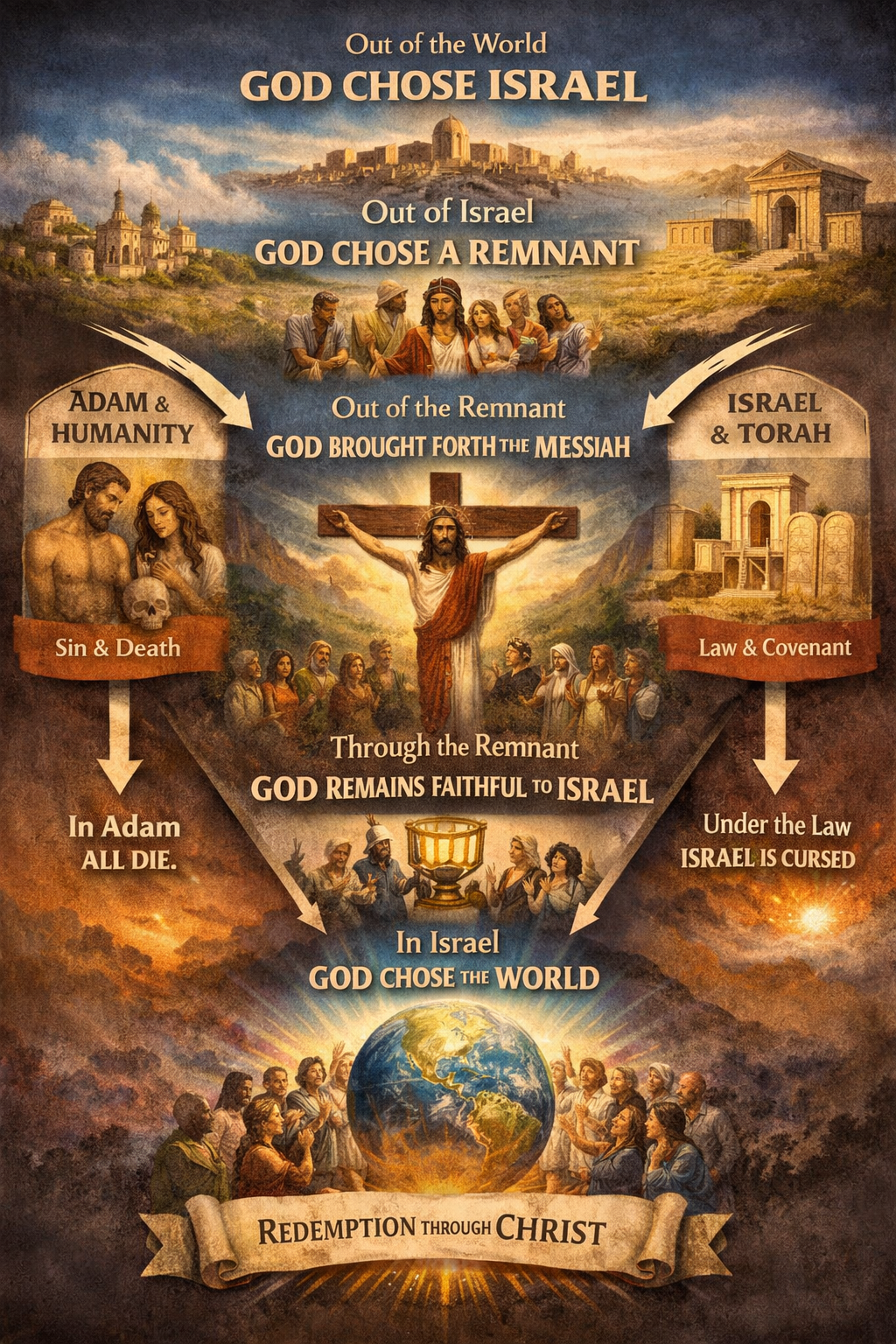
Paul’s theology of election can be expressed as a dynamic narrowing and widening:
Out of the world God chose Israel
…Out of Israel God chose a remnant
……Out of the remnant God brought forth the Messiah
……In the Messiah God formed a faithful remnant
…Through this remnant God remains faithful to Israel
In Israel God brings blessing to the world
This structure preserves:
Paul explicitly rejects the idea that the remnant replaces Israel. Instead, the remnant is the means by which God remains faithful to Israel, and Israel is the means by which God blesses the nations.
Paul’s logic often breaks down in later Christianity due to simplification:
Adam becomes the sole explanatory category, while Israel’s covenantal role fades. This flattens Paul’s careful distinction between creation-failure and covenant-failure.
Torah is reinterpreted as legalism rather than gift. This distorts Paul’s claim that the Law is “holy and good.”
Atonement becomes focused almost entirely on the cross as payment for guilt, rather than resurrection as the defeat of death and the beginning of new creation.
Romans 9–11 is sidelined. The church becomes the endpoint rather than the participant in an unfinished story.
These shifts were historically understandable—especially in a Gentile-majority, post-Temple world—but they are not faithful to Paul’s own architecture.
Paul did not abandon Israel, mythologize Adam away, or invent a new religion detached from Jewish scripture. He was a Second Temple Jew who believed that God had acted decisively within Israel’s story to resolve a problem that reached back to Adam and outward to the nations.
For Paul:
Gentile inclusion is not a detour from Israel’s vocation—it is the goal toward which that vocation always pointed.
Understanding Paul this way does not require agreeing with him. But it does require taking him seriously on his own terms.
***
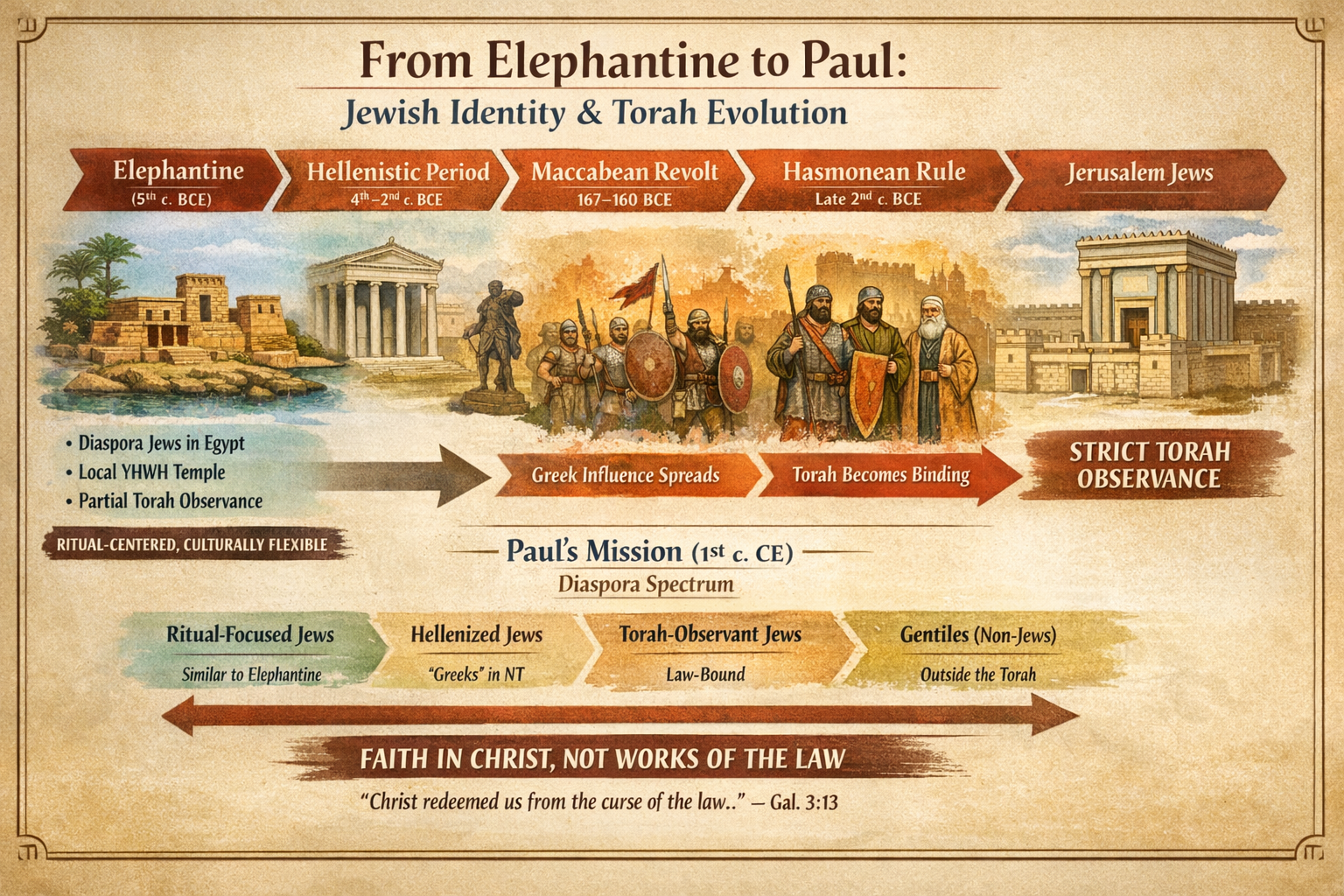
The history of Jewish communities outside Jerusalem reveals a rich diversity of religious practice long before Torah law became universally binding. One of the clearest examples is the Jewish community at Elephantine, a military colony in southern Egypt during the 5th century BCE. Studying Elephantine not only illuminates early diaspora Judaism but also helps us understand the audiences that Paul encountered on his missionary journeys centuries later.
Elephantine was a Judahite military colony, stationed on Egypt’s southern frontier before the Persian conquest (c. 525 BCE). Its members were likely Judean soldiers or mercenaries who migrated to Egypt before the major Deuteronomic reforms of the late 7th century BCE. Consequently, their religious practice reflects a pre-exilic, ritual-focused Yahwism:
In short, Elephantine Jews were religiously Jewish but socially flexible, practicing a form of Judaism that was ritual-centered rather than text-centered.
By the 2nd century BCE, Judaism had begun a process of centralization and textualization that made communities like Elephantine historically obsolete:
Elephantine, therefore, provides a snapshot of Judaism before Torah law became normative, illustrating how Jewish identity and practice evolved over centuries.
The transformation from Elephantine-style Judaism to Torah-centered Judaism was largely complete by the 2nd century BCE, driven by historical pressures:
The result: Torah became binding and normative, defining Jewish identity for the first time in a widespread, enforceable way.
By the 1st century CE, diaspora Jewish communities still exhibited considerable diversity in Torah observance and cultural assimilation:
This spectrum helps us understand Paul’s ministry: many Jews outside Jerusalem were culturally and religiously flexible, making them receptive to his message of faith in Christ over strict law observance.
In Galatians 3:13, Paul writes:
“Christ redeemed us from the curse of the law by becoming a curse for us…”
Here, he addresses an audience that includes diaspora Jews and Gentile converts who were under pressure from “Judaizers” to adopt Torah practices like circumcision. These Jews:
Paul’s argument is historically consistent: he appeals to the flexible, diaspora identity that existed in Jewish communities long before Torah law was universally enforced.
The Elephantine community shows us that early Jewish diaspora life was diverse and adaptable. Ritual practice, local temple worship, and flexible law observance were the norm outside Jerusalem. Over centuries, historical pressures—imperial rule, Hellenization, and the Hasmonean consolidation—made Torah law binding and central to Jewish identity. By Paul’s time, many diaspora Jews still embodied the Elephantine-type flexibility, explaining why his gospel could resonate with Jews and Gentiles who were devout but not fully Torah-bound.
Understanding this continuum—from Elephantine to Galatia—illuminates both the historical development of Judaism and the social context of Paul’s missionary work, highlighting how faith and law interacted in a changing world.
***

We see the gift of tongues practiced in the New Testament. In the book of Acts, the gift is associated with the baptism of the Holy Spirit. Paul also talks about the gift, most notably in his letter to the Corinthian church.
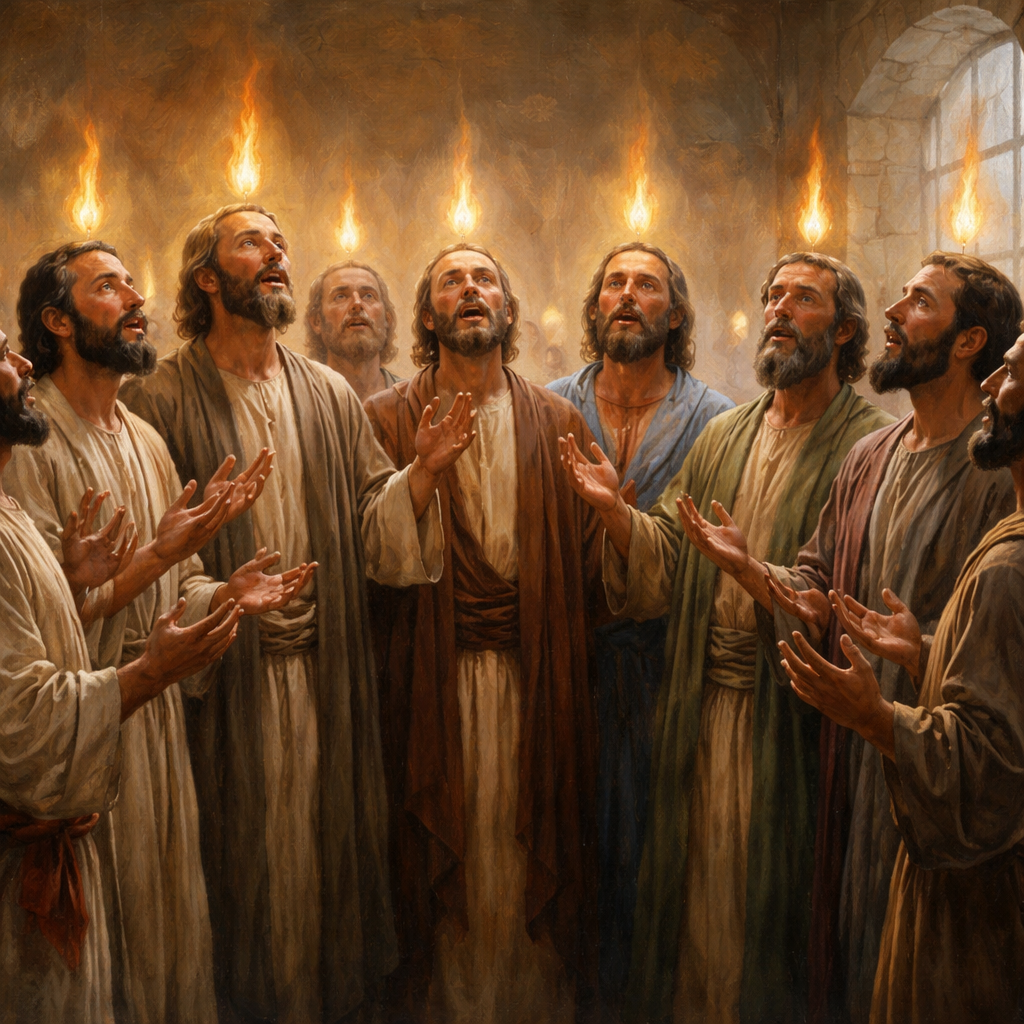
Tongues is a mysterious gift, and it can be difficult to determine its purpose. Personally, I see it as a reversal of Babel. God divided mankind at Babel through language, and then God drew mankind to Himself at Pentecost. The gift seemed to be the ability for one to speak in a real language (of which was spoken in the Roman empire) without having to first study that language. This allowed the gospel to spread out quickly across language barriers in the first critical years of the Church.
To see what came of the gift in the post-apostolic generations of the early Church we can look to the Church Fathers.
As Bishop of Lyons and a disciple of Polycarp (who knew the Apostle John), Irenaeus is one of the earliest post-apostolic writers to mention tongues. In his work Against Heresies (Book 5, Chapter 6), he describes it as a ongoing gift in his time: “We do also hear many brethren in the Church, who possess prophetic gifts, and who through the Spirit speak all kinds of languages, and bring to light for the general benefit the hidden things of men, and declare the mysteries of God.” He frames it as the ability to speak foreign languages miraculously, aligning with the Pentecost event in Acts 2, and emphasizes its role in revealing truths and benefiting the community.
For Irenaeus, the gift was still being practiced in his day, it was the ability to speak real languages, and its purpose was for prophesy and mission.
A North African theologian and apologist, Tertullian refers to tongues in Against Marcion (Book 5, Chapter 8), where he discusses spiritual gifts in the context of Montanism (a prophetic movement he later joined). “Let him who claims to have received gifts… produce a psalm, a vision, a prayer—provided it be with interpretation.” He implies tongues as intelligible speech, often requiring interpretation, and sees it as evidence of the Holy Spirit’s work similar to the apostles’. He notes encounters with the gift of interpretation in his day but doesn’t describe it as ecstatic babbling; instead, it’s tied to rational, prophetic expression.
For Tertullian, the gift was still being practiced in his day, it required interpretation, and its purpose was for the edification of the Church.
The Alexandrian scholar comments on tongues in his Commentary on 1 Corinthians and other works, such as De Principiis. He views it as the miraculous knowledge of foreign languages without prior study, emphasizing that the speaker might not understand their own words unless interpreted (echoing 1 Corinthians 14:13). Origen argues the gift was temporary, part of the “signs” of the apostolic age, and by his time, it was no longer commonly exercised.
“The signs of the Holy Spirit were manifest at the beginning… but traces of them are found in only a few.” (Against Celsus 7.8)
For Origen, the gift was real and apostolic, already becoming uncommon by the mid-3rd century, and was seen mainly as a foundational sign for the church’s early mission.
The Archbishop of Constantinople, known for his homilies, discusses tongues extensively in his Homilies on First Corinthians (e.g., Homily 35). He interprets it as speaking in actual languages like Persian, Roman, or Indian, directly linking it to Pentecost. Chrysostom stresses that it was a “sign” for unbelievers (per 1 Corinthians 14:22) and notes its cessation: by the late 4th century, it had largely disappeared from the church, as the need for such miracles had passed with the spread of Christianity.
“This whole place is very obscure; but the obscurity is produced by our ignorance of the facts referred to and by their cessation, being such as then used to occur but now no longer take place.” (Homilies on 1 Corinthians 29)
For John Chrysostom, the gift was something real from an earlier era, but no longer practiced in his day.
In works like The Letters of Petilian and his sermons, Augustine acknowledges tongues as a historical gift from the early church, where converts sometimes spoke in new languages upon baptism. However, he explicitly states that by his era, the gift had ceased: “In the earliest times, the Holy Ghost fell upon them that believed: and they spoke with tongues… These were signs adapted to the time. For there behooved to be that betokening of the Holy Spirit… That thing was done for a betokening, and it passed away.” He sees it as fulfilled in the church’s global unity rather than ongoing miracles.
For Augustine, the gift was a sign for the church’s beginning, meant to show the universality of the gospel, and was no longer needed once the Church was established.
No father describes tongues as:
No early source connects tongues with:
Tongues were real languages, not private ecstasy.
They belonged especially to the apostolic age, when the gospel was breaking into new linguistic worlds.
They declined naturally as the church became established.
They were signs of God’s power, not badges of spiritual rank.
They were always meant to serve the church, not the ego of the speaker.
In summary, the Church Fathers saw the gift of tongues as a practical miracle for spreading the gospel across linguistic barriers, not as private prayer languages or gibberish. References become scarcer after the 3rd century, with later writers like Chrysostom and Augustine indicating its decline, attributing this to the church’s maturation. This contrasts with some modern interpretations, but the patristic evidence emphasizes its historical and evangelistic role.

