
All theological positions are based on one’s philosophy of life, not the scriptures.
It’s like a game of Dodgeball. The team you’re on is determined by your philosophical presuppositions. The scriptures are just the balls being thrown around.
All theological positions are based on one’s philosophy of life, not the scriptures.
It’s like a game of Dodgeball. The team you’re on is determined by your philosophical presuppositions. The scriptures are just the balls being thrown around.

2. Pesher Interpretation:
3. Midrashic Interpretation:
4. Allegorical Interpretation:
5. Fulfillment Citation:
| NT Reference | OT Source | OT Context | NT Usage | Shift in Meaning | Method |
|---|---|---|---|---|---|
| Matthew 2:15 | Hosea 11:1 | God’s historical deliverance of Israel from Egypt, called His “son.” | Jesus’ return from Egypt, fulfilling Israel’s role. | Historical event becomes a typological prophecy about Jesus. | Typology/Fulfillment Citation |
| Matthew 1:23 | Isaiah 7:14 | Sign for King Ahaz about a child named Immanuel, born to a young woman. | Jesus’ virgin birth, using Septuagint’s “virgin.” | Historical sign becomes a messianic prophecy. | Pesher/Fulfillment Citation |
| Matthew 2:17–18 | Jeremiah 31:15 | Rachel’s mourning for Israel’s exile, with hope for restoration. | Bethlehem infants’ massacre. | Historical lament reframed as a fulfilled tragedy. | Pesher/Fulfillment Citation |
| Matthew 3:3 | Isaiah 40:3 | Preparing a way for God’s deliverance of Israel from exile. | John the Baptist preparing for Jesus. | Exile restoration prophecy fulfilled in John’s ministry. | Pesher |
| John 19:36 | Psalm 34:20 (possibly Exodus 12:46) | God’s protection of the righteous or Passover lamb regulations. | Jesus’ unbroken bones at crucifixion. | General protection or ritual rule becomes a specific prophecy. | Typology/Fulfillment Citation |
| Acts 15:16–18 | Amos 9:11–12 | Restoration of Israel’s kingdom, dominance over Edom. | Gentile inclusion in the church, using Septuagint’s “mankind.” | National restoration becomes universal salvation. | Pesher |
| Romans 9:25–26 | Hosea 2:23, 1:10 | Restoration of Israel after judgment, called “my people.” | Gentiles becoming God’s people through faith. | Israel’s restoration extended to Gentiles. | Midrash/Typology |
| Romans 10:6–8 | Deuteronomy 30:12–14 | Accessibility of the Torah for obedience. | “Word of faith” in Christ, accessible through faith. | Torah’s accessibility becomes salvation through Christ. | Midrash |
| 1 Corinthians 9:9–10 / 1 Timothy 5:18 | Deuteronomy 25:4 | Law against muzzling an ox while treading grain. | Material support for Christian ministers. | Agricultural law reinterpreted for human laborers in ministry. | Midrash/Allegory |
| 2 Corinthians 6:16–18 | Leviticus 26:12, Ezekiel 37:27, 2 Samuel 7:14 | God’s covenant presence with Israel or Davidic king. | Church as God’s temple and people, including Gentiles. | Israel/Davidic promises applied to the church. | Pesher/Midrash |
| Galatians 3:16 | Genesis 12:7 | Promise of land to Abraham’s descendants (plural). | “Offspring” as Christ, the singular heir. | Collective promise narrowed to Jesus. | Midrash/Typology |
| Galatians 4:21–31 | Genesis 16–21 | Historical narrative of Hagar and Sarah, Abraham’s sons. | Allegory of old (law) and new (faith) covenants. | Family story becomes allegory for law vs. faith. | Midrash/Allegory |
| Hebrews 1:5 | Psalm 2:7 | God’s adoption of the Davidic king at coronation. | Jesus’ eternal divine sonship. | Royal coronation becomes Christ’s divinity. | Typology/Fulfillment Citation |
| Hebrews 10:5–7 | Psalm 40:6–8 | Obedience over sacrifice in personal worship. | Jesus’ incarnation and sacrificial death. | General worship statement becomes messianic prophecy. | Midrash/Typology |
| 1 Corinthians 15:54–55 | Isaiah 25:8, Hosea 13:14 | God’s future defeat of death or taunt against death. | Christ’s resurrection defeating death. | General/judgmental texts become resurrection triumph. | Pesher |

Theology often adapts to historical events, which helps explain the different views on the end times (eschatology) even among early Christians. For instance, in letters written before the destruction of the Jerusalem temple in AD 70, Paul never links Christ’s return (the Parousia), the resurrection, or judgment to that event. Instead, he focuses on a general, future hope for all believers (e.g., 1 Corinthians 15:23; 1 Thessalonians 4:16), without mentioning the temple, which was still standing at the time.
In contrast, the Synoptic Gospels (Mark, Matthew, and Luke), likely written after the temple was destroyed, directly connect its fall to the Parousia. They portray the temple’s destruction as a sign of coming judgment and a lead-up to Christ’s return (Mark 13:2, 24–27; Matthew 24:2, 29–31; Luke 21:6, 20–28). Even so, they still view the resurrection as a future event, hinted at through symbols like the trumpet (Matthew 24:31) and affirmed in other teachings (Mark 12:25; Matthew 22:30; Luke 20:36).
Later still, the Gospel of John (written around AD 90–100) does not mention the temple’s destruction in relation to the Parousia or resurrection. Instead, it emphasizes a more spiritual or “realized” view of Christ’s presence now, while still affirming a future bodily resurrection (John 5:24–29). This reflects a shift toward a more universal theological perspective, no longer centered on the events of AD 70.
This development—from Paul’s silence on the temple, to the Synoptics’ focus on it, to John’s move beyond it—shows how early Christian beliefs about the end times evolved in response to historical changes.
Below is a comparative list of 1 Maccabees and Daniel 11…
| 1 Maccabees Event | Daniel 11 Reference | Chronological Alignment (Approximate Dates) | Notes |
|---|---|---|---|
| Seleucid oppression begins under Antiochus IV Epiphanes (1 Macc 1:10–20): Antiochus IV becomes king (175 BCE) and plunders Jerusalem, taking temple treasures. | Dan 11:21–24: A “contemptible person” (Antiochus IV) seizes the kingdom through intrigue, plunders wealth, and distributes spoil. | c. 175–170 BCE | Both texts describe Antiochus IV’s rise and early actions. Daniel’s prophecy symbolically portrays his deceit and greed, matching 1 Maccabees’ historical account of his looting. |
| Antiochus IV’s religious persecution (1 Macc 1:20–64): Antiochus bans Jewish practices (c. 167 BCE), desecrates the temple with a pagan altar (“abomination of desolation”), and enforces Hellenistic worship. | Dan 11:31: “Forces from him shall profane the sanctuary… and set up the abomination that makes desolate.” | c. 167 BCE | The “abomination of desolation” in Daniel aligns with the temple desecration in 1 Maccabees, often identified as the altar to Zeus in the Jerusalem temple. |
| Maccabean Revolt begins (1 Macc 2:1–70): Mattathias and his sons (Judas Maccabeus) resist Seleucid oppression, sparking the revolt (c. 167–166 BCE). | Dan 11:32: “The people who know their God shall stand firm and take action.” | c. 167–166 BCE | Daniel’s reference to a faithful remnant resisting aligns with the Maccabean uprising, though Daniel is less specific about the revolt’s leaders or details. |
| Judas Maccabeus’ victories (1 Macc 3:1–4:35): Judas wins battles against Seleucid generals (e.g., Apollonius, Seron, Gorgias) and recaptures Jerusalem, rededicating the temple (164 BCE). | Dan 11:32–33: The faithful “shall receive a little help” and continue to resist, though some fall. | c. 166–164 BCE | The “little help” in Daniel may allude to Judas’ early successes, though the prophecy remains vague. The temple rededication (Hanukkah) is not explicitly mentioned in Daniel. |
| Antiochus IV’s campaigns and death (1 Macc 6:1–16): Antiochus IV campaigns in the east, falls ill, and dies (164 BCE). | Dan 11:40–45: The King of the North engages in campaigns, faces turmoil, and dies with “no one to help him.” | c. 164 BCE | Both texts describe Antiochus IV’s eastern campaigns and death, though Daniel’s account is more symbolic and debated (some see Dan 11:40–45 as future or unfulfilled prophecy). |
| Continued Seleucid conflicts (1 Macc 6:18–9:57): After Antiochus IV’s death, the Maccabees face ongoing wars under Antiochus V and Demetrius I, with Judas dying (160 BCE). | Dan 11:35–39: Ongoing struggles for the faithful, with some falling, until “the time of the end.” | c. 164–160 BCE | Daniel’s vague reference to continued persecution may correspond to post-Antiochus IV conflicts in 1 Maccabees, but the prophecy shifts toward an eschatological tone. |
| Hasmonean consolidation (1 Macc 10:1–16:24): Jonathan and Simon establish Hasmonean rule, achieving relative independence (c. 160–134 BCE). | No clear parallel in Daniel 11 | c. 160–134 BCE | Daniel 11 does not clearly address the later Hasmonean period, focusing instead on earlier Seleucid conflicts or possibly an eschatological future. |
Below is a comparison of different translations rendering Daniel 9:25 (emphasis mine)…

There are some things to notice:
Firstly, the decision whether to the use “command” or “word” may depend on the translator’s bias. Do they want a decree from a king? Or a prophesy from a seer?
Secondly, the NKJV apparently wants the reader to believe this messiah is Jesus.
Third, I’ll include a possible explanation from AI as to why the Artscroll translation omits “messiah” below.
Fourth, the NKJV seems to want the reader to see the seven weeks and sixty-two weeks as occurring one right after the other, a straight sixty-nine week time period. However, the Hebrew may not allow for that. Consider the text below in Hebrew…

I asked AI (Grok and ChatGPT) if there was any mark with the word “seven” which would indicate a break after that word. This was the response…
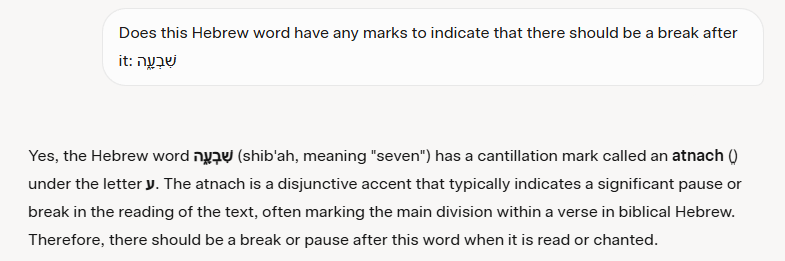
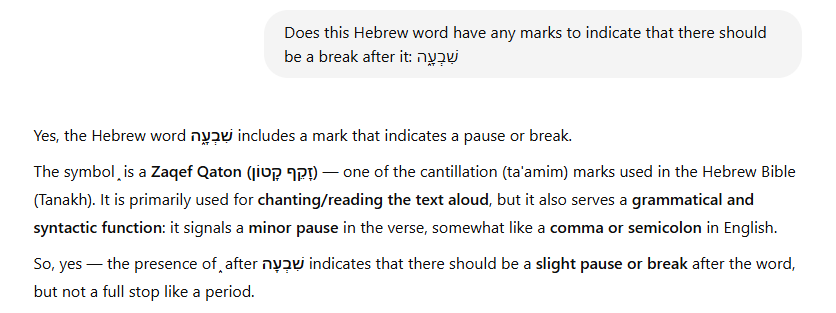
So, there should be a break after the seven weeks*, which means that, according to the prophesy, the messiah mentioned in the verse likely should have appeared in history directly after the first seven weeks, or forty-nine years. If that’s correct, this messiah is not Jesus (although it can be seen as a type of Christ). The commentary in my Artscroll bible suggests it was Cyrus, and the commentary in my NRSV suggests it was the high priest Joshua (see Haggai 1:12; Ezra 2:2, 3:2; Zechariah 4:14, 6:10-12). Therefore, according to these commentaries, the “word” going out was not a kingly decree, but rather a prophesy–possibly spoken by Jeremiah (the NRSV suggests Jeremiah 25:11). Also notice how the NRSV refers to the “word” in the past tense, meaning that for Daniel it would have already been past tense and thus not a future decree of Cyrus. Daniel 9 begins with Darius the Mede still in power, which was before Cyrus.
Carol A. Newsom, in her commentary, suggests the author of Daniel 9 was not trying to pin down precise dates, but rather “to connect important events in history by means of a symbolic heptadonal system of time.”** We must take note of the seven weeks as being a time of jubilee (see Leviticus 25:8ff), and also the 490 years as being ten jubilee periods. It doesn’t necessarily matter when the 70 weeks began as long as we can connect the right events together, and since the theme of jubilee (freedom) is being focused on we can assume the events have to do with Jews regaining their autonomy and purpose as God’s people.
James B. Jordan, in his commentary, reads the 70 weeks as consecutive.*** He makes no mention of the apparent pause in the text after the first seven weeks. He also insists that the 70 weeks began with the decree of Cyrus in 537 BC. But, if the 70 weeks are read literally and consecutively, the prophesy takes us only to the year 47 BC. Jordan’s solution to this is to say that the first seven weeks were literal (from Cyrus’s decree to Nehemiah’s return to Jerusalem). The following sixty-two weeks were symbolic, resulting in the last week being postponed. And the last week, or 70th week, was again literal, which started with the ministry of Jesus and ended with the death of Stephen in Acts 7. Jordan takes a few paragraphs to explain why the sixty-two weeks were symbolic, but basically he argues that God postpones judgement throughout scripture to be merciful, and also to harden the rebellious ones.
* There is no cantillation mark in the Hebrew which indicates there is any pause or break after the “sixty-two weeks” as the NKJV has it. There should be no period, semi colon, or comma after “sixty-two weeks.”
** Newsom, Carol A. Daniel: A Commentary. Westminster John Knox Press, 2014, p. 619.
*** Jordan, James B. The Handwriting on the Wall: A Commentary on the Book of Daniel. American Vision, 2007, p. 469ff. I am quite certain Jordan’s translation of choice is the NASB, which renders Daniel 9:25 as: “So you are to know and understand that from the issuing of a decree to restore and rebuild Jerusalem, until Messiah the Prince, there will be seven weeks and sixty-two weeks; it will be built again, with streets and moat, even in times of distress.” (emphasis mine)
***
The Hebrew of Daniel 9:25 reads:
וְתֵדַע וְתַשְׂכֵּל מִן-מֹצָא דָבָר לְהָשִׁיב וְלִבְנוֹת יְרוּשָׁלִַם עַד-מָשִׁיחַ נָגִיד שִׁבְעָה שָׁבֻעִים וְשִׁבְעִים וּשְׁנַיִם שָׁבֻעִים תָּשׁוּב וְנִבְנְתָה רְחוֹב וְחָרוּץ וּבְצוֹק הָעִתִּים
Translated literally, this is:
“Know and understand: From the going forth of the word to restore and build Jerusalem until an anointed one, a leader/prince (mashiach nagid), seven weeks; and for sixty-two weeks, it will be rebuilt, street and moat, but in troubled times.”
The key phrase here is mashiach nagid. The ArtScroll translation you cited appears to focus on nagid (“leader” or “prince”) and omits or reinterprets mashiach (“anointed one”). This could stem from the following considerations:
Jewish exegesis of Daniel 9:25 varies widely, and ArtScroll, as an Orthodox Jewish translation, likely draws on traditional commentators like Rashi, Ibn Ezra, or Saadia Gaon. These scholars often interpret the mashiach nagid as a historical figure rather than an eschatological Messiah:
By translating mashiach nagid as “the prince,” ArtScroll aligns with interpretations that identify the figure as a historical leader (e.g., Cyrus, Zerubbabel, or a high priest) rather than an eschatological “Messiah.” The term “prince” captures the leadership aspect (nagid) while sidestepping the theological weight of mashiach.
As noted in my previous response, the term mashiach is sensitive due to Christian interpretations of Daniel 9:25 as a prophecy about Jesus. ArtScroll’s choice of “prince” instead of “anointed one” may be a deliberate move to:
ArtScroll’s Tanach (Stone Edition) aims to provide a translation that is both accessible to modern readers and faithful to traditional Jewish exegesis. This involves:
The ArtScroll translation you cited—”until the appointment of the prince”—suggests an interpretive addition. The Hebrew ad mashiach nagid (“until an anointed one, a leader”) does not explicitly include “appointment,” but this may reflect:
The ArtScroll Bible’s translation of Daniel 9:25 as “until the appointment of the prince” instead of “anointed one” reflects a combination of factors:
This choice underscores ArtScroll’s commitment to presenting the text through the lens of Orthodox Jewish scholarship, avoiding interpretations that could be misconstrued as supporting Christian claims about Jesus.

