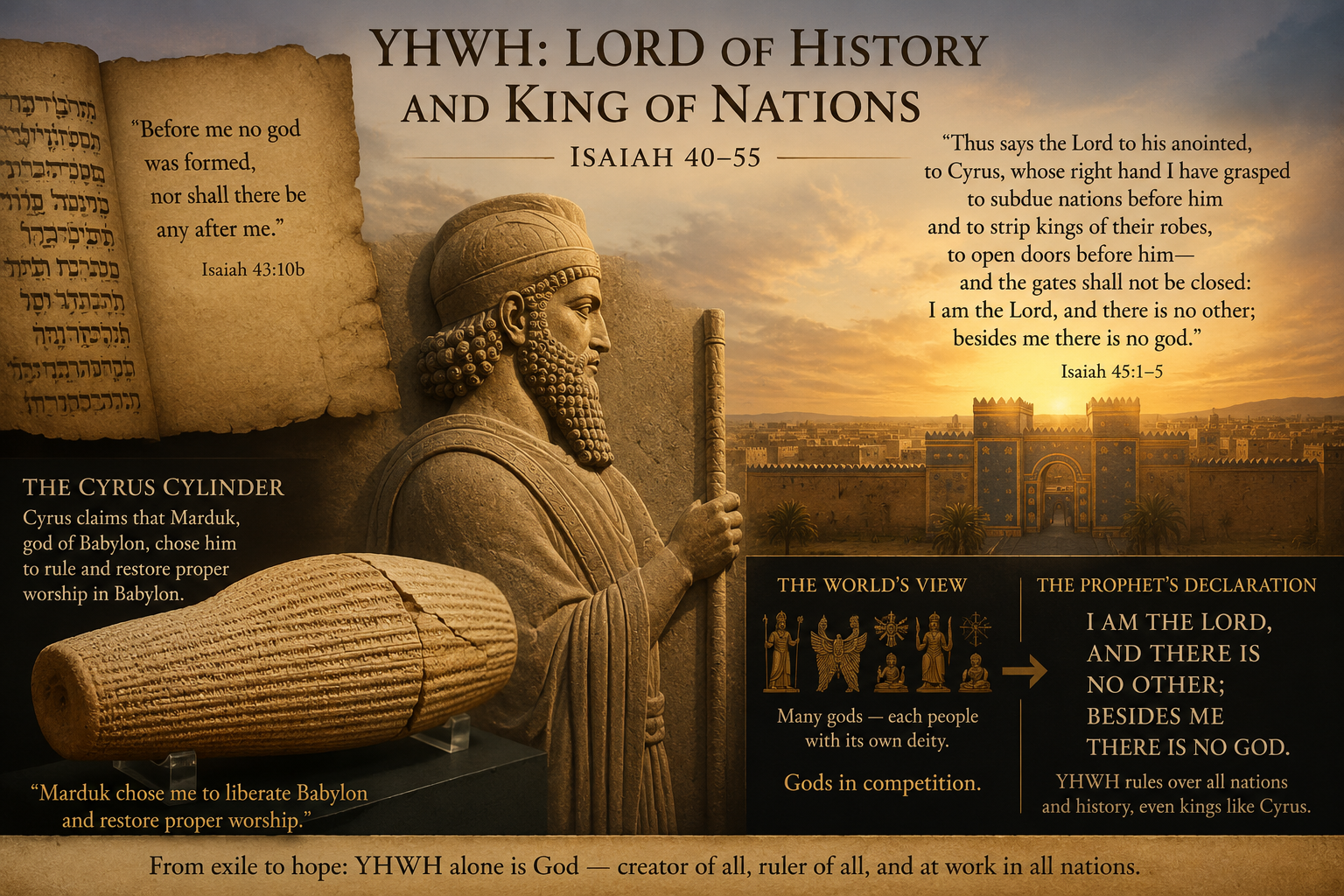

In Isaiah we first see the language of monotheism…
Before me no god was formed,
Isaiah 43:10b
nor shall there be any after me.
And there are more examples in Isaiah 44:6; 45:5-7, 14, 18, 21-22; 46:9; 48:12-13. Before this we mainly see monolatry (the religious belief that multiple deities exist, but only one is chosen to be exclusively worshiped) — Ex. 15:11; 20:3; Deut. 32:8-9; Jdg. 11:24; 1 Sam. 26:19; Ps. 82; 95:3; 96:4-5; 97:7-9.
Look at what is said about Cyrus in Isaiah 44&45…
24 Thus says the Lord, your Redeemer,
who formed you in the womb:
I am the Lord, who made all things,
who alone stretched out the heavens,
who by myself spread out the earth;
25 who frustrates the omens of soothsayers
and makes fools of diviners;
who turns back the wise
and makes their knowledge foolish;
26 who confirms the word of his servant
and fulfills the prediction of his messengers;
who says of Jerusalem, “It shall be inhabited,”
and of the cities of Judah, “They shall be rebuilt,
and I will raise up their ruins”;
27 who says to the deep, “Be dry—
I will dry up your rivers”;
28 who says of Cyrus, “He is my shepherd,
and he shall carry out all my purpose”;
and who says of Jerusalem, “It shall be rebuilt,”
and of the temple, “Your foundation shall be laid.”
Thus says the Lord to his anointed, to Cyrus,
Isaiah 44:24-45:7 (NRSV)
whose right hand I have grasped
to subdue nations before him
and to strip kings of their robes,
to open doors before him—
and the gates shall not be closed:
2 I will go before you
and level the mountains;
I will break in pieces the doors of bronze
and cut through the bars of iron;
3 I will give you the treasures of darkness
and riches hidden in secret places,
so that you may know that it is I, the Lord,
the God of Israel, who call you by your name.
4 For the sake of my servant Jacob
and Israel my chosen,
I call you by your name;
I give you a title, though you do not know me.
5 I am the Lord, and there is no other;
besides me there is no god.
I arm you, though you do not know me,
6 so that they may know, from the rising of the sun
and from the west, that there is no one besides me;
I am the Lord, and there is no other.
7 I form light and create darkness,
I make weal and create woe;
I the Lord do all these things.
We know from the Cyrus Cylinder that Cyrus, after conquering Babylon in 539 BC, claimed the Babylonian god Marduk had become angry with the previous king, searched for a righteous ruler, and selected Cyrus to take Babylon peacefully. In essence, the message was:
Marduk chose me to liberate Babylon and restore proper worship.
Cyrus employed a form of imperial propaganda that emphasized the support of local gods and portrayed himself as restoring proper worship. Normally when one nation conquered another they would credit their success to their own god being stronger than the conquered people’s god. Cyrus, however, would say, “Your own god allowed me to conquer you because you have failed your own god. I’m here to make things right.” It’s a fascinating strategy.
It would seem to be no coincidence then that it was around this time, the exilic time, that the Judahite prophets began to write monotheistically. It was YHWH who was in control of Cyrus, and it was YHWH who allowed Israel to be conquered by their enemies. Monolatry didn’t work anymore. No god could defeat YHWH. Cyrus himself said that he was empowered by the conquered people’s god, and although for Cyrus that was the Babylonian god Marduk, for the Judahite prophet it could only be YHWH.
Thus we encounter the clearest and most explicit expression of monotheism in the Hebrew Bible. No more was YHWH in competition with other gods. Rather, YHWH was in control of all nations, including those he used to discipline his own chosen people.
***
The Cylinder of Cyrus
The Cyrus Cylinder was discovered in 1879 by the Assyrian-British archaeologist Hormuzd Rassam during excavations in the ruins of Babylon. It is now housed in the British Museum.

The cylinder is a clay foundation inscription written in Akkadian cuneiform shortly after Cyrus conquered Babylon in 539 BCE. It was buried in a building foundation, so it was not intended as a public proclamation in the modern sense. Rather, it was royal propaganda and a dedication text.
What does it say?
The text can be summarized in several major sections.
1. Nabonidus is condemned
The cylinder attacks the previous Babylonian king, Nabonidus.
It accuses him of:
- Neglecting the worship of Babylon’s chief god.
- Disrupting traditional religious practices.
- Oppressing the people.
This is a standard ancient Near Eastern royal trope: the previous king is portrayed as wicked and incompetent.
2. Marduk searches for a new ruler
The chief Babylonian god, Marduk, becomes angry with Nabonidus.
The cylinder says Marduk looked throughout the lands for a righteous king and chose Cyrus.
A representative passage reads approximately:
He searched through all the countries, looking for a righteous ruler. He took Cyrus by the hand and called him by name to rule all the world.
This is the section most relevant to Isaiah 44–45.
3. Cyrus enters Babylon peacefully
The cylinder claims that Cyrus entered Babylon without battle and was welcomed by the population.
Modern historians think Babylon probably surrendered with little resistance, though the inscription certainly presents events in the most favorable way.
4. Cyrus restores temples and cults
This is the section that made the cylinder famous.
Cyrus says he:
- Restored sanctuaries.
- Returned divine statues to their home cities.
- Reestablished traditional worship.
A representative summary is:
I returned the gods to their sacred cities and restored their shrines.
This policy fits what we know from other evidence about Persian rule.
5. The gods bless Cyrus
The restored deities are then portrayed as praying for Cyrus and his son.
The message is:
The local gods are grateful for my actions and support my kingship.
What it does not say
Popular accounts sometimes exaggerate the cylinder.
For example, it does not:
- Mention human rights.
- Declare freedom of religion in a modern sense.
- Mention the Jews specifically.
- Mention Jerusalem.
- Mention YHWH.
The claim that it is the world’s first “human rights charter” is a modern interpretation and is generally rejected by historians.
Why biblical scholars care about it
The cylinder provides a fascinating parallel to Isaiah 44–45.
The cylinder says:
Marduk chose Cyrus.
Isaiah says:
YHWH chose Cyrus.
The cylinder says:
Marduk took Cyrus by the hand.
Isaiah 45:1 says:
“Thus says the LORD to his anointed, to Cyrus, whose right hand I have grasped…”
Many scholars think the Judean prophet may be consciously reinterpreting Persian imperial ideology. The Babylonian inscription credits Marduk; Isaiah insists that the true power behind Cyrus’s victories was YHWH.
That doesn’t necessarily mean Isaiah knew the cylinder itself. Rather, both texts reflect the same historical moment: Cyrus’s astonishing rise and the competing explanations for why it happened. For the Babylonians, Marduk had chosen him. For the prophet of Isaiah 40–55, it was YHWH who had called him by name and directed world events.

