“One of the difficulties with trying to create ‘solutions’ is the uncertainty of defining what is a ‘problem.’ When A and B make a transaction between themselves that C does not like, is that a problem to be solved?
“A and Bmay be employer and employee, landlord and tenant or lender and borrower. No doubt each of the primary parties to any of these transactions would prefer terms more favourable to himself or herself, but the transactions would not have taken place unless at least one, and probably both, were willing to accept something less than they might hope for.
“But many among the intelligentsia press for government to ‘do something’ about transactions terms that the parties themselves have agreed to, this call for government intervention often being based on ideas similar to those expressed by John Rawls in A Theory of Justice. However, the question must be raised as to the basis for arming intellectual coteries with the massive powers of government to forcibly undo economic transactions terms made by millions of people intimately familiar with their own individual circumstances and alternatives, in a way that distant intellectuals or government functionaries cannot possibly be familiar.”
A typical “chase your dreams” type book. Nothing groundbreaking. Lots of unnecessary fluff. Lots of psychologizing the Old Testament. The book is based on 2 Samuel 23:20 in which a man named Benaiah kills a lion. The NLT version (the version the author uses) says he chased a lion into a pit, but the Hebrew version says he went down into the pit (meaning the lion was already down there) and killed it. That sounds like semantical nit-picking, but if your book is about chasing lions based on a verse about a guy chasing a lion, it would help if the verse actually said he chased the lion.
A quote from page 8 which sums up the book quite accurately is: “The size of your dream may be the most accurate measure of the size of your God.” That statement is true… if your dream is your god.
If you are searching for meaning in your life, read a book like Man’s Search for Meaning by Viktor Frankl instead.
“A man who becomes conscious of the responsibility he bears toward a human being who affectionately waits for him, or to an unfinished work, will never be able to throw away his life. He knows the ‘why’ for his existence, and will be able to bear almost any ‘how.'”
~Viktor E. Frankl
Also, according to Peterson’s website… “thriller writer Gregg Hurwitz employed several of his ‘valuable things’ as a plot feature in his #1 international bestseller, Orphan X.”
Craig Greenfield, who has lived in the slums of Phnom Penh and the notorious Downtown Eastside in Vancouver, gives us a good example on how to live as the selfless Christian. Many, if not all, of us need to be reminded of this.
I think if Greenfield and I were to sit down and discuss politics and economics, we would disagree on a lot. His great Satan is Empire. Empire, in my opinion, like most things is not evil in and of itself. It becomes evil when corrupted by sin. And, Jesus did not come to save us from the empire, but from sin. But, I agree with Craig, that salvation from sin is not simply going to heaven when you die – salvation is heaven coming to the earth now. And so, we Christians must fight for justice and we must work with the poor now.
Not all of us are called to live as Craig does of course (and he doesn’t say we must either). I too am a Canadian living in Cambodia, and my wife is Cambodian. When we were engaged and looking for a place to live, my wife, who grew up in the slum, suggested buying a house there. There was one for sale for $1200. I considered it and went to look at the place. But, as I stood in the four meter by five meter house, with its tin roof full of holes, concrete floor, and grey brick walls only inches away from the neighbour’s walls allowing for every sound to be heard, I knew there was no way I could live there or raise a family there. We bought land on the outskirts of town and built our own house instead. And, we still worked with the same people we would have if living in the slum anyway. “Find your own Calcutta” as Craig writes in the book.
I met Craig briefly a couple of years ago and have followed his work somewhat, so I know that he truly lives what he teaches and is an authentic authority on working with the poor.
When the Cambodian king Norodom Sihanouk died in 2012, thousands of Cambodians swore they saw him in the moon. They believed his face literally appeared in the moon.
I remember once teaching Buddhist monks in Cambodia some English. I had finished explaining what the word millennium means. I said that we are now living in the third millennium according to the western calendar. I said that in the future we will have a 4th millennium, a 5th millennium, a sixth, etc… One of my students then said, “Oh, we will have come back many times by then.” He was referring to reincarnation of course.
Approximately 95% of Cambodians are Buddhist. Before Buddhism, Hinduism dominated in Cambodia. Cambodians don’t practice Buddhism at the same level. Some practice it very little. Some dedicate their whole lives to it, the monks for example.
However, you won’t find western-style atheism in Cambodia, or any country like it. The conditions necessary for atheism to flourish simply don’t exist in a culture which does not believe in a logical, reasonable, predictable Creator.
Science, as we know it today, was born in the Christian world. Christianity is the mother of science. The purpose of science is to study the physical universe, discover predictable patterns, and then use that knowledge to make life better for humanity. The first scientists were able to adopt this method due to the fact that they believed nature was predictable because it was created by a logical God. Modernism was based on the belief that we could know and understand how the universe works and manipulate the physical world to our advantage. As belief in God dwindled in the western world Post-Modernism rose. Post-Modernists are suspicious of absolutes: absolute truth and absolute patterns.
Atheism was born in the west when people began to believe that God could be understood with the same scientific methods used to understand the physical universe. Of course that does not work. How can you measure the One who created the universe as though He were a product of the universe? Atheists demand that God be scientifically provable.
Christian apologists, therefore, knowing that they can’t prove God scientifically, will turn to non-physical things to prove God: morality, consciousness, love, truth, goodness, and beauty. Morality, for example, is difficult to account for in a survival-of-the-fittest evolutionist world.
Christianity then, being the mother of science, is also the mother of Atheism. The belief in a logical and reasonable God gives us the ability to think likewise. But, when one steps off the foundation of God, and makes logic and reason the new foundation, disbelief in God arises. Unfortunately though, as the disbelief in God increases, the ability to think logically and reasonably decreases.
I’ve noticed that the militant atheism so popular ten years ago is being replaced with a much softer version today. Those outspoken atheists of the past are realizing the insanity which is taking over much of the field they liked to play in before. Gay marriage, for example, was widely accepted by atheists, but the new gender issues of today are not. If you look at popular Atheist Youtube creators you’ll notice their recent videos are much more anti-SJW compared to their older videos which are more anti-Christian/religion. Scroll down on Pat Condell’s videos for example.
This video is another good example…
It should come as no surprise to atheists that, as their own ability to think logically and reasonably is a direct result of Christianity, a rejection of Christianity is also a rejection of logic and reason. The evidence of that is all around in the insane social issues which plague western culture today.
Christian morality/logic/reason has been the immune system to the world’s evils in the past centuries, but as Christianity itself is rejected, that same morality/logic/reason is becoming an autoimmune disease. Hopefully people come to their senses sooner rather than later.


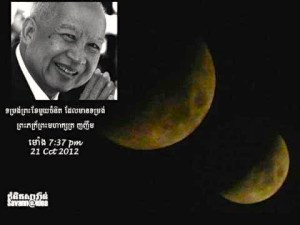 When the Cambodian king Norodom Sihanouk died in 2012, thousands of Cambodians swore they saw him in the moon. They believed his face literally appeared in the moon.
 Pursuit of Percipience