
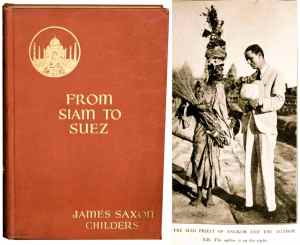
From Siam to Suez is a rare old book written by James Saxon Childers (1899-1965) detailing his journey from China to Egypt in the early 20th century. Childers was an American writer and traveller who wrote several fiction books as well as travel books. His fiction did not do too well, but his travel books were popular.
Here I share a chapter from Siam to Suez. Childers wrote each chapter of this book as a letter to either a family member or to one of his friends. This chapter was written while he was in Thailand (then called Siam). I chose this chapter because Bangkok is a place I visit regularly, and is one of my favourite places to do so. Enjoy…
Chapter VI, From Siam to Suez by James Saxon Childers (Public Domain Book)
I’m going to the fights this afternoon, Dad, because Wongkit is fighting. Wongkit is a boy from the northern hills who is so strong that men even in Bangkok heard about him. They heard that in the games he could throw the teak log farther than any other. Thinking that he might become a champion boxer, they sent for him. Six weeks ago he arrived in Bangkok, bringing his old father.
I first heard about Wongkit from Tom, my guide. “He will make a great boxer,” Tom said, “greater than any we have seen.” Then he cautioned me not to speak of Wongkit. “Only a few persons know of him and we want to keep him secret; we want to bet our money and get good odds. That’s why we brought him.”
Ten days ago Tom came to my room at the hotel. “What would you like to do this afternoon?” he asked.
“What have you?”
“Would you like to go to the market and see the silversmiths at work on bowls and boxes?”
“I’ve seen those silversmiths a dozen times.”
“Would you care to see the Siamese infantry drilling in the park?”
“It’s much too hot for that.”
“What about a visit to the gambling houses? I know where–”
“No, thank you. And I don’t want to see any temples or monasteries. And I don’t want to call and drink tea with ladies of casual virtue. I’m tired of all that. You’ll have to offer something really interesting to get me out in that sun.”
Tom thought for a moment, then gave up. “There’s nothing else,” he said.
“Then take the afternoon off.”
“Thank you, sir. I’ll just go along and see Wongkit. He’s in his training quarters and–”
I picked up my sun helmet. “Why do you guides the world over think there’s nothing but temples, and scenery, and brothels? Why didn’t you say something about Wongkit’s training quarters?”
“But, sir, do you mean–”
“I mean we’re going to see this Wongkit — that is, if he won’t object to my coming.”
“He would be honoured. But do you really mean–”
“I mean I’d rather visit a Siamese boxer in his training quarters that see most of the temples in Bangkok.”
As we drove across town, Tom told me of an elephant hunt on which he captured two enormous bulls. He was working to a glorious climax, and the story was getting more and more imaginative, when our car drew up beside a rickety pier.
“We get out here, sir,” Tom said.
We hired a small gasoline boat and crossed the river that runs through the heart of Bangkok. Then we entered one of the innumerable klongs, or canals…. Bangkok often has been called the Venice of the Orient; the name is partly justifiable, for there are some sections of the city where the streets are all canals and one can travel only by boat…. Tom and I passed dozens of small dories, anchored in the klongs, from which merchants did their trading. We passed a floating cloth shop where a young man haggled with two ladies on a shopping tour; they had paddled up in a crudely built canoe. We passed fish shops, dead fish hanging by their tails from the top of the sun-shade over the fishmonger, live fish in wire boxes let down into water. We passed crockery shops, hat shops, and ships where baskets were sold. We passed a warehouse from which a line of coolies loaded bags of rice on a great blunt-nosed sampan.
“Where’s Wongkit’s place?” I asked.
“A little further on,” Tom said, and pointed.
Behind the shops were many private homes, the backs of frail houses resting on the ground, the fronts resting on piles driven into the mud at the bottom of the canal. From our boat Tom and I saw men and their wives and children, some working, some sleeping, some playing. Many of the smaller children had pieces of bamboo tied to them so that they would float if they fell into the water.
“But don’t the mosquitoes almost eat them up?” I asked, remembering that in Bangkok one does not dine without putting feet and legs into a sack of heavy cloth and tying the top above the knees.
“The mosquitos don’t bother them,” Tom said. “Little babies, yes; but after they get older, the mosquitos don’t trouble them.”
Traffic in the canal is made up largely of boats owned by floating peddlers. Fruit peddlers steer from house to house. Women peddlers drift along in boats filled with Siamese skirts, and bright cloths for children, and cotton camisoles for young ladies. The canal restauranteur glides about in a boat not much larger than a canoe, cold food in the bow, a small stove amidship to heat rice and meat and bits of vegetables. An entire meal is piled upon a leaf and handed to a customer squatting on the bank, or who pulls alongside in another boat.
Through these canals, Tom and I cruised until at last we came to a bamboo ladder that rose from the water. We stepped from our boat and climbed the ladder. Before us was heavy undergrowth rising from a soggy marsh. Great palm trees leaned over and splotched the canal with shadows. Leading away from the ladder were planks, laid end to end.
“Wongkit lives ahead, sir,” Tom said.
We walked over the planks, mud oozing up beside them, until we came to a clearing where stood three frame houses, one of them Wongkit’s.
“He will be in the back,” Tom said.
We found him there, totally naked. I have never seen such a body. He was tall for Siamese, almost six feet, and the upper half of his body was a magnificent triangle; then his hips spread, and his legs rippled down in perfect symmetry. At a glance one could see his tremendous strength, his muscles live as young rattan. Wongkit’s features looked less like an Oriental’s than those of a Greek from the time of Praxiteles.
When Tom introduced me, Wongkit put his hands together and crouched, saluting me as royalty. I took one of his hands and shook it. He didn’t understand the custom and looked puzzled until Tom explained; then slowly he shook my hand four times, nodding and smiling as he did.
In the corner of the room stood an old man with white hair and wrinkled face. Tom introduced me, and the old man bowed and spoke. “He says,” Tom interpreted, “that he is Wongkit’s father.” In the softest and most musical voice I have ever heard, the father bade me welcome. “My house,” he said, “is the master’s house.” Then he added: “It is gracious of the American to visit my son, Wongkit.”
We sat down and watched the boy at his training. He shadow-boxed, flexed his legs, slashed backward with his elbows, rammed forward with his head; everything he did was poetry of motion. He worked for an hour and we watched. Afterward we drank tea. Then Tom and I went back to our boat. Wongkit, still naked, came with his father to see us off.
“What do you think of him?” Tom asked, as we passed through the canals.
“I don’t know, Tom. I don’t know enough about Siamese boxing, but to me he doesn’t seem vicious enough.”
Tom laughed. “That’s because he’s not fighting against any one. Wait until he gets in the ring. He will–” Tom flung out one foot and almost lost his balance– “he will win us a lot of money.”
Two days later I went to see Wongkit again. The old father and I helped Tom rig up a sack of sand for Wongkit to punch and kick, then we withdrew to a corner and sat there. Neither of us could understand anything the other said, but that made no difference. We could smile and bow to each other, and with little courtesies show our friendship.
Four times I have been to see Wongkit in his training; I can’t decide whether I go to see Wongkit and his rippling muscles, or the old man with his soft voice and kindly eyes. I am certain, though, that the father and I have become fine friends. Truly we have. I take him small gifts, and always he gives me little presents. On Friday he saved me some dwarf bananas. Day before yesterday he served me a double handful of rice, dipping it up in his hands and dropping it all hot on a banana leaf. He showed me how to catch it with my fingers, roll it into a tiny ball, and throw it in my mouth. At first I couldn’t do it properly and he laughed. When after a time I didn’t spill any, he was pleased. Then we cleansed our hands and went in to watch Wongkit at his boxing. We took our place in a corner; there was holy prayer in the father’s eyes as he watched his son, as in stillness and silence the old man fondled his pride and his glory.
Yesterday Wongkit and his father asked me about boxing in America. Wongkit wanted to know about the strange world where boxers never lack rice, and have beds to sleep on. “My father,” Wongkit said, “approves of my going to America. He will come with me. He will live as I live. He will have rice whenever he wants.”
This afternoon Wongkit is fighting for the first time. Tom already has gone, vastly excited: he and his friends have bet all their money. I haven’t bet any money, but I, too, am excited, for I have come to be fond of Wongkit, so gentle and tender with his father, and I have learned truly to love the old man. The fight is to begin in forty minutes. I must hurry to get to the ringside; I told them I’d sit in the front row. I’ll finish this letter later…
I promised I would finish this letter and because of my promise I shall. Wongkit went into the ring at ten minutes after four. He wore red tights. They were a little too short for him. After he had prayed, he turned and looked at his father. The old man nodded and held up his hands, gave his blessing to his boy. It was two minutes later that the other fighter, an experienced fighter, kicked Wongkit in the spleen, ruptured it, and killed him. Wongkit fell to the canvas, trembled, and lay still.
Some day, Dad, I may forget Wongkit, for he was a young man, strong, peering over the horizon, his dream bright within him; and he went out in a flash, before he knew. I may forget him, but I’ll never, never forget the look of the old father as he stared at that limp thing they carried away in their arms.