The Great Good Thing (Brief Book Review)

ggt
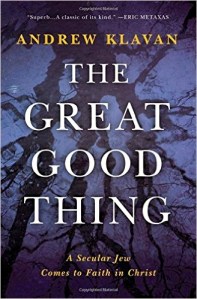
I discovered Andrew Klavan, not through his books, but through his conservative political podcast on the Daily Wire. I’ve since read two of his books: Don’t Say a Word and The Great Good Thing. 

The Great Good Thing is Klavan’s memoir — his life story focusing on his growth from secular Jew to agnostic/atheist to Christian. I say his “growth” as it is easy to see in this memoir that Klavan becomes a healthier and happier person in his life-long transition from empty religion to saving grace.

This book is for intellectuals and fans of literature. If you’re hoping for a bunch of touching mushy stories, you will be disappointed. Klavan is an author and political commentator — he lives in the realm of ideas. Therefore, Klavan’s discovery of God was through that realm. His journey began by reading and studying all the works which made western civilization what it is: the greatest culture the world has ever known. Underlying this culture all throughout is Christianity.

Andrew Klaven also discovered God through joy. At one point in the book he mentions how, with most people, their relationship with Christ leads them to joy, but with him it was the opposite — his joy led him to Christ. After many years of depression and hopelessness, Klavan was “cured” of his emptiness through the help of a psychiatrist and the growing realization that love really was the most important part of life. And, love is not just some vague idea in an uncaring universe — love comes from a real and living God.

Before becoming a Christian, Klavan began to pray regularly in his life, and through his prayers God told him to get baptized. He did, and ever since has been a devoted Christian.

Being a realist and a skeptic, Klavan makes it clear throughout the book that his conversion was never based on feelings or sentimentality — it was his reason which led him to Christ. This is why I say this book is for intellectuals: people who like things to make sense; people who like to reason their way through problems, and get annoyed when they’re expected to do otherwise.

I gave it 5/5 stars.

Further reading:

An Orthodox Jew Reviews Andrew Klavan’s ‘The Great Good Thing: A Secular Jew Comes to Faith in Christ’ 

Book of the Month/January 2017 by Douglas Wilson

Lords of Time

If we want lasting succes in our endeavors, we need to learn to work with those who will be alive 100 years from now, and, if possible, work with those who have been gone 100 years. 

We’ve done a good job conquering space (planes, trains, automobiles, Skype), but now we have to learn to conquer time.

Differences in Culture

Here is an info graphic on the differences of culture and how that reflects on missions.

(I would add some green to Cambodia though)

Culture’s Color, God’s Light
We spend a lot of time trying to understand the differences between cultures. But what is the end-game? The more we learn about other cultures, the better we can shine God’s love. Also, as we see God through our own cultural lens and engage with people from other cultures, we begin to see the world the way God sees it! Explore three cultural frameworks and take a moment to add to this important research by taking the test yourself: http://theculturetest.com.

Freedom Starts from the Bottom Up

My family takes priority over my community, my community over my city, my city over my  province/state, my province/state over my nation, my nation over the world.

If I reverse that order I become a Socialist, or a Communist, or a Fascist.

If I maintain that order I am free to unselfishly, and unforcedly, serve my community, city, province/state, and nation as I see fit.

Human History According to Franz Rosenzweig

“What happens in history, [Rosenzweig] says, is not a struggle between man’s faith and man’s reason but a struggle between God and man. In world history the absolute powers themselves are dramatis personae [the characters of the play]. Revelation breaks into the world and transforms creation, which is the Alpha of history, into redemption, which is the Omega. Philosophy has a pagan quality. It is an expression of the Alpha, of creation, of pure nature to which God has given freedom — even against himself. But as revelation comes into the world, it gradually absorbs philosophy, deprives it of its pagan elements, and illuminates it with its own light. The Omega of history will be realized after the element of creation, the world’s freedom, has spent itself. Then God, who has allowed the world to be in the Alpha, will again be the First and the Last, the Alpha and the Omega.”

~Alexander Altmann, from Franz Rosenzweig and Eugen Rosenstock-Huessy: An Introduction to Their “Letters on Judaism & Christianity”, from Judaism Despite Christianity, University of Chicago Press, 1935, page 33.