I’m uploading some notes on the book of Daniel, the Olivet Discourse, and the book of Revelation here. This is for my students to have easy access to the notes online.
If anyone else stumbles on this post, you are welcome to the notes if you are interested in the subject.
The notes on Revelation are based mainly on James B. Jordan’s Revelation Lectures(which, at the time of this posting [August 22, 2016] are on sale for $40 – down from $175 – on WordMp3.com).
Recently I’ve been teaching myself to weld. I live in Cambodia. The guys who weld here professionally are anything but rich, so the equipment they buy is the most basic and cheapest. Not cheap in quality, but cheap relative to other welding equipment. So that means no MIG or TIG welding, just stick. That also means none of those other welding types are available to buy here. I could jump over into Thailand to get it, but it’s easier for me to just learn how to stick weld.
Another thing is, most of the welding here is structural, and the most common metal building material is square tubing. The thickness of the tubing is very thin, often less than an eighth of an inch. So, the only stick electrode one can buy here (in my town anyway) is the E6013, which is designed for thin metal. How the local welders here manage to work with that thin metal without burning it full of holes is a skill I have yet to master. I usually do my own work on some thicker gauge angle iron or flat bar stuff.
My intention is not to become a professional welder. Rather, I just want to be able to fix things around the home, and do some small projects here and there. I recommend the same for anyone with some free workshop space and a desire to build stuff. I’m already a master electrician, so I have experience with electricity, but I know welding can be somewhat intimidating. But, if you work smart and safe, welding isn’t anything to be afraid of.
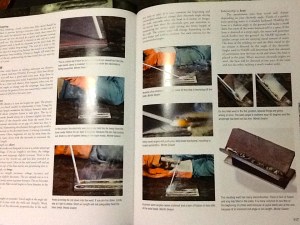
First off, I recommend reading How to Weld by Todd Bridigum. This book covers everything from safety to required tools to the different types of equipment and how to use it. The book will also help you decide what type of machine to buy. It also has quality coloured photos to show you all you need to know to get started.
Next, I recommend subscribing to some good welding Youtube channels. One of my favourites is Welding Tips & Tricks. In these videos you get to see close up what the welding process looks like before having to try it yourself. They often film with a shaded guard over the camera lens so that you can see what the welder sees as the rod is burning. It’s very helpful. And you get good advice from experienced welders. There are several welding channels on Youtube to choose from.
Here’s a typical video to be found on Welding Tips & Tricks…
And here’s another one from the Youtube channel ChuckE2009…
So, if you’ve been wanting to teach yourself to weld, then go for it. The worst that could happen is you kill yourself. But you probably won’t, so stop worrying!
Recently I listened to a conference speech online. Well, I listened to half of it. It was too boring to finish. The topic was trustworthiness. One of the points made over and over was that if you say you’re going to do something then you should actually do it. Wow! What an epiphany!
I thought, “Is this speech being give to a bunch of twelve year olds?” But no, it was being given to adults. And I thought more, “Do the people in the audience feel as though their intelligence is being insulted? They should.” The whole speech was delivered as though it was either being given to stupid adults or to inexperienced kids.
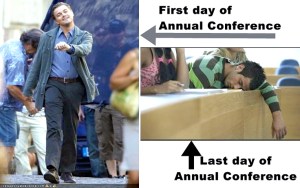
I’m usually not a fan of conferences. I don’t want to be mistaken as an ungrateful complainer though. I appreciate the amount of work that goes into organizing a conference, and I would never suggest that the organizers’ hard efforts are a waste of time (well, maybe I would). I also know that a lot of people really love conferences and truly benefit from them, and, not everyone thinks like me. In fact, I am in the minority it would seem. I understand the perceived importance of conferences. I understand people want to get together once and awhile, people who ordinarily don’t see each other, and remind themselves why they’re doing what they’re doing and why they need to help each other. I’ve met some great people at conferences; people who I continued to work with for years afterward. I understand the leadership wants conferences to set the direction for the organization, and motivate the people, and cast vision and all that stuff.
However, I’m still not a fan. There are few things more boring and pointless than sitting in a chair for three hours listening to a speech you’ve heard a hundred times already. I don’t need to listen to a lecture given by someone who has no experience in what I’m doing. I certainly don’t want to spend three or more days at a conference, away from my work and home, lying every time someone asks me about how great the conference is, pseudo-enthusiastically yelling “Hallelujah!” every time a speaker does so, and then walk away from the whole thing feeling emptier than when I showed up.
When I think of conferences I’m often reminded of a scene from the film Waterworld. The earth is covered with water, but there’s a little girl with a tattoo on her back with instructions to find dry land. Problem is, no one can read the instructions. The bad guys, called “Smokers”, capture the girl. The Smokers live on a big oil tanker and how they get it around is by rowing — hundreds of men sticking long oars out the sides and rowing, just like with the old wooden ships. The leader of the Smokers gives an inspiring speech, holding up the girl in front of everyone, proclaiming that they will find the land and create a great future, etc… After the speech the rowers are so hyped that they get to work immediately and exuberantly. Meanwhile, the leader, still not knowing how to read the instructions, in private with his closest advisors is asked, “So which way we rowin’?” and he replies, “I don’t have a g–d–n clue. Don’t worry, they’ll row for a month before they figure out I’m fakin’ it.”
I’m not suggesting that leaders in conferences are “fakin’ it”. But, I’ve lost count of how many times I’ve come out of a conference hearing attendees proclaiming all the great things they’re going to do after being so encouraged by the conference speakers, and then never doing anything. I remember driving home from a three day Christian men’s conference, my intelligence freshly insulted, and my passenger, a railroad worker, declared, “I’m going to plant a church when I get home!” And I just smiled and thought, “No, you’re not.” Because anyone making a major decision like that, in an emotionally charged atmosphere such as a conference, is never thinking straight. And he never did plant that church.
The more honest attendees will be more level-headed, or even discouraged. I’ve known several people, who were already doing some kind of ministry, come out of a Christian conference feeling small and unimportant. I’ve heard laments like, “My ministry is hard work, and I wish I would have been able to meet people at the conference who were going through the same struggles I am, so that I could have talked with them and gotten to know them. But there was no time for that. Instead we just listened to grand speeches which included things like the leader yelling, ‘This is just the beginning!!’ over and over. What’s the point in that?”
My last article, Andragogy (Adult Learning), points out how adults, when attending a class or a conference, are not interested in generalities. They want specific teaching which directly relates to what they’re doing in life. They also don’t want to just sit and listen to a lecturer without having their own life experience and knowledge taken into account. What adult wants to sit and listen to a lecture that would better be delivered to a group of twelve year olds? Adults need to engage and speak and share. I know from personal experience that I would much rather sit in a small group setting, where everyone can participate, than sit in a large conference setting where you just, well, sit.
Obviously, teaching children (pedagogy) is very different from teaching adults. Below are some notes on how to teach adults…
Adults are self-directed in their learning. Rather than passively listening to a lecture, adults like to be engaged in the class forcing them to take responsibility for their own learning. Adults like to discuss what’s being learned and provide their own input.
Adults have a lot of previous knowledge. They need to know how this new material will tie into what they already know.
For adults, the content must be relevant. Too much useless information will just make the adult student bored and the material will be forgotten. Adults need a reason to learn this new material. “How is this class going to help me get ahead?” is what the adult student asks. The course material must be relevant to the student’s life and work.
Adults are goal oriented and want to know early on in the course how we’re going to get “from here to there.” Even if the content relates to their life and work, pointless “bunny trails” will only distract and frustrate the adult student.
Adults are problem oriented and are attending the class to find answers to specific problems. If the teacher doesn’t have those answers, the adult student loses interest in, and respect for, the class.
The class needs to be fun, but not in a childish way. Activities also should be used to engage the student, but not insult their intelligence.
The teacher should strive to use visual (charts/diagrams/models), auditory (lecture), and kinaesthetic (hands-on activities) stimuli when teaching adults.
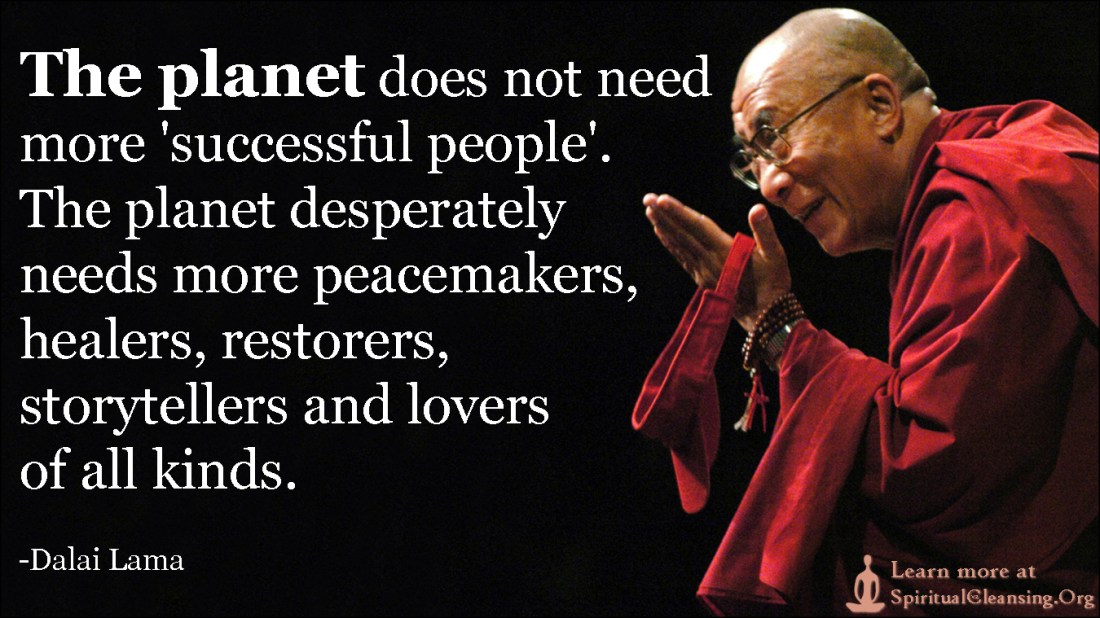
The picture above, and others like it, pop up on my social media every once and a while, and, although there is truth to it, it often leaves me scratching my head.
The people posting it are always well-to-do westerners who engage in the typical middle class life of working Monday to Friday, weekends of entertainment, and evenings of Games of Thrones watching. Also, these folks aren’t religious. They’re not atheist either. Rather, they are multiculturalists — which means all truth, cultures, and religions are equally valid. (A backdoor way of saying that nothing is valid.)
The Dalai Lama’s quote is very kind and inoffensive. Who would be against it? Only a hateful bigot. But… What does it mean? I always want to ask the person posting the quote a series of questions, which I know I’ll never get the answers to as it would cause too much uncomfortable thinking for them. So, I’ll just ask the questions here on my blog which no one reads just so that I can feel better and get on with my day.
To the person who posted the image….
Jesus said some nice things about peace and love too. So, if you would have posted the quote, “Greater love has no one than this: that he lay his life down for his friends,” and put a picture of Jesus beside it, I would assume that you were a Christian. So, can I assume that you are a Tibetan Buddhist?
Because, if you’re not a Tibetan Buddhist, we have a problem. The terms: ‘successful people,’ peacemakers, healers, restorers, storytellers, and lovers will only make sense in the context (for this particular quote) of who the Dalai Lama is. Love, for example, does not exist in a vacuum — there is always a subject and an object. If Jesus is the subject, then you can be sure that gay marriage is not the object. However, if the Dalai Lama is the subject, then gay marriage may very well be the object. So, are you a Tibetan Buddhist, a Christian, an Atheist? If you’re an atheist, the subject/object of love will change with each individual. But I already know that you’re a multiculturalist, so I can safely assume that the object of your love is anything that makes you feel warm and fuzzy — so we’ll just proceed from there.
Next question: Why is the term ‘successful people’ in quotation marks? Did the Dalai Lama speak this quote, or did he write it? If he spoke it, did he make the quotation sign with his fingers as he said ‘successful people’, or did the person who made the picture add the quotation marks as his or her own commentary? Assuming the Dalai Lama put in the quotation marks (which I doubt), how does he want us to define ‘successful people’? Rich people? But there are rich people who do a lot of good things for society, and there are a lot of evil rich people too, who drain society. Politicians? Are there no good politicians? Those quotation marks shroud the term in unnecessary mystery. What does it mean? But, you being the multiculturalist that you are, I think it’s safe to assume that, to you, ‘successful people’ refers to anyone richer and more powerful than you are.
Peacemaker — peace between who and who and who? Muslims and Jews? Muslims and Christians? North Koreans and South Koreans? Which group is going to abandon everything it believes in in order to conform to the other? As a multiculturalist, the answer to that question is: “Everyone will abandon what they believe and conform to multiculturalism.” Because, as a multiculturalist, that’s what your definition of peace is: if everyone would just admit that their beliefs are meaningless, and become multiculturalists, then we could all get along! Because, you believe that multiculturalism is the one and only truth, and since all truths are equally valid … wait … hold on … we’ve got a problem here. Jesus is called the Prince of Peace, because He reconciles humanity with God. But, we still must all conform to God — you know, the one who created us and owns us. That’s the only definition of peace that matters. (And it’s a good thing by the way.)
As for healing, I think the Dalai Lama is referring to more than just physical healing, he also means spiritual healing. So which religion will provide that spiritual healing? Is Nirvana the answer? Being born again with the Holy Spirit? Rational Atheism? Blowing yourself up and waking in paradise to find five hundred virgins at your disposal? Five hundred beautiful virgins! There’s a lot of men who’d like that one. Do we get to choose? We must if they’re all equally valid right?
Restorers. Restoring what? Storytellers. What stories?
I think that’s enough.
As for multiculturalism, I’ll just leave it to the great Mark Steyn to explain what it really means…



 ple at conferences; people who I continued to work with for years afterward. I understand the leadership wants conferences to set the direction for the organization, and motivate the people, and cast vision and all that stuff.
 Pursuit of Percipience