Broken Vessels (A Brief Book Review)

image

This is a collection of 22 essays written by Andre Dubus between 1977-1990.

The essays are personal to the author and are short stories of different times in his life. The first is lighthearted and funny, relating what life was like living in a rented house and taking care of the landlord’s stubborn and stupid sheep.

And Christ had called us his flock, his sheep; there were pictures of him holding a lamb in his arms. His face was tender and loving, and I grew up with a sense of those feelings, of being a source of them: we were sweet and lovable sheep. But after a few weeks in that New Hampshire house, I saw that Christ’s analogy meant something entirely different. We were stupid helpless brutes, and without constant watching we would foolishly destroy ourselves.
~”Out Like a Lamb”, page 4

From there the essays get more intimate as Dubus writes about his bullied childhood, his beloved kids, his precarious writing career, and the life-altering accident that took one of his legs. The title for the book comes from the last and most moving essay which, in part, he describes the trials of learning to live without the full use of his legs.

One morning in August of 1987, shuffling with my right leg and the walker, with Mrs. T (the physical therapist) in front of me and her kind younger assistants, Kathy and Betty, beside me, I began to cry. Moving across the long therapy room with beds, machines, parallel bars, and exercise bicycles, I said through my weeping: I’m not a man among men anymore and I’m not a man among women either. Kathy and Betty gently told me I was fine. Mrs. T said nothing, backing ahead of me, watching my leg, my face, my body. We kept working. I cried and talked all the way into the small room with two beds that are actually leather-cushioned tables with a sheet and a pillow on each, and the women helped me onto the table, and Mrs. T went to the end of it, to my foot, and began working on my ankle and toes and calf with her gentle strong hands. Then she looked up at me. Her voice has much peace whose resonance is her own pain she moved through and beyond. It’s in Jeremiah, she said. The potter is making a pot and it cracks. So he smashes it, and makes a new vessel. You can’t make a new vessel out of an old one. It’s time to find the real you.
~”Broken Vessels”, page171-172

It’s a great book and well worth buying and well worth reading. I give it 5 out of 5 stars.
Find it on Amazon

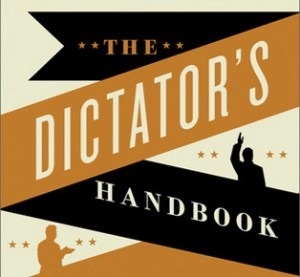
The Dictator’s Handbook (Book Review)

image

This is a somewhat amusing book looking at the differences (or better yet, similarities) between dictatorships and democracies.

Basically, according to the authors, potential political leaders need to worry most about one thing: you can not be a monolithic leader; you will have to keep a certain group of people happy in order to stay in power. How large that essential group, or coalition is, depends on what kind of government you want to form– democracy (large coalition) or dictatorship (small coalition).

In the first chapter, five basic rules are given for leaders to succeed in any system: “1) Keep your winning coalition as small as possible; 2) Keep your nominal selectorate (non-essential supporters) as large as possible; 3) Control the flow of revenue; 4) Pay your key supporters just enough to keep them loyal; 5) Don’t take money out of your supporter’s pockets to make the people’s lives better.” (If you’ve ever wondered why some governments, like the Cambodian government, don’t crack down on corruption, #5 would be your answer.)

In a dictatorship the coalition is small. It is imperative for the dictator to maintain strict control over the bank accounts so that he, and he alone, will be able to pay off the necessary people who can keep him in power, or take him out (like a military commander for example).

In a democracy the essential group of backers will be much larger, so the option of simply paying them off is much too expensive. Here the leader buys loyalty through programs and policies.

The book uses several real world examples to back the points made. For example, Samuel Doe of Liberia, who, although being an unskilled soldier, managed to assassinate the president and take control of the country.

“Doe had no idea what a president was supposed to do and even less idea of how to govern a country. What he did know was how to seize power and keep it: remove the previous ruler; find the money; form a small coalition; and pay them just enough to keep them loyal. In short order, he proceeded to replace virtually everyone who had been in the government or the army with members of his own small Krahn tribe, which made up only about 4 percent of the population. He increased the pay of army privates from $85 to $250 per month. He purged everyone he did not trust. Following secret trials, he had no fewer than fifty of his original collaborators executed.”
~page 22, chapter 2, “Coming to Power”

Sounds a lot like how the Khmer Rouge came to power in Cambodia in the ’70s.

Samuel Doe did not fair well though. He too was taken out of power, tortured (to reveal where all the money was), then cut up, cooked, and eaten. Mmm mm.

Overall I thought it was a decent book. However, I did find it to be over-simplified and too repetitive. I think, with it being nearly three hundred pages long, it could easily be a hundred pages shorter and thus a lot less monotonous.

I give it 3 out of 5 stars.

Find it on Amazon

Update October 2016…

Here’s a good video which lays out the book in under 20 minutes…

A Glimpse At Fatherhood

image
We need to remember that when God gives us a gift, that gift is given in the context of us being created in His image.

For example, marriage is not something God thought up as something that would be great for us, but has no connection to who He Himself is. The idea of creating a bride for His son was an idea which existed long before any man or woman walked the earth. The idea of two different kinds of persons, being equal, with one submitting to the other, is something that has existed in the Trinity for eternity.

Fatherhood is another of these gifts. We have fathers, we are fathers, because God is a Father first.

I am currently reading “Father Hunger” by Doug Wilson. In it he suggests reading biographies of great godly fathers. Why? Because so many of us today have such poor images of what a good father looks like, and how you perceive earthly fathers is how you’re likely to perceive God as father. Of course the Gospel will correct any wrong ideas of what God as Father looks like, but it helps to see some good examples here on the ground as well.

I found this book online: “The Story of John G Paton Or Thirty Years Among South Sea Cannibals“. It’s an autobiography about Paton’s missionary work. In the book Paton refers lovingly to his father, and it is very eye opening and heart warming. 

The book is free for Kindle, so there’s little reason not to read it yourself. Here is an excerpt where Paton talks about his father…

My dear father walked with me the first six miles of the way. His counsels and tears and heavenly conversation on that parting journey are fresh in my heart as if it had been but yesterday; and tears are on my cheeks as freely now as then, whenever memory steals me away to the scene.

For the last half mile or so we walked on together in almost unbroken silence—my father, as was often his custom, carrying hat in hand, while his long flowing yellow hair (then yellow, but in later years white as snow) streamed like a girl’s down his shoulders. His lips kept moving in silent prayers for me; and his tears fell fast when our eyes met each other in looks for which all speech was vain!

We halted on reaching the appointed parting place; he grasped my hand firmly for a minute in silence, and then solemnly and affectionately said: “God bless you, my son! Your father’s God prosper you, and keep you from all evil!”

Unable to say more, his lips kept moving in silent prayer; in tears we embraced, and parted.

I ran off as fast as I could; and, when about to turn a corner in the road where he would lose sight of me, I looked back and saw him still standing with head uncovered where I had left him—gazing after me. Waving my hat in adieu, I rounded the corner and out of sight in instant.

But my heart was too full and sore to carry me further, so I darted into the side of the road and wept for time.

Then, rising up cautiously, I climbed the dike to see if he yet stood where I had left him; and just at that moment I caught a glimpse of him climbing the dike and looking out for me! He did not see me, and after he gazed eagerly in my direction for a while he got down, set his face toward home, and began to return—his head still uncovered, and his heart, I felt sure, still rising in prayers for me.

I watched through blinding tears, till his form faded from my gaze; and then, hastening on my way, vowed deeply and oft, by the help of God, to live and act so as never to grieve or dishonor such a father and mother as he had given me. The appearance of my father, when we parted,–his advice, prayers, and tears–the road, the dike, the climbing up on it and then walking away, head uncovered–have often, often, all through life, risen vividly before my mind, and do so now while I am writing, as if it had been but an hour ago. In my earlier years particularly, when exposed to many temptations, his parting form rose before me as that of a guardian angel.

(Chapter 5)