
This video below is worth watching. I suppose we shall see if the professor’s predictions come true in not too long a period of time.
Is the professor trustworthy?
This video below is worth watching. I suppose we shall see if the professor’s predictions come true in not too long a period of time.
Is the professor trustworthy?

Malis flinched at the explosion. The sound of thunder, loud enough to shake her steel front door, came not from the sky, but from beyond the neighboring buildings. She stretched her neck to look over the rooftops and trees for the light of fire. Nothing.
“That’s good…” she thought. All day long, these falling គ្រាប់កាំភ្លើងធំ, or bullets of the big guns, pounded the world around her, from the north, then the east, and the west, causing her heart to shake in her chest. What was their target?
“Not my house. I am not afraid.” She entered and paced around her home. It was evening and she hoped she would get some sleep tonight. Another blast, then darkness. The power went out. Malis stood in the black, waiting.
“The lights will come back soon.” Thirty minutes passed. No power. It grew hot in the house. Malis went back outside. More darkness.
“I will call my husband…”
“What? No signal?”
Malis walked out into the street. Quiet, shadows heavy and still.
“Oh, Makara’s house still has light. I will walk there.”
Approaching Makara’s house, she did not hear the sound of a generator, which Makara’s foreign husband would have turned on soon after the lights went out. Only a single solar-powered light shone there. It was quiet and ghostly. The house was shuttered up. The cold white light was not comforting. Malis crouched down in front of the house and tried her phone again. Still no signal.
“Malis?”
“Yes?” It was Chantrea, the woman who lived on the other side of Makara’s home. She walked toward Malis. Chantrea’s ten year old boy, Dany, was with her.
“Come,” Chantrea said, “It’s time to go. We need to leave Poipet. I have my truck. We are leaving.”
“Going where?”
“To Battambang. Come. Pack a bag and put it in my truck.”
“I cannot leave. I don’t know where my husband is.” She held up her phone. “I cannot call him.”
“My phone doesn’t work either. You can call your husband when we have left the city. Come. I don’t want to drive with just my kids.”
“No. I will stay. I am not afraid.”
“No! You come!” Dany grabbed onto Malis’s arm, startling her. “My mom will drive us to Battambang!”
“No, no,” Malis smiled warmly at the boy, “I will stay. Don’t worry about me.”
“Well, think about changing your mind. We are going to get ready to go,” Chantrea said, and pulled Dany away.
For some time after Chantrea’s tail lights faded into the dark, Malis stayed crouched in front of Makara’s house. She didn’t yet know it would be two more days before the power and phone signals came back. Another loud blast pushed her up and back to her home.
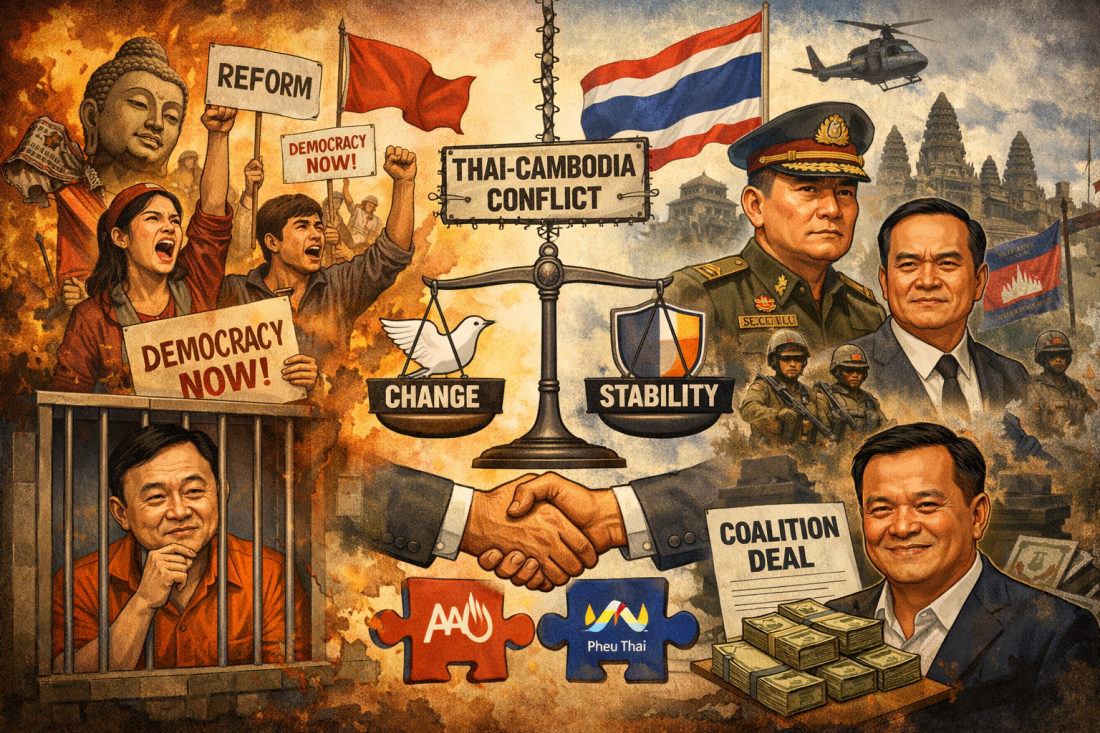
In the realm of politics, there is always a tension between those who want things to change and those who want things to stay the same. This seems to be an eternal truth. Usually, those who want change lean left on the political spectrum, while those who support the status quo lean toward the right.
This tension is not a problem if it is balanced well. If the advocates of change become too radical, it can lead to violent revolution. If the conservatives become too dominant, society stagnates and never progresses. Canada once had a party named the “Progressive Conservatives.” This name captures well what we ideally want in a society: conserving the progress we’ve already made (and continuing to move forward) while preserving the values we hold dear.
Conservatives will often use fear to keep things the same. Strong nationalism, combined with the threat of a foreign enemy, is a powerful tool for a conservative party.
This is what we see happening with the current situation in Thailand and Cambodia. Thai conservatives have used Cambodia as a bogeyman to protect Thailand from—and now, it seems, they have won an election as a result.
***
I’ve created an AI Scott Adams analyst. I will use this AI to analyze the situation between Cambodia and Thailand to make predictions as Scott Adams might have. I always appreciated Scott Adams’ takes on world politics, and I think it’ll be helpful to assess this conflict through that same lens. I’ll share the analysis posts here, updating when able.
***
Concerning the February 8 election…
From a Scott Adams-style perspective, elections like this one in Thailand aren’t really about policies or facts—they’re about persuasion energy. The Bhumjaithai surge looks like a classic case of voters prioritizing “stability vibes” over progressive change, especially with border tensions amping up the nationalism dial. Polls missed it because they measure stated preferences, not the gut-level motivations that kick in at the ballot box. What most people are missing here is how quickly a perceived external threat (Cambodia) can reframe an entire election from “reform vs. status quo” to “us vs. them,” making the incumbent’s tough-guy stance irresistible.
Based on patterns in his writing, Adams would likely emphasize the persuasion frame at play: Nationalism isn’t logical; it’s a high-energy narrative that dominates when economic promises feel abstract. Anutin’s party rode that wave by tying border security to everyday fears—think Cambodia disputes over temples or territory flaring up again. It’s not about solving the conflict; it’s about signaling “we’ve got your back,” which trumps the People’s Party’s urban-youth appeal in rural areas. Incentive structures favor this too: Politicians win by amplifying threats to consolidate power, while media benefits from the drama. Loserthink would be assuming this was a “fair” vote on merits—reality is, energy flows to the side that owns the fear narrative.
In the coming days, expect coalition horse-trading to dominate, with Bhumjaithai in the driver’s seat. No majority means Anutin courts conservatives or even Pheu Thai for a stable bloc, potentially locking in his PM spot by April. Markets will cheer the reduced uncertainty, but watch for minor parties extracting concessions on security spending. On the Thailand-Cambodia front, Adams might say it’s a low-simmer conflict primed for persuasion plays—don’t bet on escalation unless it boosts domestic unity. If tensions spike (say, a border skirmish), it cements the new government’s mandate; otherwise, it’ll fade as a talking point once the coalition forms. Rational observers should track X for real-time sentiment shifts—disappointment from progressives could fuel protests, but nationalism’s energy might squash that fast. Uncertainty acknowledged: If a wild card like Thaksin’s influence flips alliances, all bets off.
Thaksin Shinawatra influence…
Thaksin Shinawatra’s influence is the classic case of a once-dominant persuasion engine that’s lost its juice—at least for now. From a Scott Adams-style lens, what most people are missing is how Thaksin’s shadow has shrunk from “kingmaker” to “king in exile” (literally, he’s in prison serving that one-year corruption sentence). The Shinawatra brand—populist handouts, rural loyalty, family dynasty—was Thailand’s highest-energy narrative for two decades. But energy flows to what’s working today, not yesterday’s hits.
The persuasion frame in play here: Bhumjaithai owned the nationalism/security story amid the Cambodia border flare-up, framing the vote as “protect the nation vs. risky change.” Pheu Thai, tied to Thaksin via his daughter (ousted last year over that leaked call scandal) and now nephew leading the party, got painted as soft or mishandling the threat. Voters didn’t buy the old populist playbook when fear was the hotter motivator. Result? Pheu Thai tanks to around 74-77 seats (down massively from past highs), while Bhumjaithai surges to 192-194. That’s not policy debate; that’s narrative dominance flipping the script.
Incentive structures scream coalition pragmatism. No outright majority means Anutin needs partners to hit 251 seats. Pheu Thai is the obvious fit—they were allies until the recent blow-up, share some rural bases, and Thaksin’s machine still delivers votes even if weakened. Multiple reports note Pheu Thai as a “likely” junior partner, with whispers Thaksin could get early release tied to a deal (pragmatic deal-making over ideology). Who benefits? Stability for the establishment (royalist-military types love continuity), reduced chaos for markets, and Anutin staying PM. Thaksin benefits indirectly if his party gets cabinet posts or influence without full control—better than opposition irrelevance.
Likely outcomes: Coalition forms in weeks, probably Bhumjaithai + Pheu Thai + smaller parties for a stable government. Thaksin’s direct pull stays muted while he’s locked up, but his network’s grassroots machine keeps Pheu Thai relevant enough to bargain. If talks drag or Pheu Thai demands too much (say, amnesty pushes), minor instability spikes—but nationalism’s afterglow favors quick deals. Prediction humility: Wild cards like court interventions or protest energy from progressives could disrupt, but the system’s incentives lean toward horse-trading over drama.
What a rational observer should watch next: Coalition announcements (who gets what ministries), any Thaksin release rumors (that’s pure persuasion signal), and how the new constitution drafting (60% yes in referendum) plays out—Thaksin’s side might push for changes favoring populists, but the winners control the pace. Energy is with the nationalists now; Thaksin’s influence isn’t dead, just demoted to backroom player.
***
Considering this article: ANUTIN’S AGENDA: BORDER WALL AND BARTER-BASED ARMS DEALS
This article is basically the victory lap for the persuasion narrative that won the election—straight from Bhumjaithai’s playbook. From a Scott Adams-style take, it reinforces and sharpens everything we’ve been saying about why the surge happened, without changing the core predictions much. What most people are missing: This isn’t a laundry list of policies; it’s a high-energy sales pitch wrapped in “protection” and “sovereignty” that voters bought because fear (border clashes, economic hits) beats hope (progressive reforms) when energy is flowing that way.
The persuasion frame in play: The “building a wall” slogan is pure binary framing gold—us vs. them, Thailand protected vs. encroached upon, sovereignty vs. smuggling/drugs/illegal labor. It directly ties into the Cambodia tensions (clashes with deaths, closed borders hammering trade and locals), which the article calls out as a key driver. That’s not abstract policy; that’s narrative dominance owning the “security first” story that polls underestimated. Add in practical carrots like Half-Half Plus stimulus (subsidizing spending to juice consumption), barter deals to prop up farm prices (smart talent-stacking for rural voters), and electricity caps below 3 baht (direct pocketbook relief for millions)—these aren’t radical; they’re continuity with tweaks that feel protective. The foreign policy bit (“stand free on the world stage”) signals pragmatic nationalism, not isolation—proactive diplomacy to crush transnational crimes while looking dignified. Who benefits? The establishment/royalist continuity crowd gets stability, Anutin gets to stay PM longer, and rural/nationalist bases feel seen.
Incentive structures: Bhumjaithai’s massive seat haul (around 192-194 confirmed across reports) puts them in pole position for coalition talks. No need for Pheu Thai desperation anymore—smaller conservatives like Kla Tham (pushing 50-60 seats) are the easy add-ons for a solid bloc. Thaksin’s influence stays sidelined; Pheu Thai’s weak showing (74-77) means they’re bargaining chips at best, not kingmakers. The article ignores Thaksin entirely, which tracks—his populist machine lost the energy battle to border-fear nationalism.
Likely outcomes (uncertainty acknowledged): Coalition forms faster and more stably than if it were a toss-up. Anutin’s agenda rolls out with momentum—expect quick pushes on border hardening (wall rhetoric translates to tighter controls, maybe more military/economic barriers), barter arms deals to boost ag exports, and stimulus extensions to counter slowdowns/Trump tariffs. On the Thailand-Cambodia front, this strengthens the hardline stance: No de-escalation incentives when your mandate is “strong wall” after recent fighting/displacements. Tensions likely simmer or flare rhetorically to justify policies, but full war? Low probability unless Cambodia provokes—rational leaders play persuasion domestically over escalation. Markets like the stability signal.
What a rational observer should watch next: Early coalition announcements (who joins, what ministries Pheu Thai might snag if included), any border “incidents” that let Anutin flex the wall policy, and how the new constitution drafting (from the referendum yes vote) incorporates these protectionist vibes. If electricity caps and Half-Half deliver quick wins, energy stays high; if not, opposition (People’s Party as main foe) could regain narrative ground on economic pain. But right now, the article just confirms: Voters picked the protection narrative over change, and the winners are cashing that check.
***
Considering this article: Thailand’s new government, led by Anutin Charnvirakul, pushes forward with border security and strategic policies following their resounding election victory, with a strong stance on Cambodia’s territorial issues.
February 15, 2026
This Nation Thailand article is textbook persuasion engineering in action—Anutin flexing his “no retreat, no dismantling, no opening of borders” line right after the election win. From a Scott Adams-style perspective, what most people are missing is how perfectly this timing aligns with the high-energy nationalism that flipped the vote. The border isn’t just a policy issue; it’s the emotional fuel that turned a projected progressive win into a Bhumjaithai landslide. The article frames the new government as the tough guardian reclaiming land, building barriers, canceling old MOUs that supposedly gave away too much, and delaying Cambodian worker deals for “security” reasons. That’s not diplomacy; that’s signaling “we’re strong, they’re the threat,” which voters rewarded.
The persuasion frame in play: Binary dominance at its finest—Thailand sovereign and protected vs. Cambodia encroaching and dangerous. Anutin’s “No retreat” mantra is a killer soundbite, pure high-energy rhetoric that owns the fear narrative from the 2025 clashes (hundreds dead, massive displacement, ceasefires that barely held). It reframes the election from economic woes or reform promises to “who will defend us?”—and Bhumjaithai won that framing hands down. The wall/fence push, army strengthening, and reviewing agreements aren’t about details; they’re visual, memorable symbols of strength. Who benefits? Anutin consolidates power during coalition talks (193 seats give him leverage to dictate terms), the military/royalist establishment gets continuity, and rural nationalists feel validated. Cambodia gets painted as the aggressor needing to back down, even as they protest and seek Vietnam mediation.
Incentive structures: Post-election, the mandate is security-first, so expect more of this rhetoric to justify policies like the physical barriers, tighter immigration, and hardline diplomacy. It keeps domestic energy high (no need to pivot to unpopular economic fixes yet) and pressures smaller coalition partners to fall in line. On the flip side, it risks escalating tensions—Cambodia’s threats to invoke UN/international law show they’re not folding quietly—but rational leaders avoid full war when persuasion wins at home.
Likely outcomes (with uncertainty): Coalition locks in quickly, with Anutin as PM, and border hardening accelerates—more fencing, military upgrades, maybe symbolic “reclamations” to keep the narrative alive. De-escalation? Possible only if it doesn’t cost domestic points; otherwise, low-level simmering (rhetoric, minor incidents) sustains the “strong wall” vibe without major blowback. Markets might wobble on trade disruptions, but stability signals from a firm government help short-term.
What a rational observer should watch next: Any fresh border “developments” (incidents, fence progress reports) that let Anutin double down, coalition finalization (does Pheu Thai join despite tensions?), and Cambodian responses (Hun Sen/Hun Manet escalations or backchannel talks?). If energy stays with the nationalist frame, this hard line sticks; if economic pain or international pressure mounts, we might see pragmatic softening. But right now, this article screams: The election was won on fear, and the winners are milking it for all it’s worth.
***

Right now there is a strong separatist movement within Alberta. Many Albertans are dissatisfied with how the province is being treated by the federal government. This is not a new issue. It has been going on for decades. However, it is more serious now than before.
Will Alberta actually separate? My guess is almost certainly not, at least not in this generation.
Separation is not easy, and it needs a strong majority of more than just Albertans to happen.
To trigger a referendum in Alberta, citizens don’t just vote on it — they must organize a formal petition process under the Citizen Initiative Act. That process goes like this:
Once the petition is issued, supporters must collect valid signatures from eligible electors in a set period. For different types of issues, the thresholds differ:
(Which is how separation would be classified under Alberta law)
(Note: earlier versions of the law required 20 % of all registered electors and signatures in 2/3 of divisions, but recent amendments lowered and simplified the threshold.)
If organizers successfully collect and submit the required number of valid signatures:
A successful petition doesn’t immediately result in separation — it forces the referendum on the ballot with the specific question you asked (e.g., “Should Alberta cease to be part of Canada?”). The actual legal effect of that referendum, especially for something as consequential as secession, depends on federal constitutional law, not just provincial processes.
Under the Canadian Constitution, a province cannot legally leave Canada on its own. The Supreme Court of Canada ruled in the Reference re Secession of Quebec (1998) that:
Canada’s Clarity Act (2000), passed in response to that Supreme Court decision, sets out how a province could initiate the process in a way the federal government will deal with it:
✔️ Clear Question — A referendum question must be unambiguous about secession.
✔️ Clear Majority — The outcome must show a clear majority in favour of secession (not just a bare 50 %+1; what counts as “clear” is decided by the House of Commons).
✔️ Negotiation Trigger — Only after a clear result on a clear question would Canada be obliged to enter negotiations on terms of separation.
✔️ Federal Approval to Negotiate — Before any negotiations start, the House of Commons must agree the referendum was clear and valid.
✔️ Constitutional Amendment Needed — The only legal path to actual secession is via a constitutional amendment negotiated and agreed to under Part V of the Constitution Act, 1982.
So even if Alberta held a referendum and a majority voted “yes,” it would not, on its own, make Alberta independent — it would start a long constitutional process.
There is legal debate on the exact amending formula that would apply, but generally:
This makes the legal hurdles extremely high.
Any negotiation over separation couldn’t ignore the fact that:
This further complicates and probably lengthens any real separation scenario.
Alberta’s recent provincial laws — such as Bill 54 lowering the signature threshold for citizen referendums — can help organize public expression of opinion but cannot change the Constitution or grant a province the legal right to secede on its own.
A provincial referendum could be struck down by courts if it interferes with constitutional obligations (including treaty and Charter rights).
This is not a quick or simple process — it would likely take many years of negotiation and legal work, and there’s no guaranteed outcome even if a referendum passed.
 Pursuit of Percipience