Victorious Eschatology (Book Review)

image

This book is what I’d call a “nuts and bolts” approach to eschatology. Other books I’ve read on the subject take a more broad look at Biblical prophesy and try to give the overall sense of what the big story of the Bible is without making any definitive statements. This book takes the reader through a verse by verse exposition of the prophesies and the authors are not afraid to come to some profound conclusions.

I enjoyed this book a lot, and while I am still kicking the tires of the different eschatological view points, this book seriously pushed me in some new directions. It is interesting that a lot of Christians will just assume that what they’ve always heard is true. Premillennial Dispensationalism is true, right? Well, read this book and you might change your thoughts on the subject. Or, perhaps, it’ll newly get you thinking on eschatology when you’ve never considered the topic a worthwhile use of your time.

The viewpoint is a partial preterist one. Preterism is the opposite of futurism, and so, in this book, the authors argue that much of the Biblical prophesies currently believed by many to not have happened yet, have indeed already happened — prophesies that were future for the original readers, but now fulfilled and in the past for us. No future anti-Christ figure taking over the world, no microchips implanted in foreheads, no secret rapture of the Church, no revived Roman empire, 666 refers to Nero, the Olivet Discourse mainly refers to the destruction of the temple and Jerusalem in 70 AD — these are the kinds of points you’ll find in this book, and the authors present a strong case.

But, as the title suggest, the main point of this book is to present a hopeful vision of the future. Jesus has already established His kingdom, His kingdom is growing and will one day fill the earth, and our future is getting brighter and brighter, not darker and darker. And before you cry heresy, understand that many prominent church fathers held to the same view as the authors of this book, and the authors quote some of these past theologians throughout.

Read the book if you want to be challenged and perhaps learn some new exciting things about God’s great plan for humanity, heaven, and earth.

Click here to buy from Amazon: “Victorious Eschatology” by Harold R. Eberle and Martin Trench

Click here for a related article I wrote about a similar book.

Be Fruitful and Multiply

image

I don’t know what to believe about the global warming or climate change issue anymore because both sides of the contention say they’re 100% right and they cantankerously demonize each other.

But if we look to the issue from a Christian perspective, rather than a political one, we can see more clearly.

And God blessed them. And God said to them, “Be fruitful and multiply and fill the earth and subdue it and have dominion over the fish of the sea and over the birds of the heavens and over every living thing that moves on the earth.”
~Genesis 1:28

This verse is the first commission — our first duty as human beings in relation to this planet. God created the world, put our first parents into a garden surrounded by wilderness, and told them to expand the garden; take dominion.

What does it look like to take dominion?

Well obviously, since it was God who gave the order, we are to care for and nurture the earth. God cares for and nurtures His own, and so He clearly expects us to do the same. Notice how when you love and nurture plants, they grow and flourish. And when you love and care for a dog, that dog will be a loving gentle animal. It is our responsibility to enable lower life forms to reach their fullest potential. We do this through love and care. Unfortunately sin has totally screwed things up, but the original commission still stands. In fact, the newer ‘Great Commission’ given by Jesus, in Mark 16:14-18, empowers us to once again fulfill the first commission.

And I use the term ‘lower life forms’ designedly. I am not equal to a tree. I am greater than a tree. I was created in God’s image. The Giant Sequoia was not. And so while we care and nurture for the earth we are also commanded to be fruitful and multiply. That means having kids, building houses and roads, shaping the landscape, and developing new technologies. So, trees are going to be cut down, and animals are going to be relocated. This is okay when we do it in a caring, nurturing fashion.

When we obey God, act according to His character, and trust in His sovereignty, we don’t need to worry about the end of the world. Jesus came to save the world, not destroy it.

For I consider that the sufferings of this present time are not worthy to be compared with the glory which shall be revealed in us. For the earnest expectation of the creation eagerly waits for the revealing of the sons of God. For the creation was subjected to futility, not willingly, but because of Him who subjected it in hope; because the creation itself also will be delivered from the bondage of corruption into the glorious liberty of the children of God. For we know that the whole creation groans and labors with birth pangs together until now. Not only that, but we also who have the firstfruits of the Spirit, even we ourselves groan within ourselves, eagerly waiting for the adoption, the redemption of our body. For we were saved in this hope, but hope that is seen is not hope; for why does one still hope for what he sees? But if we hope for what we do not see, we eagerly wait for it with perseverance.
~Romans 8:18-25 (NKJV)

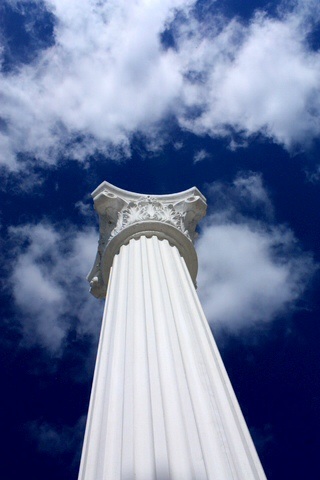
A Pedestal Too High

image

God speaks in a great language. His words are brimming and nothing in our experience can counter balance the heftiness of what He trumpets forth. Therefore, our crippling slant is to disbelieve what God has spoken about us, both in our being and doing. Our idea of Heaven and eternal life is as bland as contemporary church building architecture. We doubt hell, firstly because we are illicitly repulsed by it, secondly because we deem ourselves unworthy of it. So when God speaks, we are reluctant to apply His words to ourselves, and instead look to someone else preeminent and greater. We are content to consign God’s words to whomever is on a pedestal too high for our reach.

These days we are being conferred a shallow ‘playground righteousness’. The priests and priestesses of pop culture preach it well: “Now come on children. Let’s all be nice and get along. Everyone needs to feel good about themselves”. Now that’s fine for the playground if all there is is a playground, but for the graduated grown ups we have to go deeper than the sand; we must go down to the bedrock. A standard this deep looks to who God is, what He has set into place, and what He has done to cultivate it all. Here we have to listen carefully to God’s words, and bear the weight of those words, in our place and in our time.

I’ve heard it said that God doesn’t have a sense of humor. But of course He does. We have humor and we were created in His image. The Bible deals with a weighty matter and so we don’t see God cracking jokes in it. God takes us too seriously for that. In fact, it’s terrifying to think about how seriously God takes us. The bible describes God’s glory. The Hebrew word for glory (kabod) means weight or heaviness. That same glory passes on from God to us. We have an eternal worth that places us on a pedestal much higher than we think possible. And with that worth comes two options: turn to the Giver in faith and worship or spit on the Giver, the gift, and ourselves in disobedience.

When God created the universe (not multiverse) He set each and everything into its place. The sun goes here, the earth orbits the sun at this distance, the ocean stops at this line, each animal will reproduce its own kind, a man marries a woman. Order was brought from chaos. The book of Genesis describes the pre-created state as a dark empty wasteland. God then spoke His massive words, the sound of many waters, and everything that is came into being. Everything being done to the amplitude of never being undone. Everything with the worth that comes with eternity.

God doesn’t foresee anything, He ordains everything. And when the world fell into sin, God enacted the plan that shows us just how much worth the created world truly has. Jesus entered history and established a sovereignty that is beyond anything we could imagine. He became a man. He had to be a man in order to win the world back for men. He was born of a virgin. He had to be born of a virgin so as to not inherit the sinful nature. He lived a perfect life and satisfied God’s law. He died a bloody violent death and satisfied God’s wrath. He rose from the dead so that we who believe will do so also. He ascended into Heaven, the capital city, and established His kingdom. And He never gave up His manhood. A man, like us, sits and rules from a throne, a pedestal too high, but not too high.

**photo credit: http://www.stockfreeimages.com/10808584/Pedestal.html#_

Heaven Misplaced (Book Review)

image

‘Heaven Misplaced’ is an eschatological book written from a post-millennium point of view. If you’re unfamiliar with the term ‘post-millennium’, for now, you just need to know that the ‘millennium’ refers to the 1000 year rule and reign of Christ referred to in Revelation 20. The ‘post’ refers to when Christ will return. So, ‘post-millennium’: Jesus will rule and reign from heaven for the 1000 years (which may or not be a literal 1000 years) and He will return after, or post, the millennium. Another position is called pre-millenniumism, and another amillennialism.

The main points of the book:

1) Jesus is the savior of the whole world. This does not mean every last individual will be saved, but it also does not mean that only a handful of elect Christians will be saved. Jesus came to save the world and He will do just that.

2) Man lost dominion of the world in the garden to the “powers and principalities”. Jesus conquered the powers and principalities on the cross. Jesus has been given all authority. Man once again has dominion of the world through Christ. The Great Commission can now be accomplished.

3) The Great Commission will be fulfilled not when the Gospel reaches each nation, not when individual disciples are made in each nation; it will be fulfilled when each nation on earth is discipled — every nation a Christian nation — not every individual a Christian, but every nation being predominately Christian — a worldwide Christendom. This completion of the Great Commission will usher in the millennium. Jesus will not return until this has been accomplished.

You don’t have to agree with the post-millennialist view to benefit from reading this book. In fact, I highly recommend you do read it especially if you disagree with this view. Often views of the end times are so much doom and gloom. This book is very positive and hopeful. It’ll get you excited about being a Christian.

I gave it 5 out of 5 stars.

Find it on Amazon