

Here is a link to an excellent series on Eschatology, the book of Revelation, and Covenant Theology by David Chilton.
I highly recommend you take the time to listen to all the messages if you’re interested in the “Last Days”.
Here is a link to an excellent series on Eschatology, the book of Revelation, and Covenant Theology by David Chilton.
I highly recommend you take the time to listen to all the messages if you’re interested in the “Last Days”.
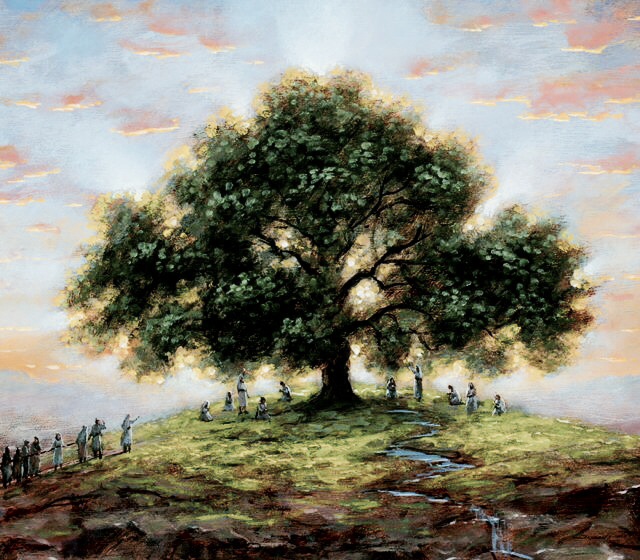
God put two special trees in the garden. The “Tree of Life” and the “Tree of the knowledge of Good and Evil.” Adam was allowed to eat of any tree as much as he wanted, but he could not eat of the tree of knowledge of good and evil.
Why then did God put that tree in the garden? Some would say, “Well, God wanted to give Adam free will and the ability to choose to be evil. And, God wanted to know if Adam really loved Him, and He couldn’t have known that unless Adam had a choice to not love Him.”
That’s a good Sunday school answer, but it makes God sound like somebody’s insecure girlfriend. “Adam, sometimes I just don’t know if you love me anymore!” Also, if that reason is the only reason, then the tree could have simply been called the “Tree of the knowledge of Evil” since Adam already knew good–in fact, that’s all he knew.
But the tree was called the knowledge of good and evil. Perhaps a better way to say it would be “the tree of being able to discern the difference between good and evil.” Being able to discern the difference between good and evil is called wisdom. If we could only choose a select few in our societies to have this wisdom, who would we choose? Our leaders of course.
In Canada, our leaders have declared that gay marriage and abortion are good things. They have lost their ability to discern the difference between good and evil. What is clearly a hateful thing in God’s eyes has been declared a “right to happiness” in our government’s eyes.
In the bible you will see that the great kings and leaders were also great judges. Solomon was known among the nations for his wisdom, a wisdom that allowed him to discern good from evil. The whole book of Proverbs is a laying out of what is good and what is evil. At the beginning of the book of Judges, we see that everyone was doing what was right in their own eyes. That’s why God sent in the judges–to discern good from evil. When ever a king lost this wisdom, the whole nation suffered.
Nebuchadnezzar was a great king. In his vision of the statue he was the head of gold–the greatest of all the empires to follow. He had another vision where he was a great tree. All the peoples took shade under his branches. What was that tree in his vision? It was the tree of the knowledge of good and evil. The wisdom to discern good from evil is given to kings.
It is the glory of God to conceal a thing: but the honour of kings is to search out a matter.
~Proverbs 25:2
You’ll notice that with the Old Covenant (the law and the Mosaic priesthood) it was all about bread. The bread of life. But when Jesus came to establish the New Covenant He added something more: wine. And while the bread stayed, the emphasis was placed on the wine.
And He took bread, gave thanks and broke it, and gave it to them, saying, “This is My body which is given for you; do this in remembrance of Me.”
Likewise He also took the cup after supper, saying, “This cup is the new covenant in My blood, which is shed for you.”
~Luke 22:19-20
He said the cup was the New Covenant, not the bread. Wine is a symbol of maturity. It takes time to prepare good wine. And while you can give a child plenty of bread, you won’t give him wine. The bread of life and the wine of maturity. The Old Covenant (the bread) prepared the way, and Jesus (the wine) brought the covenant to maturity. Jesus is King.
Back to the garden. The tree of life was the bread. The tree of knowledge of good and evil was the wine. Adam was called to be king. But he was not ready to be king right at the beginning. He needed to mature first. If Adam had obeyed God, the time would have come where God would have said, “Adam, you are ready to be king. You may now eat of the tree of knowledge.” But instead, Adam took a short cut, and in doing so forfeited his ability to eat of both trees.
Jesus Christ was called to be king also. When He was tempted in the desert by Satan, He was being tempted to take a short cut. Satan offered Him all the nations. Did Satan have the ability to give Jesus the nations? Absolutely. Satan had authority over all the nations except Israel. But Jesus did not give in. Instead, He bound the strong man and took the authority from Satan through His death and resurrection.
Jesus is the second Adam. Where Adam fell short, Jesus conquered. And now, we who believe, can rule as kings with Him, being brought into maturity by His blood.
 Right at the beginning of creation, humanity received from God what could easily be called our first “Great Commission”.
God blessed them; and God said to them, “Be fruitful and multiply, and fill the earth, and subdue it; and rule over the fish of the sea and over the birds of the sky and over every living thing that moves on the earth.”
~Genesis 1:28 NASB
“Take over the world for the glory of God” is basically what we’re commanded to do.
Skip ahead to Babel and read what the people’s two reasons were for building the tower:
They said, “Come, let us build for ourselves a city, and a tower whose top will reach into heaven, and let us make for ourselves a name, otherwise we will be scattered abroad over the face of the whole earth.”
~Genesis 11:4 NASB
They wanted to make for themselves a name (above God’s name and for their own glory), and they did not want to be scattered abroad; which is exactly what they were commanded to do: “…fill the earth, and subdue it”.
So, God scattered them. God scattered them by using different languages to cause division.
Right after the Babel story we are introduced to Abram, later to be named Abraham, the father of many. Starting with Abraham, God enters into a covenant with the Hebrew people, and for many hundreds of years, deals only with these people.
Did the Church exist in the Old Testament, or was that some different dispensation? Absolutely the Church existed in the Old Testament. Israel was the Old Testament Church; they were also of the same ethnicity. All those who were saved in the Old Testament were saved by the person and work of Jesus Christ. The animal sacrifices and the temple were types and shadows.
The old system under the law of Moses was only a shadow, a dim preview of the good things to come, not the good things themselves. The sacrifices under that system were repeated again and again, year after year, but they were never able to provide perfect cleansing for those who came to worship.
~Hebrews 10:1 NLT
Now we can jump ahead to Pentecost.
At the beginning of the book of Acts, Jesus gives the Great Commission.
“…but you will receive power when the Holy Spirit has come upon you; and you shall be My witnesses both in Jerusalem, and in all Judea and Samaria, and even to the remotest part of the earth.”
~Acts 1:8 NASB
And this is what happened when they were filled with the Holy Spirit:
When the day of Pentecost had come, they were all together in one place. And suddenly there came from heaven a noise like a violent rushing wind, and it filled the whole house where they were sitting. And there appeared to them tongues as of fire distributing themselves, and they rested on each one of them. And they were all filled with the Holy Spirit and began to speak with other tongues, as the Spirit was giving them utterance.
Now there were Jews living in Jerusalem, devout men from every nation under heaven. And when this sound occurred, the crowd came together, and were bewildered because each one of them was hearing them speak in his own language.
~Acts 2:1-6 NASB
The miracle of Pentecost was not that they spoke with other tongues. The miracle of Pentecost was that all the people present, from “every nation under heaven”, heard “the mighty deeds of God” (Acts 2:11) spoken to them in their own languages.
At Pentecost God used different languages to bring the people together.
At Pentecost God did the reverse of what He did at Babel.
Where as before God was only dealing with the Jewish people, now God was opening His arms to the gentiles as well.
The miracle of Pentecost was not that God was creating the Church in some new dispensation. The miracle of Pentecost was that God was taking the gentile nations and grafting them into the Church, which already existed as Israel, the true Israel.
Now reread the Great Commission as stated in Matthew:
And Jesus came up and spoke to them, saying, “All authority has been given to Me in heaven and on earth. Go therefore and make disciples of all the nations, baptizing them in the name of the Father and the Son and the Holy Spirit, teaching them to observe all that I commanded you; and lo, I am with you always, even to the end of the age.”
~Matthew 28:18-20 NASB
“Take over the world for the glory of God.”

The term “antichrist” is used four times in the bible; three times in 1 John, and once in 2 John.
“Children, it is the last hour; and just as you heard that antichrist is coming, even now many antichrists have appeared; from this we know that it is the last hour. They went out from us, but they were not really of us; for if they had been of us, they would have remained with us; but they went out, so that it would be shown that they all are not of us. But you have an anointing from the Holy One, and you all know it. I have not written to you because you do not know the truth, but because you do know it, and because no lie is of the truth. Who is the liar but the one who denies that Jesus is the Christ? This is the antichrist, the one who denies the Father and the Son.”
~1 John 2:18-22 NASB“By this you know the Spirit of God: every spirit that confesses that Jesus Christ has come in the flesh is from God; and every spirit that does not confess Jesus, is not from God; this is the spirit of the antichrist, of which you have heard that it is coming, and now it is already in the world. You are from God, little children, and have overcome them; because greater is He who is in you than he who is in the world. They are from the world; therefore they speak as from the world, and the world listens to them. We are from God; he who knows God listens to us; he who is not from God does not listen to us. By this we know the spirit of truth and the spirit of error.”
~1 John 4:2-6 NASB“And this is love, that we walk according to His commandments. This is the commandment, just as you have heard from the beginning, that you should walk in it.
For many deceivers have gone out into the world, those who do not acknowledge Jesus Christ as coming in the flesh. This is the deceiver and the antichrist. Watch yourselves, that you do not lose what we have accomplished, but that you may receive a full reward. Anyone who goes too far and does not abide in the teaching of Christ, does not have God; the one who abides in the teaching, he has both the Father and the Son. If anyone comes to you and teaches and does not bring this teaching, do not receive him into your house, and do not give him a greeting; for the one who gives him a greeting participates in his evil deeds.”
~2 John 1:6-11 NASB
John wrote these two letters nearly 2000 years ago. We can see from these verses that he was concerned that his readers were being deceived into believing a false teaching; a false teaching which said that Jesus did not come as a flesh and blood man from God. John speaks of people who were apparently members of the church, but began to teach falsely, and then they left the church.
John warns his readers to hold to his teaching and that if anyone came to teach anything different, they were to be ignored and not welcomed into the church. There were many false teachings going around at that time, and the apostles had to diligently fight against all these teachings. Some false teachers believed that Jesus could not be God, and a flesh and blood man at the same time, so they denied that Jesus was ever truly a man, but only had the appearance of a man. Christianity does not work if Jesus never came as a man (see Romans 5).
From these verses we can see that “antichrist” is called a spirit, which can be thought of as a system of thought influenced by demonic forces. Notice also from these verses that the term “antichrist” is not used to describe one particular individual, but rather, anyone “who denies that Jesus is the Christ”, “who denies the Father and the Son”, “who does not confess Jesus”, and “who does not acknowledge Jesus Christ as coming in the flesh”.
These days the antichrist has become a Frankenstein of biblical verses who resembles the emperor in Star Wars more than any character found in the bible.
How does the term “antichrist” apply to us today? The same way it applied to John’s readers 2000 years ago.
I should like a great lake of beer to give to God.
I should like the angels of Heaven to be tippling there for all eternity.
I should like the men of Heaven to live with me, to dance and sing.
If they wanted I’d put at their disposal vats of suffering
.
White cups of love I’d give them with a heart and a half.
Sweet pitchers of mercy I’d offer to every man.
I’d make heaven a cheerful spot,
Because the happy heart is true.
I’d make men happy for their own sakes.
I should like Jesus to be there too.
I’d like the people of heaven to gather from all the parishes around.
I’d give a special welcome to the women,
The three Marys of great renown.
I’d sit with the men, the women of God,
There by the great lake of beer
We’d be drinking good health forever,
And every drop would be a prayer.
~Saint Brigid of Ireland(?) b. 453 AD

