


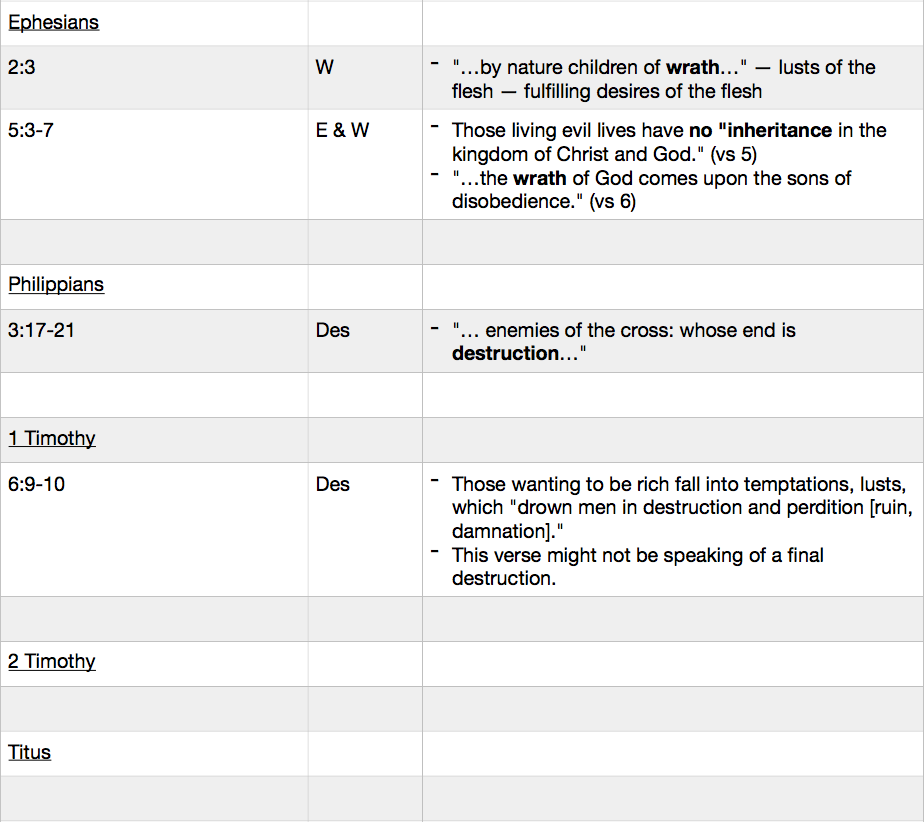
Notice the lack of H’s.
~~~
Notice the lack of H’s.
~~~
Valley of Hinnom
Old Testament
And he hath defiled Topheth [A place in the SE end of the valley of the son of Hinnom south of Jerusalem – BDB Hebrew definition], that [is] in the valley of the son of Hinnom, so that no man doth cause his son and his daughter to pass over through fire to Molech.
~2 Kings 23:10 (YLT)
A son of twenty years [is] Ahaz in his reigning, and sixteen years he hath reigned in Jerusalem, and he hath not done that which is right in the eyes of Jehovah, as David his father, and walketh in the ways of the kings of Israel, and also, molten images hath made for Baalim, and himself hath made perfume in the valley of the son of Hinnom, and burneth his sons with fire according to the abominations of the nations that Jehovah dispossessed from the presence of the sons of Israel, and sacrificeth and maketh perfume in high places, and on the heights, and under every green tree.
~2 Chronicles 28:1-3 (YLT)
And he hath caused his sons to pass over through fire in the valley of the son of Hinnom, and observed clouds and used enchantments and witchcraft, and dealt with a familiar spirit, and a wizard; he hath multiplied to do the evil thing in the eyes of Jehovah, to provoke him to anger.
~2 Chronicles 33:6 (YLT)
For, arranged from former time is Tophet, Even it for the king is prepared, He hath made deep, He hath made large, Its pile [is] fire and much wood, The breath of Jehovah, As a stream of brim stone, is burning in it!
~Isaiah 30:33 (YLT)
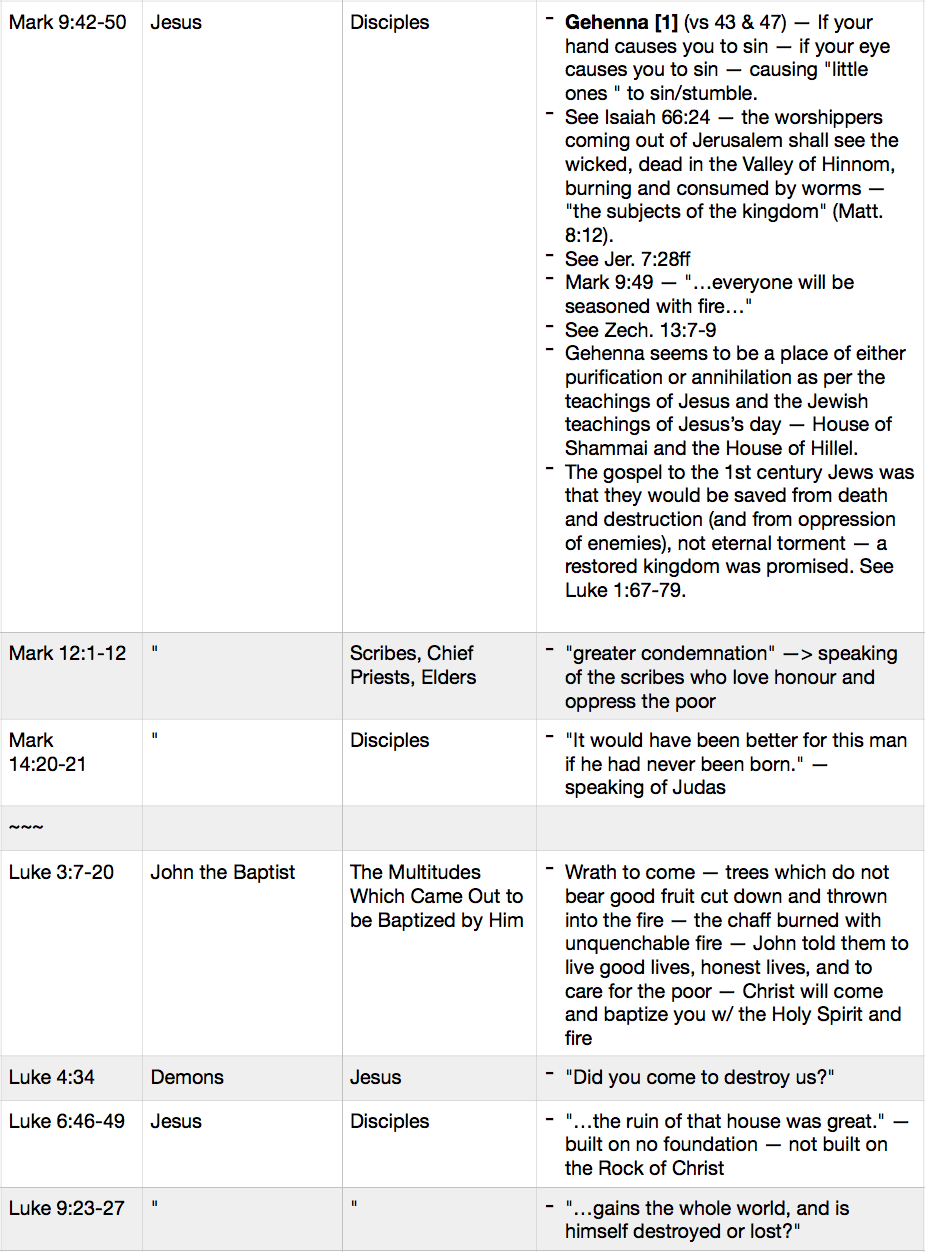
And they have gone forth, And looked on the carcases of the men Who are transgressing against me, For their worm dieth not, And their fire is not quenched, And they have been an abhorrence to all flesh!
~Isaiah 66:24 (YLT)
And have built the high places of Tophet, That [are] in the valley of the son of Hinnom, To burn their sons and their daughters with fire, Which I did not command, Nor did it come up on My heart.
~Jeremiah 7:31 (YLT)
Thus said Jehovah, ‘Go, and thou hast got a potter’s earthen vessel, and of the elders of the people, and of the elders of the priests, and thou hast gone forth unto the valley of the son of Hinnom, that [is] at the opening of the gate of the pottery, and hast proclaimed there the words that I speak unto thee, and hast said, Hear a word of Jehovah, ye kings of Judah, and inhabitants of Jerusalem, Thus said Jehovah of Hosts, God of Israel: “Lo, I am bringing in evil on this place, at which the ears of every one who is hearing it do tingle, because that they have forsaken Me, and make known this place, and make perfume in it to other gods, that they knew not, they and their fathers, and the kings of Judah, and they have filled this place [with] innocent blood, and have built the high places of Baal to burn their sons with fire, burnt-offerings to Baal, that I commanded not, nor spake of, nor did it come up on My heart. Therefore, lo, days are coming — an affirmation of Jehovah — and this place is not called any more, Tophet, and Valley of the son of Hinnom, but, Valley of slaughter.”‘
~Jeremiah 19:1-6 (YLT)
And thou hast broken the bottle before the eyes of the men who are going with thee, and hast said unto them: Thus said Jehovah of Hosts, Thus do I break this people and this city, as one breaketh the potter’s vessel, that is not able to be repaired again, and in Tophet they bury — without place to bury; so I do to this place — an affirmation of Jehovah — and to its inhabitants, so as to make this city as Tophet; and the houses of Jerusalem, and the houses of the kings of Judah, have been — as the place of Tophet — defiled, even all the houses on whose roofs they have made perfume to all the host of the heavens, so as to pour out oblations to other gods.’ And Jeremiah cometh in from Tophet, whither Jehovah had sent him to prophesy, and he standeth in the court of the house of Jehovah, and he saith unto all the people: ‘Thus said Jehovah of Hosts, God of Israel: Lo, I am bringing in unto this city, and on all its cities, all the evil that I have spoken against it, for they have hardened their neck — not to hear My words!’
~Jeremiah 19:10-15 (YLT)
And they build the high places of Baal, that [are] in the valley of the son of Hinnom, to cause their sons and their daughters to pass through to Molech, which I did not command them, nor did it come up on my heart to do this abomination, so as to cause Judah to sin.
~Jeremiah 32:35 (YLT)
New Testament
Matthew 5:22: “….whoever shall say, ‘You fool,’ shall be guilty enough to go into Gehenna.”
Matthew 5:29: “….it is better for you that one of the parts of your body perish, than for your whole body to be thrown into Gehenna.”
Matthew 5:30: “….better for you that one of the parts of your body perish, than for your whole body to go into Gehenna.”
Matthew 10:28: “….rather fear Him who is able to destroy both soul [Greek: ψυχή] and body in Gehenna.”
Matthew 18:9: “It is better for you to enter life with one eye, than with two eyes to be thrown into the Gehenna….”
Matthew 23:15: “Woe to you, scribes and Pharisees, hypocrites, because you… make one proselyte…twice as much a child of Gehenna as yourselves.”
Matthew 23:33, to the Pharisees: “You serpents, you brood of vipers, how shall you to escape the sentence of Gehenna?”
Mark 9:43: “It is better for you to enter life crippled, than having your two hands, to go into Gehenna into the unquenchable fire.”
Mark 9:45: “It is better for you to enter life lame, than having your two feet, to be cast into Gehenna.”
Mark 9:47: “It is better for you to enter the Kingdom of God with one eye, than having two eyes, to be cast into Gehenna.”
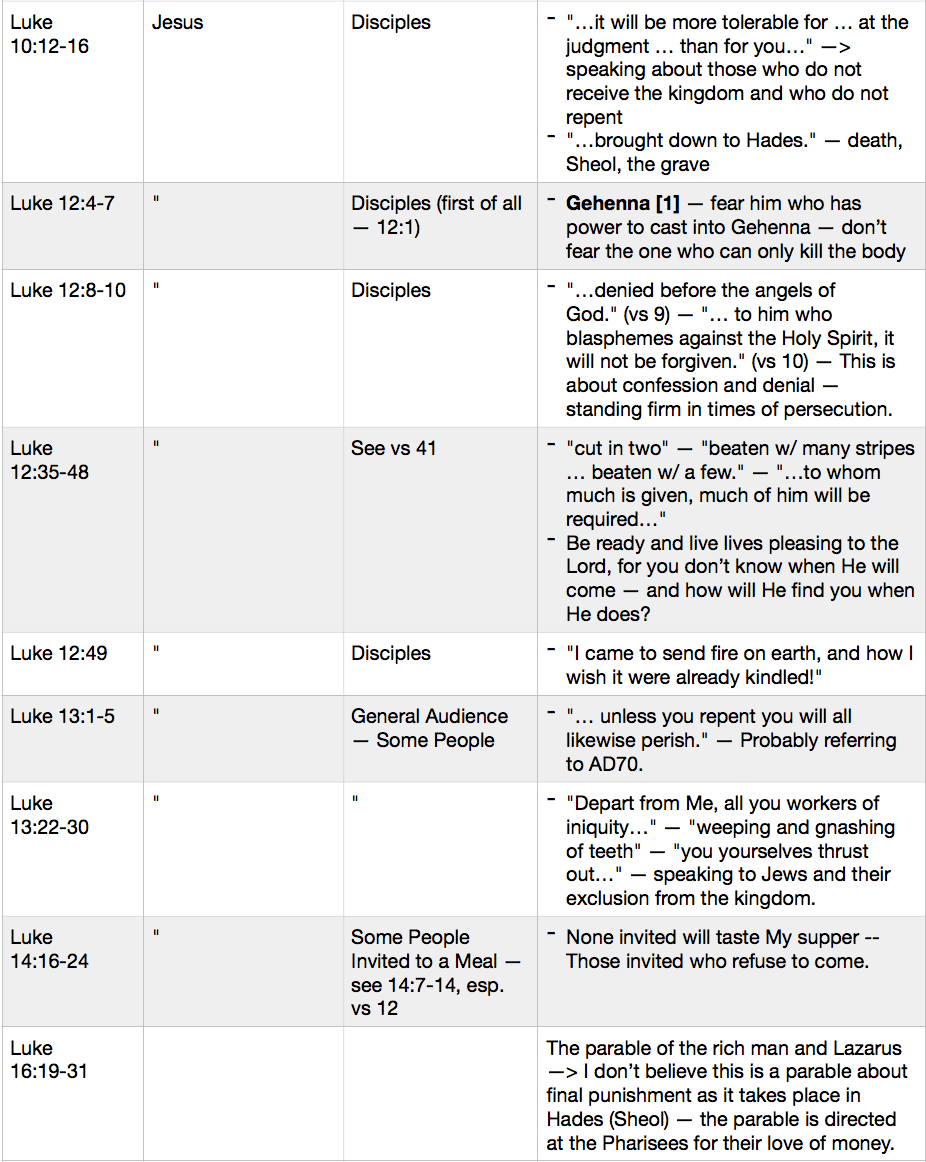
Luke 12:5: “….fear the One who, after He has killed has authority to cast into Gehenna; yes, I tell you, fear Him.”
James 3:6: “And the tongue is a fire,…and sets on fire the course of our life, and is set on fire by Gehenna.”
The Outer Darkness
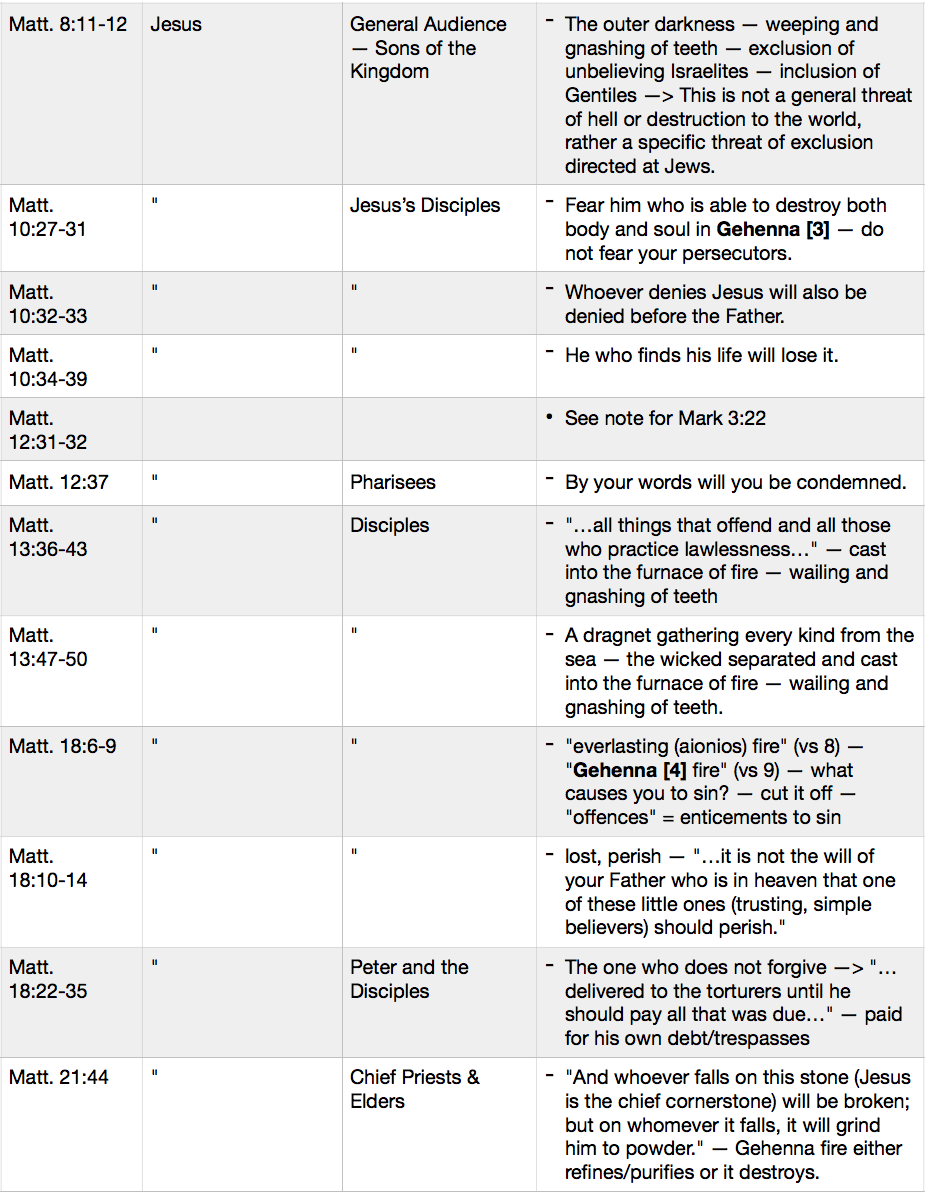
And Jesus having heard, did wonder, and said to those following, ‘Verily I say to you, not even in Israel so great faith have I found; and I say to you, that many from east and west shall come and recline (at meat) with Abraham, and Isaac, and Jacob, in the reign of the heavens, but the sons of the reign shall be cast forth to the outer darkness — there shall be the weeping and the gnashing of the teeth.’
~Matthew 8:10-12 (YLT)
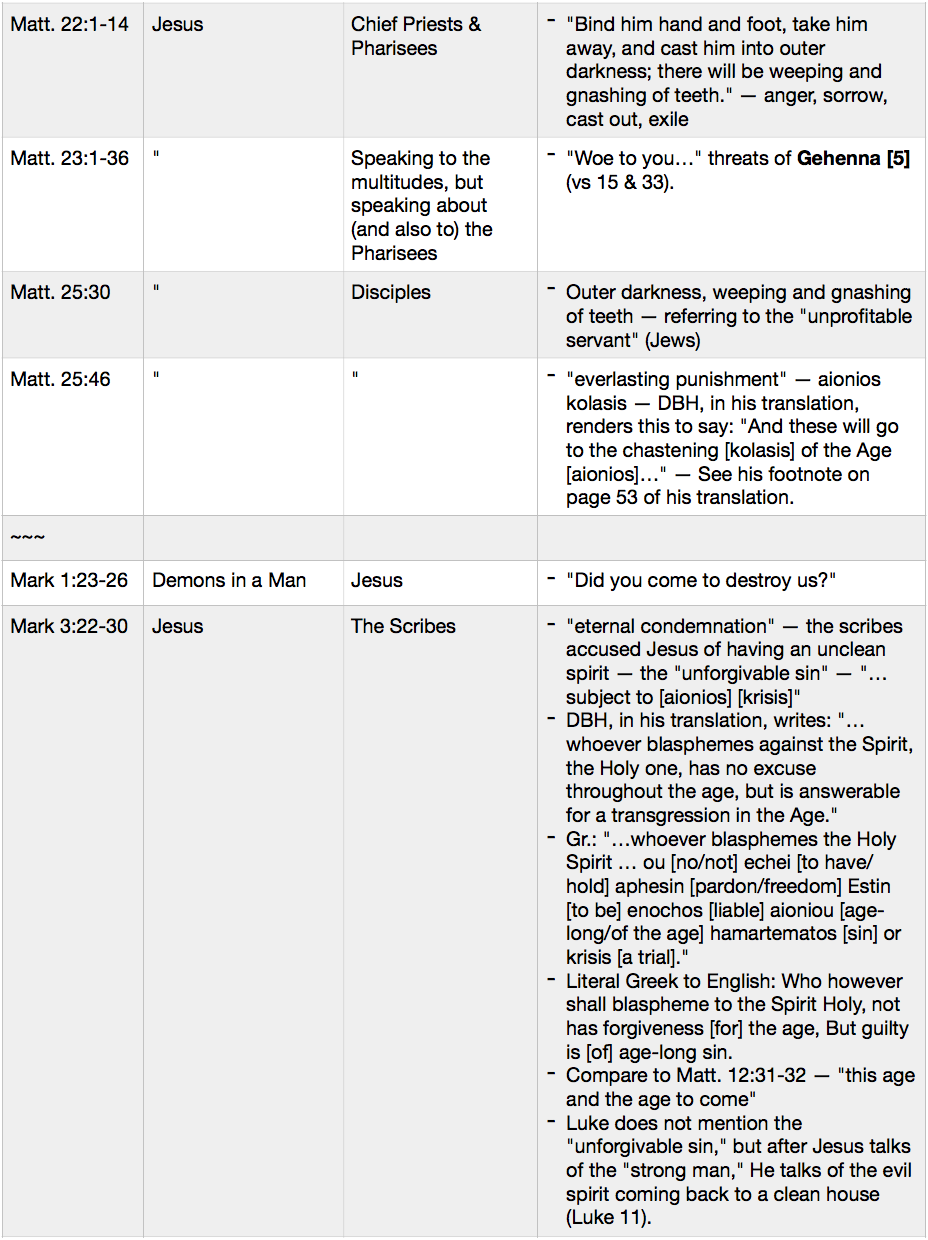
Then said the king to the ministrants, Having bound his feet and hands, take him up and cast forth to the outer darkness, there shall be the weeping and the gnashing of the teeth; for many are called, and few chosen.
~Matthew 22:13-14 (YLT)
[A]nd the unprofitable servant cast ye forth to the outer darkness; there shall be the weeping and the gnashing of the teeth.
~Matthew 25:30 (YLT)
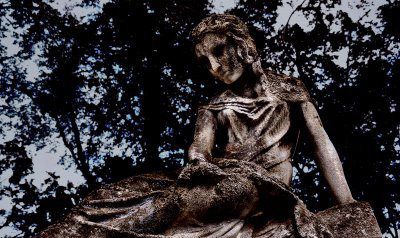
Odin contemplated the girl [named Hel], and he remembered his dreams. Then Odin said, “This child will be the ruler of the deepest of the dark places, and ruler of the dead of all the nine worlds. She will be the queen of those poor souls who die in unworthy ways — of disease or of old age, of accidents or in childbirth. Warriors who die in battle will always come to us here in Valhalla. But the dead who die in other ways will be her folk, to attend her in her darkness.”
For the first time since she had been taken from her mother, the girl Hel smiled, with half a mouth.
Odin took Hel down to the lightless world, and he showed her the immense hall in which she would receive her subjects, and watched as she named her possessions. “I will call my bowl Hunger,” said Hel. She picked up a knife. “This is called Famine. And my bed is called Sickbed.”*
***
The kingdom of the dead was ruled by one of the twelve great Olympians, Hades [or Pluto]… It is often called by his name, Hades. It lies, the Iliad says, beneath the secret places of the earth. In the Odyssey, the way to it leads over the edge of the world across Ocean. In later poets there are various entrances to it from the earth through caverns and beside deep lakes.
Tartarus and Erebus are sometimes two divisions of the underworld, Tartarus the deeper of the two, the prison of the Sons of Earth; Erebus where the dead pass as soon as they die. Often, however, there is no distinction between the two, and either is used, especially Tartarus, as a name for the entire lower region.†
***
“And thou, Capernaum, which art exalted unto heaven, shalt be brought down to hell [Hades]: for if the mighty works, which have been done in thee, had been done in Sodom, it would have remained until this day.”‡
***
For if God spared not the angels that sinned, but cast them down to hell [Tartarus], and delivered them into chains of darkness, to be reserved unto judgment … The Lord knoweth how to deliver the godly out of temptations, and to reserve the unjust unto the day of judgement to be punished…§
***
“And if thy right eye offend thee, pluck it out, and cast it from thee: for it is profitable for thee that one of thy members should perish, and not that thy whole body should be cast into hell [Gehenna].”||
***
“If I wait, the grave [Sheol] is mine house: I have made my bed in the darkness. I have said to corruption, Thou art my father: to the worm, Thou art my mother, and my sister. And where is now my hope? as for my hope, who shall see it? They shall go down to the bars of the pit, when our rest together is in the dust.”¶
***
Through me you pass into the city of woe:
Through me you pass into eternal pain:
Through me among the people lost for aye.
Justice the founder of my fabric mov’d:
To rear me was the task of power divine,
Supremest wisdom, and primeval love.
Before me things create were none, save things
Eternal, and eternal I endure.
All hope abandon ye who enter here.**
***
* Gaiman, Neil. Norse Mythology. Bloomsbury Publishing, 2017, page 81.
† Hamilton, Edith. Mythology. Little, Brown and Company, 1942, page 42.
‡ Matthew 11:23
§ 2 Peter 2:4,9
|| Matthew 5:29
¶ Job 17:13-16
** Dante Inferno. Words above the gates to Hell.


 Pursuit of Percipience