Losing All Meaning

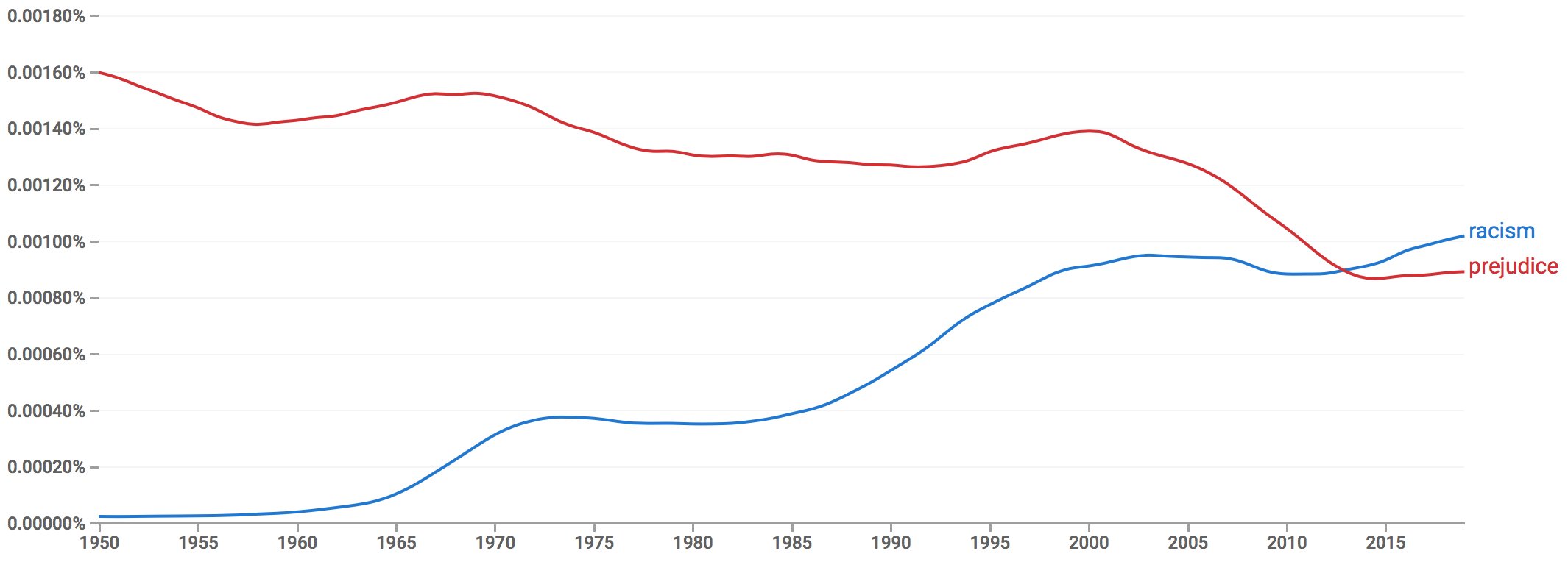
From Google Ngram Viewer – The usage of the terms “racism” and “prejudice” over time in literature

When I was a lad, one rarely heard the word “racist”. Instead, the word we were encouraged to use was “prejudice”. Don’t pre-judge people, we were taught. Treat people as individuals and ignore stereotypes. If a businessman said, “I don’t hire natives. They’re too unreliable,” no one would label that man a racist. Rather, one would encourage him to not be prejudiced against natives. We understood that just because he perceived a pattern, and applied that pattern universally, he was not necessarily being hateful towards native peoples. Was he wrong in judging all natives the same way? Yes. Was he being racist? No.

The title of racism was correctly left to the skin heads, the KKK, and the white supremacists. The racist man was one who saw his race as superior to all others and developed a genuine hatred towards all other races. The businessman above may have a genuine affection for native people, but has developed a certain opinion of them based on personal experience over the years of being a business owner.

I have a friend who is Thai. His wife is Canadian. They live in Thailand, but occasionally visit the wife’s family farm in Canada. Thailand is warm all year round, and an inexperienced Thai guy visiting Canada in the winter may not take the necessary precautions when going out at night in -30° Celsius weather. This is indeed what my friend did when deciding to make a quick late night trip to the nearest convenience store (which is not too close in farm country). Seeing as the car had a heater and he would be quickly jumping between home and car, and car to convenience store, he did not wear a jacket. Part way to the store, the car ran out of gas. My friend was forced to run through the freezing temperatures to get to the store. When he got there the female clerk was locking up for the night and he couldn’t open the door. He knocked on the glass asking to be let in. Now, it’s not unusual for a Thai man to be mistaken for a native man by the average Canadian. My friend also has tattoos. The clerk did not let him in, and he was forced to go back to his car and try to warm himself. Luckily my friend’s wife noticed how long he was taking and set out to get him, and thankfully found him before he developed hypothermia (it was close). So, was the store clerk being racist? Or prejudiced? Was she justified in her decision not to let him in knowing he had no jacket and was freezing?

These days the woman above would be labelled a racist and crucified. No one would ask her why she assumed the man at her door was dangerous. No one would care if the last ten times she was robbed, the robber looked very much like my Thai friend. Am I excusing her behaviour? No, but I wouldn’t accuse her of being a racist either. Her fear is not unexpected, and there are solutions to her prejudice which can be implemented without ruining her career and reputation.

The term “racism” has lost all meaning these days. It’s overused, and too broadly defined. This is intentional. Racism is the unforgivable sin, and the broader the definition, the easier it is to hunt down and punish the heretics. Many people are terrified of being labelled a racist, especially those in the public eye. They know that their entire life can be destroyed from even an unsubstantiated accusation. How convenient it must be to ruin your opponent by a simple finger pointing.

Let’s bring back the word “prejudice” and end the witch hunt.

Slavery in Canada?

Fact: The “Act Against Slavery” was passed in 1793.

Fact: The British government banned the institution of slavery in most of its colonies (including Canada) in 1833.

Fact: Canada did not become a self governing country until 1867.

Fact: Of the 4200 slaves cataloged (most of whom were not African) between the years 1672-1834 in what later became Canada, there are no Canadian citizens alive today who are responsible for them, who benefited from them, or who owe reparations to them.

Fact: American Black history ≠ Canadian Black history. Modern day American Black/White relations ≠ Modern day Canadian Black/White relations.

For many Canadians who know a black person (if they even know a black person), that black person is a first or second generation Canadian, and/or is not descended from slaves.

Slavery was a terrible and evil institution of our past in the west, but we must not hold the children responsible for the sins of their father’s fathers. Our generation has plenty of its own sins to answer for.

Notice how, in our western society, the easiest sins to avoid have become the worst sins in the eyes of the zeitgeist. Racism! is the unforgivable sin, yet it is one of the easiest sins to avoid. It’s easy to declare yourself a righteous non-racist, while committing a myriad of even worse sins unnoticed. The girl waving the BLM flag had an abortion last month.

History of Slavery

The Fallacy of Theodicy

Theodicy: a defence of God’s goodness and omnipotence in view of the existence of evil

We ought to reject all attempts at theodicy. God did not need sin, death, and evil to bring about His plan for creation. Sin, death, and evil did happen, but not at God’s command or decree. And, we take comfort in the fact that God hates sin, death, and evil, and He will redeem His creation from it all.

Excerpt from an article written by David B. Hart titled Tsunami and Theodicy….

“Christians often find it hard to adopt the spiritual idiom of the New Testament—to think in terms, that is, of a cosmic struggle between good and evil, of Christ’s triumph over the principalities of this world, of the overthrow of hell. All Christians know, of course, that it is through God’s self-outpouring upon the cross that we are saved, and that we are made able by grace to participate in Christ’s suffering; but this should not obscure that other truth revealed at Easter: that the incarnate God enters ‘this cosmos’ not simply to disclose its immanent rationality, but to break the boundaries of fallen nature asunder, and to refashion creation after its ancient beauty—wherein neither sin nor death had any place. Christian thought has traditionally, of necessity, defined evil as a privation of the good, possessing no essence or nature of its own, a purely parasitic corruption of reality; hence it can have no positive role to play in God’s determination of Himself or purpose for His creatures (even if by economy God can bring good from evil); it can in no way supply any imagined deficiency in God’s or creation’s goodness. Being infinitely sufficient in Himself, God had no need of a passage through sin and death to manifest His glory in His creatures or to join them perfectly to Himself. This is why it is misleading (however soothing it may be) to say that the drama of fall and redemption will make the final state of things more glorious than it might otherwise have been. No less metaphysically incoherent—though immeasurably more vile—is the suggestion that God requires suffering and death to reveal certain of his attributes (capricious cruelty, perhaps? morbid indifference? a twisted sense of humor?). It is precisely sin, suffering, and death that blind us to God’s true nature.”

Read DBH’s full article by clicking here.