Deceptive Simplicity

equity-vs-equality

Sometimes we can use simple illustrations to explain more complex ideas. That is fine if the illustration is in fact used to explain the more complex idea. Often that’s not what happens – often we’re just shown the illustration, and because it’s simple, we think we understand the more complex situation automatically.

Take the picture above: On the left, they all have a box, but still the short guy can’t see. So, on the right, the tall guy gives him his box and all is well. That’s justice, see? Simple.

Well, if I were at a game watching over the fence and some guy needed my box to stand on, and I didn’t need it myself, of course I would give mine to him – I’m not a complete jerk. But of course, a baseball game is not what’s really the issue here. We’re talking about wealth, poverty, and social politics – much more complex issues.

How can we translate the simple illustration to the real complex problem?

We ask what each item in the illustration represents.

What do the boxes represent? Money? Power? Knowledge? All three? Something else? Why are there only three boxes? They can’t get more? Why do they all start off with one box each? Why is one guy taller than the other? Do these guys always stay the same height over the course of their lives? How is time illustrated in this picture, if at all?

What does the fence represent? Why is it the height it is? Is it shorter in other places where the short guy could see over with only one box? Why are all three guys standing right next to each other? In the real world, does the tall guy even know the short guy exists? Could the tall guy simple pass his box over to the short guy without someone else getting involved? What if the tall guy doesn’t want to give up his box? What if he’s going to need it to look over a taller section of fence further down?

What does the baseball game represent? Happiness? A house, car, and a flatscreen TV? Or just basic living needs? Who determines what poverty is? What’s being compared to what? Is the standard of living the same for all three guys? Is it essential to watch the game at all? Why don’t they buy tickets and watch inside?

These are just starter questions. As they’re answered more questions will come.

So, try answering all these questions and you’ll see that the situation is much more complicated than what the picture suggests.

Here’s a couple of other versions of the picture I found online…
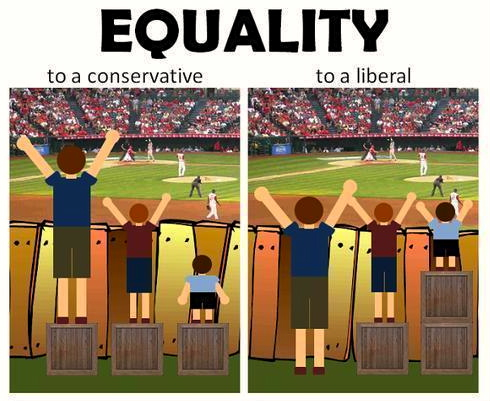
frabz-16fc88

Ha! Okay, evil conservatives are the problem.
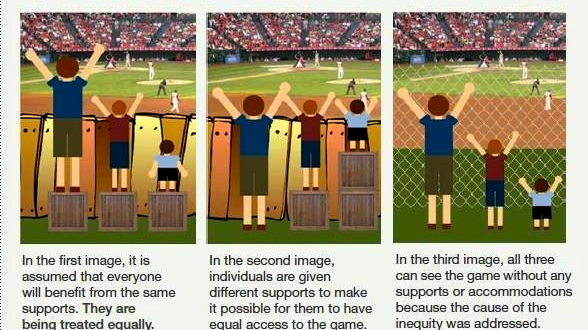
Equalisty-versus-equity-588x330

Chain link fences! Of course!


The Free Speech Trade-off

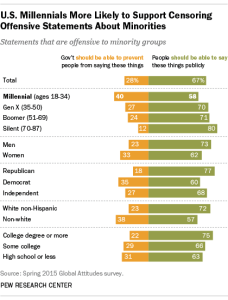
FT_15.11.19_speechAccording to this 2015 Pew Research article, 40% of U.S. millennials are in favour of the government having the authority to censor offensive speech about minorities.

Thomas Sowell has said: “Much of the social history of the Western world, over the past three decades, has been a history of replacing what worked with what sounded good.”

It sounds like a good idea to limit “hate speech”. Who would be against that? But if we stop at only what sounds good we create future trouble for ourselves. We have to ask questions and thoughtfully follow through on what these “good” ideas would actually create. Questions like: Who decides what “hate speech” is? Given the government has the authority to limit hate speech, would the government abuse that authority in the future?

I am in an interracial marriage. I’m a white Canadian, while my wife is a brown Cambodian. (Are you offended that I called her brown?) Suppose, while planning our marriage in Canada, we went to a bakery which was owned by a white supremacist. And suppose he refused to bake our wedding cake because he is against interracial marriage. I would be annoyed and a little offended at that. But, the most I would do is tell my friends and family about it and stop there. I’m not going to call the media. I’m not going to sue. I’m not going to boycott his bakery (although I can understand why others would). I’m not going to fight to give the government the power to shut him down. As much I wouldn’t like what he had done, I wouldn’t fight to take away his right to run his business as he wants. Because, if I take away his freedom, I take away everyone else’s freedom too.*

If the KKK comes marching through your town’s public square spewing hate speech against blacks and Jews, you have two options: you can ignore them or you can speak against them. One option you don’t have is to silence them. Even the KKK is protected by free speech**. However, if the KKK comes into your restaurant and decide to hold an impromptu rally, you can silence them by kicking them out of your business.

Thomas Sowell also often says: “There are no solutions, only trade-offs.” What is the free speech trade-off? Do we want the government to silence anyone who might offend us now, and, consequently, give the government the ability to abuse that authority in the future when our children and grandchildren are adults? (And if you don’t think that will happen, you just need to study history. Right now in certain Asian countries a person can be imprisoned for criticizing the government on Facebook. Do we want that in western society?) Or, we can grow a thicker skin and allow everyone to speak freely, even when it offends us, and ensure future generations will not have to live in fear that if they say the wrong thing, arbitrarily decided by government, they won’t end up in prison for ten years.

*I realize that there are already anti-discrimination laws in place, and I am not necessarily against those laws. This is just an example. 

**Free Speech: The right to speak without censorship or restraint by the government.

A Conflict of Visions (Book Overview)

a_conflict_of_visions

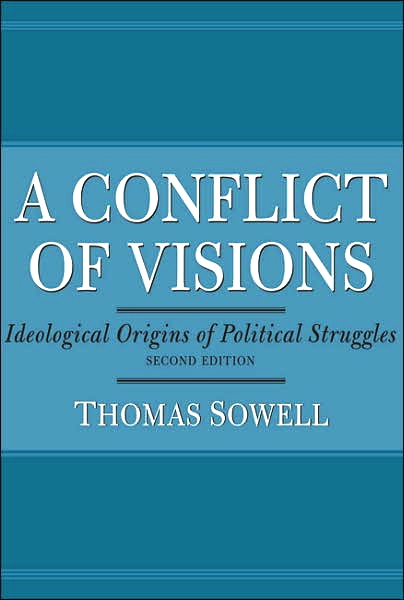
“A Conflict of Visions” was written by economist/philosopher Thomas Sowell.

Here is the description from Amazon:

In this classic work, Thomas Sowell analyzes the two competing visions that shape our debates about the nature of reason, justice, equality, and power: the “constrained” vision, which sees human nature as unchanging and selfish, and the “unconstrained” vision, in which human nature is malleable and perfectible. He describes how these two radically opposed views have manifested themselves in the political controversies of the past two centuries, including such contemporary issues as welfare reform, social justice, and crime.

Here are some of my notes on the book:

Part I ~ Patterns

  • Our visions shape our theories — visions can not be tested, they are presuppositional, and they tend to be simple.
  • Our theories can be tested by facts. Facts can not prove theories, but facts do cause us to disregard bad theories.

The Constrained Vision

  • There are realities about this world that can not be changed. Therefore, rather than wasting time and effort trying to change them, one needs to learn to work within them.
  • One needs to learn to make the most of the possibilities available within the constraints of reality.
  • The constrained vision deals in trade-offs — choosing the better option and accepting that there are no ideal options.
  • When there are people suffering in this world through poverty, war, etc., some would want you to continuously feel bad (or guilty) for those who are suffering — your guilt = their suffering. Thus you will be motivated to help them. The constrained vision says that it is useless for you to continuously “feel” their suffering (and it is unnatural as well) — better to embrace your natural inclination for self-improvement.
  • Facts = Reality
  • Virtue = the best possible trade-off/prudence
  • Your desire for self-improvement forces you to work with and for the benefit of others. Thus, as people work to improve their own lives, they end up working to improve the lives of others — the world becomes better for all people. This improvement is unintentional, but it does happen, and it happens without a human power to plan it.
  • The leaders need to be educated “down to” the level of the masses.
  • Self-interest is a better motivator than guilt and it has better results for the suffering too.
  • People’s selfish desire for self-improvement motivates them to get the job done — this is better than depending a person’s disposition for their motivation.
  • “Do right because it is in your best interest” rather than “Do right because you know it’s the right thing to do.”

The Unconstrained Vision

  • We can change the world for the better.
  • We can change human nature if only: The right people were in charge; The right institutions were created; People were educated properly; etc…
  • Whereas the Constrained Vision says that bad institutions are a result of flawed humanity, the Unconstrained Vision says that bad institutions are the cause of flawed humanity.
  • We can feel other people’s needs as well as our own (if not better).
  • Self-interest is the negative result of bad institutions.
  • There are individuals who are intelligent enough to know how to fix all our problems, and these individuals should be given the power to do so, even if it causes suffering and limited freedom for the masses.
  • The masses need to be educated “up to” the level of the leaders.
  • Idealism = Reality
  • Virtue = Final solutions to problems
  • An institution’s intentional benefits to society are the greatest virtue. Unintentional benefits to society are not acknowledged. We can always know what is good/bad for society and why that is so, and plan accordingly.

Note: The way in which Sowell uses the word vision, the word world-view could be used as well.

Note: Constrained Vision does not necessarily equal Conservative while Unconstrained Vision equals Liberal (although that seems to be the norm). One can be a Constrained Conservative or an Unconstrained. For example: a Constrained Conservative would not want to send troops into Iraq as the cost of human life and military resources would be too great for an unpredictable outcome, whereas an Unconstrained Conservative would want to send in troops believing that they could create a successful democracy in Iraq. Or, a Constrained Liberal, although wanting a large government, wants governmental power to be spread out through several government departments, whereas an Unconstrained Liberal wants an “all-knowing” leader to have sovereign control over the decisions affecting society.

Note: Nobody holds 100% to one vision and 0% to the other. There are various degrees between of course. Sowell himself clearly holds to the Constrained Vision.

Knowledge ~ The Constrained Vision

  • No one person, or small group of individuals, knows enough to make good decisions for society (or even for himself).
  • The collective knowledge of the culture and its history is best for making decisions.
  • Even if we don’t know why what is best is best, we can trust the experience of history and can still benefit.
  • We should be slow to criticize the cultural norms of our society as these norms are built on the experience of millions of people both in the past and in the present.
  • Defects in society are not in themselves reason for radical change — rational small adjustments over time will give us the best possible options for the future.

Knowledge ~ The Unconstrained Vision

  • Nothing is sacred just because its old.
  • Wisdom of the ages = ignorance of today
  • Old = untrustworthy
  • Reason and meditation is better than partially explained (or unexplained) historical collective wisdom.
  • People who hold to old traditional views need to be enlightened before any progress can be made in society.
  • If history’s collective wisdom is represented by a-x (x being today’s constrained generation; y being today’s unconstrained generation), x is ignorant because a-w is obsolete and irrelevant now.
  • Whereas with the Constrained Vision a-w is so ingrained into our minds we can’t always explain the wisdom or benefits of it, the Unconstrained Vision only considers y as having the proper knowledge to advance society.
  • y is the wisdom in the hands of a select few who must then lead society.

Knowledge ~ Reason and Rationality

  • There are two “kinds” of reason: A) cause and effect; scientific method — B) to justify one’s actions.
  • In the Constrained Vision A and B are far apart, whereas in the Unconstrained Vision, A and B are closer together.
  • Constrained Vision: We don’t always know why things are the way they are.
  • Unconstrained Vision: We know why things are the way they are and we should be able to specify those reasons.
  • Religion: God is unconstrained while humans are constrained.
  • Law: With the Constrained Vision laws are something passed down to us by previous generations, and with the Unconstrained Vision laws are seen as something to be invented afresh today.
  • Sowell quotes Hayek: “The most dangerous state in the growth of civilization may well be that in which man has come to regard all these (old) beliefs as superstitions and refuses to accept or to submit to anything which he does not rationally understand. The rationalist whose reason is not sufficient to teach him those limitations of the power of conscious reason, and who despises all the institutions and customs which have not been consciously designed, would thus become the destroyer of the civilization built upon them.” (F.A. Hayek, The Counter Revolution of Science: Studies on the Abuses of Reason [Indianapolis: Liberty Press, 1979], pp. 162-163.)

Knowledge ~ Social Policy

  • The Unconstrained Vision wishes to see more economic and social equality among the masses — even if the decision making process to produce that equality is itself unequal –> equality imposed by an unequal power structure.
  • The Constrained Vision is not so much concerned with societal inequality as it is with inequality in the power structure.
  • In regards to social planning, with the Constrained Vision, each individual sticks to what he is specialized in and allows the systemic process to determine social outcomes. When each person does his/her part (fulfills his/her role) the systemic process functions normally. If you’re a physicist, stick to physics. If you’re a carpenter, stick to carpentry. You will only corrupt the system if you get involved in areas in which you have no knowledge or experience.
  • In regards to social planning with the Unconstrained Vision, each person needs to act in ways which they feel will promote equality in all of society. If you’re a business owner, hire people who you feel are at a disadvantage. If you’re a teacher, bring up social issues in your class which you feel the students should be aware of, such as gender equality.
  • The Constrained Vision sees individuals, for example businessmen, as being unqualified to make decisions for the greater society. The businessman can best serve society by doing what he knows how to do for his own self-interest — the benefits to society will come through the systemic process. If he tries to “fix” society intentionally, he will only do damage.

Knowledge ~ Sincerity Vs. Fidelity

  • Sincerity is imperative in the Unconstrained Vision. Each individual must be sincere and sincerity = being right.
  • With the Constrained Vision, sincerity = believing what you’re doing is right. But you may not be right. (Hitler was very sincere.) With the Constrained Vision, fidelity is a virtue –> faithful commitment to one’s role in life within the sphere of one’s competence. Sincerity is not that important.
  • For example: A constrained judge is loyal to the existing law; an unconstrained judge sincerely wants to change the law for the “greater good”.
  • Because sincerity is held at such a high regard in the Unconstrained Vision, the sincerity of one who holds to the Constrained Vision is looked on suspiciously — “What are his real motives?” Whereas those who hold to the Constrained Vision are much less concerned with sincerity as the societal system is so complex that even the most sincere person can still be mistaken.
  • “The first thing a man will do for his ideals is lie.” (Joseph A. Schumpeter, History of Economic Analysis [New York: Oxford University Press, 1954], pg. 96).

Knowledge ~ Youth and Age

  • Constrained: Wisdom is of the older. Prudence is of the wise.
  • Unconstrained: Youth are unstained by the past prejudices and therefore are more capable of embracing new and better ideas.

Social Processes

  • Order and design –> some processes are more ordered than others –> Like a wild growing of vegetation versus a planned garden.

Social Processes ~ The Constrained Vision

  • There is no designer, but yet the processes work.
  • Like language — A language can be created, but a created language will be no where near the complexity of an evolved language.
  • Dictionaries of “true” languages are written after the language has developed. While dictionaries of made-up languages are written before.
  • Language does change over time, but this is not done quickly or under the design of a “master planner”.
  • Individuals plan for themselves, but no authority plans for the masses.
  • Social processes, then, evolve on their own over time as millions of individuals make decisions throughout their lives and throughout  the generations.

Social Processes ~ The Unconstrained Vision

  • We can design, like an engineer, social processes which will work.
  • One starts engineering the social processes by figuring out society’s needs, then one assembles all the relative facts, and then solutions can be found and planned for.
  • We can predict the outcome of our plans like in science.
  • Properly educated people can/must make these plans.

Social Processes ~ Time

  • With the Unconstrained Vision, the social decisions (concerning liberty, government, law, etc.) of the past generations limit the benefits of the present and the future, therefore flexibility is most desired in the ability to change past commitments as new information becomes available. Each current social decision to be made must be approached as if for the first time. Past decisions/commitments for the same issue need not be considered as the information they had in the past was less than what exists today.
  • The Constrained Vision asks these questions: Just how much more information (knowledge, rationality) do we really have now than before? What is the cost to society when making “moment to moment” decisions?
  • Where the belief is held that knowledge increases greatly over time, people tend to want to change things more quickly. In contrast, where the belief is held that knowledge increases slowly over time (or not at all in regards to rationality or wisdom — a growth in scientific or technological knowledge does not mean a society is growing wiser) the people tend to resist change and stay committed to past decisions.
  • Elsewhere, Sowell give these three questions to ask when about to make a change: Compared to what? At what cost? What is your hard evidence? He says that most liberal arguments are dispelled by these three questions.
  • Constrained Vision: Society runs better when there are rules applied to everyone, which everyone knows, and were decided on over time.
  • Unconstrained Vision: Rules are decided upon as relative issues come up based on their merit right now.
  • Constrained Vision: Right or wrong/for better or for worse, I am a citizen of my country first.
  • Unconstrained Vision: I am a citizen of the world first, country second.
  • Constrained Vision: A nation evolves slowly over time — to take it apart destroys it — it can not be put back together again in a different way.
  • Unconstrained Vision: We can build a nation how we want — take apart the building blocks — and put them together another way.
  • From the book: With the Constrained Vision, “…the incremental gain in individual knowledge by avoiding commitments is trivial, compared to the accumulated experience of the society.” (pg. 82)

** I’m not going to finish overviewing this book. It’s too much. Just buy it and read it yourself.**

***

Facing Darker Days

image

One thing that western Christians need to remember is that the Christian Church does not revolve around the western world. And so, if it appears that the Church is “dying” in the west, that certainly does not mean it is dying worldwide. In fact, the Church is growing worldwide.

But is the Church really dying in the west? Or is this some kind of publicity stunt?

Something that is indeed happening in the west is that the secular and political realms are no longer paying homage to the Church. The “new atheism” we see these days does not just want to deny God’s existence, but it wants to tear down all Christian power in society. And this does seem to be happening; the Church has been and is losing power in the secular and political spheres.

But dying? Well I guess that depends on whether or not people are really getting saved and are joining churches. The numbers of those calling themselves Christian may be down, but how reliable are those numbers anyways? Ten years ago, if a surveyor went to any given house and asked what religion the home’s dweller belongs to, they’d probably get a response like, “Well, I grew up in a Catholic family, so I guess I’m Christian.” Yet the person hasn’t set foot in a church for 25 years. These days I think people are more inclined to be honest and say they are non-religious. They no longer feel the need to show some kind of respectful acknowledgment of religious tradition.

So perhaps the Church is not dying, but rather, with the loss of the Church’s political power, we are just seeing more honesty and realism. This is a good thing. The Church thrived in a hostile Roman Empire. No one dared to pretend to be Christian for personal gain. Nor did anyone sleepily pay tribute to the faith out of some obligation to tradition. Lines were clearly drawn, and no one could be a “casual believer”.

So, as the Church loses religious control over society, no one should lament that the end is near. The Church’s true influence will grow as its false religious and political clout dwindles.

photo credit: “A Letter From Pastor Mark”

The Dictator’s Handbook (Book Review)

image

This is a somewhat amusing book looking at the differences (or better yet, similarities) between dictatorships and democracies.

Basically, according to the authors, potential political leaders need to worry most about one thing: you can not be a monolithic leader; you will have to keep a certain group of people happy in order to stay in power. How large that essential group, or coalition is, depends on what kind of government you want to form– democracy (large coalition) or dictatorship (small coalition).

In the first chapter, five basic rules are given for leaders to succeed in any system: “1) Keep your winning coalition as small as possible; 2) Keep your nominal selectorate (non-essential supporters) as large as possible; 3) Control the flow of revenue; 4) Pay your key supporters just enough to keep them loyal; 5) Don’t take money out of your supporter’s pockets to make the people’s lives better.” (If you’ve ever wondered why some governments, like the Cambodian government, don’t crack down on corruption, #5 would be your answer.)

In a dictatorship the coalition is small. It is imperative for the dictator to maintain strict control over the bank accounts so that he, and he alone, will be able to pay off the necessary people who can keep him in power, or take him out (like a military commander for example).

In a democracy the essential group of backers will be much larger, so the option of simply paying them off is much too expensive. Here the leader buys loyalty through programs and policies.

The book uses several real world examples to back the points made. For example, Samuel Doe of Liberia, who, although being an unskilled soldier, managed to assassinate the president and take control of the country.

“Doe had no idea what a president was supposed to do and even less idea of how to govern a country. What he did know was how to seize power and keep it: remove the previous ruler; find the money; form a small coalition; and pay them just enough to keep them loyal. In short order, he proceeded to replace virtually everyone who had been in the government or the army with members of his own small Krahn tribe, which made up only about 4 percent of the population. He increased the pay of army privates from $85 to $250 per month. He purged everyone he did not trust. Following secret trials, he had no fewer than fifty of his original collaborators executed.”
~page 22, chapter 2, “Coming to Power”

Sounds a lot like how the Khmer Rouge came to power in Cambodia in the ’70s.

Samuel Doe did not fair well though. He too was taken out of power, tortured (to reveal where all the money was), then cut up, cooked, and eaten. Mmm mm.

Overall I thought it was a decent book. However, I did find it to be over-simplified and too repetitive. I think, with it being nearly three hundred pages long, it could easily be a hundred pages shorter and thus a lot less monotonous.

I give it 3 out of 5 stars.

Find it on Amazon

Update October 2016…

Here’s a good video which lays out the book in under 20 minutes…