Progressive Conservatism

I think the best definition of Conservatism is this: The conservation of the progress which has already been made. And when I write “the progress which has already been made” I’m not just referring to the last thirty years; I’m referring to the last five hundred years. When talking about individual people, thinking in terms of decades is fine, but when we are talking about civilizations, we must talk of centuries. Think of what the western world was like before the Great Reformation, and compare that to today. Would we ever want to go back?

Yet, it would seem some people in the western world today really do want to go back. Read this article entitled Want Equality? Curtail Free Speech. Yes, some useful idiot actually wrote that. Now, these morons would call themselves Progressive, but when one writes, “Our Government should look to criminalise not only Islamophobia, but racist rhetoric and the criticism of feminism and LGBTQAA+ rights,” that’s anything but progressive — it’s regressive.

In Canada, a motion (M-103) was passed recently which directs the government to investigate and act against Islamophobia. Now, when I type that word, Islamophobia, on my computer, my spell-checker red flags it. Why? Because it’s not a real word. And that is the problem with M-103 — it uses a term which is not properly defined. What exactly is Islamophobia? If we break the word down and define the parts, it means: an irrational fear of the ideas of the Islamic religion.

When I encounter those who defend M-103, every time I find that they are unable to distinguish the idea which is Islam from the followers of Islam (Muslims). That’s an important distinction — one is an idea, and the other is a group of people. If we want to live in a free society we must be able to criticize ideas. Martin Luther created a freer society when he openly criticized the state of Christianity in his day. It was not easy for him to do that, and because he did, we now live in a society where we are free to criticize. But, for how long?

Listen to Canada’s Heritage Minister defend M-103 in this video. She only gets confused…

Another good example is the exchange between Ben Affleck and Sam Harris on the Bill Maher show…

Once upon a time there was a political party in Canada called the Progressive Conservatives. That sounds like an oxymoron, but it’s actually a very good term. Progressive conservatism is the idea that, while we do want to progress socially, we do not want to do so at the expense of the progress which has already been made. What has made the western world the best society to live in so far in human history? Where does our wealth come from? What economic system has allowed us to become so wealthy? (Hint: free market capitalism.) Where do our freedoms come from? What system of government has allowed us our freedoms? (Hint: a system in which the rights of the individual are elevated over the group.) We need to conserve those things and protect them from those who would dismantle them while trying to create their utopia in which no one will ever be offended.

The Right to Left Political Wormhole

wormhole
Often when people think of the left wing/right wing political scale, they think of far left types of governments as being communism or socialism, while a far right example would be fascism. But that is not accurate.

The further right you go on the scale, the smaller the government gets. A libertarian, for example, who wants private schools, private healthcare, private road building, etc., would be quite far right on the political scale with the government being responsible for very little, and private citizens being responsible for much.

So, not only will you find communism and socialism at the extreme left end of the scale, but you will find fascism there as well, as fascism requires a large controlling government structure. The only real difference between communism and fascism is that fascism allows for private ownership while the government still controls the economy. What then, would lie at the far right? It would be no government, or anarchy.

It’s understandable, though, to mistakingly place fascism at the far right, as an anarchy can very quickly morph into a fascist dictatorship. In an anarchy, where individuals control everything, it’s just a matter of time before some of those individuals become very powerful, and, in order to maintain their power, they will have to actively oppose the rise of any others to the same level of power. Boom — there’s your fascist dictatorship. So, there is a wormhole from the far right (anarchy) to the far left (dictatorship).

Wealth Inequality & Guaranteed Income

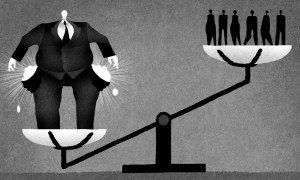
InequalityWhy is there poverty in the world? Is there not enough wealth for everyone? Some believe that the resources which produce wealth are fixed, but there is enough for everyone. Those people tend to also believe that wealth must be collected by a benevolent force, like government, and distributed fairly.

Others believe that wealth is created and the resources which are used to do so are not fixed or limited. As humanity gains knowledge about the world around us, we are able to convert more and more new kinds of resources into wealth. The key is having the skills and knowledge to do so.

But what about poverty? How can poverty be abolished once and for all? Is that even possible?

One idea is called “Basic Income” or “Guaranteed Income”. Here’s a video from Vox presenting the idea…

You can read the full article how Vox lays out this program here. But basically they say this:

“‘Basic income’ is shorthand for a range of proposals that share the idea of giving everyone in a given polity a certain amount of money on a regular basis. A basic income comes with no categorical eligibility requirements; you don’t have to be blind or disabled or unemployed to get it. Everyone gets the same amount by virtue of being a human with material needs that money can help address.”

Another site defines it like this:

“A basic income is the best policy idea you’ve never heard of. The idea is simple: instead of, or in addition to, the panoply of government transfer programs currently in place, we just give everyone in the country a set amount of money per year, no strings attached. The benefit could phase out as one’s income rises (this variant is known as a ‘guaranteed minimum income’) or could just be granted unconditionally: you get $10,000 a year, I get $10,000 a year, the poorest of the poor get $10,000 a year, Bill Gates gets $10,000, etc.”

Milton Friedman is mentioned in the Vox video as being someone who supported “Basic Income”. But, according to the two definitions above, that’s not necessarily true. Whereas the definitions above call for everyone to receive a certain amount of money, regardless of pre-existing wealth or lack thereof, Friedman proposed a system called “Negative Income Tax” (NIT). NIT only provides money to those who are poor and are in a tax bracket where, instead of paying taxes, they receive a negative tax. Also, with Friedman’s plan, the amount they receive is not necessarily enough to live on, but rather, would be an incentive for them to work and generate their own higher income. He lays out his plan here…

Friedman was against the welfare program, and he saw his NIT program as an answer to welfare.

The New York Times also wrote about Friedman’s plan. The following opening quote from the Times article shows that they either didn’t understand Friedman’s plan or were pushing their own agenda. Probably the latter.

“Milton Friedman, who died last week at 94, was the patron saint of small-government conservatism. Conservatives who invoke his name in defense of Social Security privatization and other cutbacks in the social safety net might thus be surprised to learn that he was also the architect of the most successful social welfare program of all time.”

NIT was not proposed by Friedman as a welfare program. And, how can the Times say it was the most “successful social welfare program of all time” when it was never tried?

Friedman discusses welfare, poverty, and equality here…

Poverty is not just a problem of insufficient cash, as the Vox video suggests. The Vox video states that the solution to people not having enough money is to give them money, and that the tool to eliminate poverty is cash. Well, there’s a lot more to it than that.

Human Capital” is essential to eliminating poverty. Human capital can be defined as the skills and knowledge of people to create and sustain wealth. The post-WW2 reconstruction of Europe can be used as an example. Billions of dollars were given by the USA to help in the reconstruction. And, the European nations did rebuild successfully. Billions of dollars have also been given to third-world nations over the decades, but yet, they remain poor. Why the difference? Europe, despite being devastated by war, still had its human capital, whereas the third-world nations never had the human capital in the first place.

Another example which follows the same logic… Cambodia was decimated by the Khmer Rouge in the late 1970s. Afterward, the United Nations decided it would use Cambodia as a test experiment to use UN dollars to establish a democratic government. Somewhere around three billion dollars were spent to accomplish that goal. Did it work? No, it did not. The human capital required to create and sustain a democratic system did not then, and does not yet today, exist in Cambodia.

Handing out free money without any incentive for the receiver to produce his or her own wealth is not any kind of solution — the poverty still exists and the poor are simply paid to remain poor. Increasing human capital, however, through education and the free-market system, is a historically proven method. People are very inventive, and the ability to create wealth out of what was previously considered to be valueless is our greatest asset. Where there is no incentive, there is no inventiveness.

Socialism & Capitalism

Socialism is the belief that the resources of wealth are fixed and limited, and therefore must be distributed.

Capitalism is the belief that the resources of wealth are not fixed nor limited, but rather are created.

Socialism demands equality of output even when there is no equality of input.

Capitalism demands the output to be a direct result of the input.

Socialism forces fairness for the whole while destroying the rights of the individual.

Capitalism forces fair treatment of the individual while creating inequality for the whole.

Socialism has never created a wealthy nation.

Capitalism has created wealthy nations.

Sufficient Evidence: Empirically Impossible

Recently I posted this quote on my Facebook page:

“…socialism is not merely the labor question, it is before all things the atheistic question, the question of the form taken by atheism today, the question of the tower of Babel built without God, not to mount to Heaven from earth but to set up Heaven on earth.”*

A socialist atheist got upset by the quote and felt the need to reply, which went something like this:

Socialism is not atheistic! There is no god and we just want to create a society where all are taken care of. If there is a god then provide sufficient evidence. Until then stop wasting my time!

Forgetting the fact that his response confirmed the truth of the quote, and forgetting the fact that he was the one wasting my time by responding and demanding an explanation, I thought, “What would be sufficient evidence?”

Because, of course, empirically speaking, there is no sufficient evidence to prove God. Even if Jesus were to appear in the sky above this guy’s house and cry out with a loud voice, “I am Jesus! I am God! I created the universe!” my Facebook friend would still be left with the choice of wether to believe what he saw was real or not. And if he’s predisposed not to believe then he will probably explain away the experience as something natural. 

“It is not miracles that dispose realists (or empiricists) to belief. The genuine realist, if he is an unbeliever, will always find strength and ability to disbelieve in the miraculous, and if he is confronted with a miracle as an irrefutable fact he would rather disbelieve his own senses than admit the fact. Even if he admits it, he admits it as a fact of nature till then unrecognized by him. Faith does not, in the realist, spring from the miracle but the miracle from faith. If the realist once believes, then he is bound by his very realism to admit the miraculous also. The Apostle Thomas said that he would not believe till he saw, but when he did see he said, ‘My Lord and my God!’ Was it the miracle forced him to believe? Most likely not, but he believed solely because he desired to believe and possibly he fully believed in his secret heart even when he said, ‘I do not believe till I see.'”**

Now, as for socialism, I’ll leave that for another day. Until then, read anything on economics by Thomas Sowell. 

* Dostoevsky, Fydor, The Brothers Karamazov (Barnes & Noble: New York, 2004 [1879-1880]), pg. 32.

** Ibid., pg. 31.

What did Dostoevsky mean by comparing socialism with Babel, and why did he then contrast socialism with Babel in saying that socialism strives to bring Heaven to earth (whereas at Babel they were trying to get to Heaven)?