
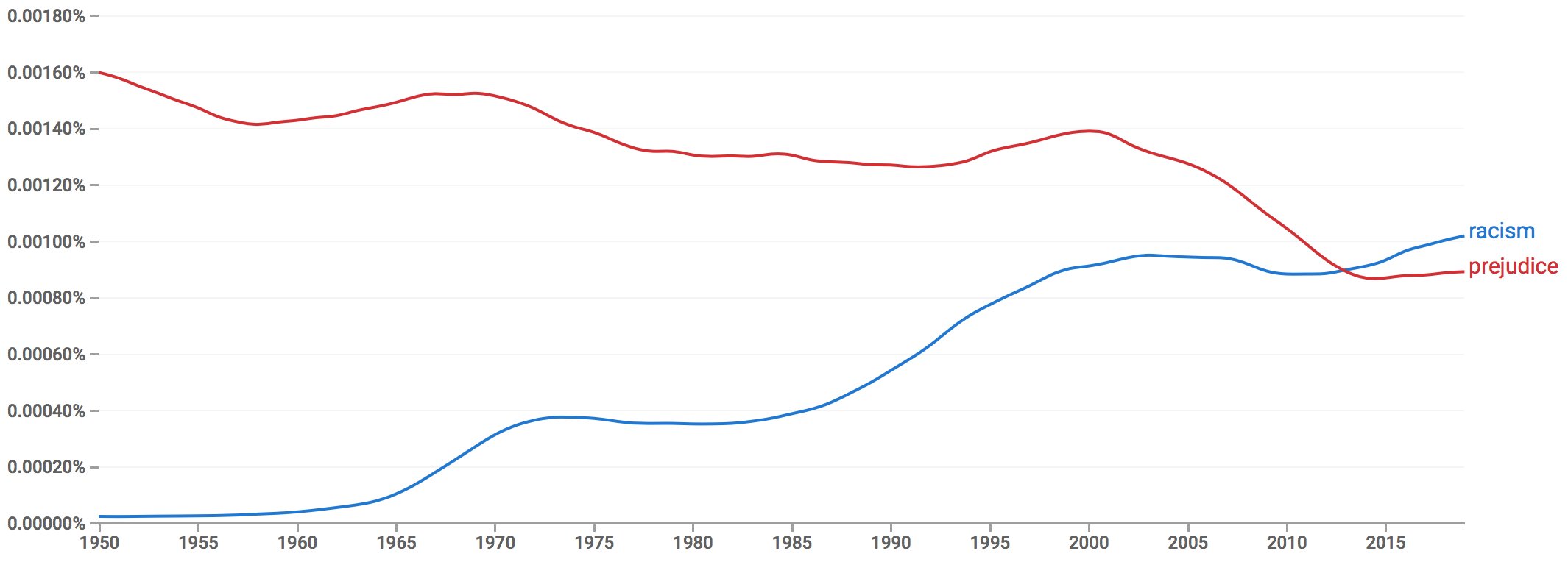
When I was a lad, one rarely heard the word “racist”. Instead, the word we were encouraged to use was “prejudice”. Don’t pre-judge people, we were taught. Treat people as individuals and ignore stereotypes. If a businessman said, “I don’t hire natives. They’re too unreliable,” no one would label that man a racist. Rather, one would encourage him to not be prejudiced against natives. We understood that just because he perceived a pattern, and applied that pattern universally, he was not necessarily being hateful towards native peoples. Was he wrong in judging all natives the same way? Yes. Was he being racist? No.
The title of racism was correctly left to the skin heads, the KKK, and the white supremacists. The racist man was one who saw his race as superior to all others and developed a genuine hatred towards all other races. The businessman above may have a genuine affection for native people, but has developed a certain opinion of them based on personal experience over the years of being a business owner.
I have a friend who is Thai. His wife is Canadian. They live in Thailand, but occasionally visit the wife’s family farm in Canada. Thailand is warm all year round, and an inexperienced Thai guy visiting Canada in the winter may not take the necessary precautions when going out at night in -30° Celsius weather. This is indeed what my friend did when deciding to make a quick late night trip to the nearest convenience store (which is not too close in farm country). Seeing as the car had a heater and he would be quickly jumping between home and car, and car to convenience store, he did not wear a jacket. Part way to the store, the car ran out of gas. My friend was forced to run through the freezing temperatures to get to the store. When he got there the female clerk was locking up for the night and he couldn’t open the door. He knocked on the glass asking to be let in. Now, it’s not unusual for a Thai man to be mistaken for a native man by the average Canadian. My friend also has tattoos. The clerk did not let him in, and he was forced to go back to his car and try to warm himself. Luckily my friend’s wife noticed how long he was taking and set out to get him, and thankfully found him before he developed hypothermia (it was close). So, was the store clerk being racist? Or prejudiced? Was she justified in her decision not to let him in knowing he had no jacket and was freezing?
These days the woman above would be labelled a racist and crucified. No one would ask her why she assumed the man at her door was dangerous. No one would care if the last ten times she was robbed, the robber looked very much like my Thai friend. Am I excusing her behaviour? No, but I wouldn’t accuse her of being a racist either. Her fear is not unexpected, and there are solutions to her prejudice which can be implemented without ruining her career and reputation.
The term “racism” has lost all meaning these days. It’s overused, and too broadly defined. This is intentional. Racism is the unforgivable sin, and the broader the definition, the easier it is to hunt down and punish the heretics. Many people are terrified of being labelled a racist, especially those in the public eye. They know that their entire life can be destroyed from even an unsubstantiated accusation. How convenient it must be to ruin your opponent by a simple finger pointing.
Let’s bring back the word “prejudice” and end the witch hunt.
 Pursuit of Percipience