One thing that western Christians need to remember is that the Christian Church does not revolve around the western world. And so, if it appears that the Church is “dying” in the west, that certainly does not mean it is dying worldwide. In fact, the Church is growing worldwide.
But is the Church really dying in the west? Or is this some kind of publicity stunt?
Something that is indeed happening in the west is that the secular and political realms are no longer paying homage to the Church. The “new atheism” we see these days does not just want to deny God’s existence, but it wants to tear down all Christian power in society. And this does seem to be happening; the Church has been and is losing power in the secular and political spheres.
But dying? Well I guess that depends on whether or not people are really getting saved and are joining churches. The numbers of those calling themselves Christian may be down, but how reliable are those numbers anyways? Ten years ago, if a surveyor went to any given house and asked what religion the home’s dweller belongs to, they’d probably get a response like, “Well, I grew up in a Catholic family, so I guess I’m Christian.” Yet the person hasn’t set foot in a church for 25 years. These days I think people are more inclined to be honest and say they are non-religious. They no longer feel the need to show some kind of respectful acknowledgment of religious tradition.
So perhaps the Church is not dying, but rather, with the loss of the Church’s political power, we are just seeing more honesty and realism. This is a good thing. The Church thrived in a hostile Roman Empire. No one dared to pretend to be Christian for personal gain. Nor did anyone sleepily pay tribute to the faith out of some obligation to tradition. Lines were clearly drawn, and no one could be a “casual believer”.
So, as the Church loses religious control over society, no one should lament that the end is near. The Church’s true influence will grow as its false religious and political clout dwindles.
If you were living in Canada in the 1990′s you would have been subjected to the “Heritage Minute” historical messages seen on TV and in movie theaters. As I have not actually watched TV for several years, I don’t know if these “Heritage Minutes” are still being produced. One that I remember well is the one about Marshall McLuhan. I thought it was stupid, and I didn’t understand what was being said.
Take a minute to watch the clip…
I hadn’t given any thought to this guy, McLuhan, until I was studying on the web about media in today’s world. He is most famous for his phrase: “The medium is the message”.
What he means by that phrase is basically this:
Media is an extension of ourselves. The device we choose to convey our message to others will determine the content of that message. And so the device, or the media, becomes the true message.
Tim Challies makes a good point in his book The Next Story that when any new media technology is created it is created for a specific environment, and even though the technology can be taken out of that original environment and be used in an entirely different type of environment, it will always take with it, where ever it is used, elements of the original environment. Power Point, for example, was created for the business board room. It is a great tool for making presentations using charts, graphs, and bullet points. But it didn’t stay in the board room. A lot of pastors use Power Point when giving their sermons. And so, when a pastor uses Power Point in delivering his sermon, he creates a business board room type of atmosphere in the church. The use of Power Point in the church brings with it elements of its original environment.
I remember when I was living in Canada attending my home church. The pastor at the time always used Power Point. He delivered his sermons using bullet points, and sometimes charts and graphs too. I once asked some new attenders, who had to drive for an hour each Sunday morning, why they decided to come to our church. Their answer was that they loved how the sermons were delivered in such a way that it made them feel as though they were at a business seminar. They didn’t comment on the content of the messages (although that was important to them too), instead they commented on the medium: how the message was delivered. The medium, then, is in itself a very powerful message. Some churches will never use Power Point. Some will have wooden pews and built in pulpits which would require a crane if anyone ever wanted to move them. In some churches the pulpit is just a glorified coffee table. These are all mediums which, in themselves, deliver very strong messages, perhaps even stronger messages than what is spoken by the preacher each Sunday.
You can also look at Christian television. What was TV originally created for? Entertainment. Therefore any TV show that isn’t entertaining will not last long. In fact the only place where you’ll see an unentertaining TV show last an undeservedly long time is on either public TV or Christian TV–where ratings don’t matter. All too often Christian TV programs simply consist of 50+ year olds sitting around a table discussing the theory of how to live life like they live life. Who finds this entertaining? Anyone under 40? I suppose the only people who do find these shows entertaining are other 50+ year olds who take comfort in that there is a show on that holds to the same values as they do. But even then I imagine that they only turn on the show so that there can be some background noise while they clean the house or something. Even the guys obsessed with the “End-Times” watch the programs that are obsessed with the “End-Times” for entertainment. They don’t watch the shows for education or information. They get a thrill from the idea that they are getting the inside edge on some secret knowledge as to when the world is going to end. And so when the maker of a Christian TV show says he doesn’t want to entertain, but rather just use TV as a tool to get his message across, then I’d say he’s chosen the wrong medium.
So with the medium being a powerful message in and of itself one cannot simply focus on the content. One has to choose the correct medium to use as well. One has to ask the right questions about what one is trying to get across to the viewers.
Here are four questions which McLuhan himself asked…
1) What does the medium or technology extend?
2) What does it make obsolete?
3) What is retrieved?
4) What does the technology reverse into if it is over-extended?
Good questions for any media producer to ask.
Media these days is a huge subject to look at, and it is very complicated. It is also a very interesting subject to study. I myself am just getting started. When I look at the questions above, and I think about how quickly technology is advancing, I wonder how things will look in ten years. Will McLuhan’s theories even apply anymore?
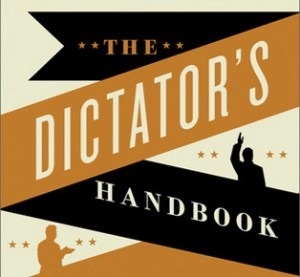
This is a somewhat amusing book looking at the differences (or better yet, similarities) between dictatorships and democracies.
Basically, according to the authors, potential political leaders need to worry most about one thing: you can not be a monolithic leader; you will have to keep a certain group of people happy in order to stay in power. How large that essential group, or coalition is, depends on what kind of government you want to form– democracy (large coalition) or dictatorship (small coalition).
In the first chapter, five basic rules are given for leaders to succeed in any system: “1) Keep your winning coalition as small as possible; 2) Keep your nominal selectorate (non-essential supporters) as large as possible; 3) Control the flow of revenue; 4) Pay your key supporters just enough to keep them loyal; 5) Don’t take money out of your supporter’s pockets to make the people’s lives better.” (If you’ve ever wondered why some governments, like the Cambodian government, don’t crack down on corruption, #5 would be your answer.)
In a dictatorship the coalition is small. It is imperative for the dictator to maintain strict control over the bank accounts so that he, and he alone, will be able to pay off the necessary people who can keep him in power, or take him out (like a military commander for example).
In a democracy the essential group of backers will be much larger, so the option of simply paying them off is much too expensive. Here the leader buys loyalty through programs and policies.
The book uses several real world examples to back the points made. For example, Samuel Doe of Liberia, who, although being an unskilled soldier, managed to assassinate the president and take control of the country.
“Doe had no idea what a president was supposed to do and even less idea of how to govern a country. What he did know was how to seize power and keep it: remove the previous ruler; find the money; form a small coalition; and pay them just enough to keep them loyal. In short order, he proceeded to replace virtually everyone who had been in the government or the army with members of his own small Krahn tribe, which made up only about 4 percent of the population. He increased the pay of army privates from $85 to $250 per month. He purged everyone he did not trust. Following secret trials, he had no fewer than fifty of his original collaborators executed.”
~page 22, chapter 2, “Coming to Power”
Sounds a lot like how the Khmer Rouge came to power in Cambodia in the ’70s.
Samuel Doe did not fair well though. He too was taken out of power, tortured (to reveal where all the money was), then cut up, cooked, and eaten. Mmm mm.
Overall I thought it was a decent book. However, I did find it to be over-simplified and too repetitive. I think, with it being nearly three hundred pages long, it could easily be a hundred pages shorter and thus a lot less monotonous.
In Cambodia I am a continuous outsider. This leads to a feeling of constant disconnect. I believe this comes from not having a point of reference for my experiences–I don’t know if what I’m seeing is normal or not. Therefore, I am neither surprised at, nor expectant to, what I experience.
My visitors from the west don’t have this issue. Their point of reference is back home in North America. To them everything is strange, or stupid, or smart…when compared to home. I used to use my home in Canada as that reference point as well, but I’ve been here too long to do that anymore. I have not been here long enough, though, to use the Cambodian way as my new reference point. I am caught between two cultures. This isn’t a negative thing and it gives me a unique perspective. Over time I will know more of what is normal and what isn’t, and this perspective will fade. But for now I can try to enjoy it, and maybe gain some wisdom from it.
Driving a vehicle is where one can experience this phenomenon most tangibly. In Canada people drive in straight lines between two straight lines. When I was driving in Canada, if I saw someone veering outside of the lines, I would pull up beside and give my dutiful look of disapproaval. Always I’d see that the driver was either drunk, a senior citizen, or an Asian. I know that sounds truly racist, but there are three reasons why it’s not: first, it’s true; second, I’m married to an Asian and my kids are Asian, so I can say things like that and not justly be called a hater; third, in Asia, to drive straight between two straight lines will only bring on the same looks of disapproval as mentioned above. It’s all relative and Asians are just driving like they’ve been taught. In Asia the lines on the road, if there even are any, are more of a suggestion, and to limit yourself to that restricted space is just bullheaded.
The problem of conflict is another interesting area to get confused about. Recently a guy in his early twenties living next door made a snide remark about my wife. My upset wife came inside and told me about it. I decided it would be good for him to answer for what he said by calling him over so that he could apologize to her. My wife didn’t like that and while the kid was walking over she was scolding me about how I was making problems. I thought I was fixing the problem, not making one. The boy stood like an idiot in front of my house until my wife told him to just go home. He got the point of what was going on though, and to this day, his facial expression goes from cocky to sheepish whenever he sees me. Afterwards my wife was clearly happy about what I did, even though I had violated some cultural taboo. Keep smiling. Bury your emotions. Don’t make problems.
A wise man once said, “If you’re not five minutes early, you’re late!”
In Canada, when I worked in construction, I would rail on the guys under me for showing up late, even if it was just five minutes. Some of them didn’t get why and suggested that working an extra five minutes at the end of the day would be a solution to showing up late five minutes in the morning. They didn’t get that it was a matter of integrity and respect. They would be shocked when I didn’t get angry when they screwed up on the job, and equally shocked at how angry I did get for being just a little late. I would explain that I expected them to screw up on the job because they were learning something new. Being on time, however, is something they should have learned when they were five years old. Usually the guys would get it quickly. As to the more thickheaded ones, I’d just start sending them home whenever they were late.
So, take that attitude into a culture that does not consider being on time important at all. Do I get angry when someone is late? Do I try to change this? Do I adapt? Do I just need to relax? When I schedule meetings for the parents of the kids in our school, I tell them to come an hour before I really want, and we still have to make phone calls about ten minutes before the meeting starts to remind many of them to come. Is this really a cultural thing? Or is it an integrity/respect thing?
One day I will figure it all out and my new frame of reference will ruin all the fun I’m having.







 Pursuit of Percipience