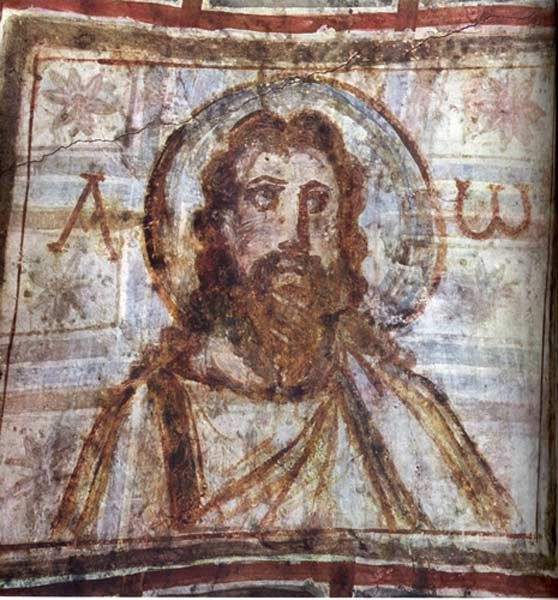
 The Meaning of Alpha and Omega
“I am the Alpha and the Omega, the beginning and the ending,” saith the Lord (Revelation 1:8).
When God calls Himself the Alpha and the Omega (the first and last letters of the Greek alphabet, A and ω), it does not mean that He was the first to show up and He’ll be the last to go away. Rather, it means that God alone existed into eternity past and God alone has the ability within Himself to exist into the eternal future. But, Α and ω does not just refer to time, but reality itself. God is not some being coming into some pre-existing reality — He is the first reality (eternal and infinite), and all other things come into being from Him, through Him, and to Him.
In order for God to be the A and the ω, He must be complete and perfect within Himself. He cannot be lacking in any way. Never has God needed to fill an empty hole in His existence. If that were so, it would mean there was some other pre-existing reality which God was trying to make His way through and understand — some other set of pre-existing “rules” that God had no authorship of and no control over. You and I were born into a pre-existing reality, and we have to figure out how to live in that reality. God is His own reality, perfect and complete, and thus He has perfect knowledge of everything, all the time. To believe that God needs to complete Himself over time is to reduce Him to a small “g” god — powerful but finite. I’m not saying God never has any desires, but His desires are for the fulfillment of finite creation/creatures (like us) rather than for the fulfillment of Himself. God wants us to be what He created us to be (and gets angry when that doesn’t happen), but He didn’t create us so that He could become what He wants to be — He already is and has always been what He wants to be. He is the A and the ω, eternally perfect and unchanging.
So, all good theology has to start from this point. If your theology suggests that God created the universe in order to meet some unfulfilled desire, it’s bad theology.
God is Love
God is a Trinity — the Father, the Son, and The Holy Spirit. He has always been this way, eternally. The perfect joy and love the Father sees in Himself causes perfect joy and love for Himself thus begetting a second Person, the Son. The perfect joy and love between Father and Son is a perfect third Person, the Holy Spirit. God has eternally existed in perfect love. Love is who He is — God is love. His love has eternally been manifest.
When one asks why God created, it is a faulty question. There is no “because” to God’s act of creation. God is perfect and complete, and creation is an outpouring of His completeness. It is an outpouring of who He is. It is an outpouring of His love.
The Small “g” God of Open Theism
The Open Theist simply believes that God does not know the future, or at least the future as determined by the actions of created beings with free will. This type of theology can be paired up with Process Theism, which teaches that God changes over time as he Himself is learning and changing. It’s easy to see why God is a small “g” god, and not the A and ω, in these types of theism because if God is not the all knowing uncaused cause of all being He is only secondary to something that’s come before, and we as worshippers ought to seek out what came before Him in order to find the truth of reality.
The Small “g” God of Calvinism
Calvinists believe that God intentionally predestined and created a large percentage of humanity to be vessels of His wrath and suffer in hell eternally. Why? The Calvinist believes that in order for God to be truly and fully known by the elect (the lucky few predestined to be saved) they must see His wrath manifested. In order for God’s wrath to be manifested, there must be subjects of His wrath. Aside from the fact that God becomes the author of evil in order for this to happen (although through some A=B ∴ A≠B logic, Calvinists deny this), Calvinism reduces God down to a small “g” god.
As noted above, God’s love has always been manifested (within the Trinity). He did not have to create in order to manifest His love. But has God’s wrath always been manifested? No. God is not wrath as He is love. Wrath is not integral to His being as love is. God’s wrath happens when His created beings refuse to be what He created them to be — it is a reaction to something that has gone wrong (and God’s character does not change in this reaction). God’s wrath is not a positive thing essential to His being. Does one have to see God’s wrath in order to know Him? Only if wrath is integral to His being, which it is not. If it were, it would have been manifest in Him from all eternity. The Calvinist says that God had to create in order to display His wrath, as though He were incomplete without being able to do so beforehand. For reasons listed above, this belief reduces God to a small “g” god.
Calvinists, using an overcooked definition of sovereignty (a ruler being in absolute control over absolutely everything), rather than using the proper definition of sovereignty (a ruler’s ability to rule however he wants unimpeded), forcibly reduce God down to a small “g” god as He becomes a god transcending good and evil, love and hate, robotically and arbitrarily choosing to love some and hate others for no other reason than to fill a seemingly irresistible and previously unmet need to display His wrath. The A and the ω, who is truly sovereign, does not need to conform to such limitations as though He were some divine computer following a logic program.
“I think the display of God’s perfections is the ultimate goal of the universe. God created the universe so that the full range of his perfections, including wrath and power and judgment and justice would be displayed.” ~John Piper (Calvinist Pastor)
I suppose there are more Christian based theisms which relate to the two above in reducing God to god, but these two seem to be the most prevalent in western Christianity today.
So what is the perfectly correct theology? Well, I don’t know that yet, but I do know where to start: God is good, loving, all knowing, all powerful, and the Alpha and the Omega. His sovereignty is not violated if He allows events to happen against His will. But, we can be confident that in the end His will for His creation will be done and it will be good as He is good, perfectly good.

 Pursuit of Percipience